Iraq Printers Market Summary
The iraq printers market was estimated at USD 461 Million in 2025 and is projected to reach USD 640 Million by 2032, growing at a CAGR of 5.6% from 2026 to 2032.
Iraq Printers Market Year-wise Growth Rate and Key Drivers
This graph highlights how the Iraq Printers Market has steadily grown over the past five years, supported by major growth factors.
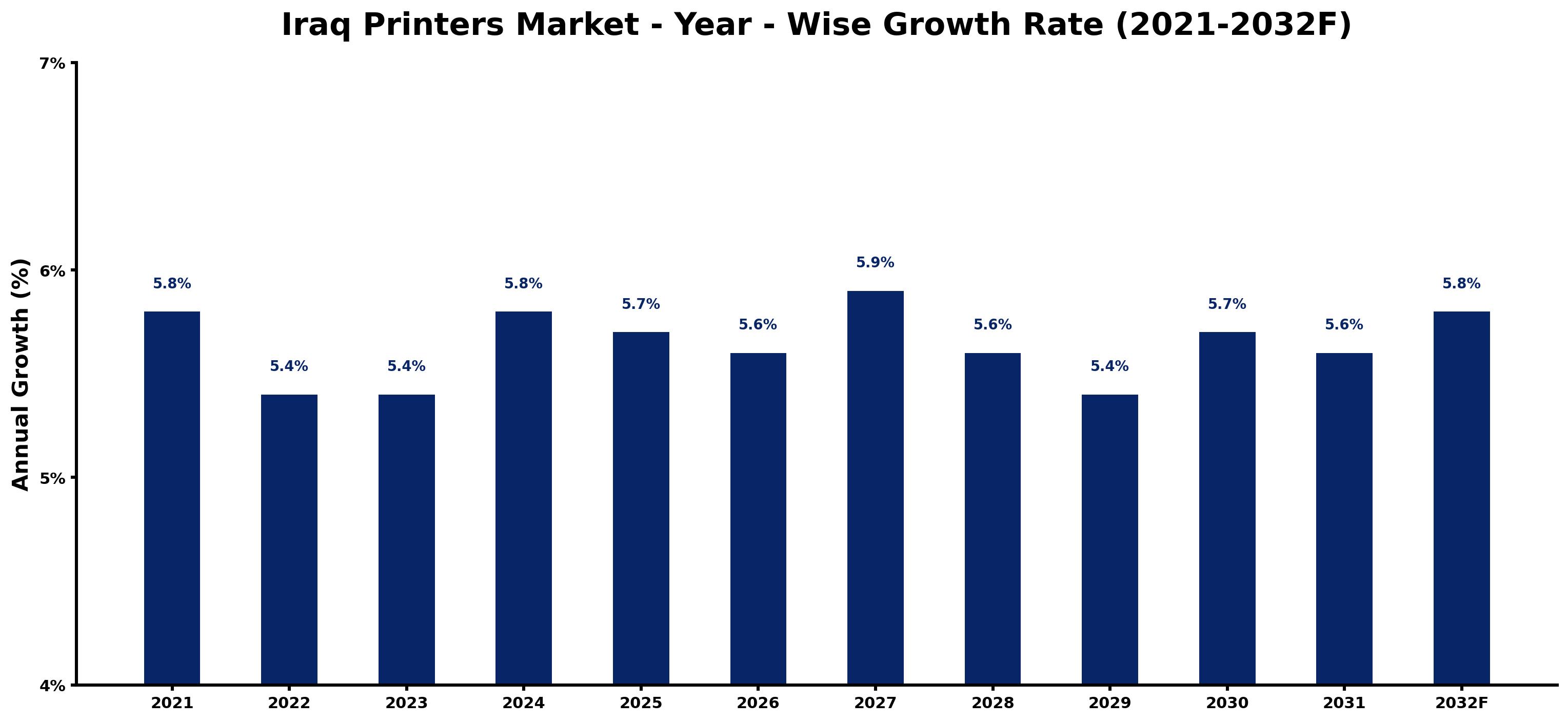
The table below presents the year wise growth rates along with the key drivers influencing the market
| Year | Growth Rate | Major Drivers |
| 2021 | 5.8% | Post-conflict reconstruction efforts bolstered public sector demand for printed materials. |
| 2022 | 5.4% | Local businesses increasingly chose digital printing solutions to enhance marketing visibility. |
| 2023 | 5.4% | Emerging small enterprises contributed to a niche for customized print products. |
| 2024 | 5.8% | Adoption of sustainable practices motivated printers to invest in eco-friendly inks. |
| 2025 | 5.7% | Revival of education institutions created substantial demand for educational printing services. |
| 2026 | 5.6% | Expansion of the retail sector led to higher demand for packaging and branding solutions. |
| 2027 | 5.9% | Technological upgrades in printing machinery improved production efficiency and output quality. |
| 2028 | 5.6% | Shifts in consumer preferences demanded more personalized and localized print offerings. |
| 2029 | 5.4% | Increased internet penetration influenced a rise in online ordering for print services. |
| 2030 | 5.7% | Collaboration among local printers encouraged innovation in print technology and services. |
| 2031 | 5.6% | Growing tourism in urban areas created demand for promotional and informational printed materials. |
| 2032 | 5.8% | Investment in digital infrastructure supported further integration of print and online platforms. |
Note - Market size estimations and growth projections presented in this report are based on 6Wresearch's advanced forecasting approach, validated with industry datasets as of June 2026.
Iraq Printers Market Synopsis
The Iraq Printers Market is projected to reach 5.6% and witness significant growth during the forecast period (2026-2032). This market is driven by a combination of factors including rising demand from both consumers and enterprises, propelled by advancements in digital documentation and increasing involvement in e-commerce. The diversification of printer types, such as inkjet, laser, and thermal printers, allows for tailored solutions aimed at meeting various printing needs across different sectors.
Iraq Printers Market Growth Drivers
The growth of the Iraq Printers Market is backed by several vital drivers that shape its current landscape:
- The adoption of digital documentation is on the rise, as businesses and individuals seek to streamline operations and reduce reliance on paper. This shift fosters a stronger demand for efficient printing technologies.
- The e-commerce sector in Iraq is expanding, creating an increasing need for high-quality printing solutions for packaging, shipping labels, and promotional materials.
- Government initiatives aimed at promoting digitization across various industries are stimulating investments in modern printing technologies, thereby driving market expansion.
- With household and small business consumers favoring affordability, the demand for inkjet printers remains strong, while larger enterprises gravitate towards laser printers for their efficiency and superior output quality.
- The increasing focus on environmental sustainability is prompting businesses to consider printers that support eco-friendly practices, adding another layer of demand in the market.
Iraq Printers Market Trends and Opportunities
Current trends within the Iraq Printers Market highlight a significant pivot towards multifunction printers, which combine printing, scanning, copying, and faxing capabilities. This trend is indicative of the increasing desire for efficiency and cost-effectiveness among businesses:
- The rising preference for wireless printers showcases a shift towards convenience and mobility, allowing users to print from various devices without being tethered to a single workstation.
- Cloud-enabled printers are emerging, aligning with the digital transformation strategies of businesses that seek to enhance operational flexibility and remote printing options.
- Security concerns are leading to a demand for printers equipped with advanced security features, ensuring that sensitive data is protected during the printing process.
- As the market matures, there is a growing inclination towards integrated solutions that offer comprehensive printing management systems tailored to meet specific business needs.
- A focus on high-volume capabilities is evident as businesses require printers that can handle larger workloads while maintaining efficiency, thus creating opportunities for advanced technology investments.
Iraq Printers Market Challenges and Restraints
Despite its potential for growth, the Iraq Printers Market faces formidable challenges that could hinder its trajectory:
- Economic constraints and trade restrictions limit access to advanced printing technologies, posing significant barriers to market entry for international manufacturers.
- The shortage of skilled technicians capable of performing maintenance and repair services leads to prolonged downtimes, impacting businesses relying heavily on printer functionality.
- Infrastructural deficiencies, including unreliable electricity supply and poor internet connectivity, hinder the efficient operation of printers across various sectors.
- Intense competition from a plethora of low-cost alternatives affects the pricing strategies of established brands, creating a challenging environment for sustained profitability.
- Market volatility stemming from economic instability may impose additional risks that could affect investment and growth potential within the printing industry.
Iraq Printers Market Investment Opportunities
The Iraq Printers Market offers several investment opportunities that are particularly promising for stakeholders looking to capitalize on growth in this sector:
- As businesses expand, there is a notable demand for advanced digital printing technologies capable of handling large volumes and providing multifunctional capabilities.
- The packaging and labeling segment is witnessing growth, particularly within the food and beverage industry, suggesting lucrative avenues for investment in specialized printing solutions.
- Collaborations with local businesses to offer tailored printing solutions can present strategic advantages, enhancing market penetration and customer relationships.
- Investments in research and development to foster innovation in printing technology will likely yield significant returns as businesses seek cutting-edge solutions to their printing needs.
- There exists potential for government-supported initiatives which could create advantageous conditions for investments in local manufacturing and technological advancements.
Iraq Printers Market Government Investment and Initiatives
Government policies play a pivotal role in shaping the dynamics of the Iraq Printers Market. Regulations surrounding imports, taxation, and trade agreements significantly influence market access for both domestic and foreign manufacturers:
- Import regulations stipulate the criteria for bringing printing equipment into Iraq, which can impose barriers or facilitate market entry depending on compliance.
- Taxation policies directly affect the affordability of printers for both businesses and consumers, influencing overall demand and pricing strategies.
- Trade agreements between Iraq and other nations may enhance competitive dynamics, allowing for a wider selection of printing technologies to enter the market.
- Public spending initiatives directed at promoting local manufacturing processes can provide a foundation for growth within the domestic printing sector.
- Government-led programs aimed at fostering technological advancements within the printing industry are likely to enhance capabilities and improve market competitiveness.
Iraq Printers Market Latest Developments (May 2025 - June 2026)
Recent developments in the Iraq Printers Market reflect an industry adapting to changing needs and technological advancements. Innovations focus on increasing efficiencies and integrating advanced functionalities into printing solutions:
- There has been a noticeable uptick in the introduction of multifunction printers, driven by the demand for cost-effective and space-saving printing solutions.
- Wireless technology and cloud connectivity are gaining traction, as businesses prioritize flexibility and accessibility in their printing operations.
- Companies are increasingly investing in security features to safeguard sensitive information during printing, addressing rising concerns about data breaches.
- Investments in large-scale commercial printing solutions have emerged, catering to the demands of expanding e-commerce and packaging sectors.
- The government's continued push for digitization is expected to catalyze investment in advanced printing technologies, enhancing market prospects.
Iraq Printers Market - Key Attractiveness of the Report
- 10 Years of Market Numbers
- Historical Data Starting from 2022 to 2025
- Base Year: 2025
- Forecast Data until 2032
- Key Performance Indicators Impacting the Market
- Major Upcoming Developments and Projects
Key Highlights of the Report:
- Iraq Printers Market Outlook
- Market Size of Iraq Printers Market, 2025
- Forecast of Iraq Printers Market, 2032F
- Historical Data and Forecast of Iraq Printers Revenues & Volume for the Period 2022-2032F
- Iraq Printers Market Trend Evolution
- Iraq Printers Market Drivers and Challenges
- Iraq Printers Price Trends
- Iraq Printers Porter's Five Forces
- Iraq Printers Industry Life Cycle
- Historical Data and Forecast of Iraq Printers Market Revenues & Volume By Type for the Period 2022-2032F
- Historical Data and Forecast of Iraq Printers Market Revenues & Volume By Multifunction printers for the Period 2022-2032F
- Historical Data and Forecast of Iraq Printers Market Revenues & Volume By Single function printers for the Period 2022-2032F
- Historical Data and Forecast of Iraq Printers Market Revenues & Volume By Technology for the Period 2022-2032F
- Historical Data and Forecast of Iraq Printers Market Revenues & Volume By Laser for the Period 2022-2032F
- Historical Data and Forecast of Iraq Printers Market Revenues & Volume By Inkjet for the Period 2022-2032F
- Historical Data and Forecast of Iraq Printers Market Revenues & Volume By Others for the Period 2022-2032F
- Iraq Printers Import Export Trade Statistics
- Market Opportunity Assessment By Type
- Market Opportunity Assessment By Technology
- Iraq Printers Top Companies Market Share
- Iraq Printers Competitive Benchmarking By Technical and Operational Parameters
- Iraq Printers Company Profiles
- Iraq Printers Key Strategic Recommendations






































