Iraq Rattan Furniture Market Size, Share & Growth Rate
The Iraq Rattan Furniture Market was estimated at USD 1492 Million in 2025 and is projected to reach USD 2141 Million by 2032, growing at a CAGR of 5.3% from 2026 to 2032. This growth trajectory is driven by an increasing demand for durable outdoor furniture, as Iraqi consumers lean towards pieces that combine aesthetics with practicality. The rise in urban living and a shift towards eco-friendly products further bolster this market, making rattan furniture a favored choice in both residential and commercial settings.
Iraq Rattan Furniture Market Year-wise Growth Rate and Key Drivers
This graph highlights how the Iraq Rattan Furniture Market has steadily grown over the years, supported by major growth factors.
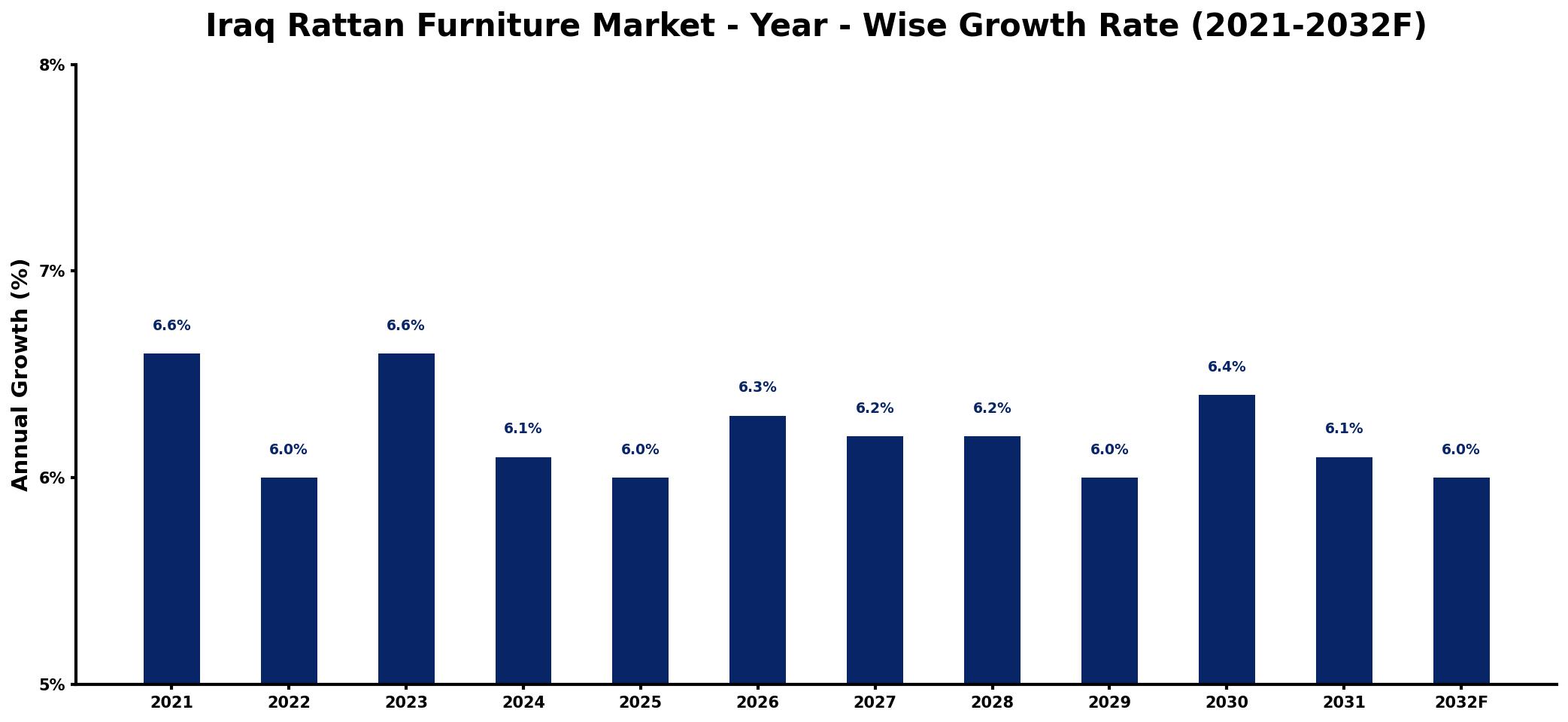
The table below presents the year‑wise growth rates along with the key drivers influencing the market
| Year | Growth Rate | Major Drivers |
| 2021 | 6.6% | Rising consumer spending habits |
| 2022 | 6.0% | Increased urban residential projects |
| 2023 | 6.6% | Growing interest in sustainability |
| 2024 | 6.1% | Expansion of local manufacturing capabilities |
| 2025 | 6.0% | Surge in online retail channels |
| 2026 | 6.3% | Growth in tourism and hospitality |
| 2027 | 6.2% | Boost in home renovation trends |
| 2028 | 6.2% | Increase in disposable income levels |
| 2029 | 6.0% | growing emerging market penetration |
| 2030 | 6.4% | Rise in outdoor living spaces |
| 2031 | 6.1% | growing commercial sector adoption |
| 2032 | 6.0% | rising end-use demand growth |
Note: Market size estimations and growth projections presented in this report are based on 6Wresearch's proprietary forecasting methodology, utilizing the latest available industry data, government publications, and primary research inputs.
Iraq Rattan Furniture Market Synopsis
The Iraq Rattan Furniture Market is undergoing a transformation fueled by consumer interest in sustainable and stylish furniture options. The organic and natural appeal of rattan is resonating with a growing demographic that values both design and functionality in their living spaces. From outdoor lounges to indoor seating, the range of rattan products is expanding to meet diverse consumer needs.
Innovative designs are making rattan furniture increasingly appealing, as manufacturers respond to shifting tastes and preferences. This market is not just about traditional aesthetics; modern adaptations are finding their place in contemporary homes, enhancing the overall ambiance while ensuring comfort and durability.
Iraq Rattan Furniture Market Key Takeaways
- The market is experiencing a surge in demand for eco-friendly furniture options, aligning with global sustainability trends.
- Urbanization and rising disposable incomes are key factors propelling the growth of rattan furniture in Iraq.
- Customization in rattan furniture design is becoming a significant factor as consumers seek personalized decor solutions.
- Investment opportunities abound as local manufacturers and foreign investors alike recognize the potential of this market.
- The availability of multifunctional rattan pieces is addressing space constraints in urban living environments.
Evaluation of Restraints in Iraq Rattan Furniture Market
While the Iraq Rattan Furniture Market shows promising growth potential, it faces notable restraints. Political instability and economic uncertainty can undermine investor confidence, leading to hesitation in market entry. Additionally, the lack of established supply chains complicates the distribution of rattan products, making it challenging for local manufacturers to compete effectively against imported goods. Limited access to quality raw materials and skilled labor further complicates production processes, potentially stalling growth.
Iraq Rattan Furniture Market Trends
Current trends highlight a marked shift towards eco-conscious consumerism, with more buyers prioritizing sustainable materials such as rattan. This is complemented by a growing appreciation for multifunctional furniture, as consumers seek to maximize space in smaller living areas. The integration of rattan furniture into both modern and traditional interior designs is on the rise, enriching home aesthetics while promoting comfort.
Iraq Rattan Furniture Market Opportunities
The market presents numerous avenues for growth and investment. As awareness of rattan's durability and beauty spreads, there is a robust opportunity to supply a wide array of rattan products. E-commerce platforms are emerging as vital channels for reaching consumers, facilitating the expansion of market presence. Innovative designs that reflect local tastes can further enhance appeal, while competitive pricing strategies will attract price-sensitive buyers in a growing economy.
Government Initiatives in the Iraq Rattan Furniture Market
Currently, the Iraqi government does not have specific policies targeting the rattan furniture market. However, general regulations surrounding trade, imports, and labor practices impact the overall business environment. While efforts are being made to improve the ease of doing business, ongoing political and security challenges continue to affect investor sentiment and operational efficiency. Awareness of these factors is crucial for companies looking to navigate the Iraqi market.
Future Insights of the Iraq Rattan Furniture Market
Looking ahead to 2026-2032, the Iraq Rattan Furniture Market is positioned for notable expansion. As consumer preferences lean increasingly towards sustainability, rattan furniture's appeal will likely grow. Additionally, with a stabilizing economy and urbanization trends continuing, demand for affordable yet stylish furniture solutions is expected to rise. Businesses that adapt to evolving consumer needs while maintaining a focus on quality and design innovation will thrive in this dynamic landscape.
Iraq Rattan Furniture Market Latest Developments (2025 - 2026)
Recent developments in the Iraq Rattan Furniture Market reflect an increasing focus on product innovation and customization. Manufacturers are exploring modern designs that cater to contemporary aesthetics while also emphasizing comfort. The growth of online retail channels is beginning to reshape consumer buying behavior, allowing for greater accessibility to rattan furniture products. Additionally, there is a noticeable shift towards more sustainable practices within the local manufacturing sector, highlighting an industry-wide commitment to eco-friendly solutions.
Iraq Rattan Furniture Market - Key Attractiveness of the Report
- 10 Years of Market Numbers
- Historical Data Starting from 2022 to 2025
- Base Year: 2025
- Forecast Data until 2032
- Key Performance Indicators Impacting the Market
- Major Upcoming Developments and Projects
Key Highlights of the Report:
- Iraq Rattan Furniture Market Outlook
- Market Size of Iraq Rattan Furniture Market, 2025
- Forecast of Iraq Rattan Furniture Market, 2032
- Historical Data and Forecast of Iraq Rattan Furniture Revenues & Volume for the Period 2022-2032F
- Iraq Rattan Furniture Market Trend Evolution
- Iraq Rattan Furniture Market Drivers and Challenges
- Iraq Rattan Furniture Price Trends
- Iraq Rattan Furniture Porter's Five Forces
- Iraq Rattan Furniture Industry Life Cycle
- Historical Data and Forecast of Iraq Rattan Furniture Market Revenues & Volume By Type for the Period 2022-2032F
- Historical Data and Forecast of Iraq Rattan Furniture Market Revenues & Volume By Table for the Period 2022-2032F
- Historical Data and Forecast of Iraq Rattan Furniture Market Revenues & Volume By Chairs for the Period 2022-2032F
- Historical Data and Forecast of Iraq Rattan Furniture Market Revenues & Volume By Storage for the Period 2022-2032F
- Historical Data and Forecast of Iraq Rattan Furniture Market Revenues & Volume By Beds for the Period 2022-2032F
- Historical Data and Forecast of Iraq Rattan Furniture Market Revenues & Volume By Others for the Period 2022-2032F
- Historical Data and Forecast of Iraq Rattan Furniture Market Revenues & Volume By Application for the Period 2022-2032F
- Historical Data and Forecast of Iraq Rattan Furniture Market Revenues & Volume By Residential for the Period 2022-2032F
- Historical Data and Forecast of Iraq Rattan Furniture Market Revenues & Volume By Commercial for the Period 2022-2032F
- Historical Data and Forecast of Iraq Rattan Furniture Market Revenues & Volume By Distribution Channel for the Period 2022-2032F
- Historical Data and Forecast of Iraq Rattan Furniture Market Revenues & Volume By Multi-brand Stores for the Period 2022-2032F
- Historical Data and Forecast of Iraq Rattan Furniture Market Revenues & Volume By Exclusive Stores for the Period 2022-2032F
- Historical Data and Forecast of Iraq Rattan Furniture Market Revenues & Volume By Online for the Period 2022-2032F
- Historical Data and Forecast of Iraq Rattan Furniture Market Revenues & Volume By Other Distribution Channel for the Period 2022-2032F
- Iraq Rattan Furniture Import Export Trade Statistics
- Market Opportunity Assessment By Type
- Market Opportunity Assessment By Application
- Market Opportunity Assessment By Distribution Channel
- Iraq Rattan Furniture Top Companies Market Share
- Iraq Rattan Furniture Competitive Benchmarking By Technical and Operational Parameters
- Iraq Rattan Furniture Company Profiles
- Iraq Rattan Furniture Key Strategic Recommendations






































