Iraq Revenue Assurance Market Size, Share & Growth Rate
The Iraq Revenue Assurance Market was estimated at USD 526 Million in 2025 and is projected to reach USD 973 Million by 2032, growing at a CAGR of 9.2% from 2026 to 2032. This substantial growth trajectory is largely driven by increasing regulatory scrutiny and the corresponding demand for transparent financial practices across various sectors. In Iraq, the need for robust risk management frameworks and compliance measures is prompting businesses and government entities to invest significantly in assurance services, ensuring stakeholder confidence and operational integrity.
Iraq Revenue Assurance Market Year-wise Growth Rate and Key Drivers
This graph highlights how the Iraq Revenue Assurance Market has steadily grown over the years, supported by major growth factors.
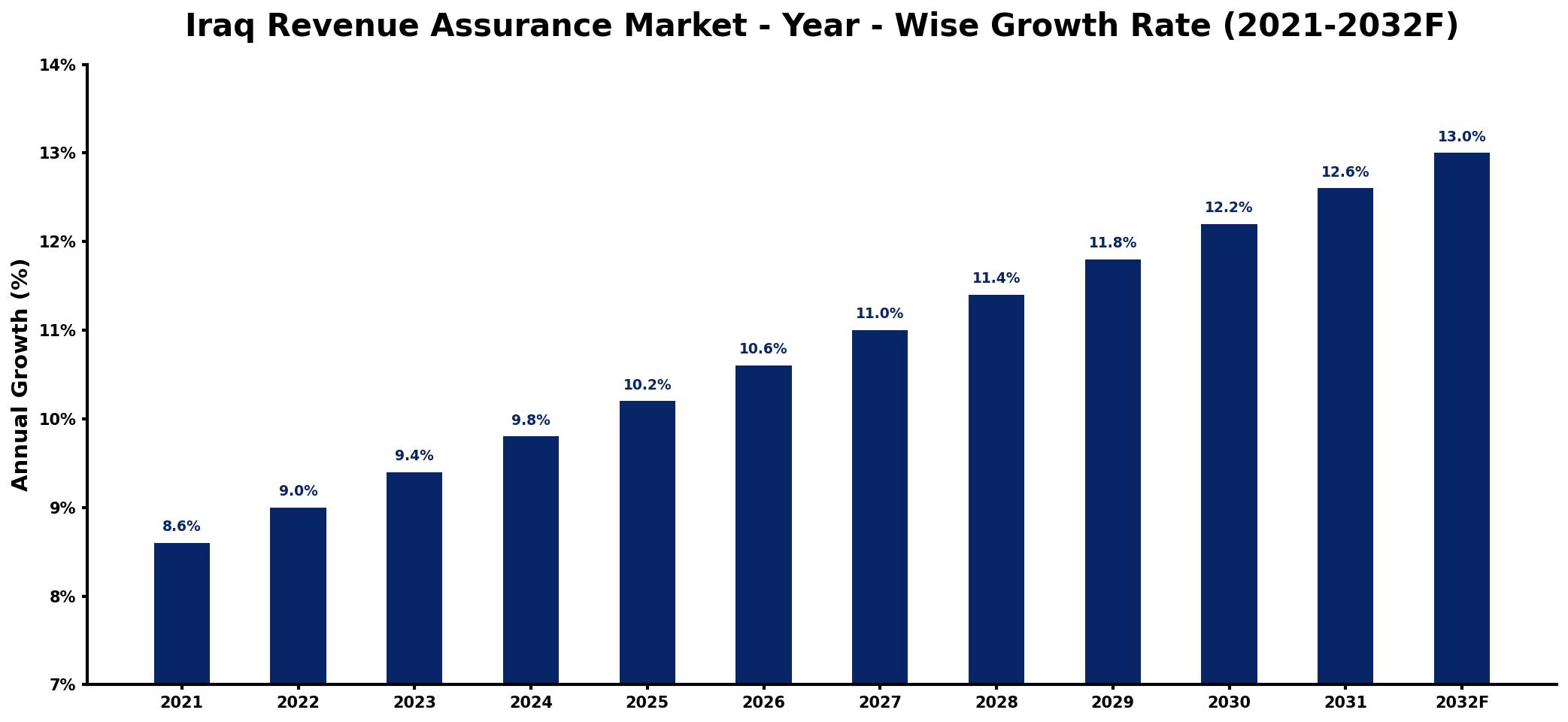
The table below presents the year‑wise growth rates along with the key drivers influencing the market
| Year | Growth Rate | Major Drivers |
| 2021 | 8.6% | increased investment in technology |
| 2022 | 9.0% | growing demand for data analytics |
| 2023 | 9.4% | rising focus on compliance standards |
| 2024 | 9.8% | expansion of telecommunications networks |
| 2025 | 10.2% | enhanced customer experience initiatives |
| 2026 | 10.6% | increased adoption of automation tools |
| 2027 | 11.0% | growth in digital transformation projects |
| 2028 | 11.4% | surge in mobile payment solutions |
| 2029 | 11.8% | increased emphasis on cybersecurity measures |
| 2030 | 12.2% | growing partnerships with fintech companies |
| 2031 | 12.6% | rising demand from electronics |
| 2032 | 13.0% | rising trends in artificial intelligence |
Note: Market size estimations and growth projections presented in this report are based on 6Wresearch's proprietary forecasting methodology, utilizing the latest available industry data, government publications, and primary research inputs.
Iraq Revenue Assurance Market Synopsis
The Iraqi market for revenue assurance is witnessing an upsurge in demand as organizations strive to enhance their financial reporting standards. Businesses, government agencies, and nonprofits alike are increasingly leveraging assurance services to ensure compliance with evolving regulatory requirements.
As entities navigate a complex economic landscape, the services provided by auditors and consultants are becoming indispensable. This demand highlights a growing recognition of the importance of financial transparency and accountability as vital components of sustainable business practices in Iraq.
Iraq Revenue Assurance Market Key Takeaways
- Strong growth anticipated, with a projected market size of USD 973 Million by 2032.
- Increasing regulatory demands are pushing businesses to prioritize assurance services.
- The market is characterized by a rising awareness of risk management strategies.
- Transparency and accountability are becoming non-negotiable in organizational practices.
- Skilled professionals in the field are critical to overcoming existing market challenges.
Evaluation of Restraints in Iraq Revenue Assurance Market
Despite its promising growth, the Iraq Revenue Assurance Market faces notable restraints. A significant challenge is the lack of standardized regulatory frameworks and enforcement mechanisms, which impedes the establishment of consistent assurance practices. Furthermore, the limited availability of reliable data can hinder accurate risk assessments, while a shortage of skilled professionals restricts the capability of firms to deliver comprehensive assurance services. Overcoming these obstacles is crucial for the sustained growth of the market.
Iraq Revenue Assurance Market Trends
A key trend shaping the Iraq Revenue Assurance Market is the shift towards digital transformation and the incorporation of technology in assurance practices. Organizations are increasingly utilizing data analytics and automation to enhance their auditing processes and improve the accuracy of financial reporting. Furthermore, the growing emphasis on corporate governance and ethical business practices is prompting firms to adopt more stringent compliance measures, thereby boosting demand for assurance services.
Iraq Revenue Assurance Market Opportunities
The evolving landscape presents genuine growth opportunities in the Iraq Revenue Assurance Market. As regulatory frameworks become more complex, there is a rising demand for specialized assurance services tailored to various industries, including finance and healthcare. Additionally, investing in professional training and certification programs can help cultivate a skilled workforce, further enhancing the quality of services available. Companies that proactively adapt to these market demands will find themselves positioned advantageously as the market matures.
Government Initiatives in the Iraq Revenue Assurance Market
The Iraqi government has made significant strides in establishing regulations aimed at improving the quality and reliability of assurance services. These initiatives include enhanced standards for professional certification and updated regulations governing auditing practices, particularly in critical sectors such as finance and healthcare. Such government policies not only aim to boost confidence among stakeholders but also to foster a culture of accountability and transparency across various industries.
Future Insights of the Iraq Revenue Assurance Market
Looking ahead to 2026-2032, the Iraq Revenue Assurance Market is expected to continue its upward trajectory, driven by an increasing recognition of the value of transparency and risk management. The integration of advanced technologies into assurance practices will likely transform the landscape, allowing organizations to operate more efficiently while meeting regulatory demands. As firms continue to invest in robust assurance frameworks, the market will evolve, presenting new challenges and opportunities for growth.
Iraq Revenue Assurance Market Latest Developments (2025 - 2026)
Recent developments in the Iraq Revenue Assurance Market highlight a growing focus on aligning assurance practices with international standards. Companies are enhancing their service offerings to meet the needs of a diverse clientele, including government bodies and private enterprises. Moreover, there has been an uptick in partnerships and collaborations aimed at sharing best practices and improving the quality of assurance services provided in the region.
Iraq Revenue Assurance Market - Key Attractiveness of the Report
- 10 Years of Market Numbers
- Historical Data Starting from 2022 to 2025
- Base Year: 2025
- Forecast Data until 2032
- Key Performance Indicators Impacting the Market
- Major Upcoming Developments and Projects
Key Highlights of the Report:
- Iraq Revenue Assurance Market Outlook
- Market Size of Iraq Revenue Assurance Market, 2025
- Forecast of Iraq Revenue Assurance Market, 2032
- Historical Data and Forecast of Iraq Revenue Assurance Revenues & Volume for the Period 2022-2032F
- Iraq Revenue Assurance Market Trend Evolution
- Iraq Revenue Assurance Market Drivers and Challenges
- Iraq Revenue Assurance Price Trends
- Iraq Revenue Assurance Porter's Five Forces
- Iraq Revenue Assurance Industry Life Cycle
- Historical Data and Forecast of Iraq Revenue Assurance Market Revenues & Volume By Component for the Period 2022-2032F
- Historical Data and Forecast of Iraq Revenue Assurance Market Revenues & Volume By Software for the Period 2022-2032F
- Historical Data and Forecast of Iraq Revenue Assurance Market Revenues & Volume By Services for the Period 2022-2032F
- Historical Data and Forecast of Iraq Revenue Assurance Market Revenues & Volume By Planning and Consulting for the Period 2022-2032F
- Historical Data and Forecast of Iraq Revenue Assurance Market Revenues & Volume By Implementation and Customization for the Period 2022-2032F
- Historical Data and Forecast of Iraq Revenue Assurance Market Revenues & Volume By Support and Maintenance for the Period 2022-2032F
- Historical Data and Forecast of Iraq Revenue Assurance Market Revenues & Volume By Managed Services for the Period 2022-2032F
- Historical Data and Forecast of Iraq Revenue Assurance Market Revenues & Volume By End-User for the Period 2022-2032F
- Historical Data and Forecast of Iraq Revenue Assurance Market Revenues & Volume By TSPs for the Period 2022-2032F
- Historical Data and Forecast of Iraq Revenue Assurance Market Revenues & Volume By Enterprises for the Period 2022-2032F
- Historical Data and Forecast of Iraq Revenue Assurance Market Revenues & Volume By Deployment Mode for the Period 2022-2032F
- Historical Data and Forecast of Iraq Revenue Assurance Market Revenues & Volume By Cloud for the Period 2022-2032F
- Historical Data and Forecast of Iraq Revenue Assurance Market Revenues & Volume By On-premises for the Period 2022-2032F
- Historical Data and Forecast of Iraq Revenue Assurance Market Revenues & Volume By Vertical for the Period 2022-2032F
- Historical Data and Forecast of Iraq Revenue Assurance Market Revenues & Volume By Telecom for the Period 2022-2032F
- Historical Data and Forecast of Iraq Revenue Assurance Market Revenues & Volume By Utilities for the Period 2022-2032F
- Historical Data and Forecast of Iraq Revenue Assurance Market Revenues & Volume By BFSI for the Period 2022-2032F
- Historical Data and Forecast of Iraq Revenue Assurance Market Revenues & Volume By Hospitality for the Period 2022-2032F
- Historical Data and Forecast of Iraq Revenue Assurance Market Revenues & Volume By Others for the Period 2022-2032F
- Iraq Revenue Assurance Import Export Trade Statistics
- Market Opportunity Assessment By Component
- Market Opportunity Assessment By End-User
- Market Opportunity Assessment By Deployment Mode
- Market Opportunity Assessment By Vertical
- Iraq Revenue Assurance Top Companies Market Share
- Iraq Revenue Assurance Competitive Benchmarking By Technical and Operational Parameters
- Iraq Revenue Assurance Company Profiles
- Iraq Revenue Assurance Key Strategic Recommendations






































