Iraq Scrap Metal Recycling Market Summary
The iraq scrap metal recycling market was estimated at USD 288 Million in 2025 and is projected to reach USD 381 Million by 2032, growing at a CAGR of 4.8% from 2026 to 2032.
Iraq Scrap Metal Recycling Market Year-wise Growth Rate and Key Drivers
This graph highlights how the Iraq Scrap Metal Recycling Market has steadily grown over the past five years, supported by major growth factors.
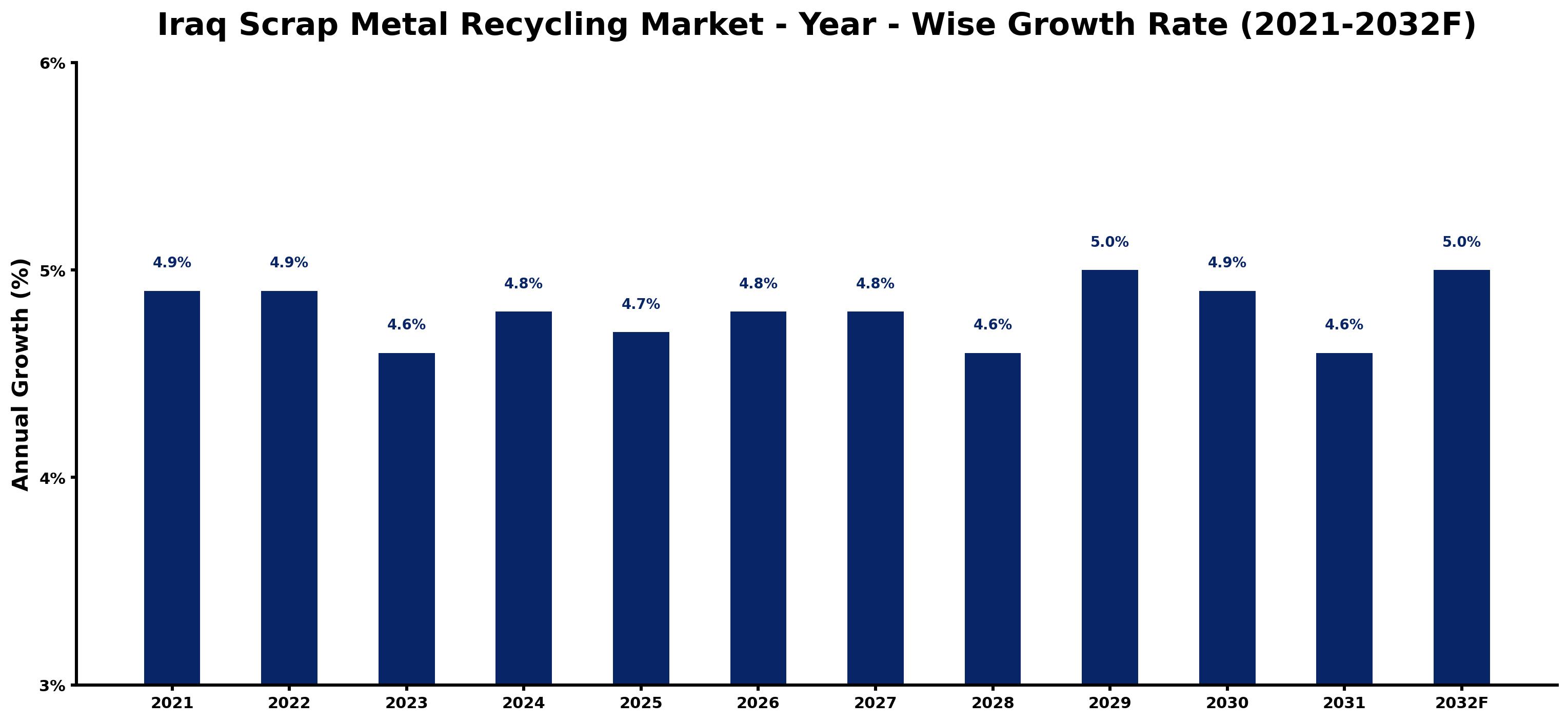
The table below presents the year wise growth rates along with the key drivers influencing the market
| Year | Growth Rate | Major Drivers |
| 2021 | 4.9% | Local scrap metal has seen increased attention amid infrastructure rebuilding efforts. |
| 2022 | 4.9% | International market fluctuations prompted local players to reassess pricing strategies. |
| 2023 | 4.6% | Emerging industrial activities have heightened the need for efficient recycling practices. |
| 2024 | 4.8% | Increased collaboration among local businesses fosters a more integrated recycling ecosystem. |
| 2025 | 4.7% | Rising urbanization rates create a greater demand for construction materials sourced locally. |
| 2026 | 4.8% | Investment in technology leads to improved sorting and processing capabilities within facilities. |
| 2027 | 4.8% | Renewed focus on sustainability encourages companies to prioritize recyclable material sourcing. |
| 2028 | 4.6% | Growing awareness of environmental impact drives community-led recycling initiatives across cities. |
| 2029 | 5.0% | Expansion of manufacturing capabilities in Iraq boosts demand for recycled metal products. |
| 2030 | 4.9% | Local policies increasingly favor recycling practices as a source of economic growth. |
| 2031 | 4.6% | Partnerships with regional players enhance the supply chain efficiency for scrap collection. |
| 2032 | 5.0% | Technological breakthroughs in recycling processes promise higher recovery rates and quality. |
Note - Market size estimations and growth projections presented in this report are based on 6Wresearch's advanced forecasting approach, validated with industry datasets as of June 2026.
Iraq Scrap Metal Recycling Market Synopsis
The Iraq Scrap Metal Recycling Market is projected to reach 4.8% and witness significant growth during the forecast period (2026-2032). This momentum is fueled by various industrial demands for sustainable management of metal waste and the growing recognition of environmental benefits associated with recycling. The market is evolving as industries increasingly seek to source raw materials through recycling processes that are not only cost-effective but also environmentally responsible.
Iraq Scrap Metal Recycling Market Growth Drivers
The growth of the Iraq Scrap Metal Recycling Market is driven by several key factors:
- Rising Construction Activities: The construction sector in Iraq has seen a resurgence, leading to an increase in the generation of scrap metal. This directly enhances the demand for recycling services to reclaim valuable materials.
- Manufacturing Industry Expansion: With the growth of manufacturing industries, there is a heightened need for raw materials that can be met through recycled scrap metal, reducing dependency on virgin resources.
- Environmental Awareness: Heightened public and governmental awareness regarding environmental sustainability is pushing more companies to adopt recycling practices, contributing to demand in the scrap metal sector.
- Resource Conservation: Recycling scrap metal contributes to conservation efforts by reducing the extraction of new materials, which is increasingly appealing in a resource-depleted environment.
- Energy Savings: The recycling of scrap metal typically requires less energy than producing new metal, making it an economically viable and environmentally friendly option for manufacturers.
Iraq Scrap Metal Recycling Market Challenges and Restraints
Despite its growth potential, the Iraq Scrap Metal Recycling Market faces several challenges:
- Infrastructure Limitations: The current recycling infrastructure in Iraq is not fully developed, which can hinder effective collection and processing of scrap metal.
- Inefficiencies in Recycling Processes: Many recycling operations are still using outdated technologies and methods, affecting the efficiency and quality of the recycling processes.
- Regulatory Environment: Inadequate enforcement of recycling regulations leads to environmental pollution and creates obstacles for legitimate recycling operations, impacting market growth.
- Lack of Government Support: Although there is recognition of the importance of recycling, limited government initiatives and funding reduce the momentum needed for industry advancement.
- Public Attitude: There can be a prevalent lack of awareness and engagement among the public regarding the benefits of scrap metal recycling, affecting the quantity of material available for recycling.
Iraq Scrap Metal Recycling Market Government Investment and Initiatives
The Iraqi government has started to implement various policies aimed at promoting sustainable waste management and enhancing the scrap metal recycling sector. Recognizing the essential role of recycling in mitigating environmental issues, the government has introduced incentives for recycling facilities, encouraging investment and innovation in this area. Furthermore, there have been discussions focusing on the development of comprehensive waste management regulations that would govern the collection and processing of scrap metal. Public funding initiatives are likely to support technological advancements in recycling processes and infrastructure developments. These government efforts underline a commitment to improving resource efficiency and environmental sustainability in Iraq.
Iraq Scrap Metal Recycling Market Latest Developments (May 2025 - June 2026)
During the period from May 2025 to June 2026, the Iraq Scrap Metal Recycling Market underwent significant developments as industry stakeholders began to align more closely with international recycling standards. There was a noticeable uptick in public-private partnerships aimed at bolstering recycling initiatives, showcasing a collaborative effort to enhance the industry's infrastructure. Additionally, innovative recycling technologies emerged, demonstrating improved efficiencies and effectiveness in processing scrap metal. The gradual introduction of more stringent regulations also indicated a shift towards a more structured recycling environment, encouraging compliance and sustainability. Overall, these developments reflect a proactive approach towards realizing the full potential of the scrap metal recycling market in Iraq.
Iraq Scrap Metal Recycling Market - Key Attractiveness of the Report
- 10 Years of Market Numbers
- Historical Data Starting from 2022 to 2025
- Base Year: 2025
- Forecast Data until 2032
- Key Performance Indicators Impacting the Market
- Major Upcoming Developments and Projects
Key Highlights of the Report:
- Iraq Scrap Metal Recycling Market Outlook
- Market Size of Iraq Scrap Metal Recycling Market, 2025
- Forecast of Iraq Scrap Metal Recycling Market, 2032
- Historical Data and Forecast of Iraq Scrap Metal Recycling Revenues & Volume for the Period 2022-2032F
- Iraq Scrap Metal Recycling Market Trend Evolution
- Iraq Scrap Metal Recycling Market Drivers and Challenges
- Iraq Scrap Metal Recycling Price Trends
- Iraq Scrap Metal Recycling Porter's Five Forces
- Iraq Scrap Metal Recycling Industry Life Cycle
- Historical Data and Forecast of Iraq Scrap Metal Recycling Market Revenues & Volume By Type for the Period 2022-2032F
- Historical Data and Forecast of Iraq Scrap Metal Recycling Market Revenues & Volume By Iron for the Period 2022-2032F
- Historical Data and Forecast of Iraq Scrap Metal Recycling Market Revenues & Volume By Copper for the Period 2022-2032F
- Historical Data and Forecast of Iraq Scrap Metal Recycling Market Revenues & Volume By Aluminum for the Period 2022-2032F
- Historical Data and Forecast of Iraq Scrap Metal Recycling Market Revenues & Volume By Lead for the Period 2022-2032F
- Historical Data and Forecast of Iraq Scrap Metal Recycling Market Revenues & Volume By Applications for the Period 2022-2032F
- Historical Data and Forecast of Iraq Scrap Metal Recycling Market Revenues & Volume By Residential & Commercial for the Period 2022-2032F
- Historical Data and Forecast of Iraq Scrap Metal Recycling Market Revenues & Volume By Industrial for the Period 2022-2032F
- Iraq Scrap Metal Recycling Import Export Trade Statistics
- Market Opportunity Assessment By Type
- Market Opportunity Assessment By Applications
- Iraq Scrap Metal Recycling Top Companies Market Share
- Iraq Scrap Metal Recycling Competitive Benchmarking By Technical and Operational Parameters
- Iraq Scrap Metal Recycling Company Profiles
- Iraq Scrap Metal Recycling Key Strategic Recommendations






































