Iraq Smart Kitchen Appliances Market Size, Share & Growth Rate
The Iraq Smart Kitchen Appliances Market was estimated at USD 403 Million in 2025 and is projected to reach USD 749 Million by 2032, growing at a CAGR of 9.3% from 2026 to 2032. This robust growth trajectory is largely influenced by rising urbanization, which is reshaping consumer lifestyles toward more technologically integrated home environments. Additionally, the increasing adoption of smart home technologies is paving the way for a generation of consumers eager to invest in appliances that enhance convenience and efficiency in their daily cooking routines.
Iraq Smart Kitchen Appliances Market Year-wise Growth Rate and Key Drivers
This graph highlights how the Iraq Smart Kitchen Appliances Market has steadily grown over the years, supported by major growth factors.
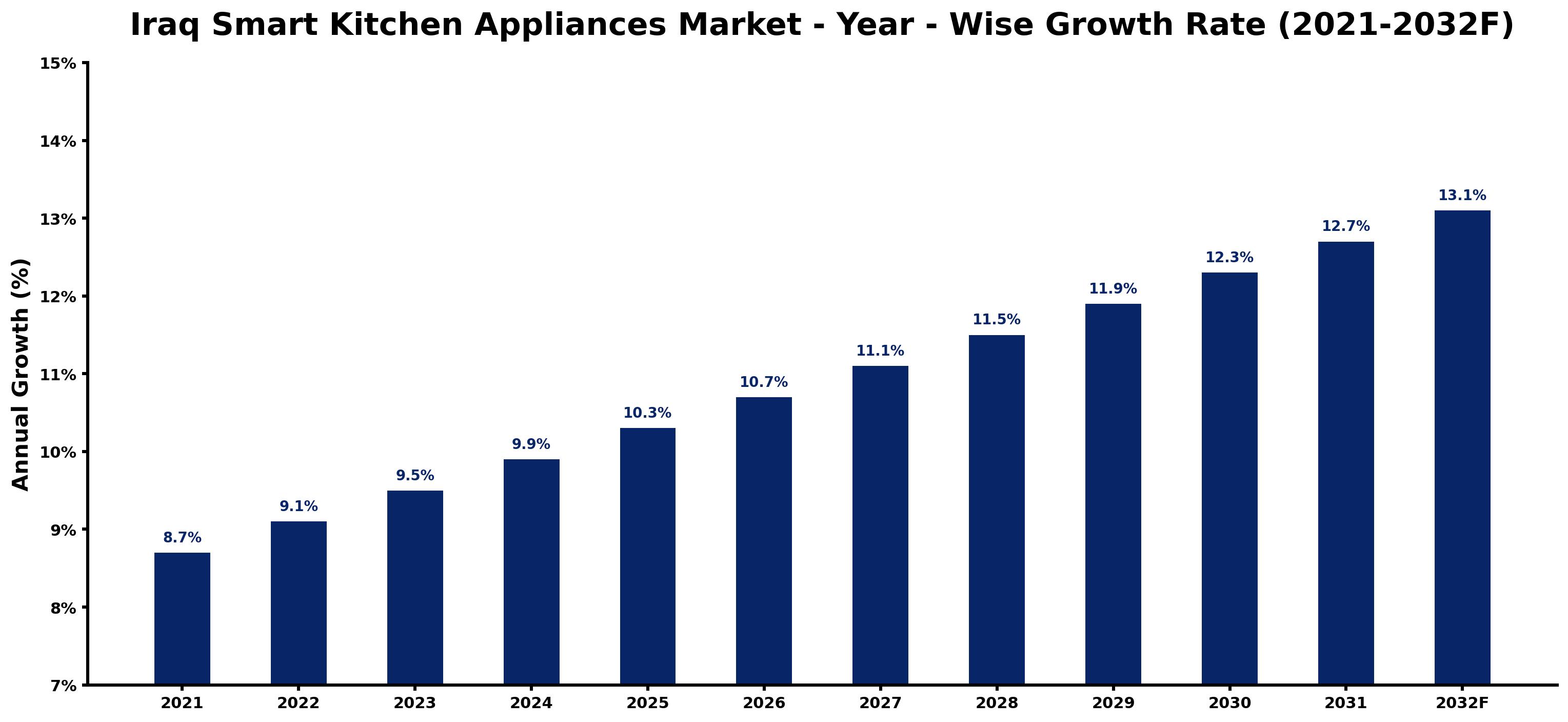
The table below presents the year‑wise growth rates along with the key drivers influencing the market
| Year | Growth Rate | Major Drivers |
| 2021 | 8.7% | Growing renewable energy integration projects |
| 2022 | 9.1% | Increasing smart city development projects |
| 2023 | 9.5% | Growing renewable energy integration projects |
| 2024 | 9.9% | Expansion of manufacturing activities |
| 2025 | 10.3% | Government infrastructure modernization initiatives |
| 2026 | 10.7% | Expansion of commercial construction activities |
| 2027 | 11.1% | Increasing smart city development projects |
| 2028 | 11.5% | Expansion of manufacturing activities |
| 2029 | 11.9% | Government infrastructure modernization initiatives |
| 2030 | 12.3% | Expansion of manufacturing activities |
| 2031 | 12.7% | Increasing adoption of advanced technologies |
| 2032 | 13.1% | Government infrastructure modernization initiatives |
Note - Market size estimations and growth projections presented in this report are based on 6Wresearch's advanced forecasting approach, validated with industry datasets as of June 2026.
Iraq Smart Kitchen Appliances Market Synopsis
A significant demand for smart kitchen appliances in Iraq stems from the urban middle-class populace, which is increasingly prioritizing technology that simplifies meal preparation and food storage. Products such as smart refrigerators and automated ovens are becoming increasingly popular as they fit seamlessly into the modern lifestyle.
Moreover, the growing trend of sustainability is compelling consumers to seek energy-efficient appliances. This is particularly relevant in Iraq, where energy conservation is not just a matter of cost but also a necessity given the country's infrastructural challenges.
Iraq Smart Kitchen Appliances Market Key Takeaways
- The market is witnessing a strong uptick in demand driven by urbanization and lifestyle changes.
- Smart kitchen appliances are increasingly recognized for their convenience and energy efficiency.
- Challenges related to infrastructure and traditional cooking preferences are significant in shaping consumer behavior.
- Government policies are progressively supporting the growth of smart kitchen technologies.
- The market is poised for substantial growth, with an expected CAGR of 9.3% from 2026 to 2032.
Evaluation of Restraints in Iraq Smart Kitchen Appliances Market
Despite the promising growth, the Iraq Smart Kitchen Appliances Market faces considerable restraints. Limited access to reliable internet connectivity affects the full functionality of these devices, which rely on seamless connectivity for optimal performance. Additionally, the existing electricity infrastructure poses challenges, as inconsistent power supply can deter consumers from investing in high-tech appliances. Cultural preferences for traditional cooking methods further complicate market penetration, as many consumers remain attached to time-honored practices despite the conveniences offered by smart technologies.
Iraq Smart Kitchen Appliances Market Trends
Current trends in the Iraq Smart Kitchen Appliances Market highlight a shift toward multifunctional devices that combine various cooking functions into one unit. Consumers are increasingly interested in products that offer flexibility and adaptability, enabling them to prepare a wide range of meals with minimal effort. Furthermore, the integration of artificial intelligence and machine learning into kitchen appliances is shaping the future of cooking, allowing for personalized settings and automated cooking processes.
Iraq Smart Kitchen Appliances Market Opportunities
The genuine growth opportunities in the Iraq Smart Kitchen Appliances Market lie in addressing the identified challenges through innovation. Companies can invest in developing appliances that operate efficiently even with fluctuating power supplies, while also enhancing connectivity capabilities. Moreover, targeting the younger, tech-savvy demographic through marketing strategies that emphasize the convenience and sustainability of smart appliances will likely spur adoption rates.
Government Initiatives in the Iraq Smart Kitchen Appliances Market
In recent years, the Iraqi government has recognized the importance of promoting smart technology adoption as part of its broader economic strategy. Initiatives have included the introduction of incentives for consumers to purchase energy-efficient appliances, as well as regulations aimed at ensuring product safety and interoperability. These policies not only stimulate market growth but also align with national goals of enhancing energy efficiency and modernizing the country's infrastructure.
Future Insights of the Iraq Smart Kitchen Appliances Market
Looking ahead to 2026-2032, the Iraq Smart Kitchen Appliances Market is set to evolve significantly. As urbanization continues to expand, an influx of consumer interest in smart technologies will likely drive innovation and competition among manufacturers. Additionally, advancements in internet infrastructure and increased public awareness of energy-efficient solutions will bolster market penetration. As these trends develop, the landscape of kitchen appliances in Iraq will shift towards a future where smart technologies are an integral part of everyday cooking.
Iraq Smart Kitchen Appliances Market Latest Developments (May 2025 - June 2026)
Recent developments in the Iraq Smart Kitchen Appliances Market indicate a strong push towards integrating more advanced technologies in cooking solutions. Industry stakeholders are actively exploring partnerships to enhance product offerings, focusing on features that resonate with local consumer preferences while addressing infrastructure challenges. Additionally, the rollout of government initiatives is gaining momentum, with public awareness campaigns designed to educate consumers about the benefits of smart appliances.
Iraq Smart Kitchen Appliances Market - Key Attractiveness of the Report
- 10 Years of Market Numbers
- Historical Data Starting from 2022 to 2025
- Base Year: 2025
- Forecast Data until 2032
- Key Performance Indicators Impacting the Market
- Major Upcoming Developments and Projects
Key Highlights of the Report:
- Iraq Smart Kitchen Appliances Market Outlook
- Market Size of Iraq Smart Kitchen Appliances Market, 2025
- Forecast of Iraq Smart Kitchen Appliances Market, 2032
- Historical Data and Forecast of Iraq Smart Kitchen Appliances Revenues & Volume for the Period 2022-2032F
- Iraq Smart Kitchen Appliances Market Trend Evolution
- Iraq Smart Kitchen Appliances Market Drivers and Challenges
- Iraq Smart Kitchen Appliances Price Trends
- Iraq Smart Kitchen Appliances Porter's Five Forces
- Iraq Smart Kitchen Appliances Industry Life Cycle
- Historical Data and Forecast of Iraq Smart Kitchen Appliances Market Revenues & Volume By Products for the Period 2022-2032F
- Historical Data and Forecast of Iraq Smart Kitchen Appliances Market Revenues & Volume By Smart Refrigerators for the Period 2022-2032F
- Historical Data and Forecast of Iraq Smart Kitchen Appliances Market Revenues & Volume By Smart Cookware and Cooktops for the Period 2022-2032F
- Historical Data and Forecast of Iraq Smart Kitchen Appliances Market Revenues & Volume By Smart Ovens for the Period 2022-2032F
- Historical Data and Forecast of Iraq Smart Kitchen Appliances Market Revenues & Volume By Other for the Period 2022-2032F
- Historical Data and Forecast of Iraq Smart Kitchen Appliances Market Revenues & Volume By Applications for the Period 2022-2032F
- Historical Data and Forecast of Iraq Smart Kitchen Appliances Market Revenues & Volume By Residential for the Period 2022-2032F
- Historical Data and Forecast of Iraq Smart Kitchen Appliances Market Revenues & Volume By Commercial for the Period 2022-2032F
- Iraq Smart Kitchen Appliances Import Export Trade Statistics
- Market Opportunity Assessment By Products
- Market Opportunity Assessment By Applications
- Iraq Smart Kitchen Appliances Top Companies Market Share
- Iraq Smart Kitchen Appliances Competitive Benchmarking By Technical and Operational Parameters
- Iraq Smart Kitchen Appliances Company Profiles
- Iraq Smart Kitchen Appliances Key Strategic Recommendations






































