Iraq Smart Locks Market Size, Share & Growth Rate
The Iraq Smart Locks Market was estimated at USD 820 Million in 2025 and is projected to reach USD 1429 Million by 2032, growing at a CAGR of 8.3% from 2026 to 2032. This robust growth trajectory is primarily fueled by increasing urbanization and rising disposable incomes, which have heightened consumer interest in smart home technologies. Additionally, the demand for advanced security solutions, including remote access and activity monitoring, continues to drive adoption among homeowners and businesses alike.
Iraq Smart Locks Market Year-wise Growth Rate and Key Drivers
This graph highlights how the Iraq Smart Locks Market has steadily grown over the years, supported by major growth factors.
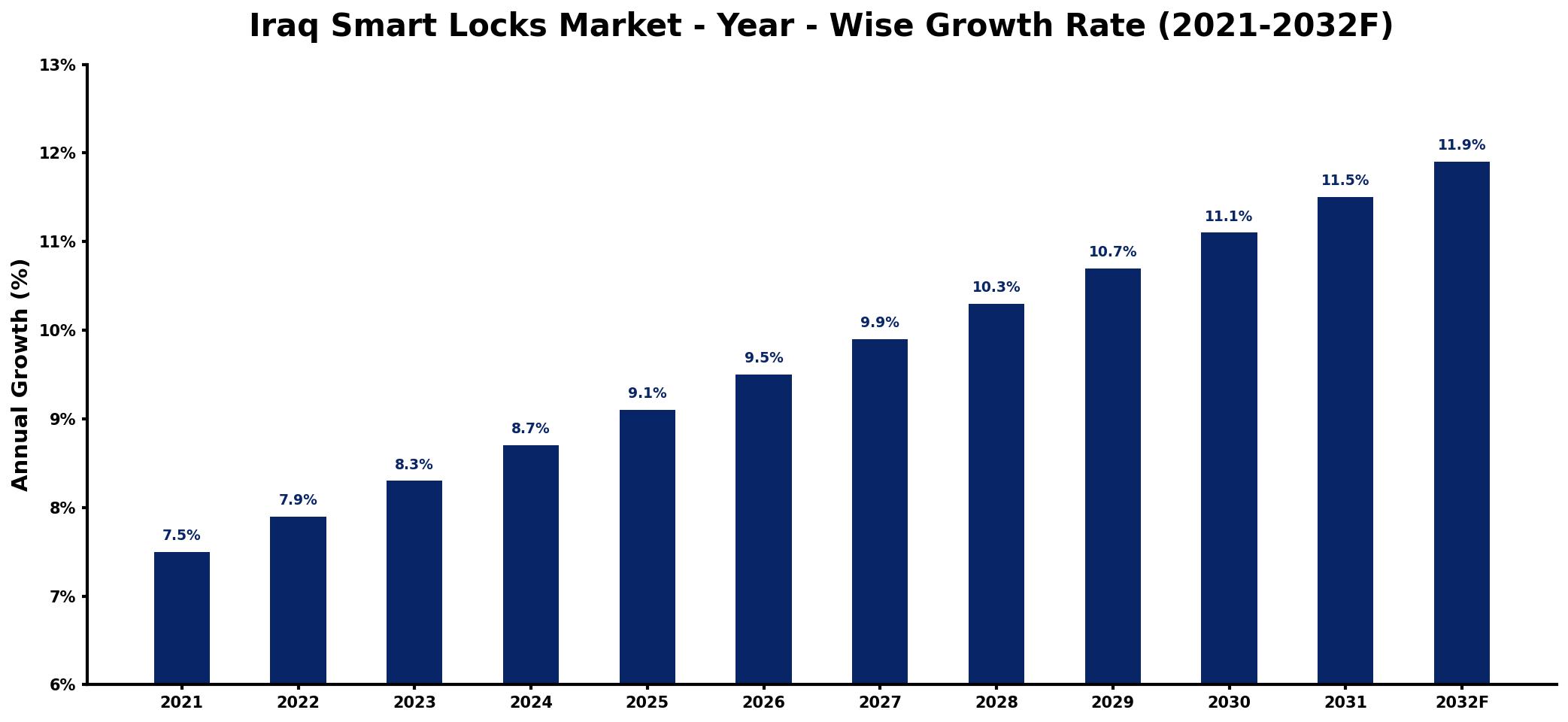
The table below presents the year‑wise growth rates along with the key drivers influencing the market
| Year | Growth Rate | Major Drivers |
| 2021 | 7.5% | rising interest in home security |
| 2022 | 7.9% | increased urbanization and modernization |
| 2023 | 8.3% | growing demand for automation technology |
| 2024 | 8.7% | expansion of real estate developments |
| 2025 | 9.1% | increased disposable income levels |
| 2026 | 9.5% | enhanced focus on energy efficiency |
| 2027 | 9.9% | growth in internet connectivity rates |
| 2028 | 10.3% | rising awareness of theft prevention |
| 2029 | 10.7% | expanding healthcare application demand |
| 2030 | 11.1% | increased investment in tech startups |
| 2031 | 11.5% | growing popularity of mobile applications |
| 2032 | 11.9% | growing regional consumption patterns |
Note: Market size estimations and growth projections presented in this report are based on 6Wresearch's proprietary forecasting methodology, utilizing the latest available industry data, government publications, and primary research inputs.
Iraq Smart Locks Market Synopsis
The strongest force shaping the Iraq Smart Locks Market is the growing consumer awareness of the benefits associated with smart home technology. As residents seek enhanced security and convenience, smart locks have emerged as a popular choice, providing features such as keyless entry and integration with broader smart home systems.
Furthermore, as urban centers expand and the middle-class population rises, the appetite for innovative security solutions is set to increase. The convergence of technology with everyday living facilitates a more connected and secure lifestyle, positioning smart locks as essential components in modern households.
Iraq Smart Locks Market Key Takeaways
- The Iraq Smart Locks Market is experiencing significant growth driven by urbanization and rising incomes.
- Consumer demand for advanced security features and smart home integration is accelerating market adoption.
- Investment opportunities exist in both local manufacturing and distribution channels for smart lock systems.
- Government initiatives aim to support the smart technology sector, enhancing regulatory and economic conditions.
- Challenges such as consumer awareness and data security concerns need to be addressed for sustainable market growth.
Evaluation of Restraints in Iraq Smart Locks Market
Despite the promising outlook, the Iraq Smart Locks Market faces several restraints. Limited consumer awareness regarding the advantages of smart lock technology remains a significant hurdle. Many potential users are still unfamiliar with the features and benefits, which hampers widespread adoption. Concerns over data security and privacy further complicate consumer trust. Furthermore, inconsistent internet connectivity in certain regions of Iraq presents operational challenges for smart devices. These factors, coupled with the high initial cost of smart lock systems compared to traditional locking mechanisms, highlight the need for manufacturers to engage in educational initiatives and focus on affordability and security measures to foster consumer confidence.
Iraq Smart Locks Market Trends
Several key trends are currently shaping the Iraq Smart Locks Market. The increasing integration of smart home technologies is at the forefront, with consumers showing a preference for systems that offer comprehensive connectivity. Enhanced security features, including biometric authentication and mobile app control, are also gaining traction. Additionally, the growing trend of home automation is influencing consumer behavior, driving interest in smart lock solutions that seamlessly fit into an interconnected living environment. As technology continues to evolve, we anticipate further innovations that will enhance usability and affordability.
Iraq Smart Locks Market Opportunities
The market presents various investment opportunities, especially as the demand for smart locks rises in urban areas. Local manufacturers and distributors can capitalize on the trend by focusing on customer education and promoting the benefits of smart security solutions. Potential avenues for growth include partnerships with home automation companies and enhancing product offerings to align with regional consumer needs. Furthermore, the increasing emphasis on security solutions offers investors the chance to support innovative startups dedicated to developing advanced locking systems tailored to the Iraqi market.
Government Initiatives in the Iraq Smart Locks Market
Government policies in Iraq are increasingly supportive of adopting smart technology, specifically in enhancing security and convenience through smart locks. Initiatives include tax incentives and subsidies for manufacturers, which aim to encourage production and consumer adoption. Furthermore, regulations to ensure data protection and cybersecurity are being put into place, enhancing consumer confidence in smart lock technologies. The government is also working towards standardizing practices within the smart lock industry to ensure quality and reliability, which is critical for fostering market growth.
Future Insights of the Iraq Smart Locks Market
Looking ahead to 2026-2032, the Iraq Smart Locks Market is set to flourish as smart home technologies gain further traction among consumers. Increasing urbanization and the rising middle class will significantly bolster demand for secure and convenient access solutions. Advancements in technologies such as IoT integration and biometric security will drive innovation, encouraging more homeowners to invest in smart locks. As consumers continue to prioritize security and convenience, market players who offer user-friendly and reliable solutions will likely succeed in capturing a larger share of this burgeoning market.
Iraq Smart Locks Market Latest Developments (2025 - 2026)
In recent months, the Iraq Smart Locks Market has witnessed a flurry of activities focused on enhancing product offerings and consumer engagement. Several companies are launching new models featuring advanced connectivity options and robust security protocols. Moreover, initiatives aimed at raising consumer awareness about the benefits of smart locks are gaining momentum, with educational campaigns and promotional events being organized across urban centers. As the market matures, an increasing number of partnerships between technology firms and local manufacturers are emerging, fostering innovation and accessibility.
Iraq Smart Locks Market - Key Attractiveness of the Report
- 10 Years of Market Numbers
- Historical Data Starting from 2022 to 2025
- Base Year: 2025
- Forecast Data until 2032
- Key Performance Indicators Impacting the Market
- Major Upcoming Developments and Projects
Key Highlights of the Report:
- Iraq Smart Locks Market Outlook
- Market Size of Iraq Smart Locks Market, 2025
- Forecast of Iraq Smart Locks Market, 2032
- Historical Data and Forecast of Iraq Smart Locks Revenues & Volume for the Period 2022-2032F
- Iraq Smart Locks Market Trend Evolution
- Iraq Smart Locks Market Drivers and Challenges
- Iraq Smart Locks Price Trends
- Iraq Smart Locks Porter's Five Forces
- Iraq Smart Locks Industry Life Cycle
- Historical Data and Forecast of Iraq Smart Locks Market Revenues & Volume By Product for the Period 2022-2032F
- Historical Data and Forecast of Iraq Smart Locks Market Revenues & Volume By Deadbolts for the Period 2022-2032F
- Historical Data and Forecast of Iraq Smart Locks Market Revenues & Volume By Lever Handles for the Period 2022-2032F
- Historical Data and Forecast of Iraq Smart Locks Market Revenues & Volume By Padlocks for the Period 2022-2032F
- Historical Data and Forecast of Iraq Smart Locks Market Revenues & Volume By Others for the Period 2022-2032F
- Historical Data and Forecast of Iraq Smart Locks Market Revenues & Volume By Technology for the Period 2022-2032F
- Historical Data and Forecast of Iraq Smart Locks Market Revenues & Volume By Bluetooth for the Period 2022-2032F
- Historical Data and Forecast of Iraq Smart Locks Market Revenues & Volume By Wi-Fi for the Period 2022-2032F
- Historical Data and Forecast of Iraq Smart Locks Market Revenues & Volume By End User for the Period 2022-2032F
- Historical Data and Forecast of Iraq Smart Locks Market Revenues & Volume By Residential for the Period 2022-2032F
- Historical Data and Forecast of Iraq Smart Locks Market Revenues & Volume By Commercial for the Period 2022-2032F
- Iraq Smart Locks Import Export Trade Statistics
- Market Opportunity Assessment By Product
- Market Opportunity Assessment By Technology
- Market Opportunity Assessment By End User
- Iraq Smart Locks Top Companies Market Share
- Iraq Smart Locks Competitive Benchmarking By Technical and Operational Parameters
- Iraq Smart Locks Company Profiles
- Iraq Smart Locks Key Strategic Recommendations






































