India Smart Locks Market Top 5 Importing Countries and Market Competition (HHI) Analysis
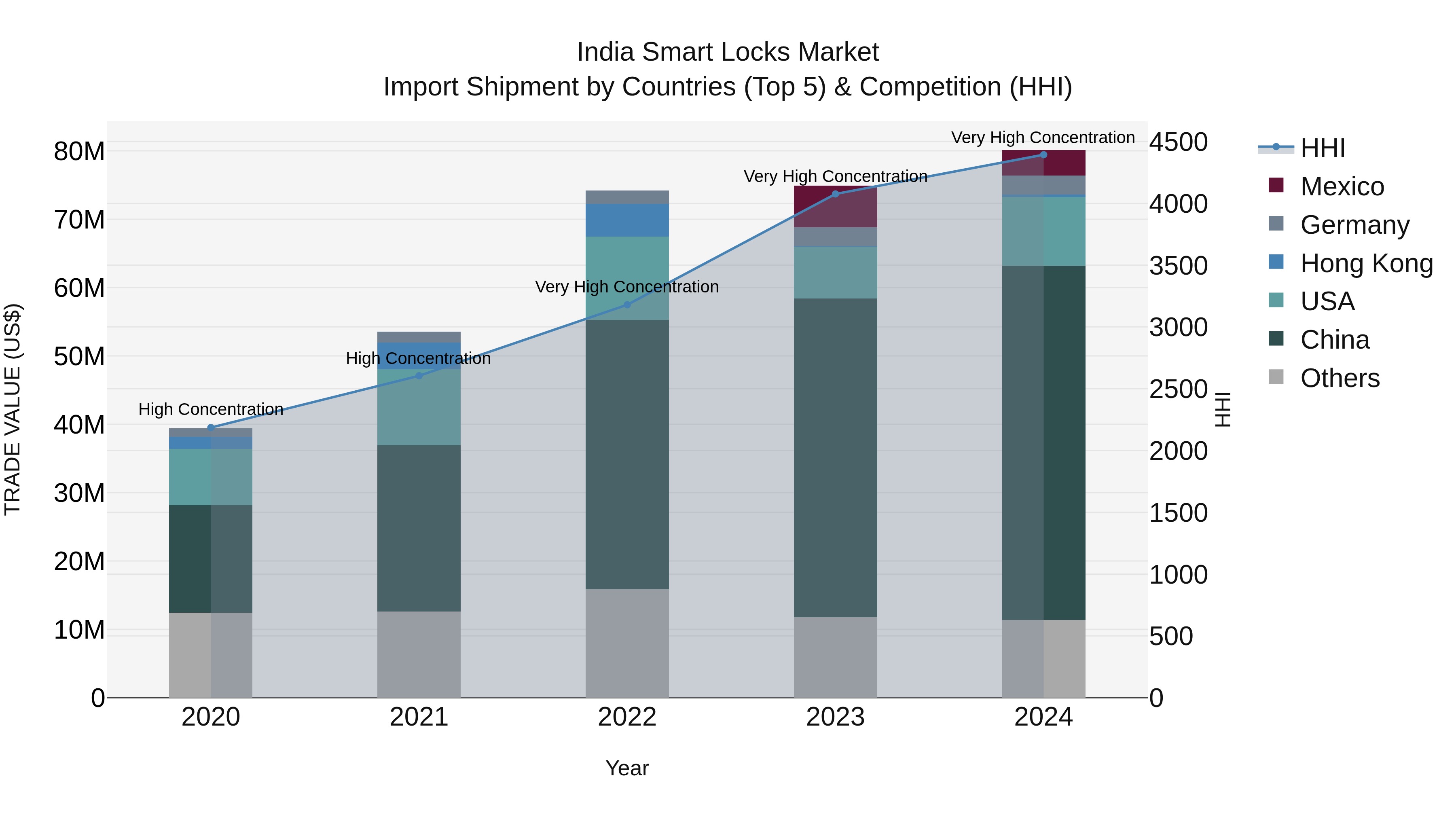
India`s smart locks import market continued to thrive in 2024, with key exporters including China, USA, Mexico, Germany, and Vietnam. The high Herfindahl-Hirschman Index (HHI) indicates a concentrated market, offering both challenges and opportunities for market players. The impressive Compound Annual Growth Rate (CAGR) of 19.42% from 2020 to 2024 signifies a robust expansion in the industry. Moreover, the growth rate of 6.91% in 2024 demonstrates sustained momentum and potential for further development in the smart locks sector in India.
India Smart Locks Market Growth Rate
According to 6Wresearch internal database and industry insights, the India Smart Locks Market is projected to grow at a compound annual growth rate (CAGR) of 11.4% during the forecast period (2026-2032).
Topics Covered in the India Smart Locks Market Report
The India Smart Locks Market report thoroughly covers the market by product type and applications. The market report provides an unbiased and detailed analysis of ongoing market trends, opportunities/high growth areas, and market drivers, which help stakeholders devise and align their market strategies according to the current and future market dynamics.
India Smart Locks Market Highlights
| Report Name | India Smart Locks Market |
| Forecast period | 2026-2032 |
| CAGR | 11.4% |
| Growing Sector | Residential Smart Home Security Solutions |
India Smart Locks Market Synopsis
India Smart Locks Market is anticipated to record notable growth due to increasing issues of home security, increased usage of smart home technology, and urbanization. Consumers are progressively becoming inclined towards using digital locks, which provide ease, accessibility, and safety. Apart from this, the increase in the real estate industry, particularly in cities, is adding to the growth of the market due to an increased demand for smart locks. The increased use of smartphones and other IoT-enabled devices is also contributing to the growth of the market.
Evaluation of Growth Drivers in the India Smart Locks Market
Below mentioned are some prominent drivers and their influence on the market dynamics:
| Drivers | Primary Segments Affected | Why it Matters (evidence) |
| Rising Smart Home Adoption | Wi-Fi & Bluetooth; Residential | Increasing use of IoT devices boosts demand for smart locks. |
| Growth in Urban Housing Projects | Deadbolts & Lever Handles; Residential | Smart locks are increasingly integrated into modern housing developments. |
| Increasing Security Concerns | All Types; Residential & Commercial | Demand for advanced security solutions drives market growth. |
| Expansion of E-Commerce Platforms | All Types; Residential | Easy availability and competitive pricing increase product accessibility. |
| Integration with Home Automation Systems | Wi-Fi; Residential & Commercial | Seamless connectivity enhances user convenience and system efficiency. |
India Smart Locks Market is expected to grow at the CAGR of 11.4% during the forecast period of 2026-2032. The growth of the market will be attributed to the increasing adoption of smart home solutions, heightened security awareness on the part of the end consumer, and the fast pace of urbanization in key cities. Moreover, developments in the construction industry, along with the deployment of IoT-based devices, have increased the demand for smart locks. Furthermore, the proliferation of e-commerce channels has also contributed to making these products available to consumers.
Evaluation of Restraints in the India Smart Locks Market
Below mentioned are some major restraints and their influence on the market dynamics:
| Restraints | Primary Segments Affected | What This Means (evidence) |
| High Initial Cost | Wi-Fi Locks; Residential | Advanced smart locks are expensive compared to traditional locks. |
| Cybersecurity Issues | Internet; Domestic and Business | Risk of hacking reduces consumer trust in smart locks. |
| Insufficient Knowledge in Tier-2 Cities | All Categories; Domestic | Inadequate awareness leads to low adoption in non-metropolitan cities. |
| Reliance on Internet Connectivity | Internet; Domestic | Internet connectivity problems may interfere with lock functionality. |
| High Installation Difficulty | All Categories; Domestic and Business | Professional installation increases total costs. |
India Smart Locks Industry Challenges
Despite rapid growth, the India Smart Locks Industry faces several challenges that may hinder its full potential. The first challenge facing such technology is the expensive cost of purchasing and installing the device, something that deters many buyers who might be on a tight budget. Second, the fear of cybersecurity threats posed by the connection of such devices is an issue. Third, people in small towns and rural regions lack adequate awareness about such a product. Fourth, lack of constant internet connectivity may affect the operation of such a device.
India Smart Locks Market Trends
Key evolving patterns shaping the India Smart Locks Market Growth include:
- Adoption of Biometric Smart Locks: With the advent of fingerprint scanners and facial recognition technology, smart locks have gained popularity amongst consumers.
- Integration of Smart Locks with Other Smart Devices: Nowadays, smart locks are being incorporated along with other smart devices like voice-enabled devices.
- Usage of Smartphones to Operate Smart Locks: It is a trend that today’s consumers favor smart locks that can be operated via their phones.
- Usage of Smart Locks in Rental Properties: The usage of smart locks in rental properties is on the rise.
Investment Opportunities in the India Smart Locks Market
Some major investment opportunities in the India Smart Locks Market Share include:
- Affordable Manufacturing of Smart Locks – Through investing in affordable manufacturing of the products, price-sensitive customers will be able to afford these products, allowing the company to expand into premium markets.
- Expansion of E-commerce Channels – The improved state of the company’s e-commerce channels will increase accessibility to customers, giving a chance to reach a larger audience in India.
- Investments in Smart City Projects – Programs such as Smart Cities Mission will create demand for advanced security solutions, giving the company a chance for sustainable growth in the smart locks segment.
Top 5 Leading Players in the India Smart Locks Market
Some leading players operating in the India Smart Locks Market include:
1. Godrej & Boyce Manufacturing Company Limited
| Company Name | Godrej & Boyce Manufacturing Company Limited |
| Established Year | 1897 |
| Headquarters | Mumbai, India |
| Official Website | Click Here |
Godrej offers a wide range of smart locks with advanced security features including biometric and digital access systems. The company focuses on innovation and reliability, catering to both residential and commercial customers across India.
2. Samsung SDS Co., Ltd.
| Company Name | Samsung SDS Co., Ltd. |
| Established Year | 1985 |
| Headquarters | South Korea |
| Official Website | Click Here |
Samsung provides technologically advanced smart locks integrated with IoT capabilities. Its products are known for durability, design, and seamless integration with smart home ecosystems, making them popular in urban Indian households.
3. Assa Abloy Group
| Company Name | Assa Abloy Group |
| Established Year | 1994 |
| Headquarters | Sweden |
| Official Website | Click Here |
Assa Abloy offers a diverse portfolio of smart locking solutions with strong emphasis on security and innovation. The company supports residential and commercial applications with reliable and high-quality digital locking systems.
4. Xiaomi Corporation
| Company Name | Xiaomi Corporation |
| Established Year | 2010 |
| Headquarters | Beijing, China |
| Official Website | Click Here |
Xiaomi provides affordable smart locks with modern features such as app connectivity and biometric access. The company focuses on cost-effective solutions, making smart locks accessible to a wider consumer base in India.
5. Yale (Assa Abloy)
| Company Name | Yale (Assa Abloy) |
| Established Year | 1840 |
| Headquarters | Stockholm, Sweden |
| Official Website | Click Here |
Yale offers premium smart lock solutions with advanced security features and sleek designs. The brand is known for its reliability and innovation, catering to modern homes and commercial establishments worldwide.
Government Regulations in the India Smart Locks Market
According to India's Government Data, policies adopted in order to facilitate the use of smart technology and digital infrastructure include the following: the Smart Cities Mission is one of the policies which promotes the use of smart technology, including smart locks within infrastructure programs. Moreover, Digital India campaigns advocate for IoT-based devices and connectivity. Another policy adopted by the government involves cyber security laws which help to provide guidelines on how to safely use smart technology. Finally, housing policies like Pradhan Mantri Awas Yojana also encourage the use of smart locks and other security features within residential areas.
Future Insights of the India Smart Locks Market
India Smart Locks Market is expected to witness significant growth driven by increasing adoption of smart home technologies and rising awareness about advanced security solutions. There is a high possibility that the growth of the market will be catalyzed by urbanization as well as the development of real estate projects in the metropolitan cities and tier-two cities. Apart from that, improvements in the IoT and AI technologies would increase the efficiency of the product. Also, the rising need for contactless and remote entry options would drive the growth of the market in India.
Market Segmentation Analysis
The report offers a comprehensive study of the subsequent market segments and their leading categories.
Deadbolts to Dominate the Market – By Product
According to Rahul, Senior Research Analyst, 6Wresearch, the Deadbolts segment dominates the India Smart Locks Market due to its strong security features and widespread usage in residential applications. The increasing adoption of smart home products and the rise in home security consciousness have been boosting the uptake of smart deadbolt locks. Moreover, such locks are compatible with mobile apps and home automation technologies. The reliability, durability, and affordability of these locks make them popular among consumers, thereby making them market leaders.
Wi-Fi Technology to Dominate the Market – By Technology
Wi-Fi-enabled smart locks hold the largest share due to their ability to provide remote access and real-time monitoring. These locks are widely preferred for their compatibility with smart home ecosystems and enhanced convenience.
Key Attractiveness of the Report
- 10 Years Market Numbers.
- Historical Data Starting from 2022 to 2025.
- Base Year: 2025.
- Forecast Data until 2032.
- Key Performance Indicators Impacting the Market.
- Major Upcoming Developments and Projects.
Key Highlights of the Report:
- India Smart Locks Market Outlook
- Market Size of India Smart Locks Market, 2025
- Forecast of India Smart Locks Market, 2032
- Historical Data and Forecast of India Smart Locks Revenues & Volume for the Period 2022-2032
- India Smart Locks Market Trend Evolution
- India Smart Locks Market Drivers and Challenges
- India Smart Locks Price Trends
- India Smart Locks Porter's Five Forces
- India Smart Locks Industry Life Cycle
- Historical Data and Forecast of India Smart Locks Market Revenues & Volume By Product for the Period 2022-2032
- Historical Data and Forecast of India Smart Locks Market Revenues & Volume By Deadbolts for the Period 2022-2032
- Historical Data and Forecast of India Smart Locks Market Revenues & Volume By Lever Handles for the Period 2022-2032
- Historical Data and Forecast of India Smart Locks Market Revenues & Volume By Padlocks for the Period 2022-2032
- Historical Data and Forecast of India Smart Locks Market Revenues & Volume By Others for the Period 2022-2032
- Historical Data and Forecast of India Smart Locks Market Revenues & Volume By Technology for the Period 2022-2032
- Historical Data and Forecast of India Smart Locks Market Revenues & Volume By Bluetooth for the Period 2022-2032
- Historical Data and Forecast of India Smart Locks Market Revenues & Volume By Wi-Fi for the Period 2022-2032
- Historical Data and Forecast of India Smart Locks Market Revenues & Volume By End User for the Period 2022-2032
- Historical Data and Forecast of India Smart Locks Market Revenues & Volume By Residential for the Period 2022-2032
- Historical Data and Forecast of India Smart Locks Market Revenues & Volume By Commercial for the Period 2022-2032
- India Smart Locks Import Export Trade Statistics
- Market Opportunity Assessment By Product
- Market Opportunity Assessment By Technology
- Market Opportunity Assessment By End User
- India Smart Locks Top Companies Market Share
- India Smart Locks Competitive Benchmarking By Technical and Operational Parameters
- India Smart Locks Company Profiles
- India Smart Locks Key Strategic Recommendations
Market Covered
The report offers a comprehensive study of the subsequent market segments:
By Product
- Deadbolts
- Lever Handles
- Padlocks
- Others
By Technology
- Bluetooth
- Wi-Fi
By End User
- Residential
- Commercial






































