Iraq Soap And Detergent Market Size, Share & Growth Rate
The Iraq Soap And Detergent Market was estimated at USD 295 Million in 2025 and is projected to reach USD 413 Million by 2032, growing at a CAGR of 4.9% from 2026 to 2032. This growth trajectory is primarily driven by a notable increase in urbanization and rising disposable incomes, which are reshaping consumer purchasing habits. As personal hygiene and cleanliness gain heightened importance, the demand for diverse and innovative soap and detergent products continues to surge.
Iraq Soap And Detergent Market Year-wise Growth Rate and Key Drivers
This graph highlights how the Iraq Soap And Detergent Market has steadily grown over the years, supported by major growth factors.
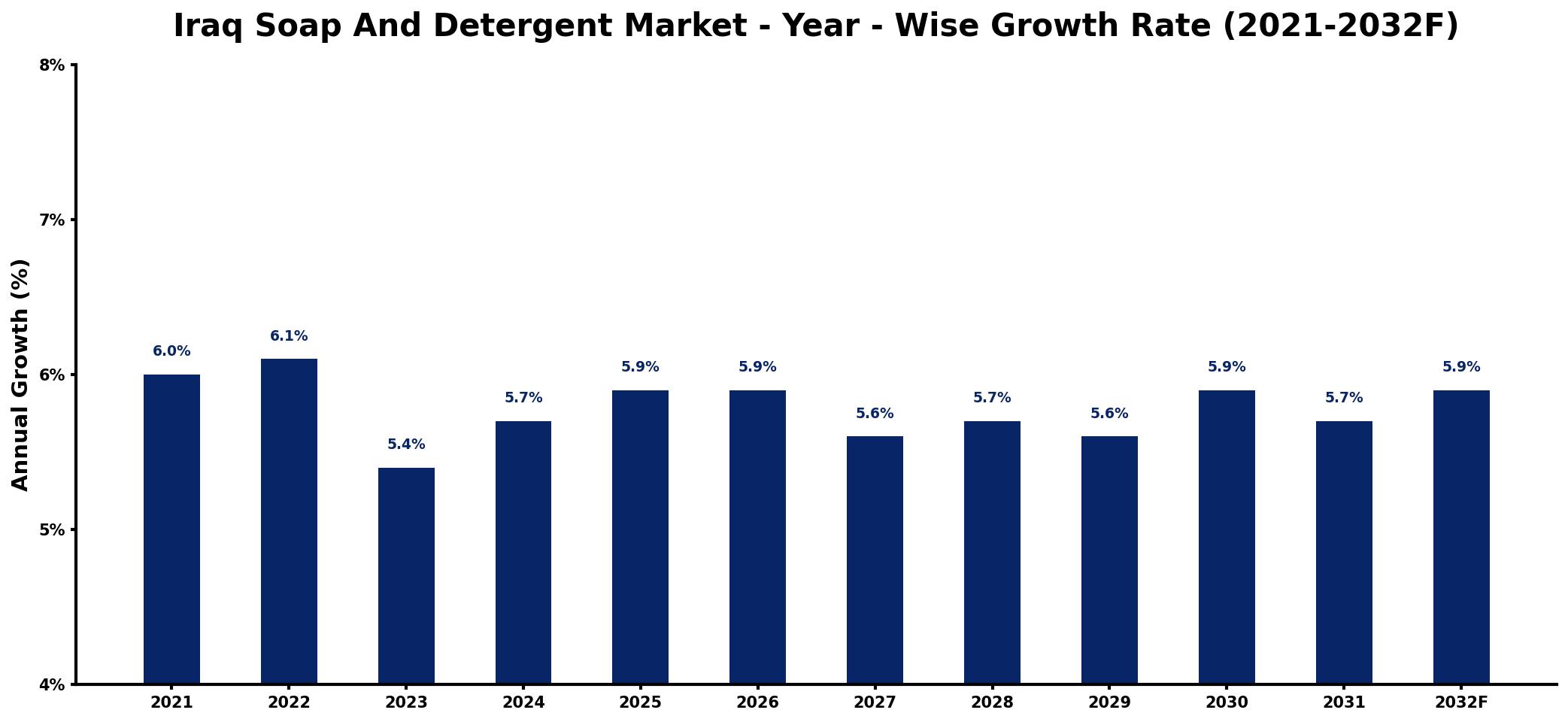
The table below presents the year‑wise growth rates along with the key drivers influencing the market
| Year | Growth Rate | Major Drivers |
| 2021 | 6.0% | Rising consumer spending power |
| 2022 | 6.1% | Expansion of retail distribution channels |
| 2023 | 5.4% | Growing awareness of hygiene standards |
| 2024 | 5.7% | Increase in local manufacturing capacity |
| 2025 | 5.9% | Surge in urban population growth |
| 2026 | 5.9% | Higher investment in marketing strategies |
| 2027 | 5.6% | Emergence of eco-friendly alternatives |
| 2028 | 5.7% | Boost in online shopping trends |
| 2029 | 5.6% | Increased exports to neighboring markets |
| 2030 | 5.9% | Growing demand for premium products |
| 2031 | 5.7% | expanding manufacturing base activity |
| 2032 | 5.9% | Strengthening of local partnerships |
Note: Market size estimations and growth projections presented in this report are based on 6Wresearch's proprietary forecasting methodology, utilizing the latest available industry data, government publications, and primary research inputs.
Iraq Soap And Detergent Market Synopsis
In Iraq, the soap and detergent market is witnessing an uptick in consumer interest for liquid products, which are perceived as more convenient and effective compared to traditional alternatives. Despite this shift, bar soaps remain entrenched in many households, reflecting the balance of modernity and tradition in consumer preferences.
Local manufacturers and international players are competing fiercely, offering a wide array of products tailored to meet the varying needs of consumers. As awareness of hygiene rises, the market is increasingly aligning with health and sustainability trends, pushing for natural and environmentally friendly product formulations.
Iraq Soap And Detergent Market Key Takeaways
- The market is projected to grow significantly, reaching USD 413 Million by 2032.
- Liquid soaps are increasingly favored for their convenience, while bar soaps maintain strong demand.
- Consumer preferences are shifting towards eco-friendly and natural products, fostering innovation.
- Urbanization and rising disposable incomes are key factors driving market growth.
- The competitive landscape includes both local manufacturers and international brands.
Evaluation of Restraints in Iraq Soap And Detergent Market
Despite the growth potential, the Iraq soap and detergent market faces several constraints. Political instability remains a concern, leading to disruptions in supply chains and affecting distribution efficiency. Additionally, fluctuations in raw material prices, influenced by economic sanctions and exchange rate volatility, can impose further challenges on production costs. The presence of counterfeit goods and informal markets complicates the competitive environment, hindering the efforts of legitimate businesses striving to establish a foothold.
Iraq Soap And Detergent Market Trends
Current trends in the Iraq soap and detergent market highlight a growing consumer preference for products free of harmful chemicals. As awareness around sustainability rises, there is an increasing demand for eco-friendly packaging and natural formulations. The ascent of e-commerce is also reshaping the retail landscape, with more consumers opting to purchase hygiene products online for their convenience. This shift is prompting manufacturers to diversify their offerings and explore innovative product solutions to align with evolving consumer expectations.
Iraq Soap And Detergent Market Opportunities
The Iraq soap and detergent market presents attractive investment opportunities, particularly in light of the country's demographic growth and economic evolution. With consumers increasingly seeking high-quality hygiene products, there is significant potential for manufacturers who can offer innovative solutions, particularly in the eco-friendly segment. Additionally, investing in enhanced distribution networks and marketing strategies may yield substantial returns as the urban consumer base expands. Research and development efforts focusing on natural ingredients could also represent lucrative avenues for growth.
Government Initiatives in the Iraq Soap And Detergent Market
The Iraqi government is implementing policies aimed at bolstering local production capabilities and reducing reliance on imports in the soap and detergent sector. Import tariffs and quality standards are being enforced to protect domestic manufacturers while ensuring consumer safety. Additionally, initiatives to support research and development are crucial for enhancing product innovation, thereby increasing the competitiveness of local businesses. These policies reflect a commitment to not only fortify the industry but also promote overall economic stability.
Future Insights of the Iraq Soap And Detergent Market
Looking ahead to 2026-2032, the Iraq soap and detergent market is poised for continued growth, driven by increasing population and urbanization trends. As consumer awareness of hygiene and sustainable practices expands, manufacturers are likely to enhance their focus on eco-friendly offerings. Innovations in product development and marketing strategies will become vital for capturing evolving consumer demands. However, stakeholders must remain vigilant against potential economic and political challenges that could impact the market landscape.
Iraq Soap And Detergent Market Latest Developments (2025 - 2026)
In recent months, the Iraq soap and detergent market has seen a shift towards greater investment in sustainable product lines, with several manufacturers exploring the use of biodegradable ingredients. Retailers are also expanding their online presence to better cater to the growing trend of e-commerce among consumers. Additionally, marketing campaigns emphasizing health and wellness benefits associated with hygiene products are gaining traction, reflecting the changing dynamics of consumer priorities in the region.
Iraq Soap And Detergent Market - Key Attractiveness of the Report
- 10 Years of Market Numbers
- Historical Data Starting from 2022 to 2025
- Base Year: 2025
- Forecast Data until 2032
- Key Performance Indicators Impacting the Market
- Major Upcoming Developments and Projects
Key Highlights of the Report:
- Iraq Soap And Detergent Market Outlook
- Market Size of Iraq Soap And Detergent Market, 2025
- Forecast of Iraq Soap And Detergent Market, 2032
- Historical Data and Forecast of Iraq Soap And Detergent Revenues & Volume for the Period 2022-2032F
- Iraq Soap And Detergent Market Trend Evolution
- Iraq Soap And Detergent Market Drivers and Challenges
- Iraq Soap And Detergent Price Trends
- Iraq Soap And Detergent Porter's Five Forces
- Iraq Soap And Detergent Industry Life Cycle
- Historical Data and Forecast of Iraq Soap And Detergent Market Revenues & Volume By Type for the Period 2022-2032F
- Historical Data and Forecast of Iraq Soap And Detergent Market Revenues & Volume By Laundry Detergent for the Period 2022-2032F
- Historical Data and Forecast of Iraq Soap And Detergent Market Revenues & Volume By Soap for the Period 2022-2032F
- Historical Data and Forecast of Iraq Soap And Detergent Market Revenues & Volume By Dishwashing Detergent for the Period 2022-2032F
- Historical Data and Forecast of Iraq Soap And Detergent Market Revenues & Volume By Toothpaste for the Period 2022-2032F
- Historical Data and Forecast of Iraq Soap And Detergent Market Revenues & Volume By Others for the Period 2022-2032F
- Historical Data and Forecast of Iraq Soap And Detergent Market Revenues & Volume By Application for the Period 2022-2032F
- Historical Data and Forecast of Iraq Soap And Detergent Market Revenues & Volume By Body for the Period 2022-2032F
- Historical Data and Forecast of Iraq Soap And Detergent Market Revenues & Volume By Clothing for the Period 2022-2032F
- Historical Data and Forecast of Iraq Soap And Detergent Market Revenues & Volume By Others for the Period 2022-2032F
- Iraq Soap And Detergent Import Export Trade Statistics
- Market Opportunity Assessment By Type
- Market Opportunity Assessment By Application
- Iraq Soap And Detergent Top Companies Market Share
- Iraq Soap And Detergent Competitive Benchmarking By Technical and Operational Parameters
- Iraq Soap And Detergent Company Profiles
- Iraq Soap And Detergent Key Strategic Recommendations






































