Iraq Technical Textile Market Size, Share & Growth Rate
The Iraq Technical Textile Market was estimated at USD 489 Million in 2025 and is projected to reach USD 639 Million by 2032, growing at a CAGR of 3.9% from 2026 to 2032. This growth trajectory is primarily driven by the country's ongoing industrialization, with significant investments in infrastructure projects and a rising demand across sectors such as construction, healthcare, and automotive. As these industries expand, the necessity for high-performance and innovative textile solutions continues to gain momentum, offering vast potential for market development.
Iraq Technical Textile Market Year-wise Growth Rate and Key Drivers
This graph highlights how the Iraq Technical Textile Market has steadily grown over the years, supported by major growth factors.
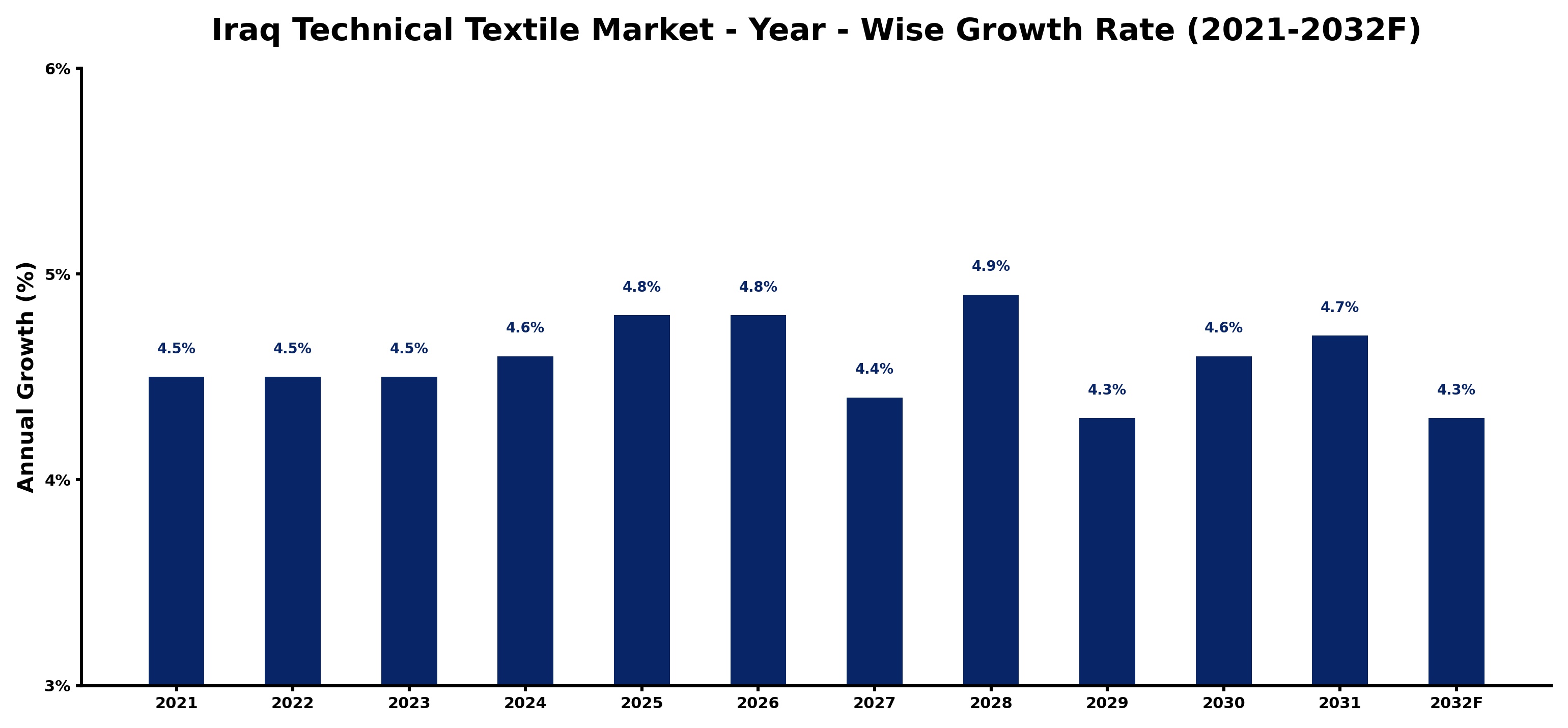
The table below presents the year‑wise growth rates along with the key drivers influencing the market
| Year | Growth Rate | Major Drivers |
| 2021 | 4.5% | Government investment in infrastructure |
| 2022 | 4.5% | Increased demand for protective gear |
| 2023 | 4.5% | Rise in automotive textile applications |
| 2024 | 4.6% | Expansion of construction projects underway |
| 2025 | 4.8% | Growth in medical textile innovations |
| 2026 | 4.8% | Rising interest in sustainable materials |
| 2027 | 4.4% | Technological advancements in production |
| 2028 | 4.9% | Increased export opportunities emerging |
| 2029 | 4.3% | Consumer awareness of technical textiles |
| 2030 | 4.6% | Collaboration with international manufacturers |
| 2031 | 4.7% | Industrial activity supported growth |
| 2032 | 4.3% | Emerging trends in smart textiles |
Note - Market size estimations and growth projections presented in this report are based on 6Wresearch’s advanced forecasting approach, validated with industry datasets as of June 2026.
Iraq Technical Textile Market Synopsis
The increasing adoption of technical textiles in various sectors is a defining characteristic of the Iraq Technical Textile Market. Applications such as geotextiles for construction projects, medical textiles for healthcare, and specialized fabrics for the automotive industry are gaining traction, reflecting a growing awareness of their performance benefits.
Moreover, the shift towards sustainability is influencing production strategies within the market. A focus on eco-friendly materials and innovative technologies is shaping the product landscape, providing avenues for growth while addressing environmental concerns.
Iraq Technical Textile Market Key Takeaways
- Strong growth fueled by increasing industrialization and infrastructure development.
- Significant demand for geotextiles, medical textiles, and protective clothing.
- Shift towards sustainable and innovative materials in response to environmental regulations.
- Investment opportunities abound, particularly in partnerships and joint ventures.
- Government initiatives are bolstering domestic production and reducing import reliance.
Evaluation of Restraints in Iraq Technical Textile Market
Despite the promising outlook, the Iraq Technical Textile Market faces several restraints that may inhibit its growth. Limited awareness of technical textiles among potential users has created a gap in demand. Additionally, the market suffers from a lack of skilled labor necessary for specialized production, which is compounded by inadequate infrastructure for high-quality manufacturing. Competition from imported textiles, which often benefit from better economies of scale, adds pressure on local producers. Political instability further complicates the market landscape, posing challenges to long-term investment and development.
Iraq Technical Textile Market Trends
The market is witnessing several trends that reflect shifting demands and technological advancements. Notably, the integration of smart textiles with functionalities such as temperature regulation and antimicrobial properties is becoming increasingly prevalent. This reflects a broader movement towards enhanced performance materials across various applications. Furthermore, as environmental concerns grow, manufacturers are increasingly prioritizing sustainable practices, resulting in a broader selection of eco-friendly textiles in the market.
Iraq Technical Textile Market Opportunities
Investment opportunities in the Iraq Technical Textile Market are robust, particularly in sectors driven by governmental infrastructure initiatives. The expanding construction, healthcare, and automotive sectors are particularly promising for growth. Innovative product development, including advanced textiles tailored for specific applications, presents potential for companies looking to capture market share. As the country aims to diversify its economy away from oil, the technical textile sector offers a fertile ground for strategic investments and partnerships.
Government Initiatives in the Iraq Technical Textile Market
The Iraqi government has implemented various policies aimed at fostering domestic production within the technical textile sector. These measures include tariffs on imported textiles to encourage local manufacturing and efforts to boost research and development initiatives that enhance the capabilities of local industries. Such policies are designed to create a more competitive environment, ultimately promoting self-sufficiency and supporting the overall growth of the technical textile industry in the country.
Future Insights of the Iraq Technical Textile Market
Looking ahead to 2026-2032, the Iraq Technical Textile Market is poised for notable expansion. The government's ongoing emphasis on economic diversification and development will likely stimulate demand for technical textiles, especially in critical applications such as geotextiles and protective clothing. With increasing awareness of the benefits associated with high-performance textiles, market players can expect a steadily growing customer base. However, addressing existing challenges such as labor skills and infrastructure will be vital for sustained growth and innovation.
Iraq Technical Textile Market Latest Developments (May 2025 - June 2026)
Recent developments in the Iraq Technical Textile Market highlight an increasing focus on research and development, with efforts to introduce innovative products that meet the specific needs of local industries. Additionally, collaborations between educational institutions and manufacturers are emerging to enhance skills in the workforce, addressing the shortage of skilled labor. The market is also seeing a shift towards adopting advanced manufacturing technologies, which is expected to improve production capabilities and quality standards.
Iraq Technical Textile Market - Key Attractiveness of the Report
- 10 Years of Market Numbers
- Historical Data Starting from 2022 to 2025
- Base Year: 2025
- Forecast Data until 2032
- Key Performance Indicators Impacting the Market
- Major Upcoming Developments and Projects
Key Highlights of the Report:
- Iraq Technical Textile Market Outlook
- Market Size of Iraq Technical Textile Market, 2025
- Forecast of Iraq Technical Textile Market, 2032
- Historical Data and Forecast of Iraq Technical Textile Revenues & Volume for the Period 2022-2032F
- Iraq Technical Textile Market Trend Evolution
- Iraq Technical Textile Market Drivers and Challenges
- Iraq Technical Textile Price Trends
- Iraq Technical Textile Porter's Five Forces
- Iraq Technical Textile Industry Life Cycle
- Historical Data and Forecast of Iraq Technical Textile Market Revenues & Volume By Material for the Period 2022-2032F
- Historical Data and Forecast of Iraq Technical Textile Market Revenues & Volume By Natural Fiber for the Period 2022-2032F
- Historical Data and Forecast of Iraq Technical Textile Market Revenues & Volume By Synthetic polymers/fibers for the Period 2022-2032F
- Historical Data and Forecast of Iraq Technical Textile Market Revenues & Volume By Mineral fiber for the Period 2022-2032F
- Historical Data and Forecast of Iraq Technical Textile Market Revenues & Volume By Regenerated Fiber for the Period 2022-2032F
- Historical Data and Forecast of Iraq Technical Textile Market Revenues & Volume By Metal fiber for the Period 2022-2032F
- Historical Data and Forecast of Iraq Technical Textile Market Revenues & Volume By Others for the Period 2022-2032F
- Historical Data and Forecast of Iraq Technical Textile Market Revenues & Volume By Technology for the Period 2022-2032F
- Historical Data and Forecast of Iraq Technical Textile Market Revenues & Volume By Woven for the Period 2022-2032F
- Historical Data and Forecast of Iraq Technical Textile Market Revenues & Volume By Knitted for the Period 2022-2032F
- Historical Data and Forecast of Iraq Technical Textile Market Revenues & Volume By Non-Woven for the Period 2022-2032F
- Historical Data and Forecast of Iraq Technical Textile Market Revenues & Volume By others for the Period 2022-2032F
- Historical Data and Forecast of Iraq Technical Textile Market Revenues & Volume By End Use Application for the Period 2022-2032F
- Historical Data and Forecast of Iraq Technical Textile Market Revenues & Volume By MobilTech for the Period 2022-2032F
- Historical Data and Forecast of Iraq Technical Textile Market Revenues & Volume By InduTech for the Period 2022-2032F
- Historical Data and Forecast of Iraq Technical Textile Market Revenues & Volume By SporTech for the Period 2022-2032F
- Historical Data and Forecast of Iraq Technical Textile Market Revenues & Volume By BuildTech for the Period 2022-2032F
- Historical Data and Forecast of Iraq Technical Textile Market Revenues & Volume By HomeTech for the Period 2022-2032F
- Historical Data and Forecast of Iraq Technical Textile Market Revenues & Volume By ClothTech for the Period 2022-2032F
- Historical Data and Forecast of Iraq Technical Textile Market Revenues & Volume By MediTech for the Period 2022-2032F
- Historical Data and Forecast of Iraq Technical Textile Market Revenues & Volume By Others for the Period 2022-2032F
- Iraq Technical Textile Import Export Trade Statistics
- Market Opportunity Assessment By Material
- Market Opportunity Assessment By Technology
- Market Opportunity Assessment By End Use Application
- Iraq Technical Textile Top Companies Market Share
- Iraq Technical Textile Competitive Benchmarking By Technical and Operational Parameters
- Iraq Technical Textile Company Profiles
- Iraq Technical Textile Key Strategic Recommendations






































