Iraq Toilet seat Market Size, Share & Growth Rate
The Iraq Toilet seat Market was estimated at USD 154 Million in 2025 and is projected to reach USD 202 Million by 2032, growing at a CAGR of 4.0% from 2026 to 2032. This upward trend is primarily fueled by increasing urbanization and rising disposable incomes, which are driving demand for modern sanitation solutions. Furthermore, growing awareness regarding hygiene and sanitation, alongside government initiatives to enhance infrastructure, are pivotal in shaping the future landscape of this market.
Iraq Toilet seat Market Year-wise Growth Rate and Key Drivers
This graph highlights how the Iraq Toilet seat Market has steadily grown over the years, supported by major growth factors.
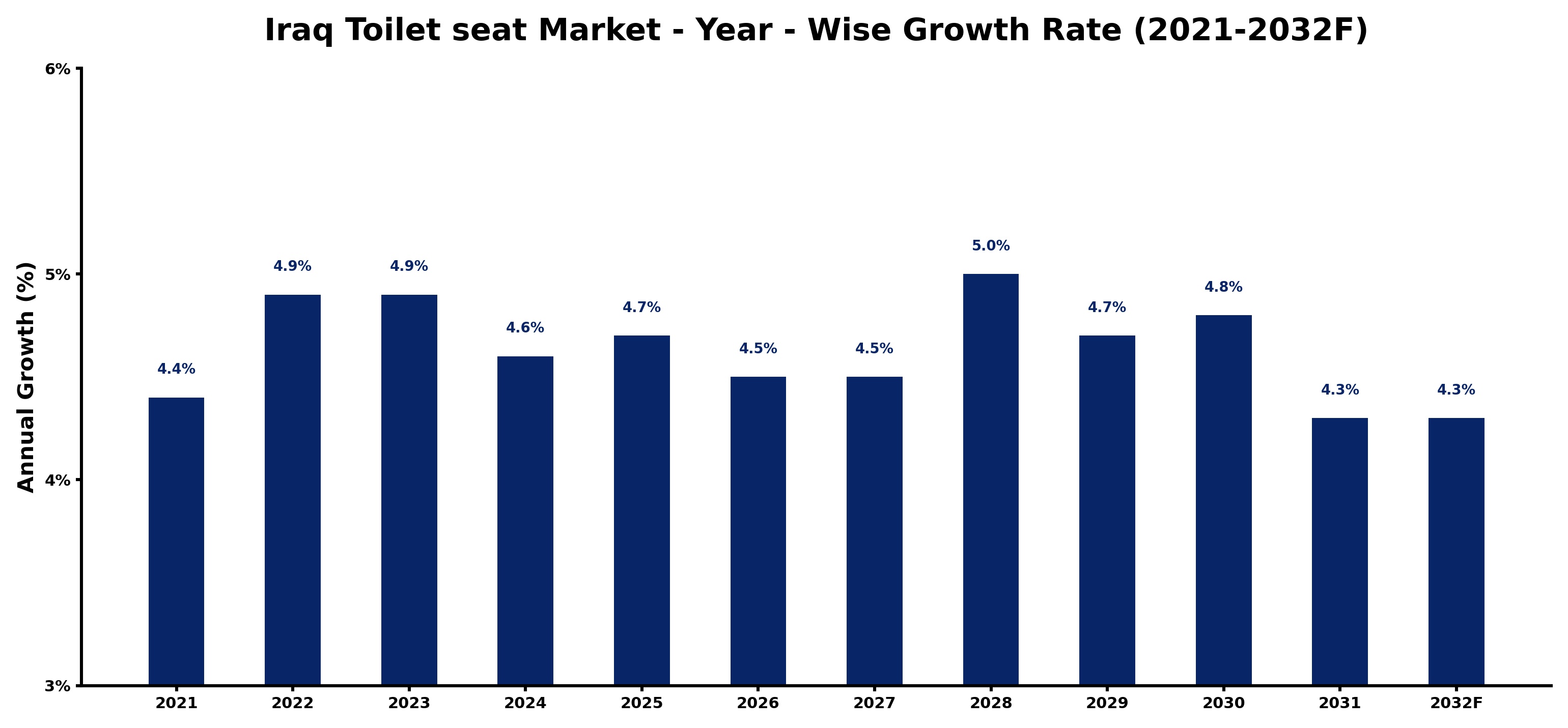
The table below presents the year‑wise growth rates along with the key drivers influencing the market
| Year | Growth Rate | Major Drivers |
| 2021 | 4.4% | Increasing industrial infrastructure investments |
| 2022 | 4.9% | Expansion of manufacturing activities |
| 2023 | 4.9% | Expansion of commercial construction activities |
| 2024 | 4.6% | Expansion of manufacturing activities |
| 2025 | 4.7% | Increasing smart city development projects |
| 2026 | 4.5% | Increasing adoption of advanced technologies |
| 2027 | 4.5% | Expansion of manufacturing activities |
| 2028 | 5.0% | Rising electricity demand across industries |
| 2029 | 4.7% | Growing urbanization and commercial development |
| 2030 | 4.8% | Expansion of commercial construction activities |
| 2031 | 4.3% | Expansion of manufacturing activities |
| 2032 | 4.3% | Growing renewable energy integration projects |
Note - Market size estimations and growth projections presented in this report are based on 6Wresearch’s advanced forecasting approach, validated with industry datasets as of June 2026.
Iraq Toilet seat Market Synopsis
Recent momentum in the Iraq toilet seat market has highlighted a transformation towards innovative and technologically advanced products. However, the market is poised to experience greater growth as consumer preferences shift increasingly towards modern fixtures that enhance hygiene and comfort.
As traditional sanitation methods give way to modern solutions, the market is witnessing an escalation in demand for advanced features such as bidet functionalities and heated seats. Looking ahead, the ongoing commitment to improving sanitation infrastructure will likely further propel market expansion.
Iraq Toilet seat Market Key Takeaways
- The market is experiencing a notable shift towards technologically advanced toilet seat products.
- Government policies are focused on improving sanitation infrastructure and regulating quality standards.
- Investment opportunities are ripe due to rising disposable incomes and urbanization trends.
- Eco-friendly and sustainable products are increasingly gaining consumer interest.
- Consumer education and market awareness remain critical for further adoption of modern toilet seats.
Evaluation of Restraints in Iraq Toilet seat Market
Despite promising growth, the Iraq toilet seat market faces several limitations. A predominant challenge is the prevailing preference for traditional squat toilets, which continues to impact the acceptance of Western-style toilet seats. Economic factors, including fluctuating exchange rates and inflation, further constrain consumer purchasing power, impeding the transition to more advanced products. Additionally, inconsistencies in sanitation infrastructure and access to clean water hinder market penetration, while counterfeit goods pose risks to quality and brand reputation.
Iraq Toilet seat Market Trends
Current trends indicate a clear consumer shift towards features that enhance hygiene and convenience, including touchless operation and self-cleaning functionalities. Alongside these technological advancements, there is an emerging interest in customized designs that improve the aesthetic appeal of bathrooms. Moreover, eco-conscious consumers are increasingly seeking products made from sustainable materials, aligning with global trends emphasizing environmental responsibility.
Iraq Toilet seat Market Opportunities
The Iraq toilet seat market holds significant investment opportunities, particularly in the residential and commercial sectors, as demands for modern sanitary fixtures grow. Companies that focus on introducing high-quality, durable, and innovative products tailored to local preferences stand to gain competitive advantages. Collaborations with local distributors and retailers will be essential in establishing effective distribution channels, further enhancing market reach and facilitating growth.
Government Initiatives in the Iraq Toilet seat Market
The Iraqi government is actively involved in enhancing the sanitation sector, implementing policies that ensure quality control and adherence to health and safety standards. Regulations are in place to monitor the import and export of toilet seats, aiming to maintain market integrity by restricting substandard products. These initiatives are designed to bolster consumer confidence while fostering a competitive and sustainable market environment.
Future Insights of the Iraq Toilet seat Market
The future outlook for the Iraq toilet seat market is optimistic, anticipated to thrive due to ongoing urbanization, enhanced living standards, and heightened awareness of hygiene practices. As consumers increasingly demand comfort and sustainability, manufacturers will need to innovate and diversify product offerings to meet evolving preferences. This strategic alignment will not only cater to current demands but also anticipate shifts towards more eco-friendly solutions, positioning the market for robust growth through 2032.
Iraq Toilet seat Market Latest Developments (May 2025 - June 2026)
In recent months, the Iraq toilet seat market has seen notable advancements in product offerings, with manufacturers emphasizing technological integrations such as smart toilets and eco-friendly materials. Additionally, there is a growing trend towards partnerships between local firms and international brands, aimed at enhancing distribution channels and product availability. These movements signify a robust evolution within the market, aligning with consumer demands for quality and innovation.
Iraq Toilet seat Market - Key Attractiveness of the Report
- 10 Years of Market Numbers
- Historical Data Starting from 2022 to 2025
- Base Year: 2025
- Forecast Data until 2032
- Key Performance Indicators Impacting the Market
- Major Upcoming Developments and Projects
Key Highlights of the Report:
- Iraq Toilet seat Market Outlook
- Market Size of Iraq Toilet seat Market, 2025
- Forecast of Iraq Toilet seat Market, 2032
- Historical Data and Forecast of Iraq Toilet seat Revenues & Volume for the Period 2022-2032F
- Iraq Toilet seat Market Trend Evolution
- Iraq Toilet seat Market Drivers and Challenges
- Iraq Toilet seat Price Trends
- Iraq Toilet seat Porter's Five Forces
- Iraq Toilet seat Industry Life Cycle
- Historical Data and Forecast of Iraq Toilet seat Market Revenues & Volume By Bowl Shape for the Period 2022-2032F
- Historical Data and Forecast of Iraq Toilet seat Market Revenues & Volume By Elongated for the Period 2022-2032F
- Historical Data and Forecast of Iraq Toilet seat Market Revenues & Volume By Round for the Period 2022-2032F
- Historical Data and Forecast of Iraq Toilet seat Market Revenues & Volume By Square for the Period 2022-2032F
- Historical Data and Forecast of Iraq Toilet seat Market Revenues & Volume By Raw Material for the Period 2022-2032F
- Historical Data and Forecast of Iraq Toilet seat Market Revenues & Volume By Plastic for the Period 2022-2032F
- Historical Data and Forecast of Iraq Toilet seat Market Revenues & Volume By Wood for the Period 2022-2032F
- Historical Data and Forecast of Iraq Toilet seat Market Revenues & Volume By Ceramic for the Period 2022-2032F
- Historical Data and Forecast of Iraq Toilet seat Market Revenues & Volume By Urea Molding Compound for the Period 2022-2032F
- Historical Data and Forecast of Iraq Toilet seat Market Revenues & Volume By Others for the Period 2022-2032F
- Historical Data and Forecast of Iraq Toilet seat Market Revenues & Volume By Category for the Period 2022-2032F
- Historical Data and Forecast of Iraq Toilet seat Market Revenues & Volume By Smart for the Period 2022-2032F
- Historical Data and Forecast of Iraq Toilet seat Market Revenues & Volume By Ordinary for the Period 2022-2032F
- Historical Data and Forecast of Iraq Toilet seat Market Revenues & Volume By Application for the Period 2022-2032F
- Historical Data and Forecast of Iraq Toilet seat Market Revenues & Volume By Residential for the Period 2022-2032F
- Historical Data and Forecast of Iraq Toilet seat Market Revenues & Volume By Commercial for the Period 2022-2032F
- Historical Data and Forecast of Iraq Toilet seat Market Revenues & Volume By Distribution Channel for the Period 2022-2032F
- Historical Data and Forecast of Iraq Toilet seat Market Revenues & Volume By Online for the Period 2022-2032F
- Historical Data and Forecast of Iraq Toilet seat Market Revenues & Volume By Offline for the Period 2022-2032F
- Iraq Toilet seat Import Export Trade Statistics
- Market Opportunity Assessment By Bowl Shape
- Market Opportunity Assessment By Raw Material
- Market Opportunity Assessment By Category
- Market Opportunity Assessment By Application
- Market Opportunity Assessment By Distribution Channel
- Iraq Toilet seat Top Companies Market Share
- Iraq Toilet seat Competitive Benchmarking By Technical and Operational Parameters
- Iraq Toilet seat Company Profiles
- Iraq Toilet seat Key Strategic Recommendations






































