Iraq Unified Threat Management Market Size & Growth Rate (2026-2032)
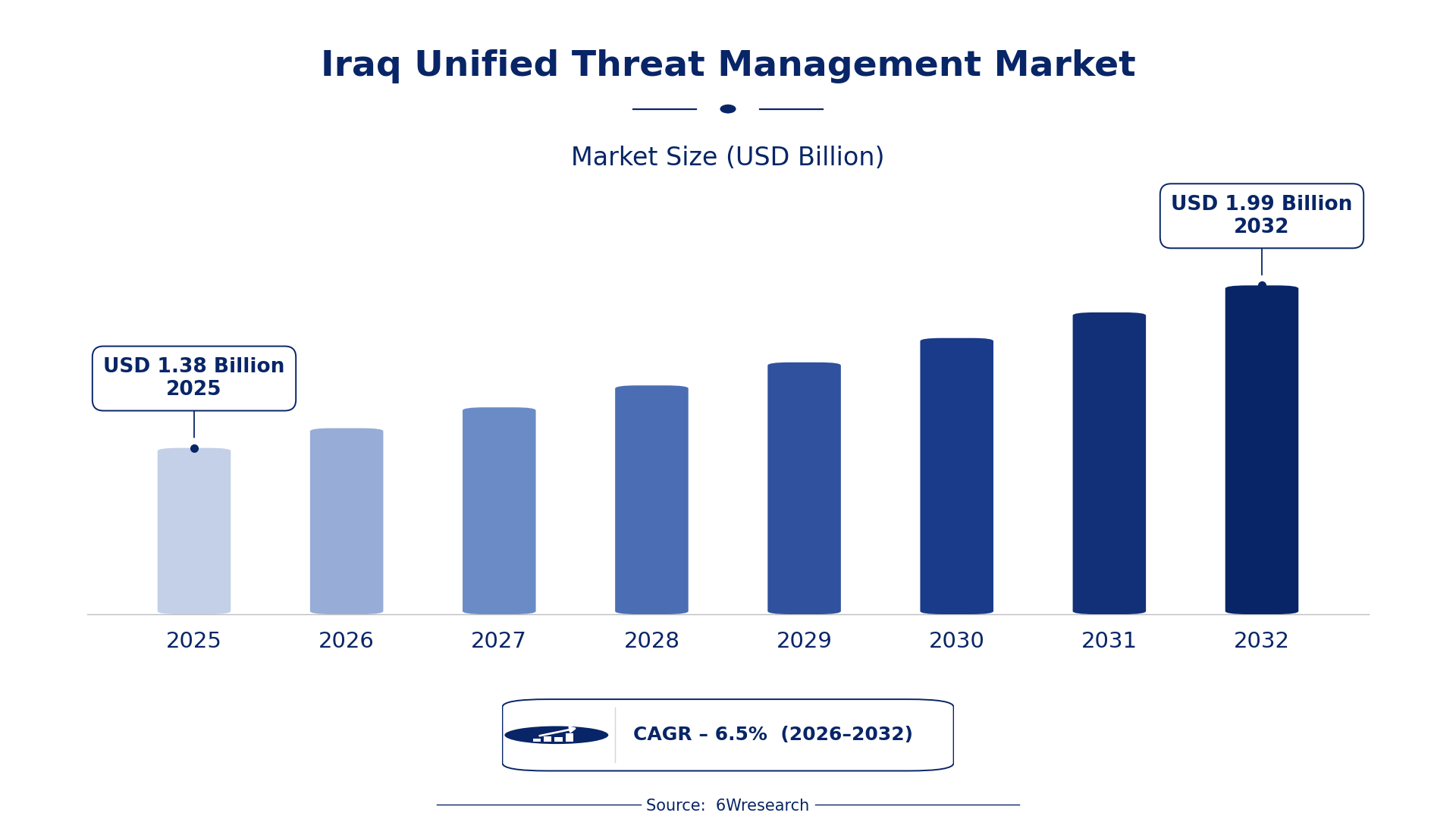
The Iraq Unified Threat Management Market was estimated at USD 1383 Million in 2025 and is projected to reach USD 1991 Million by 2032, growing at a CAGR of 6.5% from 2026 to 2032.
Iraq Unified Threat Management Market Synopsis
The demand for unified threat management solutions in Iraq is surging as businesses face an unprecedented increase in cyber threats. With the proliferation of digital operations, small and medium-sized enterprises are particularly in need of integrated security systems that provide comprehensive protection against a range of vulnerabilities.
As organizations seek to fortify their defenses, the market is responding with advanced solutions that combine traditional security measures with cutting-edge technologies. These offerings are increasingly appealing to both government agencies and service providers striving to ensure the security of sensitive data.
Iraq Unified Threat Management Market Year-wise Growth Rate and Key Drivers
This graph illustrates the annual growth rates of the Iraq Unified Threat Management Market from 2021 to 2032, highlighting a steady upward trajectory and projected expansion over the forecast period.
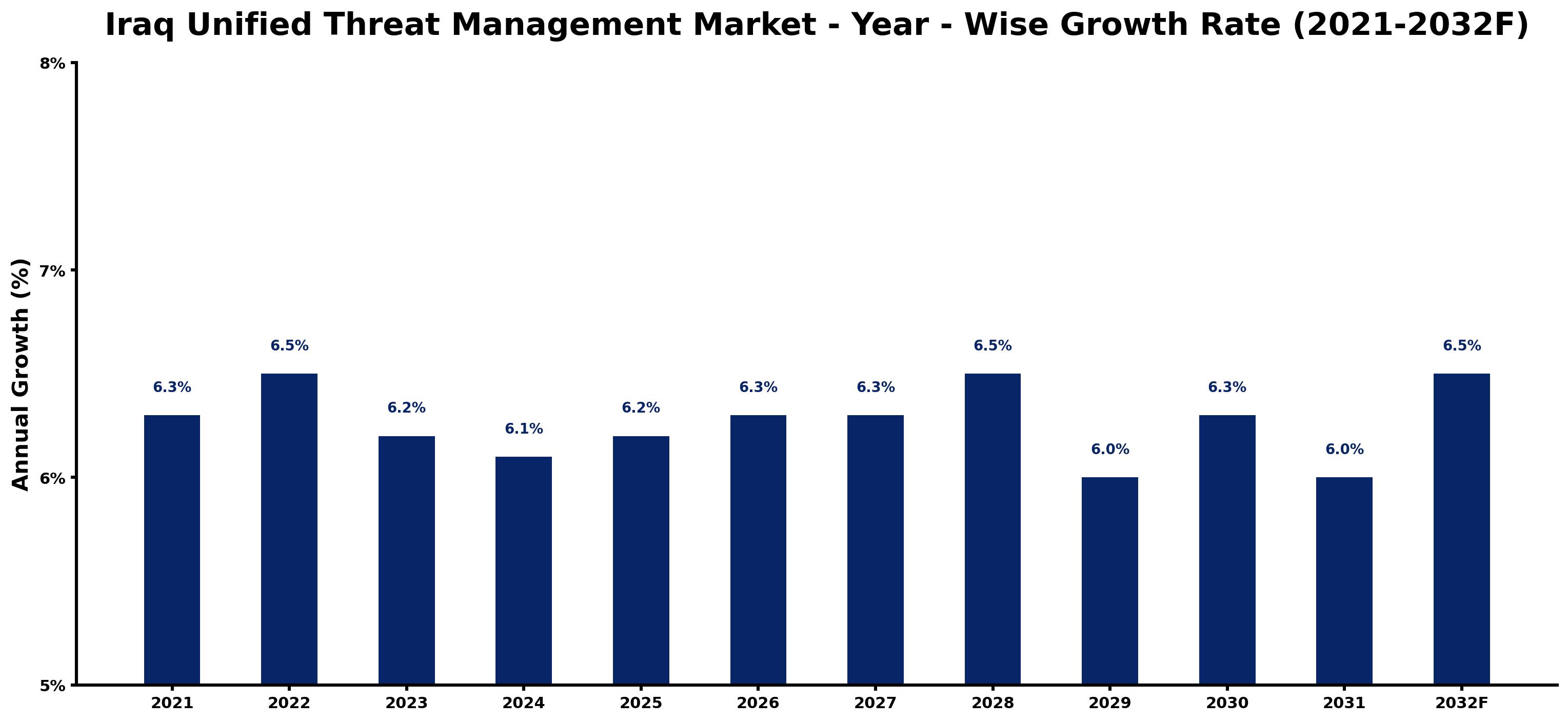
The table below presents the year‑wise growth rates along with the key drivers influencing the market
| Year | Growth Rate | Major Drivers |
| 2021 | 6.3% | Ministry of Communication's cybersecurity strategy implementation boosting demand. |
| 2022 | 6.5% | Rising adoption of biometric systems in government facilities. |
| 2023 | 6.2% | Growing awareness of cybersecurity among small businesses in Baghdad. |
| 2024 | 6.1% | New telecom regulations require stronger security for service providers. |
| 2025 | 6.2% | Partnerships with international firms enhance local cyber defenses. |
| 2026 | 6.3% | Increased investments by banks in data protection technologies. |
| 2027 | 6.3% | Local universities integrating cybersecurity in educational programs. |
| 2028 | 6.5% | Government campaigns promoting digital identity verification systems. |
| 2029 | 6.0% | Ongoing conflicts drive need for robust organizational security strategies. |
| 2030 | 6.3% | Emergence of local cybersecurity startups innovating threat management solutions. |
| 2031 | 6.0% | Governmental push for secure digital transactions encourages market growth. |
| 2032 | 6.5% | National ICT strategy emphasizes resilience against cyber threats. |
Note: Market size estimations and growth projections presented in this report are based on 6Wresearch's proprietary forecasting methodology, utilizing the latest available industry data, government publications, and primary research inputs.
Iraq Unified Threat Management Market Key Takeaways
Below are some of the specific key takeaways from the market, including:
- The market is witnessing substantial growth driven by escalating cyber threats and a push for integrated security solutions.
- Adoption of cloud-based UTM solutions is on the rise among enterprises, reflecting a shift in security strategy.
- Government policies aimed at improving cybersecurity frameworks are fostering a supportive environment for UTM deployment.
- Small and medium-sized businesses are becoming major consumers of UTM services, emphasizing the need for cost-effective security solutions.
- Technological advancements in threat detection and response capabilities are reshaping the UTM offerings available in the market.
Evaluation of Restraints in Iraq Unified Threat Management Market
Despite its growth potential, the Iraq Unified Threat Management Market grapples with challenges that hinder its progress. The rapid evolution of cyber threats outpaces the current capabilities of many UTM solutions, leaving gaps in protection. Limited access to advanced threat detection technologies compounds this issue, making it difficult for companies to respond effectively to attacks.
Budget constraints are another significant restraint; many organizations struggle to allocate sufficient funds for robust IT security investments. This lack of financial resources often results in inadequate cybersecurity measures, exposing businesses to increased risks of data breaches and system vulnerabilities.
Iraq Unified Threat Management Market Trends
There are notable trends emerging within the Iraq Unified Threat Management Market. A marked shift towards cloud-based UTM solutions reflects the changing landscape of IT infrastructure. Companies are increasingly recognizing the benefits of scalable and flexible security models that cloud platforms provide.
on top of that, the integration of artificial intelligence and machine learning technologies into UTM systems is gaining traction. These advancements enhance the ability to detect anomalies and respond to threats more swiftly, representing a critical evolution in threat management strategies.
Iraq Unified Threat Management Market Opportunities
The Iraq Unified Threat Management Market presents substantial growth opportunities for stakeholders. As more organizations recognize the necessity of effective cybersecurity measures, demand for UTM solutions will continue to escalate. Companies that can offer tailored solutions addressing specific industry needs will likely capture a significant market share.
Partnerships between technology vendors and local businesses could create innovative service models that enhance the delivery of UTM solutions. Additionally, increased government incentives for adopting cybersecurity measures will pave the way for investments and development of new security technologies.
Government Initiatives in the Iraq Unified Threat Management Market
Government action is playing an influential role in shaping the Iraq Unified Threat Management Market. As cyber threats continue to rise, policymakers are prioritizing the establishment of cybersecurity standards and frameworks aimed at enhancing national security. This focus not only drives market growth but also fosters collaboration between the public and private sectors.
- A national cybersecurity framework was introduced in 2023, setting baseline standards for all organizations to enhance their threat management capabilities.
- Currently, the government is rolling out initiatives to provide grants to small and medium-sized enterprises for implementing UTM solutions, aimed at promoting widespread cybersecurity adoption.
- A planned public-private partnership is underway, intended to boost the development of local cybersecurity talent by 2024.
- The introduction of regulations mandating the reporting of cybersecurity incidents by businesses is expected to take effect in late 2025.
- A recent initiative launched in 2023 aims to upgrade national cybersecurity infrastructure across key public sectors, including healthcare and finance.
Future Insights of the Iraq Unified Threat Management Market
Looking towards 2026-2032, the Iraq Unified Threat Management Market is positioned for notable growth. With cyber threats becoming increasingly sophisticated, the demand for advanced UTM solutions will heighten. Organizations will continue to seek integrated security systems that not only defend against a variety of attacks but also offer real-time threat intelligence.
As government regulations strengthen, businesses will be compelled to invest in more comprehensive security measures. This evolving environment presents opportunities for technology providers to innovate and diversify their offerings, ensuring they meet the dynamic needs of Iraq's market.
Iraq Unified Threat Management Market Latest Developments
The past 12-14 months have seen significant movement in the Iraq Unified Threat Management Market, as organizations look to enhance their cybersecurity postures. Increased investments in UTM solutions demonstrate a clear shift in focus from reactive to proactive security measures.
- A major technology vendor announced the launch of a new cloud-based UTM platform in early 2025, designed to meet the specific security needs of regional enterprises.
- A pilot program aimed at training cybersecurity professionals in local universities began in mid-2025 and remains ongoing.
- The rollout of a comprehensive cybersecurity awareness campaign targeting SMBs started in Q2 2025 and is gaining traction.
- Upcoming, a service expansion is planned for late 2025, with new regional offices dedicated to providing UTM services in underserved markets.
- A strategic partnership between local businesses and international cybersecurity firms was forged in early 2025, aimed at boosting local expertise in threat management.
Iraq Unified Threat Management Market - Key Attractiveness of the Report
- 10 Years of Market Numbers
- Historical Data Starting from 2022 to 2025
- Base Year: 2025
- Forecast Data until 2032
- Key Performance Indicators Impacting the Market
- Major Upcoming Developments and Projects
Key Highlights of the Report:
- Iraq Unified Threat Management Market Outlook
- Market Size of Iraq Unified Threat Management Market, 2025
- Forecast of Iraq Unified Threat Management Market, 2032
- Historical Data and Forecast of Iraq Unified Threat Management Revenues & Volume for the Period 2022-2032F
- Iraq Unified Threat Management Market Trend Evolution
- Iraq Unified Threat Management Market Drivers and Challenges
- Iraq Unified Threat Management Price Trends
- Iraq Unified Threat Management Porter's Five Forces
- Iraq Unified Threat Management Industry Life Cycle
- Historical Data and Forecast of Iraq Unified Threat Management Market Revenues & Volume By Appliance for the Period 2022-2032F
- Historical Data and Forecast of Iraq Unified Threat Management Market Revenues & Volume By Hardware for the Period 2022-2032F
- Historical Data and Forecast of Iraq Unified Threat Management Market Revenues & Volume By Software for the Period 2022-2032F
- Historical Data and Forecast of Iraq Unified Threat Management Market Revenues & Volume By Virtual for the Period 2022-2032F
- Historical Data and Forecast of Iraq Unified Threat Management Market Revenues & Volume By Distribution Channel for the Period 2022-2032F
- Historical Data and Forecast of Iraq Unified Threat Management Market Revenues & Volume By Direct for the Period 2022-2032F
- Historical Data and Forecast of Iraq Unified Threat Management Market Revenues & Volume By VAR??s for the Period 2022-2032F
- Historical Data and Forecast of Iraq Unified Threat Management Market Revenues & Volume By Distributors for the Period 2022-2032F
- Historical Data and Forecast of Iraq Unified Threat Management Market Revenues & Volume By Organization Size for the Period 2022-2032F
- Historical Data and Forecast of Iraq Unified Threat Management Market Revenues & Volume By SOHO for the Period 2022-2032F
- Historical Data and Forecast of Iraq Unified Threat Management Market Revenues & Volume By SMB for the Period 2022-2032F
- Historical Data and Forecast of Iraq Unified Threat Management Market Revenues & Volume By Enterprises for the Period 2022-2032F
- Historical Data and Forecast of Iraq Unified Threat Management Market Revenues & Volume By Services for the Period 2022-2032F
- Historical Data and Forecast of Iraq Unified Threat Management Market Revenues & Volume By Support and Maintenance for the Period 2022-2032F
- Historical Data and Forecast of Iraq Unified Threat Management Market Revenues & Volume By Managed UTM for the Period 2022-2032F
- Iraq Unified Threat Management Import Export Trade Statistics
- Market Opportunity Assessment By Appliance
- Market Opportunity Assessment By Distribution Channel
- Market Opportunity Assessment By Organization Size
- Market Opportunity Assessment By Services
- Iraq Unified Threat Management Top Companies Market Share
- Iraq Unified Threat Management Competitive Benchmarking By Technical and Operational Parameters
- Iraq Unified Threat Management Company Profiles
- Iraq Unified Threat Management Key Strategic Recommendations






































