Iraq Urea Market Size, Share & Growth Rate
The Iraq Urea Market was estimated at USD 333 Million in 2025 and is projected to reach USD 444 Million by 2032, growing at a CAGR of 4.2% from 2026 to 2032. This growth trajectory is underpinned by the increasing reliance on nitrogen-based fertilizers, particularly urea, which is crucial for enhancing agricultural productivity in Iraq. As the agricultural sector continues to expand, driven by both domestic demand and government support, urea's role as a primary nutrient source will further cement its significance in the market.
Iraq Urea Market Year-wise Growth Rate and Key Drivers
This graph highlights how the Iraq Urea Market has steadily grown over the years, supported by major growth factors.
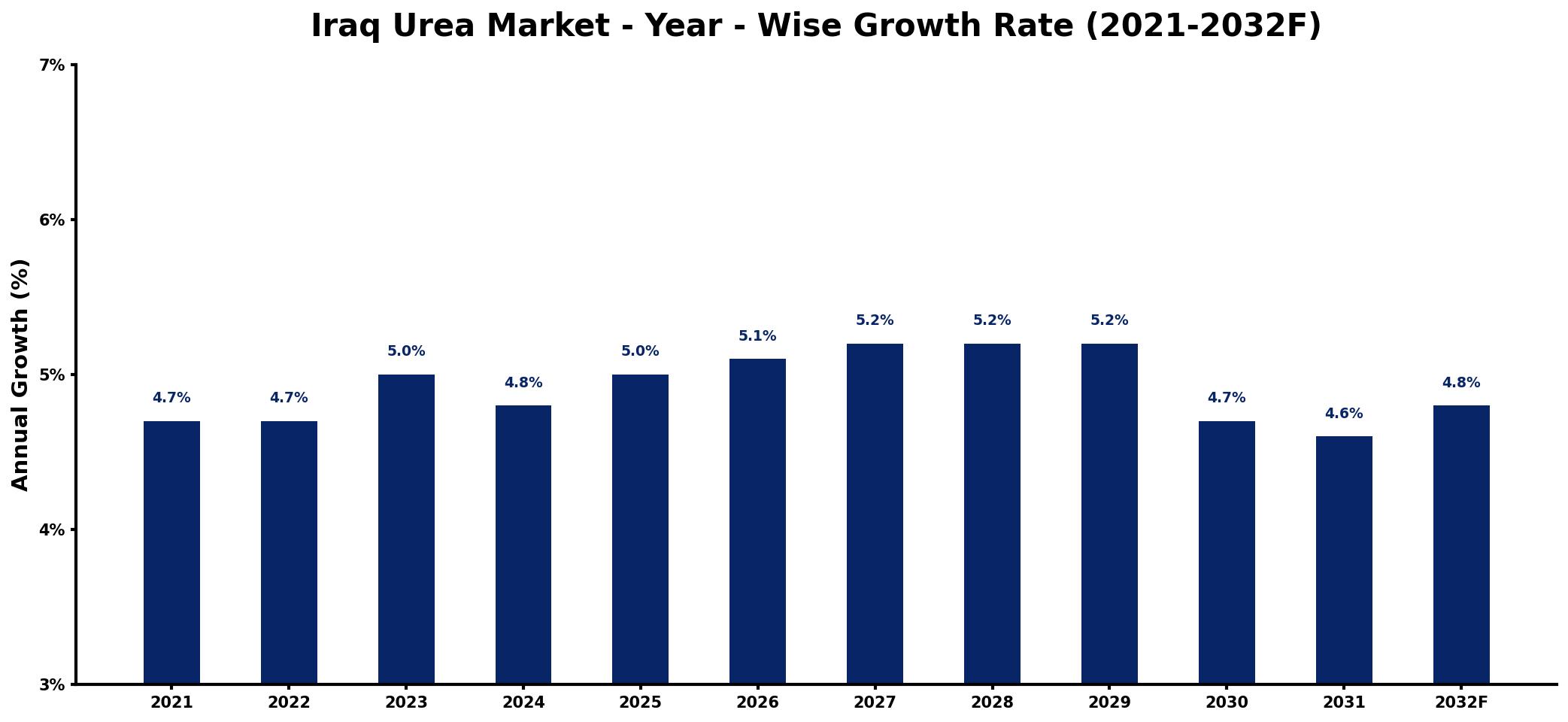
The table below presents the year‑wise growth rates along with the key drivers influencing the market
| Year | Growth Rate | Major Drivers |
| 2021 | 4.7% | Increased agricultural production investments |
| 2022 | 4.7% | Rising demand from fertilizer sector |
| 2023 | 5.0% | Expansion of irrigation projects |
| 2024 | 4.8% | Growing livestock industry requirements |
| 2025 | 5.0% | Higher crop yield expectations |
| 2026 | 5.1% | Enhanced distribution network efficiency |
| 2027 | 5.2% | Development of new farming technologies |
| 2028 | 5.2% | Increased government agricultural support |
| 2029 | 5.2% | Growing export opportunities for produce |
| 2030 | 4.7% | Strengthened agricultural research initiatives |
| 2031 | 4.6% | Rising awareness of soil health |
| 2032 | 4.8% | Improved farmer access to finance |
Note: Market size estimations and growth projections presented in this report are based on 6Wresearch's proprietary forecasting methodology, utilizing the latest available industry data, government publications, and primary research inputs.
Iraq Urea Market Synopsis
The strongest force currently shaping the Iraq Urea Market is the rapid growth in agricultural activities fueled by modern farming practices and a rising population. This surge in agricultural demand places increased pressure on farmers and agribusinesses to secure high-quality fertilizers, making urea a pivotal input for crop cultivation.
In addition to agricultural expansion, advancements in urea production technology are enhancing efficiency and reducing costs. Such technological innovations not only improve the quality of urea fertilizers but also boost production capacity, providing a competitive edge in meeting the local demand.
Iraq Urea Market Key Takeaways
- Urea remains a key input for improving soil fertility and crop yields in Iraq.
- The government supports the urea market through subsidies and quality regulations.
- Production technology advancements are driving efficiency and capacity in the market.
- Price volatility presents a challenge, impacting farmer access to urea fertilizers.
- Demand for nitrogen-rich fertilizers is expected to grow in line with agricultural expansion.
Evaluation of Restraints in Iraq Urea Market
Despite its growth potential, the Iraq Urea Market faces significant restraints that hinder its progress. Volatility in global fertilizer prices can create uncertainty for farmers and agribusinesses, potentially leading to reduced investment in urea fertilizers. Moreover, limited access to natural gas feedstock, which is essential for urea production, further complicates the supply chain. Additionally, the existing infrastructure for storage and distribution is often inadequate, which can affect the availability and affordability of urea, posing challenges for timely agricultural applications.
Iraq Urea Market Trends
Current trends in the Iraq Urea Market reflect an increasing adoption of precision agriculture techniques, which promote optimized fertilizer usage and enhance crop yield. Furthermore, there is a growing focus on sustainability, prompting interest in eco-friendly urea production processes. Emerging technologies, such as controlled-release fertilizers, are also gaining traction as they address concerns related to nutrient leaching and environmental impact, ensuring a more sustainable approach to fertilizer application.
Iraq Urea Market Opportunities
Genuine growth opportunities lie in the modernization of the agricultural sector, particularly through investment in urea production facilities that utilize the latest technology. Collaborations between the government and private sector players can further enhance production capabilities and ensure a steady supply of urea fertilizers to meet increasing agricultural demands. Additionally, the potential for exporting urea to neighboring regions represents an avenue for market expansion, leveraging Iraq's strategic geographic position.
Government Initiatives in the Iraq Urea Market
The Iraqi government has implemented several initiatives to bolster agricultural productivity and support the urea market. These include financial subsidies for fertilizer purchases, aimed at making essential inputs more accessible to farmers. Furthermore, regulations established to ensure fertilizer quality standards are crucial for maintaining market integrity and fostering consumer trust, thereby contributing to a more robust agricultural sector.
Future Insights of the Iraq Urea Market
Looking ahead to the period from 2026 to 2032, the Iraq Urea Market is anticipated to experience steady growth driven by the evolving agricultural landscape. The ongoing government support and commitment to enhancing the agricultural sector will likely foster a conducive environment for urea consumption. As advancements in technology continue to improve production efficiency and reduce costs, the market is positioned for a promising trajectory, meeting both local and regional fertilizer demands.
Iraq Urea Market Latest Developments (2025 - 2026)
Recent industry developments indicate a growing focus on enhancing production capabilities in the Iraq Urea Market. Efforts are being made to modernize existing facilities, with the integration of advanced technologies aimed at increasing efficiency and reducing environmental impact. Additionally, collaborations between government and private entities are emerging to enhance distribution networks, ensuring better access to urea fertilizers across various agricultural regions.
Iraq Urea Market - Key Attractiveness of the Report
- 10 Years of Market Numbers
- Historical Data Starting from 2022 to 2025
- Base Year: 2025
- Forecast Data until 2032
- Key Performance Indicators Impacting the Market
- Major Upcoming Developments and Projects
Key Highlights of the Report:
- Iraq Urea Market Outlook
- Market Size of Iraq Urea Market, 2025
- Forecast of Iraq Urea Market, 2032
- Historical Data and Forecast of Iraq Urea Revenues & Volume for the Period 2022-2032F
- Iraq Urea Market Trend Evolution
- Iraq Urea Market Drivers and Challenges
- Iraq Urea Price Trends
- Iraq Urea Porter's Five Forces
- Iraq Urea Industry Life Cycle
- Historical Data and Forecast of Iraq Urea Market Revenues & Volume By Grade for the Period 2022-2032F
- Historical Data and Forecast of Iraq Urea Market Revenues & Volume By Fertilizer for the Period 2022-2032F
- Historical Data and Forecast of Iraq Urea Market Revenues & Volume By Feed for the Period 2022-2032F
- Historical Data and Forecast of Iraq Urea Market Revenues & Volume By Technical for the Period 2022-2032F
- Historical Data and Forecast of Iraq Urea Market Revenues & Volume By End-user Industry for the Period 2022-2032F
- Historical Data and Forecast of Iraq Urea Market Revenues & Volume By Agriculture for the Period 2022-2032F
- Historical Data and Forecast of Iraq Urea Market Revenues & Volume By Chemical for the Period 2022-2032F
- Historical Data and Forecast of Iraq Urea Market Revenues & Volume By Automotive for the Period 2022-2032F
- Historical Data and Forecast of Iraq Urea Market Revenues & Volume By Medical for the Period 2022-2032F
- Historical Data and Forecast of Iraq Urea Market Revenues & Volume By Others for the Period 2022-2032F
- Iraq Urea Import Export Trade Statistics
- Market Opportunity Assessment By Grade
- Market Opportunity Assessment By End-user Industry
- Iraq Urea Top Companies Market Share
- Iraq Urea Competitive Benchmarking By Technical and Operational Parameters
- Iraq Urea Company Profiles
- Iraq Urea Key Strategic Recommendations






































