Iraq Vegetable oils Market Summary
The iraq vegetable oils market was estimated at USD 167 Million in 2025 and is projected to reach USD 224 Million by 2032, growing at a CAGR of 5.3% from 2026 to 2032.
Iraq Vegetable oils Market Year-wise Growth Rate and Key Drivers
This graph highlights how the Iraq Vegetable oils Market has steadily grown over the past five years, supported by major growth factors.
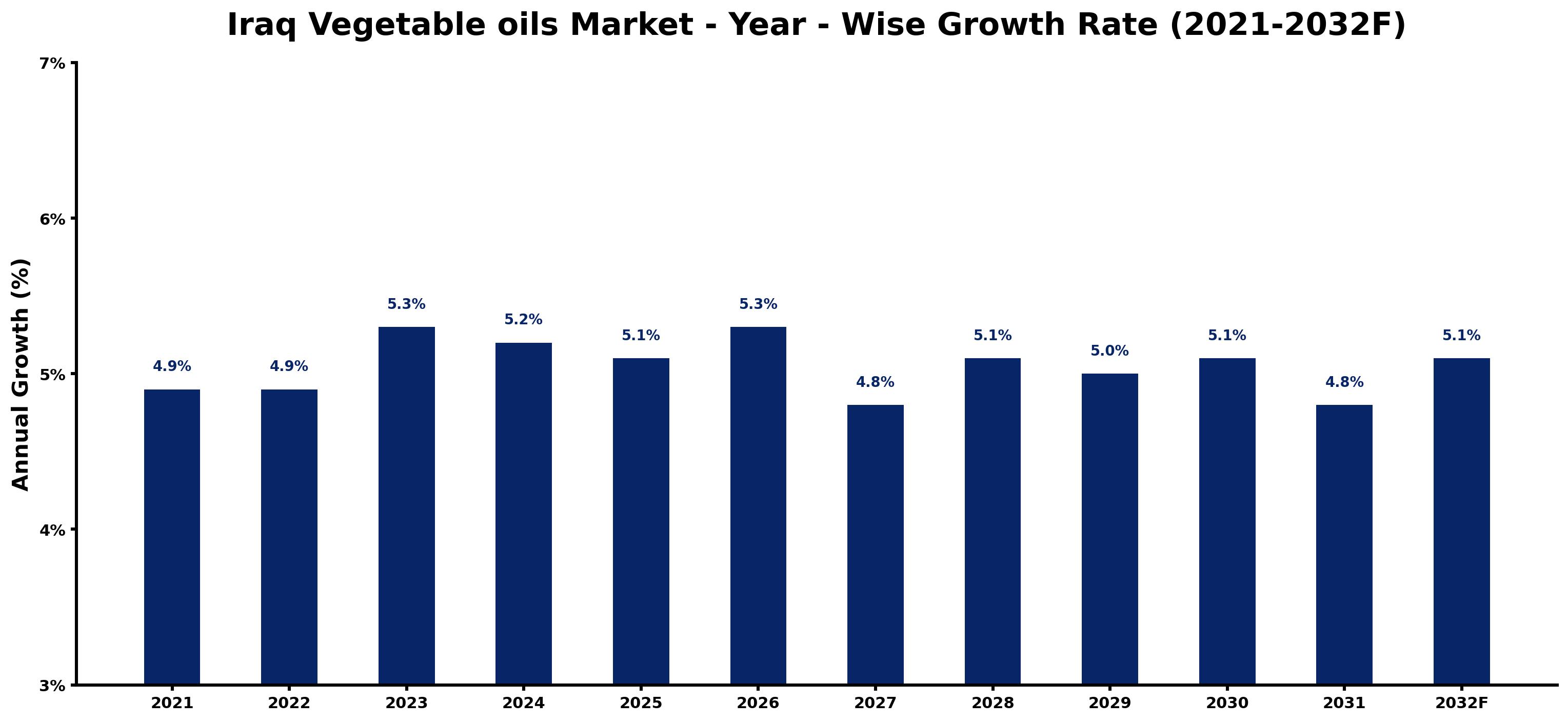
The table below presents the year wise growth rates along with the key drivers influencing the market
| Year | Growth Rate | Major Drivers |
| 2021 | 4.9% | Consumer preferences demonstrate a shift towards healthier cooking oils amid changing diets. |
| 2022 | 4.9% | Local agriculture initiatives gain traction, boosting domestic vegetable oil production capabilities. |
| 2023 | 5.3% | International partnerships facilitate the import of advanced refining technology and processes. |
| 2024 | 5.2% | Increased awareness of health benefits raises the profile of sunflower and olive oils. |
| 2025 | 5.1% | Significant urban population growth drives demand for convenient cooking solutions in households. |
| 2026 | 5.3% | Infrastructure investments enhance distribution networks, improving access to rural consumers. |
| 2027 | 4.8% | Expanding food service sector creates new channels for vegetable oil consumption increase. |
| 2028 | 5.1% | Innovations in sustainable packaging appeal to eco-conscious consumers within the market. |
| 2029 | 5.0% | Rising tourism boosts demand for local cuisine, elevating vegetable oil usage in restaurants. |
| 2030 | 5.1% | Market diversification introduces exotic oils, catering to evolving culinary preferences in Iraq. |
| 2031 | 4.8% | Increased disposable income allows consumers to afford premium vegetable oil brands. |
| 2032 | 5.1% | Health campaigns focus on diet improvement, further solidifying vegetable oils' market presence. |
Note - Market size estimations and growth projections presented in this report are based on 6Wresearch's advanced forecasting approach, validated with industry datasets as of June 2026.
Iraq Vegetable oils Market Synopsis
The Iraq Vegetable oils Market is projected to reach 5.3% and witness significant growth during the forecast period (2026-2032). This market encompasses a variety of edible oils derived from plant seeds, fruits, and nuts, which are extensively used in cooking, frying, and food preparation throughout the country. The demand for vegetable oils such as olive oil, sunflower oil, and canola oil has been fueled by their versatility and distinct nutritional properties, making them key components in both domestic kitchens and the food service industry.
Iraq Vegetable oils Market Growth Drivers
Several factors are propelling the growth of the Iraq Vegetable oils Market. A notable driver includes the increasing food consumption rates, which are rising in tandem with the urbanization and growing population. As consumers become more health-conscious, there is a parallel rise in the demand for cooking oils that are perceived as healthier alternatives, such as olive and canola oil. Additionally, advancements in oilseed cultivation practices and processing techniques have improved the efficiency and yield of vegetable oil production.
- The expanding food service sector, including restaurants and catering services, has amplified the demand for various vegetable oils as essential cooking ingredients.
- Growing awareness regarding the nutritional benefits of different oils has influenced consumer choices, thereby boosting demand for high-quality vegetable oils.
- Innovations in packaging and distribution have enhanced the accessibility of vegetable oils, making them more available to consumers across various regions of Iraq.
- Increased export opportunities for Iraqi vegetable oils are emerging, driven by regional demand for quality cooking oils.
- The rise in bakery and confectionery industries, which utilize vegetable oils in their products, further supports market expansion.
Iraq Vegetable oils Market Challenges and Restraints
Despite the positive outlook, the Iraq Vegetable oils Market faces several challenges that could impede its growth. Among these, fluctuating global commodity prices significantly impact local costs, creating price volatility in the market. Limited domestic production capacity for certain oilseeds constrains the local supply, making Iraq dependent on imports to meet its consumption needs. Furthermore, inadequate agricultural infrastructure poses hurdles for oilseed cultivation and processing, which can lead to discrepancies in quality and availability.
- The lack of modern farming technology and knowledge among producers can lead to suboptimal yields and inefficient processing methods.
- Market participants may face increasing competition from imported oils, which can be available at lower prices, thus affecting local producers.
- Inconsistent government policies can create uncertainty in investment and production strategies for stakeholders in the market.
- Environmental challenges, including climate change, can adversely affect crop yields essential for vegetable oil production.
- Logistical issues related to transportation and distribution can hinder the timely availability of vegetable oils in various markets.
Iraq Vegetable oils Market Government Investment and Initiatives
The Iraqi government is actively investing in initiatives aimed at bolstering the vegetable oils market, reflecting a commitment to enhancing food security and supporting agricultural growth. Key policies have been introduced to provide subsidies to oilseed farmers, facilitating access to essential resources for oil production. Investments in oil processing infrastructure are also being prioritized to improve efficiency and output quality in the market. Regulations have been established to ensure quality standards in edible oils, further promoting consumer safety and confidence.
- Subsidy programs for farmers will mitigate operational costs, encouraging more local production of oilseeds.
- Government-backed initiatives to modernize farming practices will help increase oil yield and reduce dependency on imports.
- Investment in transportation infrastructure aims to enhance the distribution of vegetable oils, ensuring wider market access.
- Training programs for local producers on best practices and sustainable farming techniques are being implemented.
- Collaboration with international agencies may facilitate technology transfer in oilseed processing and production.
Iraq Vegetable oils Market Latest Developments (May 2025 - June 2026)
Recent developments in the Iraq Vegetable oils Market have been characterized by increased focus on local production capabilities and quality enhancement. Initiatives to promote domestic oilseed cultivation are likely to gain traction as government support intensifies. Innovations in processing technologies that improve oil extraction efficiency are also on the rise, reflecting a commitment to boosting market competitiveness. Furthermore, emerging trends in consumer preferences are reshaping the market landscape, with a noticeable inclination towards organic and health-oriented oils.
- Collaboration between agricultural cooperatives and government agencies has led to improved seed quality and farming techniques.
- New processing plants are being established, increasing the local capacity to produce various vegetable oils.
- Consumer education campaigns emphasizing the health benefits of vegetable oils are influencing purchasing decisions across demographics.
- Efforts to standardize quality assurance protocols are underway, aiming to enhance consumer confidence in locally produced oils.
- Partnerships with international organizations are likely to provide insights into sustainable practices and market expansion strategies.
Iraq Vegetable oils Market - Key Attractiveness of the Report
- 10 Years of Market Numbers
- Historical Data Starting from 2022 to 2025
- Base Year: 2025
- Forecast Data until 2032
- Key Performance Indicators Impacting the Market
- Major Upcoming Developments and Projects
Key Highlights of the Report:
- Iraq Vegetable oils Market Outlook
- Market Size of Iraq Vegetable oils Market, 2025
- Forecast of Iraq Vegetable oils Market, 2032
- Historical Data and Forecast of Iraq Vegetable oils Revenues & Volume for the Period 2022-2032F
- Iraq Vegetable oils Market Trend Evolution
- Iraq Vegetable oils Market Drivers and Challenges
- Iraq Vegetable oils Price Trends
- Iraq Vegetable oils Porter's Five Forces
- Iraq Vegetable oils Industry Life Cycle
- Historical Data and Forecast of Iraq Vegetable oils Market Revenues & Volume By Types for the Period 2022-2032F
- Historical Data and Forecast of Iraq Vegetable oils Market Revenues & Volume By Palm Oil for the Period 2022-2032F
- Historical Data and Forecast of Iraq Vegetable oils Market Revenues & Volume By Soybean Oil for the Period 2022-2032F
- Historical Data and Forecast of Iraq Vegetable oils Market Revenues & Volume By Rapeseed Oil for the Period 2022-2032F
- Historical Data and Forecast of Iraq Vegetable oils Market Revenues & Volume By Sunflower Oil for the Period 2022-2032F
- Historical Data and Forecast of Iraq Vegetable oils Market Revenues & Volume By Olive Oil for the Period 2022-2032F
- Historical Data and Forecast of Iraq Vegetable oils Market Revenues & Volume By Others for the Period 2022-2032F
- Historical Data and Forecast of Iraq Vegetable oils Market Revenues & Volume By Applications for the Period 2022-2032F
- Historical Data and Forecast of Iraq Vegetable oils Market Revenues & Volume By Food for the Period 2022-2032F
- Historical Data and Forecast of Iraq Vegetable oils Market Revenues & Volume By Feed for the Period 2022-2032F
- Historical Data and Forecast of Iraq Vegetable oils Market Revenues & Volume By Industrial for the Period 2022-2032F
- Iraq Vegetable oils Import Export Trade Statistics
- Market Opportunity Assessment By Types
- Market Opportunity Assessment By Applications
- Iraq Vegetable oils Top Companies Market Share
- Iraq Vegetable oils Competitive Benchmarking By Technical and Operational Parameters
- Iraq Vegetable oils Company Profiles
- Iraq Vegetable oils Key Strategic Recommendations






































