Iraq Vehicles for disabled Market Size, Share & Growth Rate
The Iraq Vehicles for disabled Market was estimated at USD 491 Million in 2025 and is projected to reach USD 674 Million by 2032, growing at a CAGR of 4.6% from 2026 to 2032. This anticipated growth reflects a significant shift toward enhanced mobility solutions for individuals with physical disabilities in Iraq. The growing awareness of accessibility and inclusivity, coupled with advancements in vehicle modification technologies, is acting as a catalyst for this market's expansion.
Iraq Vehicles for disabled Market Year-wise Growth Rate and Key Drivers
This graph highlights how the Iraq Vehicles for disabled Market has steadily grown over the years, supported by major growth factors.
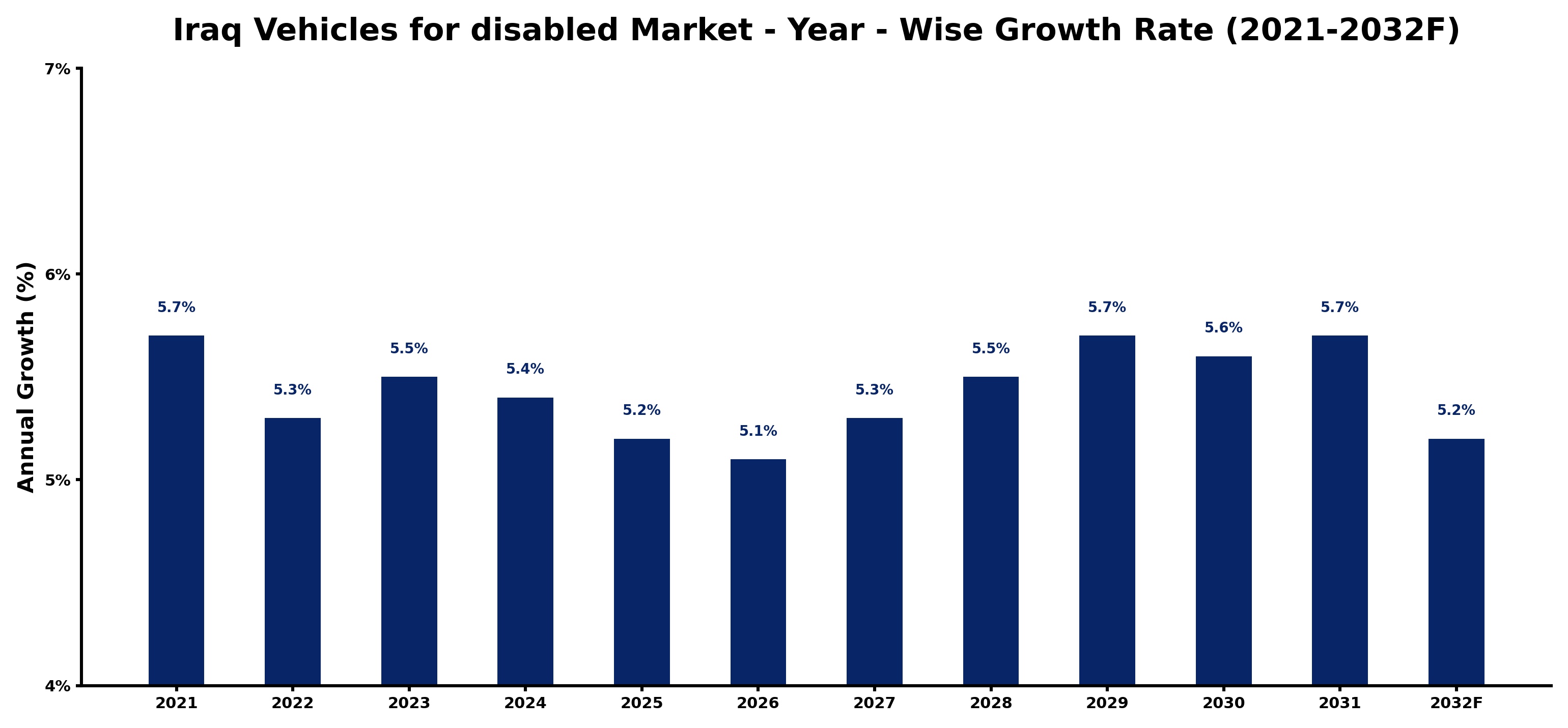
The table below presents the year‑wise growth rates along with the key drivers influencing the market
| Year | Growth Rate | Major Drivers |
| 2021 | 5.7% | Increased government support initiatives |
| 2022 | 5.3% | Rising awareness of accessibility needs |
| 2023 | 5.5% | Technological advancements enhanced mobility |
| 2024 | 5.4% | Growing demand for adaptive vehicles |
| 2025 | 5.2% | Expansion of rehabilitation services market |
| 2026 | 5.1% | Improved public transportation accessibility |
| 2027 | 5.3% | Increased funding for disability programs |
| 2028 | 5.5% | Partnerships with NGOs expanded outreach |
| 2029 | 5.7% | Enhanced insurance coverage for vehicles |
| 2030 | 5.6% | Rising consumer preference for inclusivity |
| 2031 | 5.7% | Development of customized vehicle options |
| 2032 | 5.2% | Growing community support for initiatives |
Note - Market size estimations and growth projections presented in this report are based on 6Wresearch’s advanced forecasting approach, validated with industry datasets as of June 2026.
Iraq Vehicles for disabled Market Synopsis
The most powerful force currently shaping the Iraq Vehicles for disabled Market is the increasing demand for mobility solutions tailored to the needs of individuals with disabilities. This growing recognition has prompted families, caregivers, and disability service organizations to seek accessible vehicles, leading to a notable uptick in market adoption.
Moreover, the local government's efforts to improve safety and accessibility standards for vehicles designed for disabled individuals further drive market dynamics. These regulations, which mandate the inclusion of essential features such as wheelchair ramps and adapted driving controls, are crucial in ensuring that vehicles meet the needs of their users effectively.
Iraq Vehicles for disabled Market Key Takeaways
- The Iraq Vehicles for disabled Market is driven by rising awareness of disability inclusivity.
- Technological advancements in vehicle modifications are enhancing mobility solutions.
- Government regulations are vital for ensuring accessibility and safety in vehicles.
- Affordability remains a significant barrier for many potential users in the market.
- Public transportation systems often lack sufficient accessibility features, impacting mobility options.
Evaluation of Restraints in Iraq Vehicles for disabled Market
Despite the positive growth trajectory, the Iraq Vehicles for disabled Market faces considerable challenges. One of the primary restraints is the limited accessibility features in public transportation, which hampers overall mobility for individuals with disabilities. Additionally, affordability issues related to specialized mobility vehicles can restrict access for many families and individuals, deterring wider market adoption. Furthermore, the lack of adequate infrastructure to support wheelchair access in urban areas poses significant limitations, reducing the overall effectiveness of the available mobility solutions.
Iraq Vehicles for disabled Market Trends
The market is currently witnessing several transformative trends. Innovations in adaptive technologies, such as advanced vehicle modifications for improved accessibility, are becoming more common. Additionally, there is an increasing focus on electric mobility solutions, which align with global sustainability goals while offering greater independence for disabled users. The rise in partnerships between disability service organizations and vehicle manufacturers is another notable trend, facilitating the development of customized solutions that cater to the unique needs of individuals with disabilities.
Iraq Vehicles for disabled Market Opportunities
Opportunities for growth within the Iraq Vehicles for disabled Market are plentiful. There is a significant need for increased investment in public transportation infrastructure to enhance accessibility features. Additionally, manufacturers can capitalize on the demand for affordable, high-quality mobility solutions tailored to the local market. Expanding service networks to include maintenance and customization services will also provide substantial growth avenues. Investing in educational initiatives that raise awareness about available mobility solutions can further drive demand and enhance market potential.
Government Initiatives in the Iraq Vehicles for disabled Market
The Iraqi government has taken various initiatives aimed at improving accessibility for individuals with disabilities. Regulations have been established to ensure that vehicles designed for disabled persons meet safety and accessibility standards. Public spending on accessibility projects has also seen a positive shift, reflecting the government's commitment to fostering an inclusive environment. Furthermore, programs promoting awareness and education about disability rights and mobility options are in place, encouraging a cultural change towards inclusivity.
Future Insights of the Iraq Vehicles for disabled Market
Looking ahead, the Iraq Vehicles for disabled Market is poised for continued growth between 2026 and 2032. As the government increasingly prioritizes accessibility and inclusivity in its policies, the demand for adapted vehicles is likely to rise. The introduction of new technologies and the expansion of specialized service networks will further bolster market dynamics. Additionally, a growing societal emphasis on disability rights and independence is expected to contribute significantly to the market's evolution, offering a more favorable environment for investment and innovation.
Iraq Vehicles for disabled Market Latest Developments (May 2025 - June 2026)
Recent developments in the Iraq Vehicles for disabled Market indicate a progressive shift towards enhancing mobility solutions. Key initiatives are being launched to improve the infrastructure for accessibility, while advancements in vehicle technology are increasingly being adopted. There have also been growing collaborations between NGOs and the private sector to develop more cost-effective mobility solutions tailored specifically for the local population. These efforts signal a promising direction for the market, aiming to meet the diverse needs of individuals with disabilities in Iraq.
Iraq Vehicles for disabled Market - Key Attractiveness of the Report
- 10 Years of Market Numbers
- Historical Data Starting from 2022 to 2025
- Base Year: 2025
- Forecast Data until 2032
- Key Performance Indicators Impacting the Market
- Major Upcoming Developments and Projects
Key Highlights of the Report:
- Iraq Vehicles for disabled Market Outlook
- Market Size of Iraq Vehicles for disabled Market, 2025
- Forecast of Iraq Vehicles for disabled Market, 2032
- Historical Data and Forecast of Iraq Vehicles for disabled Revenues & Volume for the Period 2022-2032F
- Iraq Vehicles for disabled Market Trend Evolution
- Iraq Vehicles for disabled Market Drivers and Challenges
- Iraq Vehicles for disabled Price Trends
- Iraq Vehicles for disabled Porter's Five Forces
- Iraq Vehicles for disabled Industry Life Cycle
- Historical Data and Forecast of Iraq Vehicles for disabled Market Revenues & Volume By Vehicle Type for the Period 2022-2032F
- Historical Data and Forecast of Iraq Vehicles for disabled Market Revenues & Volume By Passenger Car for the Period 2022-2032F
- Historical Data and Forecast of Iraq Vehicles for disabled Market Revenues & Volume By SUV/MPV for the Period 2022-2032F
- Historical Data and Forecast of Iraq Vehicles for disabled Market Revenues & Volume By Pick-up Truck for the Period 2022-2032F
- Historical Data and Forecast of Iraq Vehicles for disabled Market Revenues & Volume By Mobility Scooter for the Period 2022-2032F
- Historical Data and Forecast of Iraq Vehicles for disabled Market Revenues & Volume By Manufacturer Type for the Period 2022-2032F
- Historical Data and Forecast of Iraq Vehicles for disabled Market Revenues & Volume By OEM for the Period 2022-2032F
- Historical Data and Forecast of Iraq Vehicles for disabled Market Revenues & Volume By Third-Party Customization for the Period 2022-2032F
- Historical Data and Forecast of Iraq Vehicles for disabled Market Revenues & Volume By Entry Configuration for the Period 2022-2032F
- Historical Data and Forecast of Iraq Vehicles for disabled Market Revenues & Volume By Side Entry for the Period 2022-2032F
- Historical Data and Forecast of Iraq Vehicles for disabled Market Revenues & Volume By Rear Entry for the Period 2022-2032F
- Historical Data and Forecast of Iraq Vehicles for disabled Market Revenues & Volume By Entry Mechanism for the Period 2022-2032F
- Historical Data and Forecast of Iraq Vehicles for disabled Market Revenues & Volume By Ramp for the Period 2022-2032F
- Historical Data and Forecast of Iraq Vehicles for disabled Market Revenues & Volume By Lifting Equipment for the Period 2022-2032F
- Historical Data and Forecast of Iraq Vehicles for disabled Market Revenues & Volume By Driving Option for the Period 2022-2032F
- Historical Data and Forecast of Iraq Vehicles for disabled Market Revenues & Volume By Driving on Swivel Seat for the Period 2022-2032F
- Historical Data and Forecast of Iraq Vehicles for disabled Market Revenues & Volume By Driving through Wheelchair for the Period 2022-2032F
- Historical Data and Forecast of Iraq Vehicles for disabled Market Revenues & Volume By Driving on Normal Seat for the Period 2022-2032F
- Iraq Vehicles for disabled Import Export Trade Statistics
- Market Opportunity Assessment By Vehicle Type
- Market Opportunity Assessment By Manufacturer Type
- Market Opportunity Assessment By Entry Configuration
- Market Opportunity Assessment By Entry Mechanism
- Market Opportunity Assessment By Driving Option
- Iraq Vehicles for disabled Top Companies Market Share
- Iraq Vehicles for disabled Competitive Benchmarking By Technical and Operational Parameters
- Iraq Vehicles for disabled Company Profiles
- Iraq Vehicles for disabled Key Strategic Recommendations






































