Iraq Video Conferencing Market Size & Growth Rate (2026-2032)
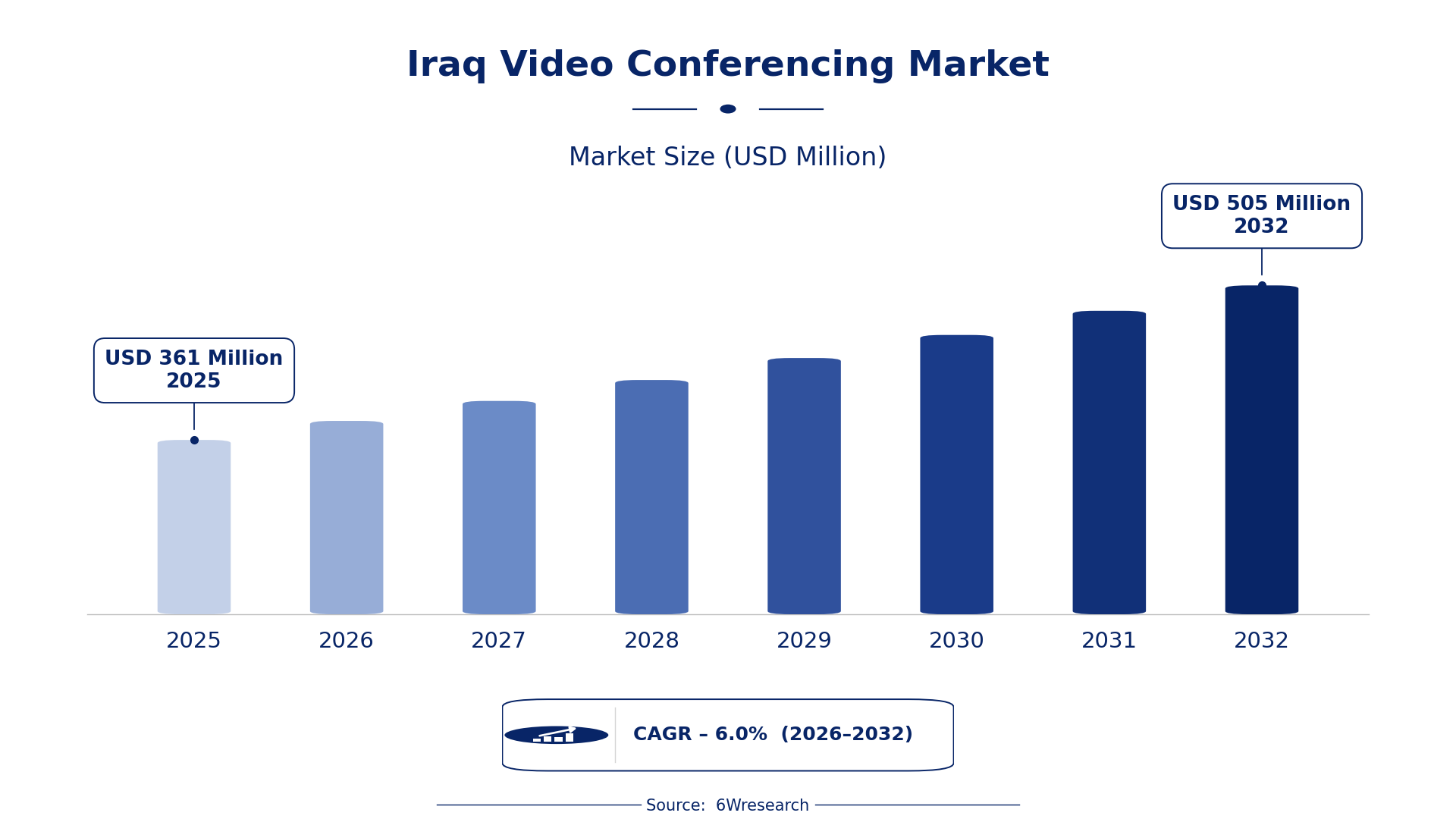
The Iraq Video Conferencing Market was estimated at USD 361 Million in 2025 and is projected to reach USD 505 Million by 2032, growing at a CAGR of 6.0% from 2026 to 2032.
Iraq Video Conferencing Market Synopsis
The primary force propelling the Iraq Video Conferencing Market is the rising demand for remote collaboration tools. The surge in remote work, accelerated by global events, has necessitated efficient communication solutions across various sectors, including business, education, and healthcare.
As organizations increasingly embrace hybrid work models, the shift towards digital communication platforms becomes imperative. The integration of advanced video conferencing technologies is enhancing user experiences, enabling seamless interactions and greater productivity among teams operating from disparate locations.
Iraq Video Conferencing Market Year-wise Growth Rate and Key Drivers
This graph illustrates the annual growth rates of the Iraq Video Conferencing Market from 2021 to 2032, highlighting a steady upward trajectory and projected expansion over the forecast period.
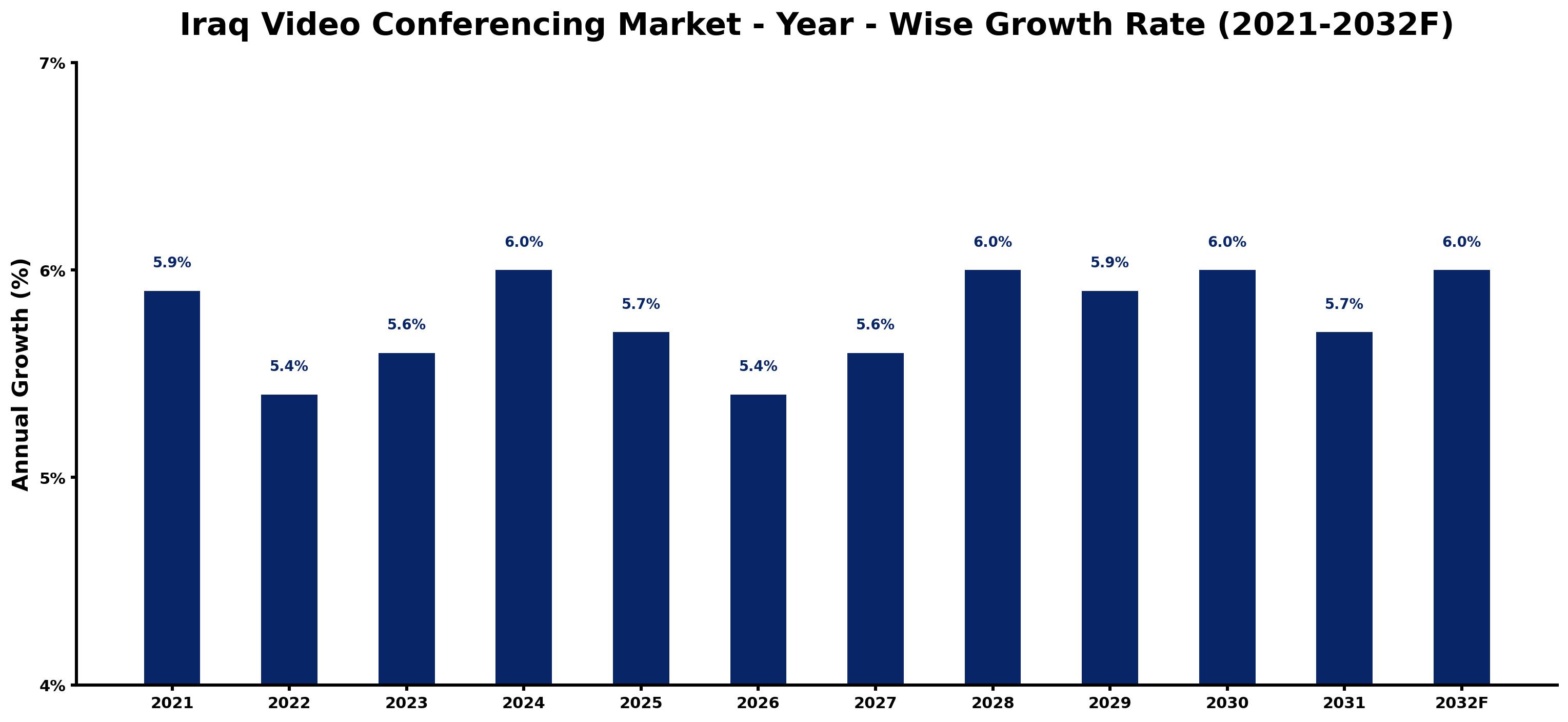
The table below presents the year‑wise growth rates along with the key drivers influencing the market
| Year | Growth Rate | Major Drivers |
| 2021 | 5.9% | Increased remote work adoption due to COVID-19 pandemic. |
| 2022 | 5.4% | Government initiatives promoting digital education and online learning. |
| 2023 | 5.6% | Growing interest in virtual business meetings among enterprises. |
| 2024 | 6.0% | Investment in secure government communication technology upgrades. |
| 2025 | 5.7% | Local startups innovating in video collaboration tools. |
| 2026 | 5.4% | Increased smartphone penetration facilitating video conferencing use. |
| 2027 | 5.6% | Rising youth population embracing digital communication platforms. |
| 2028 | 6.0% | Strengthening of ICT workforce through vocational training programs. |
| 2029 | 5.9% | Surge in cross-border partnerships enhancing video conferencing needs. |
| 2030 | 6.0% | Regulatory encouragement for remote public services implementation. |
| 2031 | 5.7% | Demand for enhanced cybersecurity in governmental online meetings. |
| 2032 | 6.0% | Adoption of video conferencing by non-profits for outreach. |
Note: Market size estimations and growth projections presented in this report are based on 6Wresearch's proprietary forecasting methodology, utilizing the latest available industry data, government publications, and primary research inputs.
Iraq Video Conferencing Market Key Takeaways
Below are some of the specific key takeaways from the market, including:
- The market is experiencing steady growth due to the increasing adoption of remote work and digital collaboration tools.
- Video conferencing solutions are essential for sectors such as education and government, driving significant demand.
- Infrastructure challenges, particularly in internet connectivity, remain a barrier to broader adoption.
- Government initiatives are focused on enhancing communication infrastructure, reflecting a supportive regulatory environment.
- Technological advancements are continually improving the user experience in video conferencing applications.
Evaluation of Restraints in Iraq Video Conferencing Market
Despite the promising outlook, the Iraq Video Conferencing Market faces significant challenges. Limited internet connectivity hampers effective usage, particularly in rural areas where infrastructure remains underdeveloped. This issue is exacerbated by inadequate technical support and training, making it difficult for users to fully leverage video conferencing capabilities. The overall effectiveness of these solutions is, therefore, influenced by these persistent infrastructural constraints, which need addressing for the market to reach its full potential.
Iraq Video Conferencing Market Trends
Several trends are shaping the Iraq Video Conferencing Market. The rise of hybrid work models has led to an increased focus on flexible communication solutions that cater to both in-office and remote employees. on top of that, there is a notable shift towards integrated platforms that combine video conferencing with project management and collaborative tools, enhancing overall productivity. The education sector is also embracing these technologies, with educational institutions increasingly adopting video conferencing for remote learning initiatives.
Iraq Video Conferencing Market Opportunities
The landscape presents several promising growth opportunities. Investment in digital infrastructure is a key area where stakeholders can engage, particularly as the government emphasizes enhancing connectivity. Additionally, the ongoing demand for training programs focused on user education in video conferencing technologies offers a viable avenue for market players. Expanding into underserved regions and tailoring solutions for specific industries can also unlock new revenue streams.
Government Initiatives in the Iraq Video Conferencing Market
Government policies are critical to the progression of the Iraq Video Conferencing Market. The focus is on improving communication infrastructure and fostering an environment conducive to remote collaboration. By investing in relevant technologies and regulations, the government aims to bolster various sectors reliant on effective communication tools.
- A recent initiative focused on upgrading national digital infrastructure to enhance internet connectivity, launched in early 2025.
- Currently ongoing is a regulatory framework that mandates data privacy protections for video conferencing tools, ensuring user trust.
- A planned public-private partnership is expected to facilitate the rollout of advanced communication technologies by 2027.
- The government has introduced funding programs aimed at supporting educational institutions in adopting video conferencing technologies.
- Upcoming initiatives are set to focus on enhancing technical training for users, which is crucial for maximizing the effectiveness of video conferencing solutions.
Future Insights of the Iraq Video Conferencing Market
Looking ahead to 2026-2032, the Iraq Video Conferencing Market is likely to evolve significantly. The ongoing push for improved connectivity will drive adoption rates, particularly as more users become accustomed to virtual meetings. Companies that prioritize user experience and integrate advanced technologies will have a competitive edge. As the public sector continues to invest in digital infrastructure, the foundation for sustained market growth will be solidified.
Iraq Video Conferencing Market Latest Developments
Over the past year, activity within the Iraq Video Conferencing Market has intensified, reflecting a broader trend towards digital collaboration. Companies are increasingly launching innovative solutions to meet the growing demand for effective remote communication tools. This momentum suggests a rapidly maturing market with significant potential for further development.
- A major technology vendor announced a new video conferencing platform tailored specifically for educational institutions, launched in Q1 2025.
- An initiative that began in mid-2025 is currently underway, aimed at enhancing user experience through advanced analytics and user feedback integration.
- By the end of 2025, a leading regional operator plans to roll out a comprehensive training program for users to improve their proficiency with video conferencing tools.
- Another ongoing project involves the upgrade of existing video conferencing facilities in government offices, initiated in early 2025.
- A partnership between local telecom providers is expected to launch a new service package designed to improve connectivity for remote users by mid-2026.
Iraq Video Conferencing Market - Key Attractiveness of the Report
- 10 Years of Market Numbers
- Historical Data Starting from 2022 to 2025
- Base Year: 2025
- Forecast Data until 2032
- Key Performance Indicators Impacting the Market
- Major Upcoming Developments and Projects
Key Highlights of the Report:
- Iraq Video Conferencing Market Outlook
- Market Size of Iraq Video Conferencing Market, 2025
- Forecast of Iraq Video Conferencing Market, 2032
- Historical Data and Forecast of Iraq Video Conferencing Revenues & Volume for the Period 2022-2032F
- Iraq Video Conferencing Market Trend Evolution
- Iraq Video Conferencing Market Drivers and Challenges
- Iraq Video Conferencing Price Trends
- Iraq Video Conferencing Porter's Five Forces
- Iraq Video Conferencing Industry Life Cycle
- Historical Data and Forecast of Iraq Video Conferencing Market Revenues & Volume By Component for the Period 2022-2032F
- Historical Data and Forecast of Iraq Video Conferencing Market Revenues & Volume By Hardware for the Period 2022-2032F
- Historical Data and Forecast of Iraq Video Conferencing Market Revenues & Volume By Solutions for the Period 2022-2032F
- Historical Data and Forecast of Iraq Video Conferencing Market Revenues & Volume By Services for the Period 2022-2032F
- Historical Data and Forecast of Iraq Video Conferencing Market Revenues & Volume By Application for the Period 2022-2032F
- Historical Data and Forecast of Iraq Video Conferencing Market Revenues & Volume By Corporate Communications for the Period 2022-2032F
- Historical Data and Forecast of Iraq Video Conferencing Market Revenues & Volume By Training for the Period 2022-2032F
- Historical Data and Forecast of Iraq Video Conferencing Market Revenues & Volume By Development for the Period 2022-2032F
- Historical Data and Forecast of Iraq Video Conferencing Market Revenues & Volume By Marketing & Client Engagement for the Period 2022-2032F
- Historical Data and Forecast of Iraq Video Conferencing Market Revenues & Volume By Deployment Mode for the Period 2022-2032F
- Historical Data and Forecast of Iraq Video Conferencing Market Revenues & Volume By On-premises for the Period 2022-2032F
- Historical Data and Forecast of Iraq Video Conferencing Market Revenues & Volume By Cloud for the Period 2022-2032F
- Historical Data and Forecast of Iraq Video Conferencing Market Revenues & Volume By Vertical for the Period 2022-2032F
- Historical Data and Forecast of Iraq Video Conferencing Market Revenues & Volume By BFSI for the Period 2022-2032F
- Historical Data and Forecast of Iraq Video Conferencing Market Revenues & Volume By IT and Telecom for the Period 2022-2032F
- Historical Data and Forecast of Iraq Video Conferencing Market Revenues & Volume By Healthcare & Lifescience for the Period 2022-2032F
- Historical Data and Forecast of Iraq Video Conferencing Market Revenues & Volume By Education for the Period 2022-2032F
- Historical Data and Forecast of Iraq Video Conferencing Market Revenues & Volume By Media and Entertainment for the Period 2022-2032F
- Historical Data and Forecast of Iraq Video Conferencing Market Revenues & Volume By Other Verticals for the Period 2022-2032F
- Iraq Video Conferencing Import Export Trade Statistics
- Market Opportunity Assessment By Component
- Market Opportunity Assessment By Application
- Market Opportunity Assessment By Deployment Mode
- Market Opportunity Assessment By Vertical
- Iraq Video Conferencing Top Companies Market Share
- Iraq Video Conferencing Competitive Benchmarking By Technical and Operational Parameters
- Iraq Video Conferencing Company Profiles
- Iraq Video Conferencing Key Strategic Recommendations






































