Iraq Wireless Charging Market Size, Share & Growth Rate
The Iraq Wireless Charging Market was estimated at USD 956 Million in 2025 and is projected to reach USD 1376 Million by 2032, growing at a CAGR of 5.3% from 2026 to 2032. This robust growth trajectory is underpinned by an increasing proliferation of smartphones and digital devices among consumers, who are actively seeking more convenient charging solutions. As Iraq's infrastructure modernizes and technological literacy improves, the demand for wireless charging solutions is anticipated to accelerate, pushing market expansion further.
Iraq Wireless Charging Market Year-wise Growth Rate and Key Drivers
This graph highlights how the Iraq Wireless Charging Market has steadily grown over the years, supported by major growth factors.
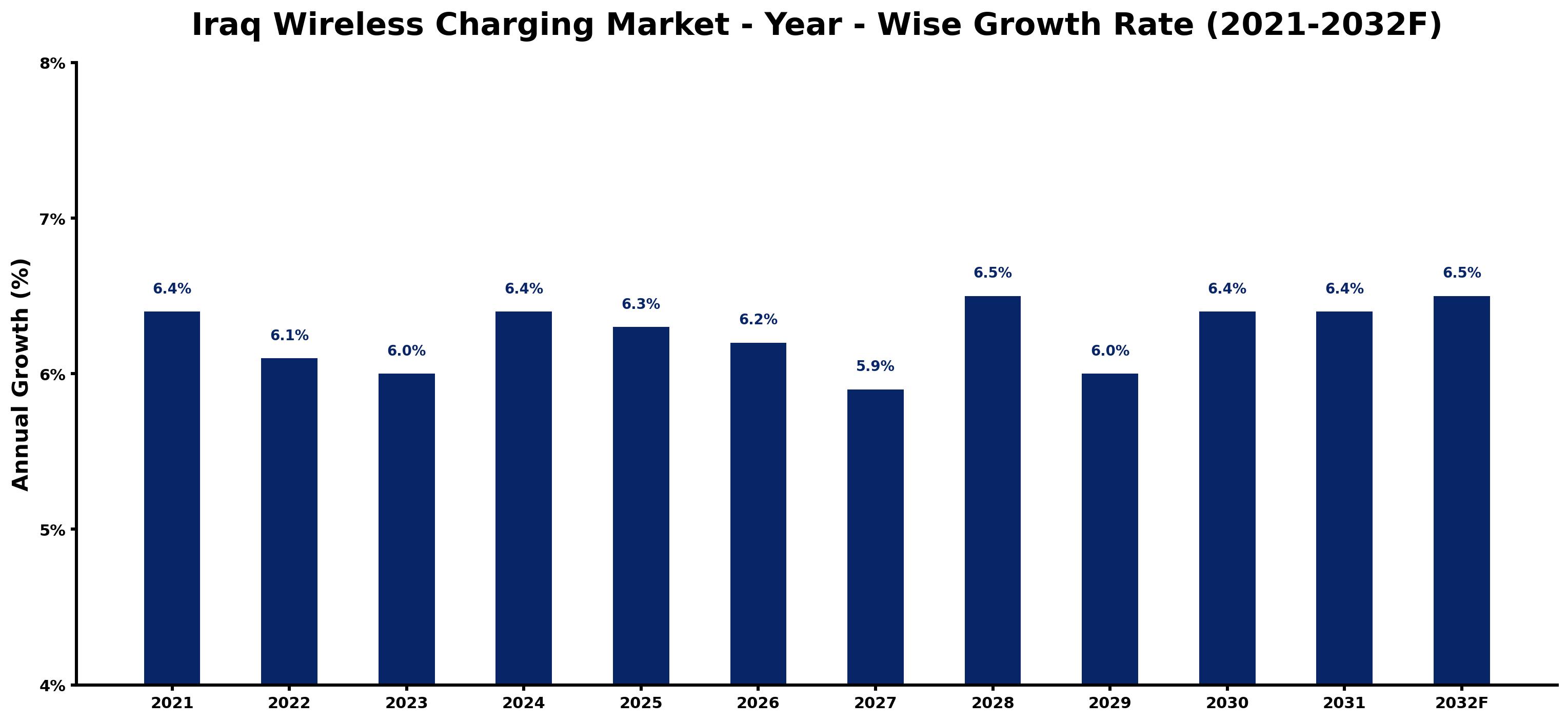
The table below presents the year‑wise growth rates along with the key drivers influencing the market
| Year | Growth Rate | Major Drivers |
| 2021 | 6.4% | Growing urbanization and commercial development |
| 2022 | 6.1% | Expansion of manufacturing activities |
| 2023 | 6.0% | Expansion of commercial construction activities |
| 2024 | 6.4% | Increasing adoption of advanced technologies |
| 2025 | 6.3% | Expansion of commercial construction activities |
| 2026 | 6.2% | Increasing industrial automation investments |
| 2027 | 5.9% | Expansion of commercial construction activities |
| 2028 | 6.5% | Growing renewable energy integration projects |
| 2029 | 6.0% | Increasing adoption of advanced technologies |
| 2030 | 6.4% | Growing renewable energy integration projects |
| 2031 | 6.4% | Rapid growth in telecom and data center sectors |
| 2032 | 6.5% | Increasing adoption of advanced technologies |
Note - Market size estimations and growth projections presented in this report are based on 6Wresearch's advanced forecasting approach, validated with industry datasets as of June 2026.
Iraq Wireless Charging Market Synopsis
Currently, the Iraq wireless charging market is witnessing a noteworthy shift towards advanced charging solutions, as consumers adapt to the technological conveniences of modern life. The growing number of electronic devices, coupled with an increasing trend of tech-savvy consumers, is amplifying the appetite for wireless charging options across various demographics.
Moreover, the popularity of wireless charging solutions is being bolstered by their integration into public infrastructure. Airports, cafes, and shopping centers are starting to embrace this technology, recognizing its potential to enhance customer experience and drive foot traffic.
Iraq Wireless Charging Market Key Takeaways
- The market is driven by the increasing smartphone penetration and evolving consumer preferences for convenience.
- Integration of wireless charging technology in public spaces is enhancing its accessibility and appeal.
- Investments in product innovations and partnerships are expected to intensify competition among market participants.
- Challenges such as limited consumer awareness and high costs remain key barriers to widespread adoption.
- The market outlook is optimistic, with significant growth opportunities aligned with technological advancements.
Evaluation of Restraints in Iraq Wireless Charging Market
Despite the market's growth potential, several constraints are limiting its advancement. A critical challenge is the insufficient infrastructure to adequately support wireless charging stations throughout urban areas. Additionally, consumer awareness remains low, with many individuals unaware of the benefits and practicalities of wireless charging solutions. Concerns about safety and efficiency further complicate market adoption. Coupled with the relatively high costs of wireless charging equipment and the slow pace of regulatory developments, these factors collectively pose significant hurdles that stakeholders must navigate to foster broader acceptance and usage.
Iraq Wireless Charging Market Trends
The market is currently witnessing several noteworthy trends that shape its landscape. One significant trend is the emergence of public charging stations equipped with wireless technology, fostering greater user convenience. Furthermore, the development of faster and more powerful wireless charging capabilities is becoming a priority, aiming to meet consumer demands for efficiency. Additionally, the integration of wireless charging features in diverse electronic devices beyond smartphones, such as tablets and wearables, is expanding the market's reach. Innovations, including long-distance wireless charging and application in electric vehicles, are poised to further enhance market dynamics.
Iraq Wireless Charging Market Opportunities
The Iraq wireless charging market presents several compelling investment opportunities, particularly in sectors associated with the increasing proliferation of electronic devices. Companies can explore the development and distribution of wireless charging accessories such as pads and stands, which are becoming essential for consumers. Moreover, establishing wireless charging stations in strategic locations—such as airports, malls, and cafes—could capture the growing demand. Collaborations with smartphone manufacturers for integration and promotion could also yield substantial returns, given the shift toward this innovative technology among consumers.
Government Initiatives in the Iraq Wireless Charging Market
While there are currently no specific policies targeting the wireless charging sector in Iraq, the government is demonstrating a commitment to promoting technological advancement and innovation. Efforts to improve the overall business environment and infrastructure may indirectly facilitate the wireless charging market's growth. Stakeholders should remain vigilant about potential policy developments and engage proactively with government entities to advocate for regulations that would encourage the expansion of this emerging sector.
Future Insights of the Iraq Wireless Charging Market
Looking ahead to the 2026-2032 period, the future of the Iraq wireless charging market appears bright, driven by steady smartphone penetration and a burgeoning demand for practical charging solutions. The ongoing trends of smart homes and the rise of Internet of Things (IoT) devices are expected to further catalyze market growth. As innovations in wireless charging technology continue to emerge, including faster and longer-range capabilities, consumer interest is likely to escalate. An improving infrastructure landscape will complement this growth, positioning the market for significant opportunities in the near future.
Iraq Wireless Charging Market Latest Developments (May 2025 - June 2026)
Recent developments in the Iraq wireless charging market indicate a shift towards increased collaboration among technology providers and public infrastructure developers. Efforts to integrate wireless charging into more urban public areas are gaining traction, with preliminary initiatives being rolled out. Additionally, advancements in product offerings, particularly those focusing on enhanced charging speeds and efficiency, are becoming more prominent as companies seek to establish a competitive edge. Such trends illustrate a dynamic market landscape aimed at improving consumer access to wireless charging technology.
Iraq Wireless Charging Market - Key Attractiveness of the Report
- 10 Years of Market Numbers
- Historical Data Starting from 2022 to 2025
- Base Year: 2025
- Forecast Data until 2032
- Key Performance Indicators Impacting the Market
- Major Upcoming Developments and Projects
Key Highlights of the Report:
- Iraq Wireless Charging Market Outlook
- Market Size of Iraq Wireless Charging Market, 2025
- Forecast of Iraq Wireless Charging Market, 2032
- Historical Data and Forecast of Iraq Wireless Charging Revenues & Volume for the Period 2022-2032F
- Iraq Wireless Charging Market Trend Evolution
- Iraq Wireless Charging Market Drivers and Challenges
- Iraq Wireless Charging Price Trends
- Iraq Wireless Charging Porter's Five Forces
- Iraq Wireless Charging Industry Life Cycle
- Historical Data and Forecast of Iraq Wireless Charging Market Revenues & Volume By Technology for the Period 2022-2032F
- Historical Data and Forecast of Iraq Wireless Charging Market Revenues & Volume By Resonant for the Period 2022-2032F
- Historical Data and Forecast of Iraq Wireless Charging Market Revenues & Volume By RF for the Period 2022-2032F
- Historical Data and Forecast of Iraq Wireless Charging Market Revenues & Volume By Inductive for the Period 2022-2032F
- Historical Data and Forecast of Iraq Wireless Charging Market Revenues & Volume By Others for the Period 2022-2032F
- Historical Data and Forecast of Iraq Wireless Charging Market Revenues & Volume By Applications for the Period 2022-2032F
- Historical Data and Forecast of Iraq Wireless Charging Market Revenues & Volume By Healthcare for the Period 2022-2032F
- Historical Data and Forecast of Iraq Wireless Charging Market Revenues & Volume By Automotive for the Period 2022-2032F
- Historical Data and Forecast of Iraq Wireless Charging Market Revenues & Volume By Consumer Electronics for the Period 2022-2032F
- Historical Data and Forecast of Iraq Wireless Charging Market Revenues & Volume By Industrial for the Period 2022-2032F
- Historical Data and Forecast of Iraq Wireless Charging Market Revenues & Volume By Others for the Period 2022-2032F
- Iraq Wireless Charging Import Export Trade Statistics
- Market Opportunity Assessment By Technology
- Market Opportunity Assessment By Applications
- Iraq Wireless Charging Top Companies Market Share
- Iraq Wireless Charging Competitive Benchmarking By Technical and Operational Parameters
- Iraq Wireless Charging Company Profiles
- Iraq Wireless Charging Key Strategic Recommendations






































