Israel Home Appliances Market Top 5 Importing Countries and Market Competition (HHI) Analysis
Israel`s home appliances import market in 2024 continued to see significant contributions from top exporters such as China, South Korea, Japan, Turkey, and the UAE. Despite moderate concentration levels indicated by the HHI, the market experienced a slight decline with a CAGR of -1.21% from 2020 to 2024. However, there was a notable uptick in growth from 2023 to 2024, with a growth rate of 19.6%, suggesting potential opportunities for further expansion and diversification in the coming years.
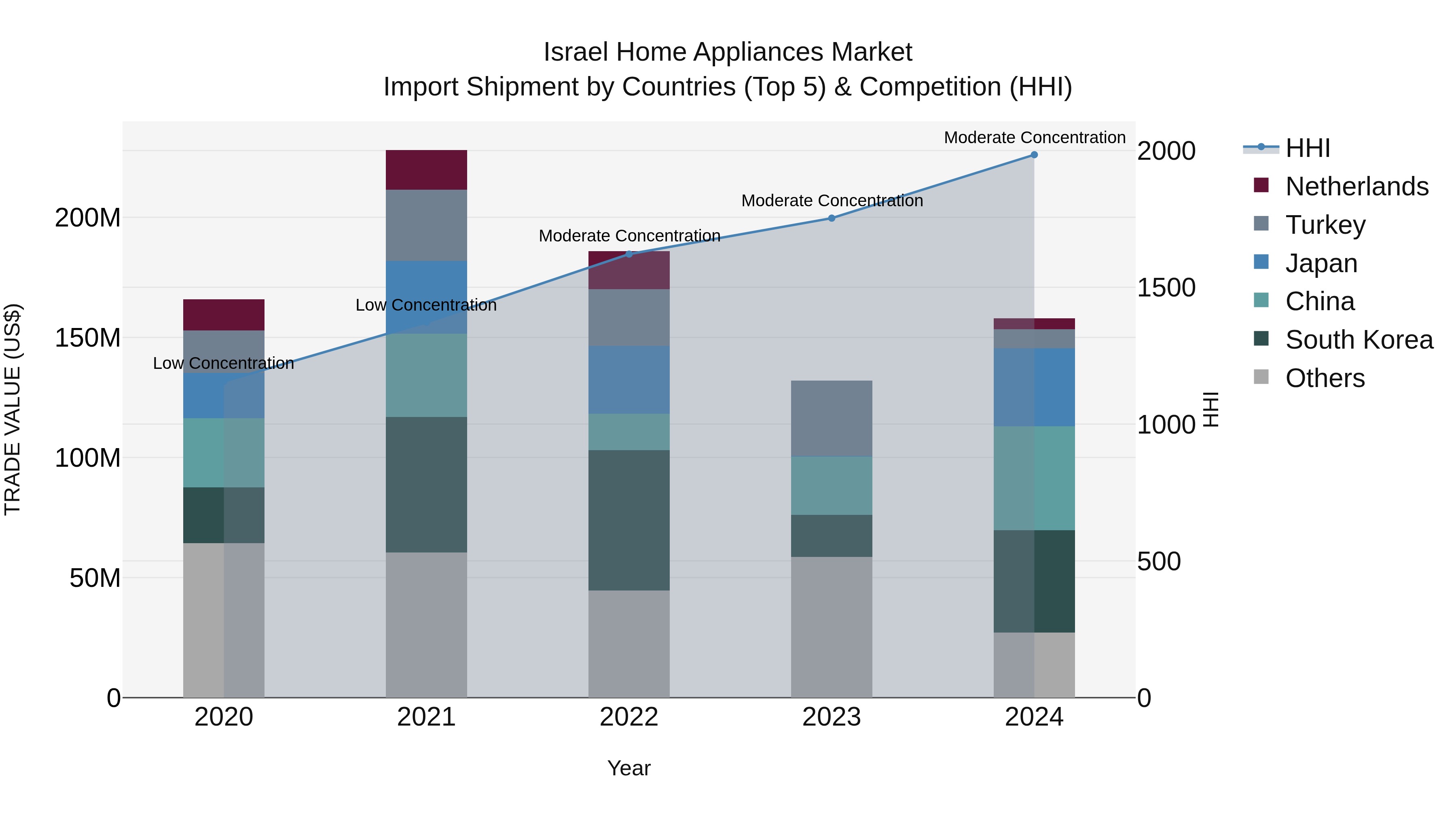
Israel Home Appliances Market Synopsis
The home appliances market in Israel provides a wide range of products including refrigerators, washing machines, ovens, and dishwashers. This market is influenced by technological advancements, energy efficiency standards, and consumer preferences for smart and connected appliances that enhance convenience and functionality.
Drivers of the market
Israel Home Appliances Market experiences growth due to rising household incomes and urbanization, leading to increased demand for convenience and efficiency in household chores. Technological advancements in smart appliances further stimulate market expansion.
Challenges of the market
The home appliances market in Israel encounters challenges related to energy efficiency, product durability, and consumer affordability. Manufacturers must innovate to develop appliances that consume less energy, require fewer resources for maintenance, and offer advanced features to meet evolving consumer demands. Moreover, addressing concerns such as product lifespan and end-of-life disposal is essential for sustainability and regulatory compliance.
Government Policy of the market
Israel promotes consumer safety, energy efficiency, and product quality in the home appliances market through regulatory standards, labeling requirements, and consumer education programs. Government policies aim to ensure compliance with international standards and promote sustainable manufacturing practices in household appliance production.
Key Highlights of the Report:
- Israel Home Appliances Market Outlook
- Market Size of Israel Home Appliances Market, 2024
- Forecast of Israel Home Appliances Market, 2031
- Historical Data and Forecast of Israel Home Appliances Revenues & Volume for the Period 2021-2031
- Israel Home Appliances Market Trend Evolution
- Israel Home Appliances Market Drivers and Challenges
- Israel Home Appliances Price Trends
- Israel Home Appliances Porter`s Five Forces
- Israel Home Appliances Industry Life Cycle
- Historical Data and Forecast of Israel Home Appliances Market Revenues & Volume By Product Types for the Period 2021-2031
- Historical Data and Forecast of Israel Home Appliances Market Revenues & Volume By Kitchen Appliances for the Period 2021-2031
- Historical Data and Forecast of Israel Home Appliances Market Revenues & Volume By Washing Appliances for the Period 2021-2031
- Historical Data and Forecast of Israel Home Appliances Market Revenues & Volume By Entertainment Appliances for the Period 2021-2031
- Historical Data and Forecast of Israel Home Appliances Market Revenues & Volume By Air Conditioner for the Period 2021-2031
- Historical Data and Forecast of Israel Home Appliances Market Revenues & Volume By Others for the Period 2021-2031
- Historical Data and Forecast of Israel Home Appliances Market Revenues & Volume By Technology for the Period 2021-2031
- Historical Data and Forecast of Israel Home Appliances Market Revenues & Volume By Wi-Fi for the Period 2021-2031
- Historical Data and Forecast of Israel Home Appliances Market Revenues & Volume By Bluetooth for the Period 2021-2031
- Historical Data and Forecast of Israel Home Appliances Market Revenues & Volume By ZigBee for the Period 2021-2031
- Historical Data and Forecast of Israel Home Appliances Market Revenues & Volume By Radio Frequency Identification for the Period 2021-2031
- Historical Data and Forecast of Israel Home Appliances Market Revenues & Volume By Cellular Technology for the Period 2021-2031
- Historical Data and Forecast of Israel Home Appliances Market Revenues & Volume By IoT for the Period 2021-2031
- Historical Data and Forecast of Israel Home Appliances Market Revenues & Volume By Distribution Channel for the Period 2021-2031
- Historical Data and Forecast of Israel Home Appliances Market Revenues & Volume By Retail for the Period 2021-2031
- Historical Data and Forecast of Israel Home Appliances Market Revenues & Volume By E-commerce for the Period 2021-2031
- Historical Data and Forecast of Israel Home Appliances Market Revenues & Volume By Others for the Period 2021-2031
- Israel Home Appliances Import Export Trade Statistics
- Market Opportunity Assessment By Product Types
- Market Opportunity Assessment By Technology
- Market Opportunity Assessment By Distribution Channel
- Israel Home Appliances Top Companies Market Share
- Israel Home Appliances Competitive Benchmarking By Technical and Operational Parameters
- Israel Home Appliances Company Profiles
- Israel Home Appliances Key Strategic Recommendations






































