Israel Iodine Market Top 5 Importing Countries and Market Competition (HHI) Analysis
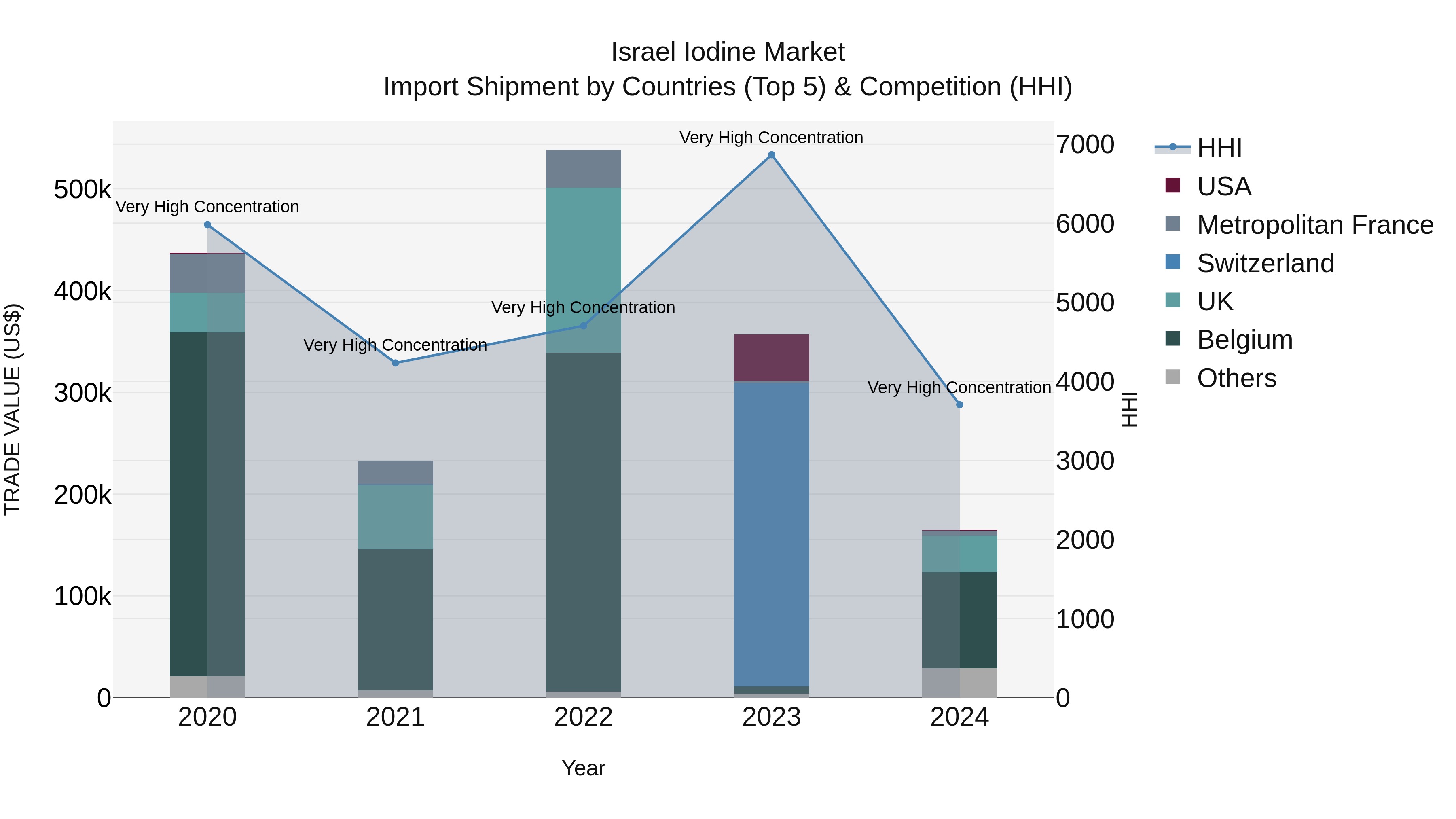
The Israel iodine import market in 2024 continued to see a high concentration of shipments from top exporting countries such as Belgium, UK, Germany, India, and Metropolitan France. Despite the challenging market conditions, the Compound Annual Growth Rate (CAGR) from 2020 to 2024 stood at -21.61%, with a significant decline in growth rate from 2023 to 2024 at -53.78%. These figures indicate a complex and evolving landscape for iodine imports in Israel, potentially influenced by various factors affecting global trade dynamics.
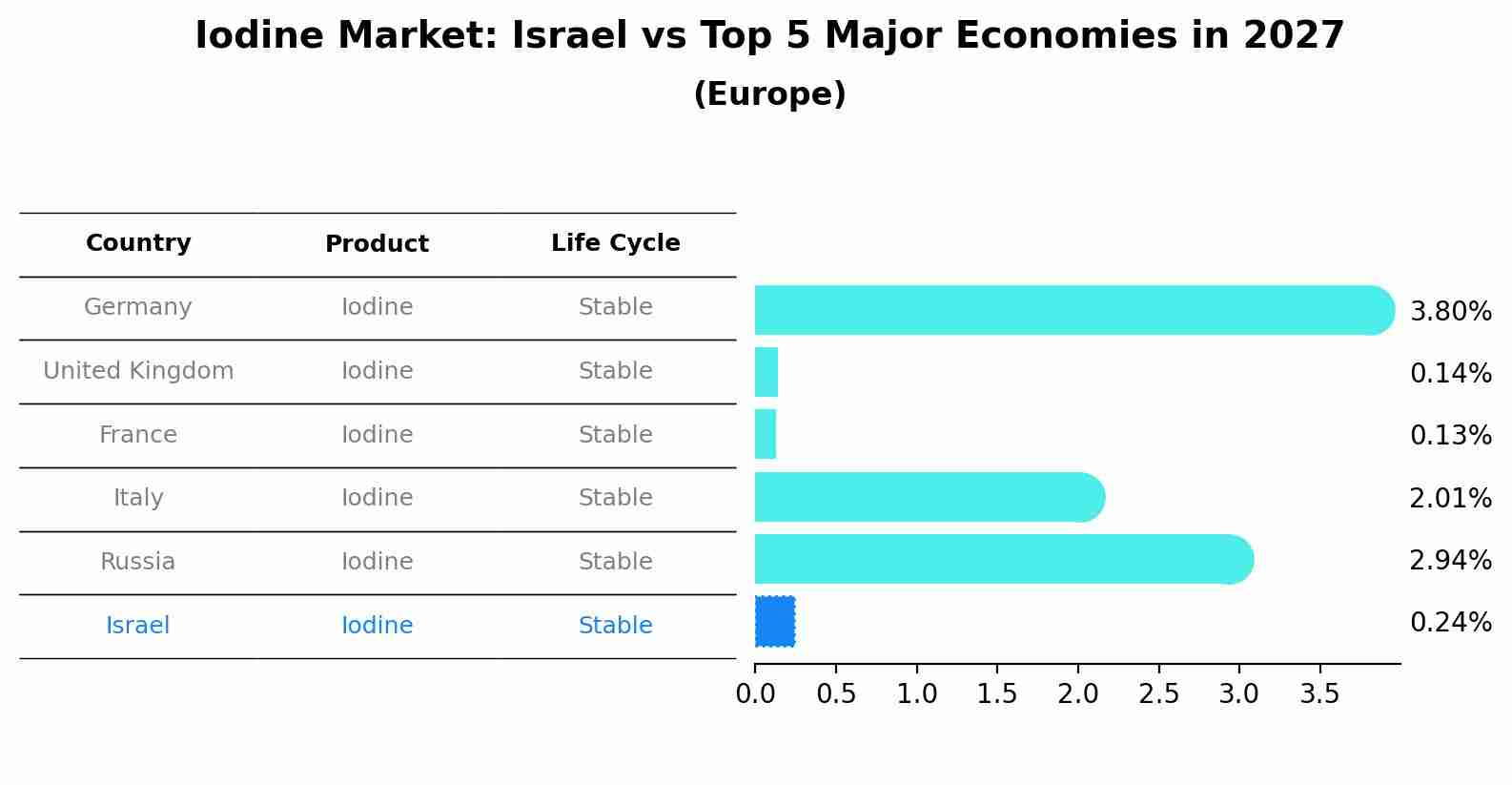
Iodine Market: Israel vs Top 5 Major Economies in 2027 (Europe)
Israel's Iodine market is anticipated to experience a stable growth rate of 0.24% by 2027, reflecting trends observed in the largest economy Germany, followed by United Kingdom, France, Italy and Russia.
Israel Iodine Market Synopsis
Israel iodine market encompasses the production and distribution of iodine, a crucial element used in various industries such as healthcare, pharmaceuticals, and electronics. Iodine derivatives are utilized in applications ranging from thyroid medications to LCD displays.
Drivers of the market
The Israel iodine market is driven by its diverse applications across industries such as healthcare, pharmaceuticals, electronics, and agriculture. Iodine is used in the production of pharmaceuticals, nutritional supplements, and disinfectants, as well as in LCD displays, catalysts, and animal feed additives. The increasing demand for iodine in healthcare and industrial applications, coupled with its limited natural availability, drives market growth and necessitates efficient production and supply chain management strategies.
Challenges of the market
The iodine market faces challenges including supply stability, purity requirements, and environmental regulations. Ensuring a stable supply of high-purity iodine, meeting stringent purity standards, and complying with environmental regulations are crucial for supporting medical, industrial, and nutritional applications in Israel.
Government Policy of the market
To support healthcare and industrial applications, the Israel government promotes safety and sustainability in the iodine market. Policies aim to ensure regulatory compliance, research funding, and industry collaboration to develop high-purity and pharmaceutical-grade iodine products for use in thyroid disorders, pharmaceuticals, and specialty chemicals.
Key Highlights of the Report:
- Israel Iodine Market Outlook
- Market Size of Israel Iodine Market, 2024
- Forecast of Israel Iodine Market, 2031
- Historical Data and Forecast of Israel Iodine Revenues & Volume for the Period 2021-2031
- Israel Iodine Market Trend Evolution
- Israel Iodine Market Drivers and Challenges
- Israel Iodine Price Trends
- Israel Iodine Porter`s Five Forces
- Israel Iodine Industry Life Cycle
- Historical Data and Forecast of Israel Iodine Market Revenues & Volume By Source for the Period 2021-2031
- Historical Data and Forecast of Israel Iodine Market Revenues & Volume By Caliche Ore for the Period 2021-2031
- Historical Data and Forecast of Israel Iodine Market Revenues & Volume By Underground Brines for the Period 2021-2031
- Historical Data and Forecast of Israel Iodine Market Revenues & Volume By Recycling for the Period 2021-2031
- Historical Data and Forecast of Israel Iodine Market Revenues & Volume By Seaweeds for the Period 2021-2031
- Historical Data and Forecast of Israel Iodine Market Revenues & Volume By Form for the Period 2021-2031
- Historical Data and Forecast of Israel Iodine Market Revenues & Volume By Organic Compounds for the Period 2021-2031
- Historical Data and Forecast of Israel Iodine Market Revenues & Volume By Inorganic Salts & Complexes for the Period 2021-2031
- Historical Data and Forecast of Israel Iodine Market Revenues & Volume By Elemental & Isotopes for the Period 2021-2031
- Historical Data and Forecast of Israel Iodine Market Revenues & Volume By Application for the Period 2021-2031
- Historical Data and Forecast of Israel Iodine Market Revenues & Volume By X-Ray Contrast Media for the Period 2021-2031
- Historical Data and Forecast of Israel Iodine Market Revenues & Volume By Pharmaceuticals for the Period 2021-2031
- Historical Data and Forecast of Israel Iodine Market Revenues & Volume By Optical Polarizing Films for the Period 2021-2031
- Historical Data and Forecast of Israel Iodine Market Revenues & Volume By Catalyst in Polymer Processing for the Period 2021-2031
- Historical Data and Forecast of Israel Iodine Market Revenues & Volume By Animal Feed for the Period 2021-2031
- Historical Data and Forecast of Israel Iodine Market Revenues & Volume By Fluorochemicals for the Period 2021-2031
- Historical Data and Forecast of Israel Iodine Market Revenues & Volume By Human Nutrition for the Period 2021-2031
- Historical Data and Forecast of Israel Iodine Market Revenues & Volume By Othersfor the Period 2021-2031
- Israel Iodine Import Export Trade Statistics
- Market Opportunity Assessment By Source
- Market Opportunity Assessment By Form
- Market Opportunity Assessment By Application
- Israel Iodine Top Companies Market Share
- Israel Iodine Competitive Benchmarking By Technical and Operational Parameters
- Israel Iodine Company Profiles
- Israel Iodine Key Strategic Recommendations






































