Israel Lead Market Year-wise Growth Rate (2021-2031F)
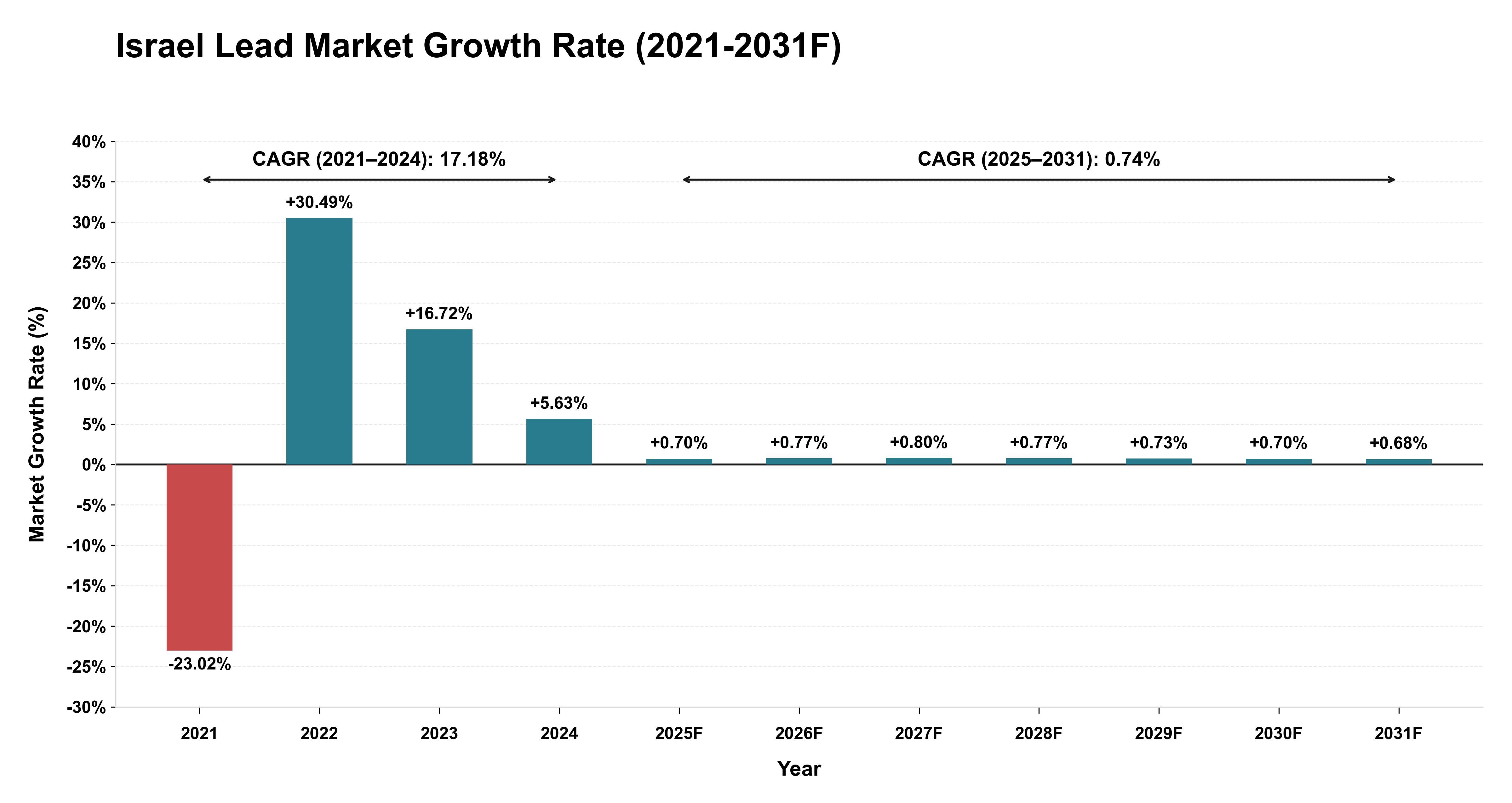
The Israel Lead Market experienced a tumultuous period from 2021 to 2024, marked by a sharp decline in 2021 followed by strong rebounds in subsequent years, with growth rates varying from -23.02% to 30.49%. This erratic trajectory was likely influenced by global economic uncertainties impacting lead demand in industries like automotive, electronics, and construction. The historical CAGR of 17.18% reflects this volatility and the market's resilience in recovering from downturns. Looking ahead to 2025-2031, the forecasted CAGR of 0.74% suggests a stabilization phase with minimal growth expected as the market adjusts to new regulatory frameworks promoting sustainable practices and alternative materials, impacting lead consumption patterns and supply chain dynamics in Israel.
Key Highlights of the Report:
- Israel Lead Market Outlook
- Market Size of Israel Lead Market, 2024
- Forecast of Israel Lead Market, 2031
- Historical Data and Forecast of Israel Lead Revenues & Volume for the Period 2021-2031
- Israel Lead Market Trend Evolution
- Israel Lead Market Drivers and Challenges
- Israel Lead Price Trends
- Israel Lead Porter`s Five Forces
- Israel Lead Industry Life Cycle
- Historical Data and Forecast of Israel Lead Market Revenues & Volume By Isotopesfor the Period 2021-2031
- Historical Data and Forecast of Israel Lead Market Revenues & Volume By Lead-204 for the Period 2021-2031
- Historical Data and Forecast of Israel Lead Market Revenues & Volume By Lead-207 for the Period 2021-2031
- Historical Data and Forecast of Israel Lead Market Revenues & Volume By Lead-206 for the Period 2021-2031
- Historical Data and Forecast of Israel Lead Market Revenues & Volume By Lead-208 for the Period 2021-2031
- Historical Data and Forecast of Israel Lead Market Revenues & Volume By Applications for the Period 2021-2031
- Historical Data and Forecast of Israel Lead Market Revenues & Volume By Batteries for the Period 2021-2031
- Historical Data and Forecast of Israel Lead Market Revenues & Volume By Cable sheaths for the Period 2021-2031
- Historical Data and Forecast of Israel Lead Market Revenues & Volume By Shipbuilding for the Period 2021-2031
- Historical Data and Forecast of Israel Lead Market Revenues & Volume By Light industry for the Period 2021-2031
- Historical Data and Forecast of Israel Lead Market Revenues & Volume By Others for the Period 2021-2031
- Historical Data and Forecast of Israel Lead Market Revenues & Volume By End-users for the Period 2021-2031
- Historical Data and Forecast of Israel Lead Market Revenues & Volume By Mechanical Industry for the Period 2021-2031
- Historical Data and Forecast of Israel Lead Market Revenues & Volume By Construction Industry for the Period 2021-2031
- Historical Data and Forecast of Israel Lead Market Revenues & Volume By Defense for the Period 2021-2031
- Historical Data and Forecast of Israel Lead Market Revenues & Volume By Electronics for the Period 2021-2031
- Historical Data and Forecast of Israel Lead Market Revenues & Volume By Others for the Period 2021-2031
- Israel Lead Import Export Trade Statistics
- Market Opportunity Assessment By Isotopes
- Market Opportunity Assessment By Applications
- Market Opportunity Assessment By End-users
- Israel Lead Top Companies Market Share
- Israel Lead Competitive Benchmarking By Technical and Operational Parameters
- Israel Lead Company Profiles
- Israel Lead Key Strategic Recommendations






































