Israel Satellite Market Growth Rate Analysis (2025 - 2031)
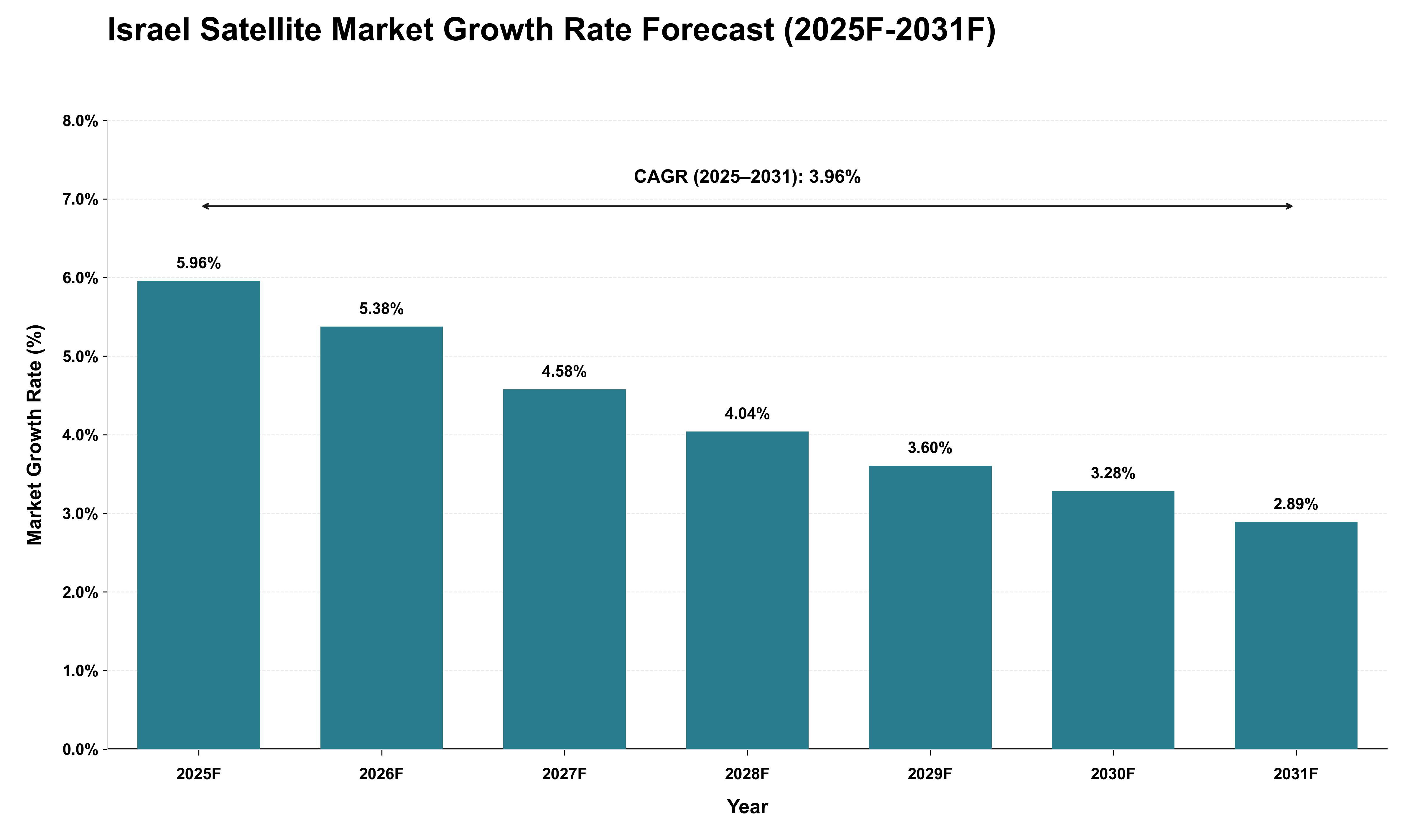
The Israel satellite market will experience a notable transition driven by advancements in technology and increasing product substitution, particularly as new satellite technologies emerge and existing systems become more efficient. The projected CAGR of 3.96% from 2025 to 2031 reflects a gradual deceleration in growth rates, with initial years showing robust increases—5.96% in 2025—before tapering off to 2.89% by 2031. This trend indicates a shift towards more sophisticated satellite solutions that leverage artificial intelligence and miniaturization, enhancing operational capabilities while reducing costs. Additionally, the market will likely face import dependencies as global supply chains evolve, influencing pricing dynamics and competitive positioning. Cyclical trends may also emerge as demand fluctuates with geopolitical factors and technological disruptions, necessitating strategic adaptations from industry players to maintain relevance in an increasingly complex landscape.
Key Highlights of the Report:
- Israel Satellite Market Outlook
- Market Size of Israel Satellite Market, 2024
- Forecast of Israel Satellite Market, 2031
- Historical Data and Forecast of Israel Satellite Revenues & Volume for the Period 2021-2031
- Israel Satellite Market Trend Evolution
- Israel Satellite Market Drivers and Challenges
- Israel Satellite Price Trends
- Israel Satellite Porter`s Five Forces
- Israel Satellite Industry Life Cycle
- Historical Data and Forecast of Israel Satellite Market Revenues & Volume By Type for the Period 2021-2031
- Historical Data and Forecast of Israel Satellite Market Revenues & Volume By Large Satellite for the Period 2021-2031
- Historical Data and Forecast of Israel Satellite Market Revenues & Volume By Mini Satellite for the Period 2021-2031
- Historical Data and Forecast of Israel Satellite Market Revenues & Volume By Micro Satellite for the Period 2021-2031
- Historical Data and Forecast of Israel Satellite Market Revenues & Volume By Nano Satellite for the Period 2021-2031
- Historical Data and Forecast of Israel Satellite Market Revenues & Volume By End User for the Period 2021-2031
- Historical Data and Forecast of Israel Satellite Market Revenues & Volume By Commercial for the Period 2021-2031
- Historical Data and Forecast of Israel Satellite Market Revenues & Volume By Civil for the Period 2021-2031
- Historical Data and Forecast of Israel Satellite Market Revenues & Volume By Government for the Period 2021-2031
- Historical Data and Forecast of Israel Satellite Market Revenues & Volume By Others for the Period 2021-2031
- Historical Data and Forecast of Israel Satellite Market Revenues & Volume By Application for the Period 2021-2031
- Historical Data and Forecast of Israel Satellite Market Revenues & Volume By Scientific Research for the Period 2021-2031
- Historical Data and Forecast of Israel Satellite Market Revenues & Volume By Technology Demonstration and Verification for the Period 2021-2031
- Historical Data and Forecast of Israel Satellite Market Revenues & Volume By Earth Observation and Remote Sensing for the Period 2021-2031
- Historical Data and Forecast of Israel Satellite Market Revenues & Volume By Scientific Research for the Period 2021-2031
- Historical Data and Forecast of Israel Satellite Market Revenues & Volume By Communication for the Period 2021-2031
- Historical Data and Forecast of Israel Satellite Market Revenues & Volume By Others for the Period 2021-2031
- Israel Satellite Import Export Trade Statistics
- Market Opportunity Assessment By Type
- Market Opportunity Assessment By End User
- Market Opportunity Assessment By Application
- Israel Satellite Top Companies Market Share
- Israel Satellite Competitive Benchmarking By Technical and Operational Parameters
- Israel Satellite Company Profiles
- Israel Satellite Key Strategic Recommendations






































