Israel Whiskey Market Year-wise Growth Rate (2021-2031F)
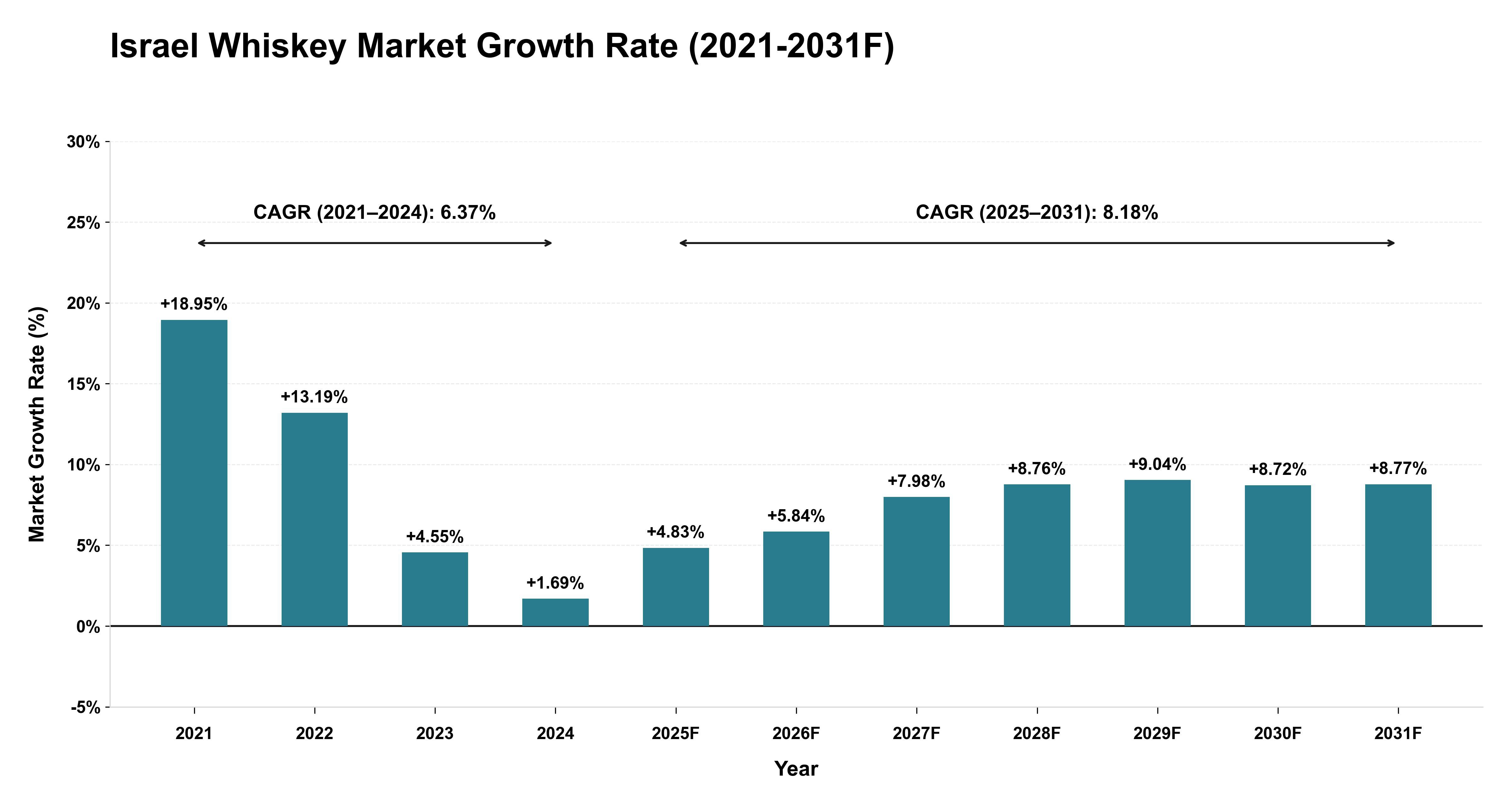
The Israel Whiskey Market experienced robust growth during 2021-2024, with a progressively decreasing trend in growth rates from 18.95% in 2021 to 1.69% in 2024, reflecting initial excitement followed by stabilization. This phase was characterized by increasing demand from discerning consumers and expanding distribution channels. Looking ahead to 2025-2031, the forecasted CAGR of 8.18% indicates a reinvigoration of the market, driven by evolving consumer preferences towards premium spirits and innovative product offerings. Anticipated accelerations in growth rates from 4.83% in 2025 to around 8.77% by 2031 suggest a maturing market finding new avenues for expansion through targeted marketing strategies, product diversification, and possibly international market penetration, underpinned by a favorable regulatory environment and technological advancements in production processes.
Israel Whiskey Market Synopsis
Israel whiskey market is on the rise, characterized by a burgeoning interest in premium alcoholic beverages and craft distilling. The country`s whiskey consumption is influenced by a growing appreciation for high-quality spirits and a cultural shift towards exploring diverse alcoholic flavors. Israel distilleries are gaining recognition for producing unique and high-quality whiskey, contributing to the market`s expansion. The increasing number of whiskey tasting events and the establishment of whiskey bars further bolster the market growth.
Drivers of the market
The whiskey market in Israel is driven by a combination of increasing disposable incomes and a growing preference for premium alcoholic beverages. The cultural shift towards social drinking and the rising influence of Western lifestyles have led to higher consumption of whiskey. Furthermore, the tourism industry also plays a role in boosting whiskey sales.
Challenges of the market
The whiskey market in Israel faces hurdles such as high import taxes and stringent regulations on alcohol distribution and marketing. Local production is limited, which means reliance on imports that are subject to geopolitical tensions and trade barriers. Additionally, there is stiff competition from other alcoholic beverages, which makes market penetration challenging for new entrants.
Government Policy of the market
The Israel whiskey market benefits from government policies that promote local distilleries through tax incentives and grants. The government also enforces strict quality control and labeling standards to maintain high product quality. Additionally, marketing campaigns are supported to enhance the global reputation of Israel whiskey.
Key Highlights of the Report:
- Israel Whiskey Market Outlook
- Market Size of Israel Whiskey Market, 2024
- Forecast of Israel Whiskey Market, 2031
- Historical Data and Forecast of Israel Whiskey Revenues & Volume for the Period 2021-2031
- Israel Whiskey Market Trend Evolution
- Israel Whiskey Market Drivers and Challenges
- Israel Whiskey Price Trends
- Israel Whiskey Porter`s Five Forces
- Israel Whiskey Industry Life Cycle
- Historical Data and Forecast of Israel Whiskey Market Revenues & Volume By Product Type for the Period 2021-2031
- Historical Data and Forecast of Israel Whiskey Market Revenues & Volume By American Whisky for the Period 2021-2031
- Historical Data and Forecast of Israel Whiskey Market Revenues & Volume By Irish Whisky for the Period 2021-2031
- Historical Data and Forecast of Israel Whiskey Market Revenues & Volume By Scotch Whisky for the Period 2021-2031
- Historical Data and Forecast of Israel Whiskey Market Revenues & Volume By Canadian Whisky for the Period 2021-2031
- Historical Data and Forecast of Israel Whiskey Market Revenues & Volume By Others for the Period 2021-2031
- Historical Data and Forecast of Israel Whiskey Market Revenues & Volume By Distribution Channel for the Period 2021-2031
- Historical Data and Forecast of Israel Whiskey Market Revenues & Volume By On-trade for the Period 2021-2031
- Historical Data and Forecast of Israel Whiskey Market Revenues & Volume By Off-trade for the Period 2021-2031
- Israel Whiskey Import Export Trade Statistics
- Market Opportunity Assessment By Product Type
- Market Opportunity Assessment By Distribution Channel
- Israel Whiskey Top Companies Market Share
- Israel Whiskey Competitive Benchmarking By Technical and Operational Parameters
- Israel Whiskey Company Profiles
- Israel Whiskey Key Strategic Recommendations






































