Italy Aggregates Market: Import Trend Analysis
In 2024, Italy import trend for the aggregates Market: Import Trend Analysis showed a steady increase in demand for construction materials. The country imported a significant volume of aggregates to meet infrastructure and construction needs, reflecting a positive growth trajectory in the Market: Import Trend Analysis.
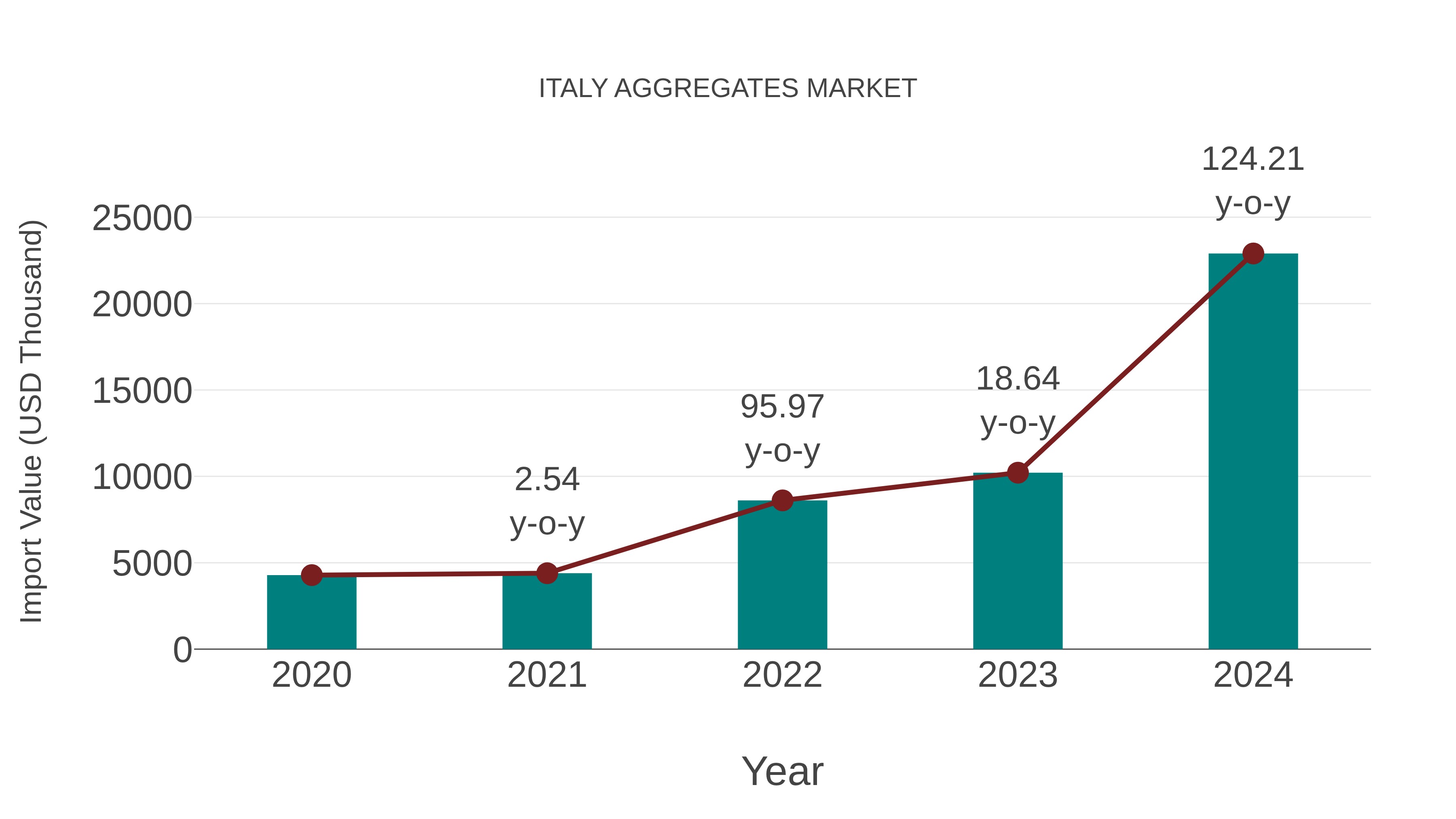
Italy Aggregates Market Overview
The Italy aggregates market is characterized by a strong demand for construction materials due to ongoing infrastructure projects and urban development. Gravel, sand, and crushed stones are the primary types of aggregates consumed in the market, with applications in road construction, building foundations, and concrete production. The market is influenced by government investments in infrastructure, residential construction activities, and commercial real estate developments. Key players in the Italy aggregates market include companies such as Buzzi Unicem, Italcementi, and Colacem. Sustainability and environmental concerns are gaining importance in the market, leading to a shift towards the use of recycled aggregates and alternative materials. Overall, the Italy aggregates market is expected to witness steady growth driven by ongoing construction activities and increasing emphasis on sustainable practices.
Italy Aggregates Market Trends
The Italy aggregates market is experiencing steady growth due to increasing infrastructure development projects and construction activities. Sustainable practices and environmental concerns are driving the demand for recycled aggregates in the country. There is a growing focus on using recycled materials to minimize the impact on natural resources and reduce carbon emissions. Additionally, advancements in technology, such as the use of mobile crushers and screening equipment, are improving efficiency in aggregate production. Market players are also investing in research and development to innovate new products and solutions to meet the evolving needs of the industry. Overall, the Italy aggregates market is witnessing a shift towards more sustainable practices and technological advancements to support the growing demand in the construction sector.
Italy Aggregates Market Challenges
The Italy aggregates market faces several challenges, including regulatory restrictions on quarrying activities, environmental concerns related to extraction and transportation of aggregates, and increasing competition from recycled materials. Additionally, fluctuating demand in the construction sector and economic uncertainties can impact the market dynamics. Limited availability of suitable land for quarrying operations and issues related to obtaining permits for new extraction sites also pose challenges for industry players. Furthermore, the need to invest in sustainable practices and technologies to minimize environmental impact while maintaining cost-effectiveness adds another layer of complexity to the market. Overall, navigating these challenges requires strategic planning, innovation, and collaboration among stakeholders in the Italy aggregates market.
Italy Aggregates Market Investment Opportunities
Investment opportunities in the Italy aggregates market are promising due to the country`s strong construction sector and infrastructure development projects. With increased government focus on improving transportation networks and urban development, demand for aggregates such as sand, gravel, and crushed stone is expected to rise. Investors can consider opportunities in quarrying and mining operations to supply raw materials to construction companies. Additionally, investing in companies that provide equipment and technology for aggregate production and processing can also be lucrative. With sustainable construction practices gaining importance, there is potential for investments in innovative solutions for recycling and reusing aggregates. Overall, the Italy aggregates market presents opportunities for growth and profitability in line with the country`s infrastructure development goals.
Italy Aggregates Market Government Policy
In Italy, the aggregates market is regulated by government policies aimed at promoting sustainable development and environmental protection. The Italian government has implemented strict regulations on the extraction, processing, and transportation of aggregates to minimize the environmental impact of mining activities. These regulations include requirements for obtaining permits, conducting environmental impact assessments, and restoring mining sites post-extraction. Additionally, the government has introduced incentives for the use of recycled aggregates to reduce reliance on natural resources and promote circular economy practices. Overall, the government`s policies in the Italian aggregates market prioritize sustainability, environmental conservation, and resource efficiency to ensure long-term viability of the sector while mitigating negative impacts on the environment.
Italy Aggregates Market Future Outlook
The future outlook for the Italy aggregates market appears promising, driven by ongoing infrastructure development projects and construction activities across the country. The demand for aggregates, including sand, gravel, and crushed stone, is expected to remain robust due to the continued investments in residential, commercial, and industrial construction projects. Additionally, government initiatives to improve transportation networks and upgrade existing infrastructure will further bolster the demand for aggregates. Technological advancements in the extraction and processing of aggregates are likely to enhance efficiency and sustainability in the industry. Overall, the Italy aggregates market is anticipated to experience steady growth in the foreseeable future, presenting opportunities for market players to expand their operations and capitalize on the evolving market dynamics.
Key Highlights of the Report:
- Italy Aggregates Market Outlook
- Market Size of Italy Aggregates Market, 2025
- Forecast of Italy Aggregates Market, 2032
- Historical Data and Forecast of Italy Aggregates Revenues & Volume for the Period 2022-2032F
- Italy Aggregates Market Trend Evolution
- Italy Aggregates Market Drivers and Challenges
- Italy Aggregates Price Trends
- Italy Aggregates Porter's Five Forces
- Italy Aggregates Industry Life Cycle
- Historical Data and Forecast of Italy Aggregates Market Revenues & Volume By Product Type for the Period 2022-2032F
- Historical Data and Forecast of Italy Aggregates Market Revenues & Volume By Crushed Stone for the Period 2022-2032F
- Historical Data and Forecast of Italy Aggregates Market Revenues & Volume By Sand for the Period 2022-2032F
- Historical Data and Forecast of Italy Aggregates Market Revenues & Volume By Gravel for the Period 2022-2032F
- Historical Data and Forecast of Italy Aggregates Market Revenues & Volume By Recycled Aggregates for the Period 2022-2032F
- Historical Data and Forecast of Italy Aggregates Market Revenues & Volume By Application for the Period 2022-2032F
- Historical Data and Forecast of Italy Aggregates Market Revenues & Volume By Construction Materials for the Period 2022-2032F
- Historical Data and Forecast of Italy Aggregates Market Revenues & Volume By Road Construction for the Period 2022-2032F
- Historical Data and Forecast of Italy Aggregates Market Revenues & Volume By Concrete Production for the Period 2022-2032F
- Historical Data and Forecast of Italy Aggregates Market Revenues & Volume By Landscaping for the Period 2022-2032F
- Historical Data and Forecast of Italy Aggregates Market Revenues & Volume By End User for the Period 2022-2032F
- Historical Data and Forecast of Italy Aggregates Market Revenues & Volume By Construction Industry for the Period 2022-2032F
- Historical Data and Forecast of Italy Aggregates Market Revenues & Volume By Residential for the Period 2022-2032F
- Historical Data and Forecast of Italy Aggregates Market Revenues & Volume By Commercial for the Period 2022-2032F
- Italy Aggregates Import Export Trade Statistics
- Market Opportunity Assessment By Product Type
- Market Opportunity Assessment By Application
- Market Opportunity Assessment By End User
- Italy Aggregates Top Companies Market Share
- Italy Aggregates Competitive Benchmarking By Technical and Operational Parameters
- Italy Aggregates Company Profiles
- Italy Aggregates Key Strategic Recommendations






































