Italy Artificial Intelligence in Retail Market Size & Growth Rate (2026-2032)
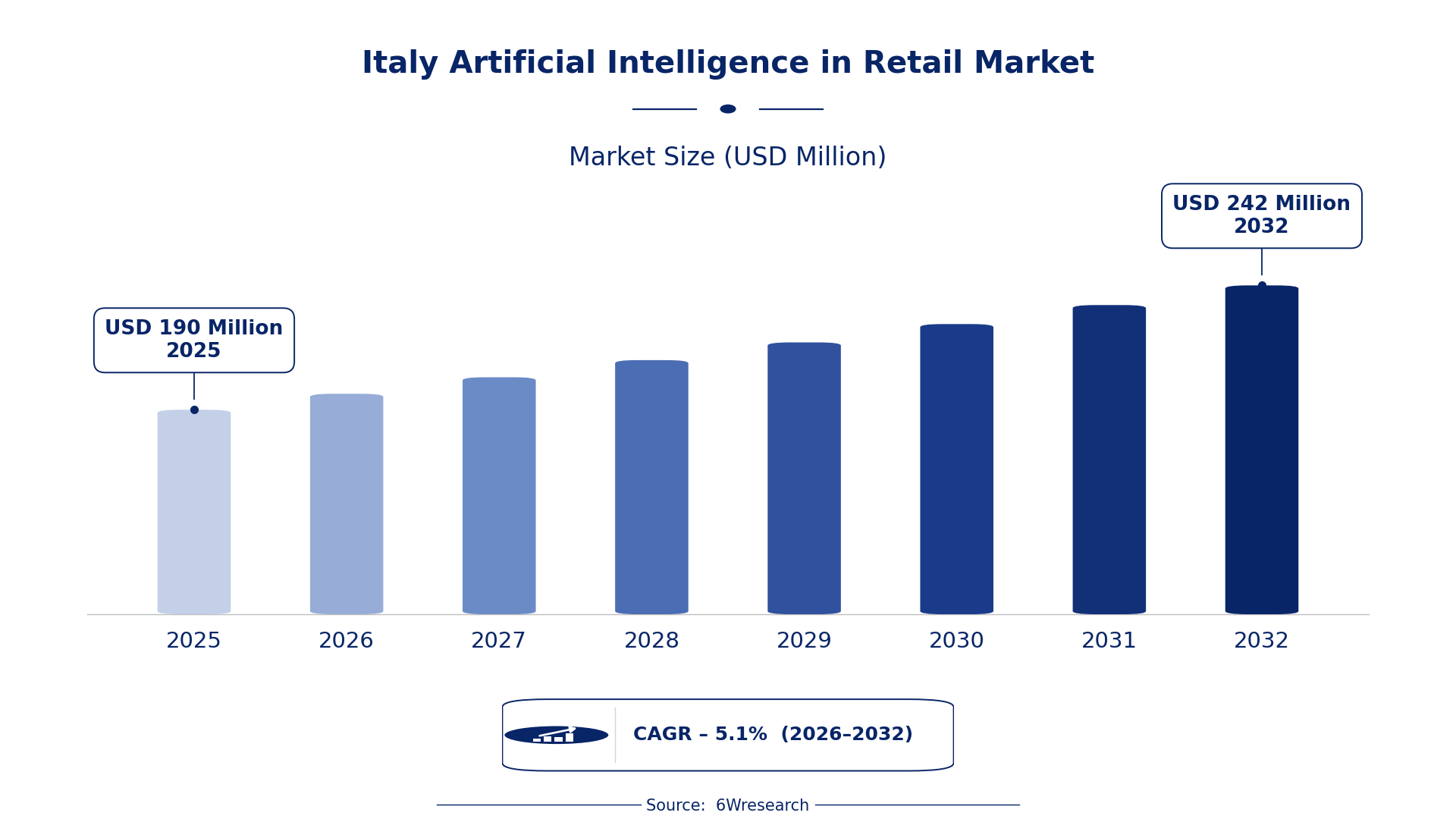
The Italy Artificial Intelligence in Retail Market was estimated at USD 190 Million in 2025 and is projected to reach USD 242 Million by 2032, growing at a CAGR of 5.1% from 2026 to 2032.
Italy Artificial Intelligence in Retail Market Synopsis
The adoption of artificial intelligence in the retail sector in Italy is rapidly gaining traction. Retailers are increasingly utilizing AI technologies to transform customer interactions and optimize their operational frameworks, leading to enhanced efficiency and improved service delivery.
Current trends indicate a shift towards data-driven strategies, with AI applications such as personalized recommendations and predictive analytics becoming commonplace. This transformation is largely fueled by the burgeoning e-commerce sector and changing consumer preferences, pushing retailers to innovate continuously.
Italy Artificial Intelligence in Retail Market Year-wise Growth Rate and Key Drivers
This graph illustrates the annual growth rates of the Italy Artificial Intelligence in Retail Market from 2021 to 2032, highlighting a steady upward trajectory and projected expansion over the forecast period.
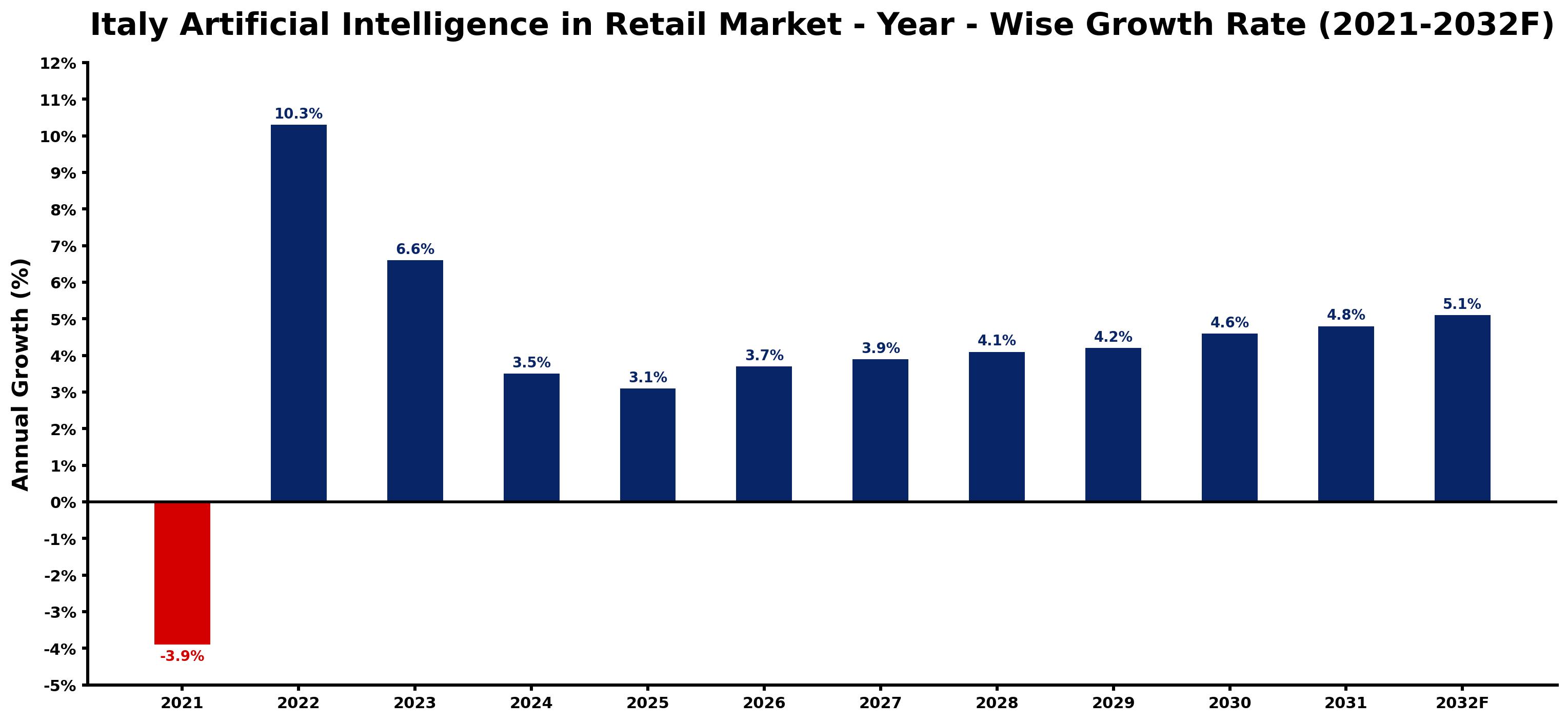
The table below presents the year‑wise growth rates along with the key drivers influencing the market
| Year | Growth Rate | Major Drivers |
| 2021 | -3.9% | Delayed EU AI regulations impacted investment decisions. |
| 2022 | 10.3% | E-commerce growth spurred AI-driven personalized shopping experiences. |
| 2023 | 6.6% | Increased investment in retail tech by Italian startups. |
| 2024 | 3.5% | National AI strategy promotes retail innovation and competitiveness. |
| 2025 | 3.1% | AI tools enhancing supply chain efficiency in Italian retail. |
| 2026 | 3.7% | Consumer preference for chatbot-supported shopping experiences rise. |
| 2027 | 3.9% | Retail analytics adoption accelerates for data-driven decision-making. |
| 2028 | 4.1% | Sustainability initiatives drive AI use for inventory management. |
| 2029 | 4.2% | Cultural shift towards tech-savvy shopping attract AI investment. |
| 2030 | 4.6% | Regulatory support for AI ethics boosts consumer trust. |
| 2031 | 4.8% | Growing local talent pool in data science and AI. |
| 2032 | 5.1% | AI integration in loyalty programs enhances customer retention. |
Note: Market size estimations and growth projections presented in this report are based on 6Wresearch's proprietary forecasting methodology, utilizing the latest available industry data, government publications, and primary research inputs.
Italy Artificial Intelligence in Retail Market Key Takeaways
Below are some of the specific key takeaways from the market, including:
- Increasing integration of AI tools for personalized customer experiences.
- Rising demand for advanced analytics in inventory management and supply chain optimization.
- Enhanced focus on data privacy and regulatory compliance in AI applications.
- Growing investment opportunities in AI-driven startups and innovative solutions.
- Significant advancements in machine learning and natural language processing technologies.
Evaluation of Restraints in Italy Artificial Intelligence in Retail Market
Despite its promising growth, the Italy Artificial Intelligence in Retail Market faces notable challenges. High initial costs associated with AI technology implementation deter many retailers from adopting these solutions. Additionally, integrating AI with existing systems presents a complex hurdle for many businesses, particularly smaller retailers lacking the resources for a smooth transition. Concerns about data privacy and the potential displacement of jobs by automation further complicate the market dynamics, creating resistance among consumers and employees alike.
Italy Artificial Intelligence in Retail Market Trends
The trend towards personalization is dominating the Italy Artificial Intelligence in Retail Market. Retailers are increasingly utilizing AI to analyze customer data, enabling them to offer tailored recommendations and experiences. Another emerging trend is the integration of AI with Internet of Things (IoT) devices, allowing for real-time insights and enhanced decision-making capabilities. Facial recognition technologies are also gaining ground, supporting targeted marketing efforts and personalized shopping experiences.
Italy Artificial Intelligence in Retail Market Opportunities
Investment opportunities are abundant in the Italian AI retail market. Retailers are seeking solutions for optimizing inventory management and demand forecasting, which presents a lucrative entry point for tech companies. Additionally, there is a growing interest in AI-driven platforms that provide comprehensive data analytics and automation tools. Investors focusing on innovative AI applications that enhance customer engagement and streamline operations will likely find significant returns.
Government Initiatives in the Italy Artificial Intelligence in Retail Market
The Italian government is actively shaping the future of artificial intelligence in the retail sector through a series of initiatives aimed at promoting ethical AI use. Recent policies emphasize data privacy, transparency in AI algorithms, and the mitigation of biases in AI-driven decisions. These efforts are crucial for ensuring that AI technologies are deployed responsibly while fostering innovation in the retail space.
- A national digital infrastructure upgrade programme launched in early 2025 to improve connectivity and data access for retailers.
- Current initiatives are underway to enhance workforce digital skills, preparing employees for AI integration within retail operations.
- A regulatory framework introduced in 2025 mandating transparency in AI applications is being implemented to protect consumer rights.
- Planned collaborations between the public sector and tech companies aim to develop innovative AI solutions tailored for the retail market by 2026.
Future Insights of the Italy Artificial Intelligence in Retail Market
Looking ahead, the Italy Artificial Intelligence in Retail Market is set for continued expansion. As retailers increasingly recognize the value of AI in enhancing customer experiences and optimizing operations, adoption rates are expected to rise steadily. Key drivers will include advancements in machine learning and natural language processing, allowing retailers to gain deeper insights into consumer behavior and preferences. This ongoing evolution will position AI as a central component of retail strategies, paving the way for innovative solutions and improved competitive advantage.
Italy Artificial Intelligence in Retail Market Latest Developments
In the past year, the Italy Artificial Intelligence in Retail Market has witnessed notable advancements, reflecting a strong momentum in AI adoption. Retailers are increasingly investing in AI technologies to elevate customer engagement and streamline operational processes. This trend is expected to continue as businesses explore new opportunities to leverage AI's capabilities.
- A leading technology vendor launched a new AI-driven customer service platform in Q1 2025, enhancing response times and customer satisfaction.
- An initiative that began in mid-2025 is currently underway to integrate AI into supply chain logistics, improving efficiency and reducing costs.
- Retailers are planning to implement predictive analytics tools in late 2026, aiming to optimize inventory management and enhance sales forecasting.
- A collaborative project between tech firms and retailers to develop AI-powered personalized marketing solutions is set to kick off in early 2026.
Italy Artificial Intelligence in Retail Market - Key Attractiveness of the Report
- 10 Years of Market Numbers
- Historical Data Starting from 2022 to 2025
- Base Year: 2025
- Forecast Data until 2032
- Key Performance Indicators Impacting the Market
- Major Upcoming Developments and Projects
Key Highlights of the Report:
- Italy Artificial Intelligence in Retail Market Outlook
- Market Size of Italy Artificial Intelligence in Retail Market, 2025
- Forecast of Italy Artificial Intelligence in Retail Market, 2032
- Historical Data and Forecast of Italy Artificial Intelligence in Retail Revenues & Volume for the Period 2022-2032F
- Italy Artificial Intelligence in Retail Market Trend Evolution
- Italy Artificial Intelligence in Retail Market Drivers and Challenges
- Italy Artificial Intelligence in Retail Price Trends
- Italy Artificial Intelligence in Retail Porter's Five Forces
- Italy Artificial Intelligence in Retail Industry Life Cycle
- Historical Data and Forecast of Italy Artificial Intelligence in Retail Market Revenues & Volume By Type for the Period 2022-2032F
- Historical Data and Forecast of Italy Artificial Intelligence in Retail Market Revenues & Volume By Online for the Period 2022-2032F
- Historical Data and Forecast of Italy Artificial Intelligence in Retail Market Revenues & Volume By Offline for the Period 2022-2032F
- Historical Data and Forecast of Italy Artificial Intelligence in Retail Market Revenues & Volume By Service for the Period 2022-2032F
- Historical Data and Forecast of Italy Artificial Intelligence in Retail Market Revenues & Volume By Professional for the Period 2022-2032F
- Historical Data and Forecast of Italy Artificial Intelligence in Retail Market Revenues & Volume By Managed for the Period 2022-2032F
- Historical Data and Forecast of Italy Artificial Intelligence in Retail Market Revenues & Volume By Technology for the Period 2022-2032F
- Historical Data and Forecast of Italy Artificial Intelligence in Retail Market Revenues & Volume By Machine Learning for the Period 2022-2032F
- Historical Data and Forecast of Italy Artificial Intelligence in Retail Market Revenues & Volume By Deep Learning for the Period 2022-2032F
- Historical Data and Forecast of Italy Artificial Intelligence in Retail Market Revenues & Volume By NLP for the Period 2022-2032F
- Italy Artificial Intelligence in Retail Import Export Trade Statistics
- Market Opportunity Assessment By Type
- Market Opportunity Assessment By Service
- Market Opportunity Assessment By Technology
- Italy Artificial Intelligence in Retail Top Companies Market Share
- Italy Artificial Intelligence in Retail Competitive Benchmarking By Technical and Operational Parameters
- Italy Artificial Intelligence in Retail Company Profiles
- Italy Artificial Intelligence in Retail Key Strategic Recommendations






































