Tajikistan Artificial Intelligence in Retail Market Size & Growth Rate (2026-2032)
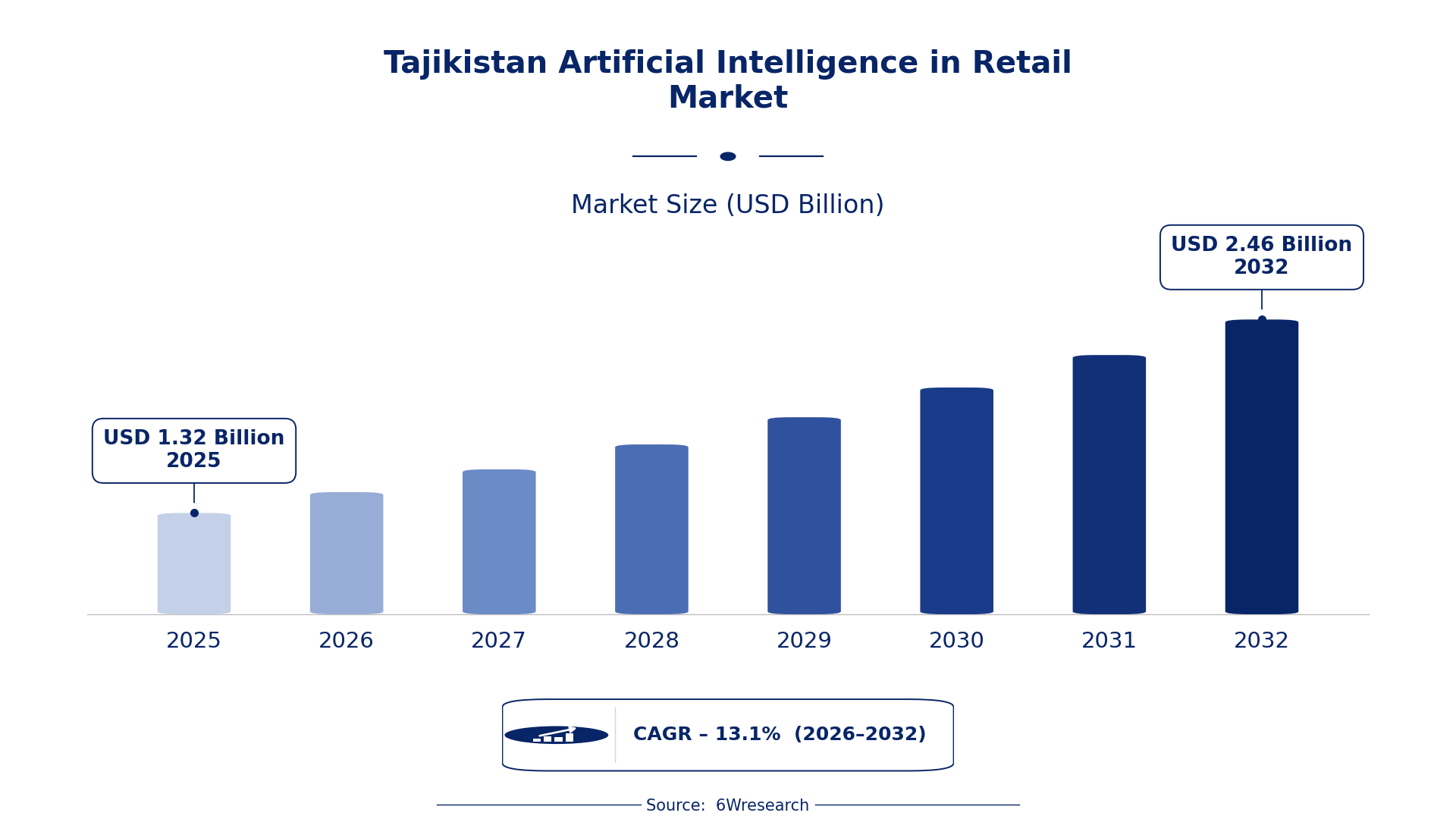
The Tajikistan Artificial Intelligence in Retail Market was estimated at USD 1321 Million in 2025 and is projected to reach USD 2457 Million by 2032, growing at a CAGR of 13.1% from 2026 to 2032.
Tajikistan Artificial Intelligence in Retail Market Synopsis
The Tajikistan Artificial Intelligence in Retail Market is currently on an upward trajectory, fueled by a wave of digital transformation across various sectors. Retailers are increasingly realizing the benefits of AI technologies, which enhance both operational efficiencies and customer engagement.
Looking ahead, the market is set to evolve further, with advancements in AI capabilities expected to redefine how retailers approach sales, inventory management, and customer interactions. This progressive shift presents not just challenges but also remarkable opportunities for growth and innovation.
Tajikistan Artificial Intelligence in Retail Market Year-wise Growth Rate and Key Drivers
This graph illustrates the annual growth rates of the Tajikistan Artificial Intelligence in Retail Market from 2021 to 2032, highlighting a steady upward trajectory and projected expansion over the forecast period.
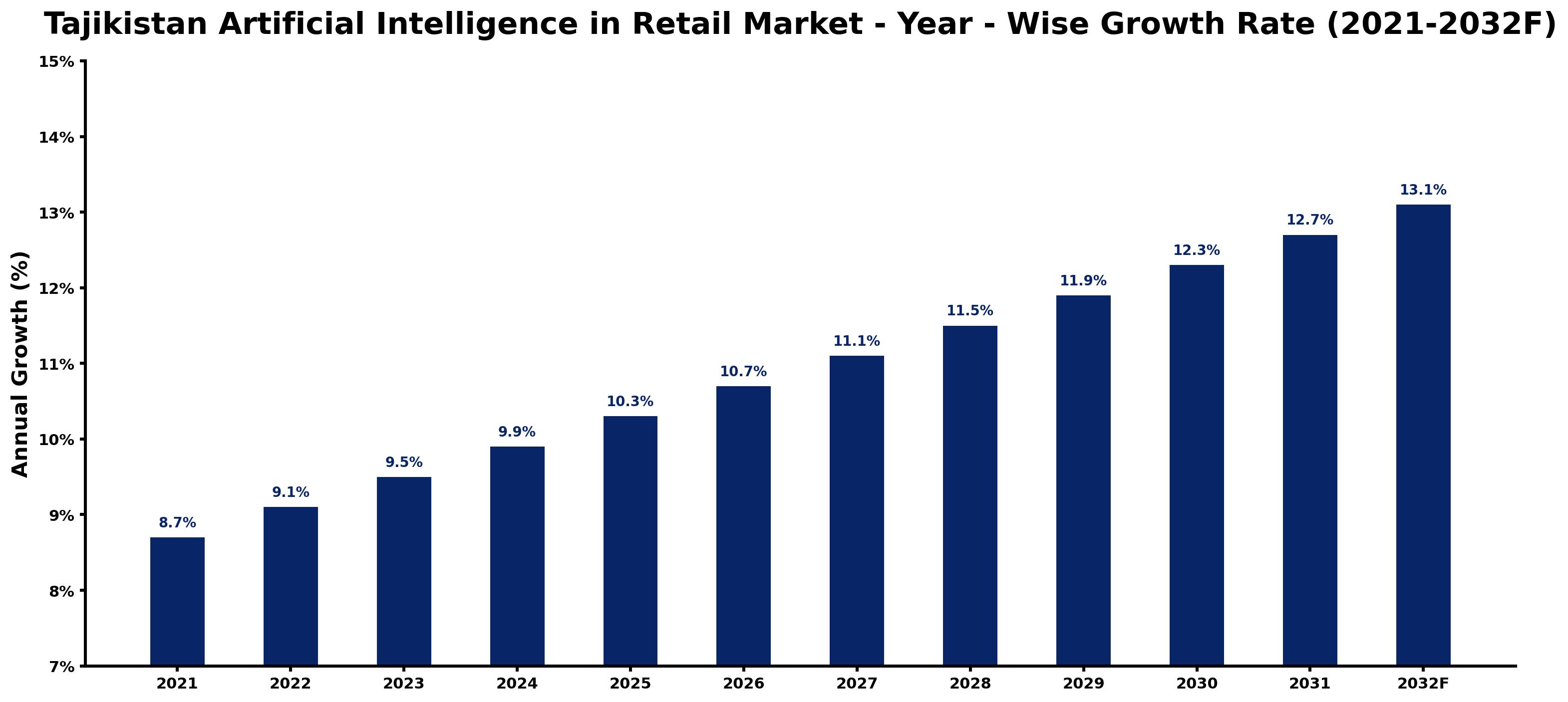
The table below presents the year‑wise growth rates along with the key drivers influencing the market
| Year | Growth Rate | Major Drivers |
| 2021 | 8.7% | Launch of Tajikistan's national digital economy strategy. |
| 2022 | 9.1% | Increasing mobile internet penetration drives online retail innovations. |
| 2023 | 9.5% | Local startups investing in AI-driven customer insights technologies. |
| 2024 | 9.9% | Government support for e-commerce boosting AI adoption. |
| 2025 | 10.3% | Collaboration with international firms enhances AI capabilities. |
| 2026 | 10.7% | Growing youth population demanding tech-savvy shopping experiences. |
| 2027 | 11.1% | Investment in smart retail solutions by local entrepreneurs. |
| 2028 | 11.5% | Retail sector modernization driven by consumer behavior analytics. |
| 2029 | 11.9% | Tajikistan's urbanization trends favor AI-powered retail platforms. |
| 2030 | 12.3% | Adoption of personalized shopping experiences using AI insights. |
| 2031 | 12.7% | Retail sector embracing AI for enhanced customer engagement. |
| 2032 | 13.1% | Regulatory support for innovative tech solutions in retail. |
Note: Market size estimations and growth projections presented in this report are based on 6Wresearch's proprietary forecasting methodology, utilizing the latest available industry data, government publications, and primary research inputs.
Tajikistan Artificial Intelligence in Retail Market Key Takeaways
Below are some of the specific key takeaways from the market, including:
- The integration of AI technologies is increasingly seen as essential for competitive advantage in the retail sector.
- Retailers are adopting AI-driven tools for personalized marketing and enhanced customer experiences.
- There is a growing trend towards utilizing chatbots and demand forecasting algorithms in retail operations.
- The market is supported by a surge in e-commerce and a tech-savvy consumer base.
- Challenges such as limited infrastructure and expertise remain, but investments are being made to address these issues.
Evaluation of Restraints in Tajikistan Artificial Intelligence in Retail Market
Despite the promising growth trajectory, the Tajikistan Artificial Intelligence in Retail Market faces significant constraints. Limited access to advanced technology hampers retailers' ability to implement AI solutions effectively. on top of that, inadequate infrastructure for AI deployment and a general lack of awareness regarding AI benefits among retailers inhibit widespread adoption. High implementation costs also create barriers, making it difficult for many businesses to invest in necessary technologies. Without a clear regulatory framework, the complexity of navigating AI integration adds another layer of challenge, underscoring the need for strategic investments in training and infrastructure development.
Tajikistan Artificial Intelligence in Retail Market Trends
Current trends in the Tajikistan Artificial Intelligence in Retail Market are leaning heavily toward personalization and operational efficiency. AI-powered chatbots are becoming a common tool for enhancing customer interactions, providing 24/7 support and personalized recommendations. Demand forecasting algorithms are gaining traction, allowing retailers to optimize inventory management and reduce waste.
Additionally, the rise of computer vision technology is facilitating smart shelf monitoring, enabling retailers to track stock levels in real-time. These trends reflect a broader shift towards data-driven decision-making in the retail sector, driven by the need to meet evolving consumer expectations.
Tajikistan Artificial Intelligence in Retail Market Opportunities
The potential for growth in the Tajikistan Artificial Intelligence in Retail Market is substantial. As e-commerce continues to expand, there is an opportunity for retailers to adopt AI solutions that streamline operations and enhance the shopping experience. Partnerships with AI solution providers can unlock new capabilities, allowing retailers to implement advanced analytics and automation effectively.
Investing in data analytics and developing omnichannel strategies will be crucial for retailers aiming to capitalize on AI's benefits. By addressing existing barriers and leveraging emerging technologies, businesses can position themselves for long-term success in a competitive marketplace.
Government Initiatives in the Tajikistan Artificial Intelligence in Retail Market
Government policies play a crucial role in shaping the Tajikistan Artificial Intelligence in Retail Market. Although there are no specific policies directly targeting AI in retail, the government's focus on digitalization and technological advancement supports the broader adoption of AI technologies. Initiatives to improve digital infrastructure and promote e-commerce are laying the groundwork for future developments in AI integration.
- A recently completed national digital infrastructure upgrade program aims to enhance connectivity and support technology adoption across sectors.
- Current initiatives include the enhancement of e-commerce platforms and online payment systems, facilitating easier transactions for retailers.
- Upcoming plans involve developing targeted policies to promote AI adoption in various industries, including retail, expected to be introduced by 2025.
- Ongoing efforts to raise awareness among retailers about the benefits of AI technologies are underway, aiming to bridge knowledge gaps.
- Support for tech startups focused on AI solutions is being fostered through government-backed incubator programs.
Future Insights of the Tajikistan Artificial Intelligence in Retail Market
Looking ahead to 2026-2032, the Tajikistan Artificial Intelligence in Retail Market is anticipated to flourish as retailers increasingly adopt AI technologies to enhance customer experiences and optimize operational efficiency. As digitalization continues to permeate the retail sector, AI-driven solutions such as personalized recommendations and predictive analytics will become vital for maintaining competitive advantage. The growing trend of online shopping will further amplify the demand for AI applications, compelling retailers to differentiate themselves in a crowded marketplace.
Tajikistan Artificial Intelligence in Retail Market Latest Developments
In the past year, the Tajikistan Artificial Intelligence in Retail Market has seen a flurry of activity, with various stakeholders focusing on enhancing their AI capabilities. This momentum reflects a growing recognition of AI's potential to transform retail operations and customer engagement. Companies are increasingly investing in AI technologies to streamline processes and improve service delivery.
- A major technology vendor launched a new AI-driven inventory management system in early 2025, aimed at helping retailers optimize stock levels.
- An ongoing initiative focused on integrating AI-powered chatbots into customer service operations has shown promising results since its introduction in mid-2025.
- Plans for an upcoming AI technology training program for retailers are expected to be announced in late 2025, aimed at enhancing skillsets within the industry.
- A partnership between leading e-commerce platforms and AI solution providers is currently underway, expected to improve personalized marketing strategies by mid-2026.
- Retailers are piloting smart shelf technologies, with initial rollouts expected to begin in Q3 2026 to enhance inventory visibility.
Tajikistan Artificial Intelligence in Retail Market - Key Attractiveness of the Report
- 10 Years of Market Numbers
- Historical Data Starting from 2022 to 2025
- Base Year: 2025
- Forecast Data until 2032
- Key Performance Indicators Impacting the Market
- Major Upcoming Developments and Projects
Key Highlights of the Report:
- Tajikistan Artificial Intelligence in Retail Market Outlook
- Market Size of Tajikistan Artificial Intelligence in Retail Market, 2025
- Forecast of Tajikistan Artificial Intelligence in Retail Market, 2032
- Historical Data and Forecast of Tajikistan Artificial Intelligence in Retail Revenues & Volume for the Period 2022-2032F
- Tajikistan Artificial Intelligence in Retail Market Trend Evolution
- Tajikistan Artificial Intelligence in Retail Market Drivers and Challenges
- Tajikistan Artificial Intelligence in Retail Price Trends
- Tajikistan Artificial Intelligence in Retail Porter's Five Forces
- Tajikistan Artificial Intelligence in Retail Industry Life Cycle
- Historical Data and Forecast of Tajikistan Artificial Intelligence in Retail Market Revenues & Volume By Type for the Period 2022-2032F
- Historical Data and Forecast of Tajikistan Artificial Intelligence in Retail Market Revenues & Volume By Online for the Period 2022-2032F
- Historical Data and Forecast of Tajikistan Artificial Intelligence in Retail Market Revenues & Volume By Offline for the Period 2022-2032F
- Historical Data and Forecast of Tajikistan Artificial Intelligence in Retail Market Revenues & Volume By Service for the Period 2022-2032F
- Historical Data and Forecast of Tajikistan Artificial Intelligence in Retail Market Revenues & Volume By Professional for the Period 2022-2032F
- Historical Data and Forecast of Tajikistan Artificial Intelligence in Retail Market Revenues & Volume By Managed for the Period 2022-2032F
- Historical Data and Forecast of Tajikistan Artificial Intelligence in Retail Market Revenues & Volume By Technology for the Period 2022-2032F
- Historical Data and Forecast of Tajikistan Artificial Intelligence in Retail Market Revenues & Volume By Machine Learning for the Period 2022-2032F
- Historical Data and Forecast of Tajikistan Artificial Intelligence in Retail Market Revenues & Volume By Deep Learning for the Period 2022-2032F
- Historical Data and Forecast of Tajikistan Artificial Intelligence in Retail Market Revenues & Volume By NLP for the Period 2022-2032F
- Tajikistan Artificial Intelligence in Retail Import Export Trade Statistics
- Market Opportunity Assessment By Type
- Market Opportunity Assessment By Service
- Market Opportunity Assessment By Technology
- Tajikistan Artificial Intelligence in Retail Top Companies Market Share
- Tajikistan Artificial Intelligence in Retail Competitive Benchmarking By Technical and Operational Parameters
- Tajikistan Artificial Intelligence in Retail Company Profiles
- Tajikistan Artificial Intelligence in Retail Key Strategic Recommendations






































