Italy Biometrics Technology Market Growth Rate
According to 6Wresearch internal database and industry insights, the Italy Biometrics Technology Market is projected to grow at a compound annual growth rate (CAGR) of 9.4% during the forecast period (2026-2032).
Italy Biometrics Technology Market Year-wise Growth Rate and Key Drivers
This graph highlights how the Italy Biometrics Technology Market has steadily grown over the past five years, supported by major growth Factors.
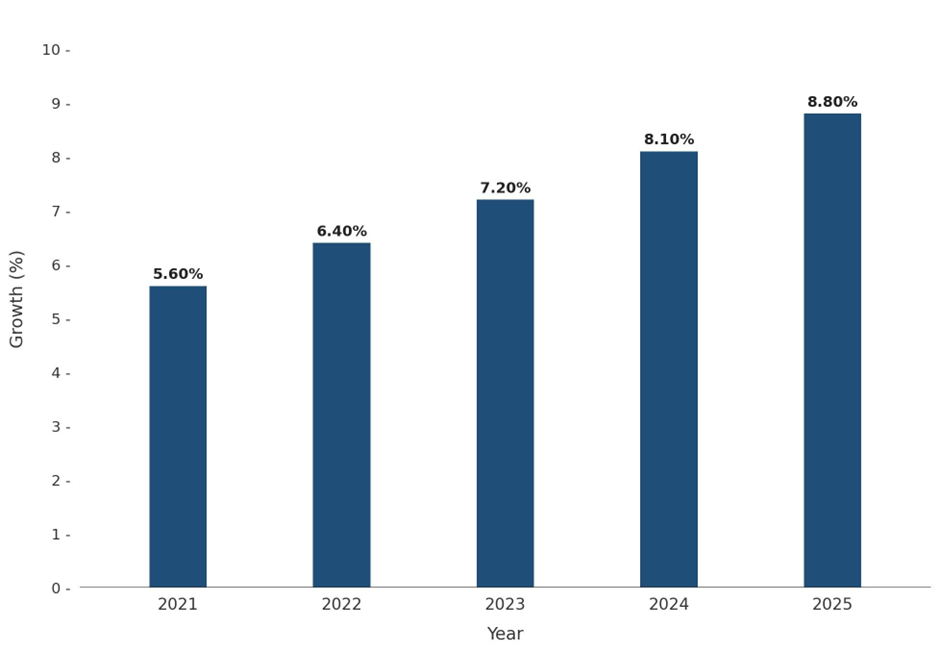
The table below presents the year‑wise growth rates along with the key drivers influencing the market
| Year | Est. Annual Growth (%) | Growth Drivers |
| 2021 | 5.6% | Rising demand for secure authentication systems in banking and finance |
| 2022 | 6.4% | Increasing adoption of biometric solutions in government identity programs |
| 2023 | 7.2% | Expansion of biometric-enabled devices in consumer electronics |
| 2024 | 8.1% | Growth in smart city and surveillance infrastructure |
| 2025 | 8.8% | Increasing integration of AI-driven biometric technologies |
Topics Covered in the Italy Biometrics Technology Market Report
The Italy Biometrics Technology Market report thoroughly covers the market by product type and applications. The market report provides an unbiased and detailed analysis of ongoing market trends, opportunities/high growth areas, and market drivers, which help stakeholders devise and align their market strategies according to the current and future market dynamics.
Italy Biometrics Technology Market Highlights
| Report Name |
Italy Biometrics Technology Market |
| Forecast period | 2026-2032 |
| CAGR | 9.4% |
| Market Size |
Banking & Finance |
Italy Biometrics Technology Market Synopsis
Italy Biometrics Technology Market is anticipated to record notable growth due to increased demand for secure authentication solutions, heightened cyber security threats, and a wide variety of applications within multiple industries. There is an observable growth in the deployment of biometric technologies, including finger print and facial recognition technologies, iris scanners, among others, within the banking sector, governments, as well as consumer electronic industry. Moreover, investment in smart city projects and digital identification solutions is also propelling growth in the market.
Evaluation of Growth Drivers in the Italy Biometrics Technology Market (2026-2032)
Below mentioned are some prominent drivers and their influence on the market dynamics:
| Drivers | Primary Segments Affected | Why it Matters (Evidence) |
| Rising Cybersecurity Concerns | Fingerprint & Face; Banking & Finance | Increasing fraud cases drive adoption of secure biometric authentication systems. |
| Government Digital Identity Programs | All Types; Government | National ID and e-governance initiatives boost biometric system deployment. |
| Growth of Smart Devices | Facial & Voice Recognition; Consumer Electronics | Handsets and wearables have incorporated biometric authentication capabilities. |
| Smart Cities Growth | Facial & Iris Recognition; Security Applications | Security surveillance employs biometric technologies to ensure safety. |
| Rise in Financial Services | Fingerprint & Vein Recognition; Financial Sector | Biometrics increase security and convenience in financial transactions. |
Italy Biometrics Technology Market is expected to grow at the CAGR of 9.4% during the forecast period of 2026-2032. The growth of the biometrics market is fueled by increasing demands for authentication systems from various industries, including the financial sector, governments, and healthcare organizations. The increase in cyber attacks and identity thefts has increased the use of biometric technologies. Furthermore, the development of smart cities and digital transformation strategies contributes to the growth of the market. Ongoing improvements in AI and machine learning improve biometric precision, while rising consumer consciousness promotes its use in consumer products.
Evaluation of Restraints in the Italy Biometrics Technology Market
Below mentioned are some major restraints and their influence on the market dynamics:
| Restraints | Primary Segments Affected | What This Means (Evidence) |
| Data Privacy Issues | All Biometric Types; Government & Finance | Stringent rules restrict data gathering and storing biometric data. |
| Expensive to Implement | Iris & Vein; Corporate Security | Costly systems hinder widespread implementation. |
| Technical Obstacles | Two-Factor Authentication (Face & Voice); Household Products | The biometric system is susceptible to environmental conditions. |
| Interoperability Issues | Biometrics of all Types; Organizations | The biometric system cannot be seamlessly integrated into the current system. |
| Possibility of Security Compromises | All Biometric Systems; Financial Services | Compromised security may result in biometric data being misused. |
Italy Biometrics Technology Industry Challenges
Even though the Italy Biometrics Technology Industry is growing steadily, it still faces a number of practical challenges. Data security continues to be a major issue, since stringent policies demand proper management of personal data. There is also the challenge of high costs of implementation, particularly where expensive technology such as iris and vein recognition is involved. Compatibility with pre-existing systems may also prove to be difficult and costly, resulting in slow adoption of biometric technology. Technical problems associated with accuracy in some environments may affect efficiency.
Italy Biometrics Technology Market Trends
Key trends shaping the Italy Biometrics Technology Market Growth include:
- Increased Deployment of Facial Recognition Technologies: The growing implementation in surveillance and security systems helps to monitor more effectively.
- AI Integration in Biometric Technologies: Biometric technologies powered by AI can provide higher efficiency and flexibility in authentication.
- Deployment of Biometrics in Mobiles: The latest mobile phones are incorporating biometric technology in order to improve their security.
- Utilization of Biometric Technologies in Healthcare Systems: Healthcare systems utilize biometric technologies for identification and protection purposes.
Investment Opportunities in the Italy Biometrics Technology Market
Key investment opportunities in the Italy Biometrics Technology Market include:
- Artificial Intelligence-Driven Biometrics – Supporting advanced algorithms to optimize the performance of biometrics.
- Smart City Development – Providing financial support to biometric surveillance systems in smart cities.
- Biometrics for Mobile Devices – Designing authentication mechanisms in mobile phones and wearable gadgets.
- Biometrics for Healthcare Security – Applying biometrics to patient identification and data security in hospitals.
- Biometrics in Financial Services – Enhancing financial services by integrating biometric verification techniques.
Top 5 Leading Players in the Italy Biometrics Technology Market
Some leading players operating in the Italy Biometrics Technology Market include:
1. Thales Group
| Company Name | Thales Group |
|---|---|
| Established Year | 2000 |
| Headquarters | Paris, France |
| Official Website | Click Here |
Thales Group provides advanced biometric and digital identity solutions used in government and commercial sectors. The company focuses on secure authentication systems, leveraging innovation and global expertise to support identity verification and cybersecurity applications across Italy.
2. IDEMIA
| Company Name | IDEMIA |
|---|---|
| Established Year | 2017 |
| Headquarters | Courbevoie, France |
| Official Website | Click Here |
IDEMIA specializes in augmented identity solutions, offering biometric technologies such as fingerprint and facial recognition. The company supports secure authentication across banking, government, and travel sectors, enhancing digital identity and security frameworks in Italy.
3. NEC Corporation
| Company Name | NEC Corporation |
|---|---|
| Established Year | 1899 |
| Headquarters | Tokyo, Japan |
| Official Website | Click Here |
NEC Corporation is a global leader in biometric technologies, providing facial recognition and fingerprint systems. The company focuses on high-accuracy solutions for security, law enforcement, and enterprise applications, contributing significantly to Italy’s biometric market growth.
4. Fujitsu Limited
| Company Name | Fujitsu Limited |
|---|---|
| Established Year | 1935 |
| Headquarters | Tokyo, Japan |
| Official Website | Click Here |
Fujitsu offers innovative biometric authentication technologies, including palm vein recognition systems. The company emphasizes secure and reliable solutions for financial institutions, healthcare providers, and government agencies, supporting digital transformation initiatives in Italy.
5. HID Global Corporation
| Company Name | HID Global Corporation |
|---|---|
| Established Year | 1991 |
| Headquarters | Texas, USA |
| Official Website | Click Here |
HID Global provides identity and access management solutions, including biometric authentication systems. The company focuses on secure access control technologies and supports organizations in enhancing security infrastructure across various industries in Italy.
Government Regulations Introduced in the Italy Biometrics Technology Market
According to Italy’s Government Data, various regulations and innovations have had a considerable impact on the biometrics technology market. GDPR is one such regulation that ensures the secure use of biometric information. In addition to this, the deployment of government-led digital identity systems such as SPID has been contributing towards the increasing use of biometric authentication systems. Investment made by governments in developing smart cities has further resulted in an increase in the application of biometric systems for surveillance purposes. Finally, the need for cybersecurity infrastructure has also driven organizations to adopt advanced authentication mechanisms.
Future Insights of the Italy Biometrics Technology Market
Italy Biometrics Technology Market Share is expected to witness strong growth driven by increasing digital transformation, rising demand for secure authentication, and advancements in biometric technologies. The emergence of smart city programs along with identity programs backed by governments will keep on generating more possibilities in the future. In addition, the combination of artificial intelligence and machine learning will help improve the efficacy of biometric technology. The rising use of contactless and mobile-based authentication techniques will also boost the market. The market has potential to grow constantly due to continuous innovations and various applications in different sectors.
Market Segmentation Analysis
The report offers a comprehensive study of the subsequent market segments and their leading categories.
Fingerprint to Dominate the Market – By Types
According to Mohit, Senior Research Analyst, 6Wresearch, the Fingerprint segment dominates the Italy Biometrics Technology Market. This dominance has been made possible by its prevalence in mobile devices, banking systems, and government uses due to its reliability and efficiency. This technology sector is favored due to its easy integration and recognition by consumers. In addition, improvements have been made in the field of fingerprint scanning technology.
Banking & Finance to Dominate the Market – By Applications
The Banking & Finance segment is another key contributor to the Italy Biometrics Technology Market. Banks are integrating biometric technology into their operations to increase security and minimize fraudulent activities. For example, fingerprinting and facial recognition are popular technologies that banks deploy to improve transactions. The popularity of mobile banking and ATMs has also boosted this segment's performance.
Key Attractiveness of the Report
- 10 Years of Market Numbers.
- Historical Data Starting from 2022 to 2025.
- Base Year: 2025.
- Forecast Data until 2032.
- Key Performance Indicators Impacting the Market.
- Major Upcoming Developments and Projects.
Key Highlights of the Report:
- Italy Biometrics Technology Market Outlook
- Market Size of Italy Biometrics Technology Market, 2025
- Forecast of Italy Biometrics Technology Market, 2032
- Historical Data and Forecast of Italy Biometrics Technology Revenues & Volume for the Period 2022 - 2032
- Italy Biometrics Technology Market Trend Evolution
- Italy Biometrics Technology Market Drivers and Challenges
- Italy Biometrics Technology Price Trends
- Italy Biometrics Technology Porter's Five Forces
- Italy Biometrics Technology Industry Life Cycle
- Historical Data and Forecast of Italy Biometrics Technology Market Revenues & Volume By Types for the Period 2022 - 2032
- Historical Data and Forecast of Italy Biometrics Technology Market Revenues & Volume By Fingerprint for the Period 2022 - 2032
- Historical Data and Forecast of Italy Biometrics Technology Market Revenues & Volume By Palm for the Period 2022 - 2032
- Historical Data and Forecast of Italy Biometrics Technology Market Revenues & Volume By Face for the Period 2022 - 2032
- Historical Data and Forecast of Italy Biometrics Technology Market Revenues & Volume By Iris / Retina for the Period 2022 - 2032
- Historical Data and Forecast of Italy Biometrics Technology Market Revenues & Volume By Vein for the Period 2022 - 2032
- Historical Data and Forecast of Italy Biometrics Technology Market Revenues & Volume By Voice for the Period 2022 - 2032
- Historical Data and Forecast of Italy Biometrics Technology Market Revenues & Volume By Signature and others for the Period 2022 - 2032
- Historical Data and Forecast of Italy Biometrics Technology Market Revenues & Volume By Applications for the Period 2022 - 2032
- Historical Data and Forecast of Italy Biometrics Technology Market Revenues & Volume By Government for the Period 2022 - 2032
- Historical Data and Forecast of Italy Biometrics Technology Market Revenues & Volume By Defense for the Period 2022 - 2032
- Historical Data and Forecast of Italy Biometrics Technology Market Revenues & Volume By Travel & Immigration for the Period 2022 - 2032
- Historical Data and Forecast of Italy Biometrics Technology Market Revenues & Volume By Home Security for the Period 2022 - 2032
- Historical Data and Forecast of Italy Biometrics Technology Market Revenues & Volume By Banking & finance for the Period 2022 - 2032
- Historical Data and Forecast of Italy Biometrics Technology Market Revenues & Volume By Consumer electronics for the Period 2022 - 2032
- Historical Data and Forecast of Italy Biometrics Technology Market Revenues & Volume By Healthcare for the Period 2022 - 2032
- Historical Data and Forecast of Italy Biometrics Technology Market Revenues & Volume By Commercial security and others for the Period 2022 - 2032
- Italy Biometrics Technology Import Export Trade Statistics
- Market Opportunity Assessment By Types
- Market Opportunity Assessment By Applications
- Italy Biometrics Technology Top Companies Market Share
- Italy Biometrics Technology Competitive Benchmarking By Technical and Operational Parameters
- Italy Biometrics Technology Company Profiles
- Italy Biometrics Technology Key Strategic Recommendations
Market Covered
The report offers a comprehensive study of the subsequent market segments:
By Types
- Fingerprint
- Palm
- Face
- Iris / Retina
- Vein
- Voice
- Signature and others
By Applications
- Government
- Defense
- Travel & Immigration
- Home Security
- Banking & finance
- Consumer electronics
- Healthcare
- Commercial security and others






































