Italy Cloud Infrastructure Services Market Size & Growth Rate (2026-2032)
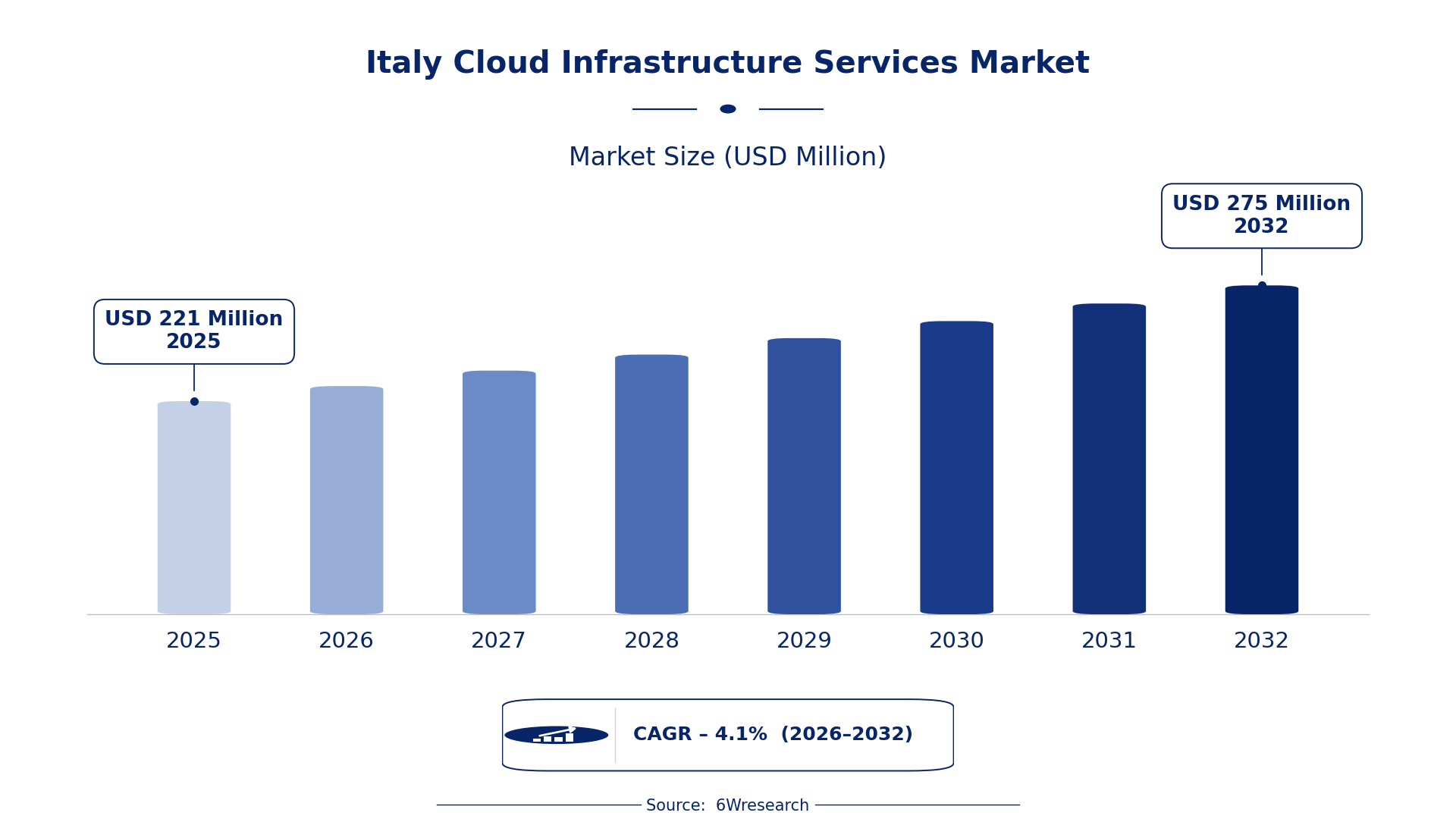
The Italy Cloud Infrastructure Services Market was estimated at USD 221 Million in 2025 and is projected to reach USD 275 Million by 2032, growing at a CAGR of 4.1% from 2026 to 2032.
Italy Cloud Infrastructure Services Market Synopsis
The demand for cloud infrastructure services in Italy is surging as organizations recognize the advantages of shifting from traditional IT setups to cloud-based solutions. Businesses are eager to harness scalable and cost-effective options that facilitate their digital transformation journeys, with a particular emphasis on Infrastructure as a Service (IaaS) offerings.
As Italian companies increasingly migrate workloads to the cloud, they are reducing capital expenditures associated with hardware and maintenance. This transition is spurred by the rising importance of data analytics, IoT, and AI technologies, which all rely on robust cloud infrastructure to operate effectively.
Italy Cloud Infrastructure Services Market Year-wise Growth Rate and Key Drivers
This graph illustrates the annual growth rates of the Italy Cloud Infrastructure Services Market from 2021 to 2032, highlighting a steady upward trajectory and projected expansion over the forecast period.
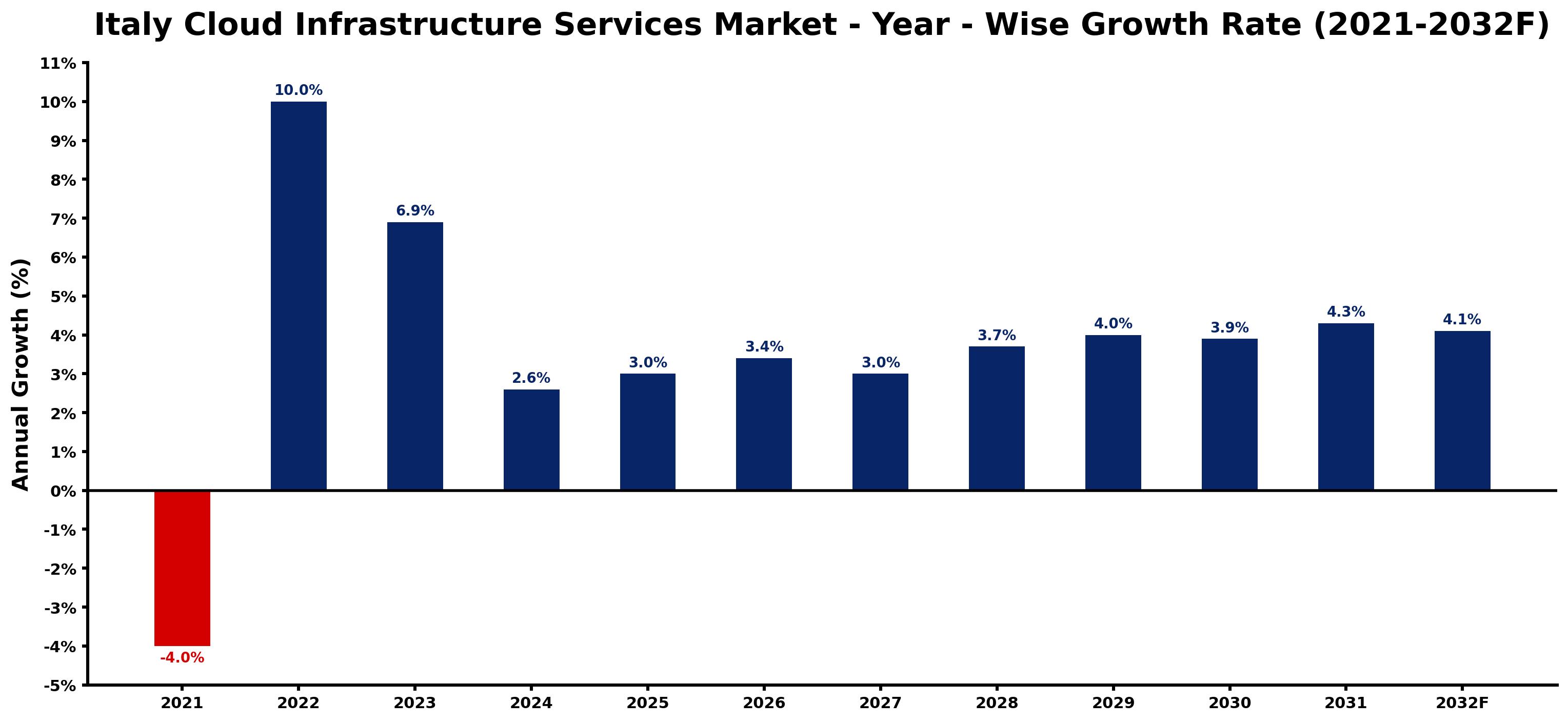
The table below presents the year‑wise growth rates along with the key drivers influencing the market
| Year | Growth Rate | Major Drivers |
| 2021 | -4.0% | Italian government delays on digital transformation funding |
| 2022 | 10.0% | Italian government promoting digital transformation initiatives for SMEs |
| 2023 | 6.9% | Increasing cybersecurity regulations boosting cloud service adoption |
| 2024 | 2.6% | Regional focus on green data centers for sustainability |
| 2025 | 3.0% | Telecom Italia enhancing cloud capabilities for enterprise customers |
| 2026 | 3.4% | Rising e-commerce demand fueling need for cloud resources |
| 2027 | 3.0% | Italian industries migrating to cloud for cost efficiency |
| 2028 | 3.7% | Cloud services supporting education sector's digitalization efforts |
| 2029 | 4.0% | Growth of IoT applications driving cloud infrastructure needs |
| 2030 | 3.9% | Emerging fintech sector utilizing cloud for innovative solutions |
| 2031 | 4.3% | National policies incentivizing cloud investment and innovation |
| 2032 | 4.1% | Increased adoption of hybrid cloud models by enterprises |
Note: Market size estimations and growth projections presented in this report are based on 6Wresearch's proprietary forecasting methodology, utilizing the latest available industry data, government publications, and primary research inputs.
Italy Cloud Infrastructure Services Market Key Takeaways
Below are some of the specific key takeaways from the market, including:
- The shift to cloud-based models is reshaping the IT infrastructure of Italian organizations.
- Cost savings and operational agility are primary drivers for businesses adopting cloud services.
- Regulatory constraints around data sovereignty pose challenges for cloud service providers.
- Emerging technologies such as AI and IoT are significantly influencing cloud adoption rates.
- Local players are competing alongside global providers, enriching the service offerings available.
Evaluation of Restraints in Italy Cloud Infrastructure Services Market
Despite the positive growth trajectory, several restraints limit the Italy Cloud Infrastructure Services Market. One major obstacle is the necessity for a robust network infrastructure that can support high-performance cloud services. Providers often grapple with regulatory challenges, particularly concerning data sovereignty laws, which complicate data management and compliance efforts. on top of that, the competitive environment demands optimization of resource utilization while managing costs, a delicate balance that both providers and consumers must achieve. The risk of vendor lock-in and the need for interoperability across multi-cloud environments also add layers of complexity for businesses looking to adopt these services.
Italy Cloud Infrastructure Services Market Trends
Current trends in the Italy Cloud Infrastructure Services Market indicate a clear shift towards hybrid cloud solutions, as organizations seek flexibility in managing workloads. There's a growing focus on enhancing cybersecurity measures to protect sensitive data in cloud environments. Additionally, many businesses are exploring partnerships with cloud service providers to innovate and accelerate their digital initiatives. The integration of artificial intelligence into cloud services is also becoming prevalent, enabling more efficient data processing and analytics.
Italy Cloud Infrastructure Services Market Opportunities
The opportunities within the Italy Cloud Infrastructure Services Market are substantial. The increasing demand for cloud-based solutions across various sectors, including healthcare, finance, and retail, presents a fertile ground for investment. As businesses continue to embrace digital transformation, there is a pressing need for tailored cloud solutions that address specific industry challenges. The expansion of broadband connectivity initiatives by the government further enhances access to cloud services, making it an opportune time for providers to expand their offerings.
Government Initiatives in the Italy Cloud Infrastructure Services Market
The Italian government is actively promoting cloud adoption to modernize public sector IT infrastructure and stimulate innovation across industries. Through a range of policies, the government aims to encourage businesses to transition to cloud computing, which is crucial for enhancing efficiency and reducing costs. Current initiatives focus on fostering digital connectivity and expanding broadband access, directly impacting the growth of the cloud infrastructure services market.
- A national digital infrastructure upgrade programme recently completed in 2025 has enhanced connectivity for public services.
- Ongoing initiatives are centered around the Cloud First approach, which mandates the use of cloud solutions in public sector projects.
- Planned public-private partnerships expected to roll out by 2028 aim to improve telecom infrastructure access across rural areas.
- The government is currently reviewing data protection regulations to ensure compliance with EU standards while promoting cloud services.
- A regulatory framework introduced in 2025 is promoting billing transparency for cloud services, enhancing consumer trust.
Future Insights of the Italy Cloud Infrastructure Services Market
Looking ahead to 2026-2032, the Italy Cloud Infrastructure Services Market is expected to evolve significantly. Continued digital transformation efforts will drive further cloud adoption, with businesses increasingly seeking flexible and secure cloud solutions. Emerging technologies, particularly in AI and machine learning, will transform how companies utilize cloud services, paving the way for innovative applications and enhanced operational efficiencies. As regulatory frameworks stabilize, confidence in cloud solutions will likely grow, encouraging wider adoption.
Italy Cloud Infrastructure Services Market Latest Developments
Over the past year, activity within the Italy Cloud Infrastructure Services Market has intensified, reflecting broader trends in digital transformation and cloud adoption. Numerous initiatives have been launched, signaling a commitment from both the public and private sectors to enhance cloud capabilities. As organizations increasingly recognize the value of cloud solutions, the market is poised for accelerated growth.
- A major technology vendor launched a new IaaS platform in early 2025, focusing on improving operational agility for SMEs.
- In Q3 2025, a leading regional operator expanded its data center capabilities to accommodate growing demand for cloud services.
- An initiative that began in mid-2025 is currently underway, aiming to enhance cybersecurity protocols for cloud services.
- Plans for a nationwide cloud education programme targeting businesses are expected to commence in early 2026.
- A collaborative project between technology firms and universities is set to kick off in late 2025, aimed at fostering innovation in cloud technologies.
Italy Cloud Infrastructure Services Market - Key Attractiveness of the Report
- 10 Years of Market Numbers
- Historical Data Starting from 2022 to 2025
- Base Year: 2025
- Forecast Data until 2032
- Key Performance Indicators Impacting the Market
- Major Upcoming Developments and Projects
Key Highlights of the Report:
- Italy Cloud Infrastructure Services Market Outlook
- Market Size of Italy Cloud Infrastructure Services Market, 2025
- Forecast of Italy Cloud Infrastructure Services Market, 2032
- Historical Data and Forecast of Italy Cloud Infrastructure Services Revenues & Volume for the Period 2022-2032F
- Italy Cloud Infrastructure Services Market Trend Evolution
- Italy Cloud Infrastructure Services Market Drivers and Challenges
- Italy Cloud Infrastructure Services Price Trends
- Italy Cloud Infrastructure Services Porter's Five Forces
- Italy Cloud Infrastructure Services Industry Life Cycle
- Historical Data and Forecast of Italy Cloud Infrastructure Services Market Revenues & Volume By Service Type for the Period 2022-2032F
- Historical Data and Forecast of Italy Cloud Infrastructure Services Market Revenues & Volume By Compute as a Service for the Period 2022-2032F
- Historical Data and Forecast of Italy Cloud Infrastructure Services Market Revenues & Volume By Storage as a Service for the Period 2022-2032F
- Historical Data and Forecast of Italy Cloud Infrastructure Services Market Revenues & Volume By Disaster Recovery and Backup as a Service for the Period 2022-2032F
- Historical Data and Forecast of Italy Cloud Infrastructure Services Market Revenues & Volume By Networking as a Service for the Period 2022-2032F
- Historical Data and Forecast of Italy Cloud Infrastructure Services Market Revenues & Volume By Desktop as a Service for the Period 2022-2032F
- Historical Data and Forecast of Italy Cloud Infrastructure Services Market Revenues & Volume By Managed Hosting for the Period 2022-2032F
- Historical Data and Forecast of Italy Cloud Infrastructure Services Market Revenues & Volume By Deployment Type for the Period 2022-2032F
- Historical Data and Forecast of Italy Cloud Infrastructure Services Market Revenues & Volume By On-premises for the Period 2022-2032F
- Historical Data and Forecast of Italy Cloud Infrastructure Services Market Revenues & Volume By Cloud for the Period 2022-2032F
- Historical Data and Forecast of Italy Cloud Infrastructure Services Market Revenues & Volume By Organization Size for the Period 2022-2032F
- Historical Data and Forecast of Italy Cloud Infrastructure Services Market Revenues & Volume By Small and Medium-sized Enterprises (SMEs) for the Period 2022-2032F
- Historical Data and Forecast of Italy Cloud Infrastructure Services Market Revenues & Volume By Large Enterprises for the Period 2022-2032F
- Historical Data and Forecast of Italy Cloud Infrastructure Services Market Revenues & Volume By Vertical for the Period 2022-2032F
- Historical Data and Forecast of Italy Cloud Infrastructure Services Market Revenues & Volume By Banking, Financial Services, and Insurance (BFSI) for the Period 2022-2032F
- Historical Data and Forecast of Italy Cloud Infrastructure Services Market Revenues & Volume By IT and Telecommunications for the Period 2022-2032F
- Historical Data and Forecast of Italy Cloud Infrastructure Services Market Revenues & Volume By Government and Public Sector for the Period 2022-2032F
- Historical Data and Forecast of Italy Cloud Infrastructure Services Market Revenues & Volume By Retail and Consumer Goods for the Period 2022-2032F
- Historical Data and Forecast of Italy Cloud Infrastructure Services Market Revenues & Volume By Manufacturing for the Period 2022-2032F
- Historical Data and Forecast of Italy Cloud Infrastructure Services Market Revenues & Volume By Energy and Utilities for the Period 2022-2032F
- Historical Data and Forecast of Italy Cloud Infrastructure Services Market Revenues & Volume By Media and Entertainment for the Period 2022-2032F
- Historical Data and Forecast of Italy Cloud Infrastructure Services Market Revenues & Volume By Healthcare and Life Sciences for the Period 2022-2032F
- Italy Cloud Infrastructure Services Import Export Trade Statistics
- Market Opportunity Assessment By Service Type
- Market Opportunity Assessment By Deployment Type
- Market Opportunity Assessment By Organization Size
- Market Opportunity Assessment By Vertical
- Italy Cloud Infrastructure Services Top Companies Market Share
- Italy Cloud Infrastructure Services Competitive Benchmarking By Technical and Operational Parameters
- Italy Cloud Infrastructure Services Company Profiles
- Italy Cloud Infrastructure Services Key Strategic Recommendations






































