Italy Cocoa Products Market Size (2020-2030)
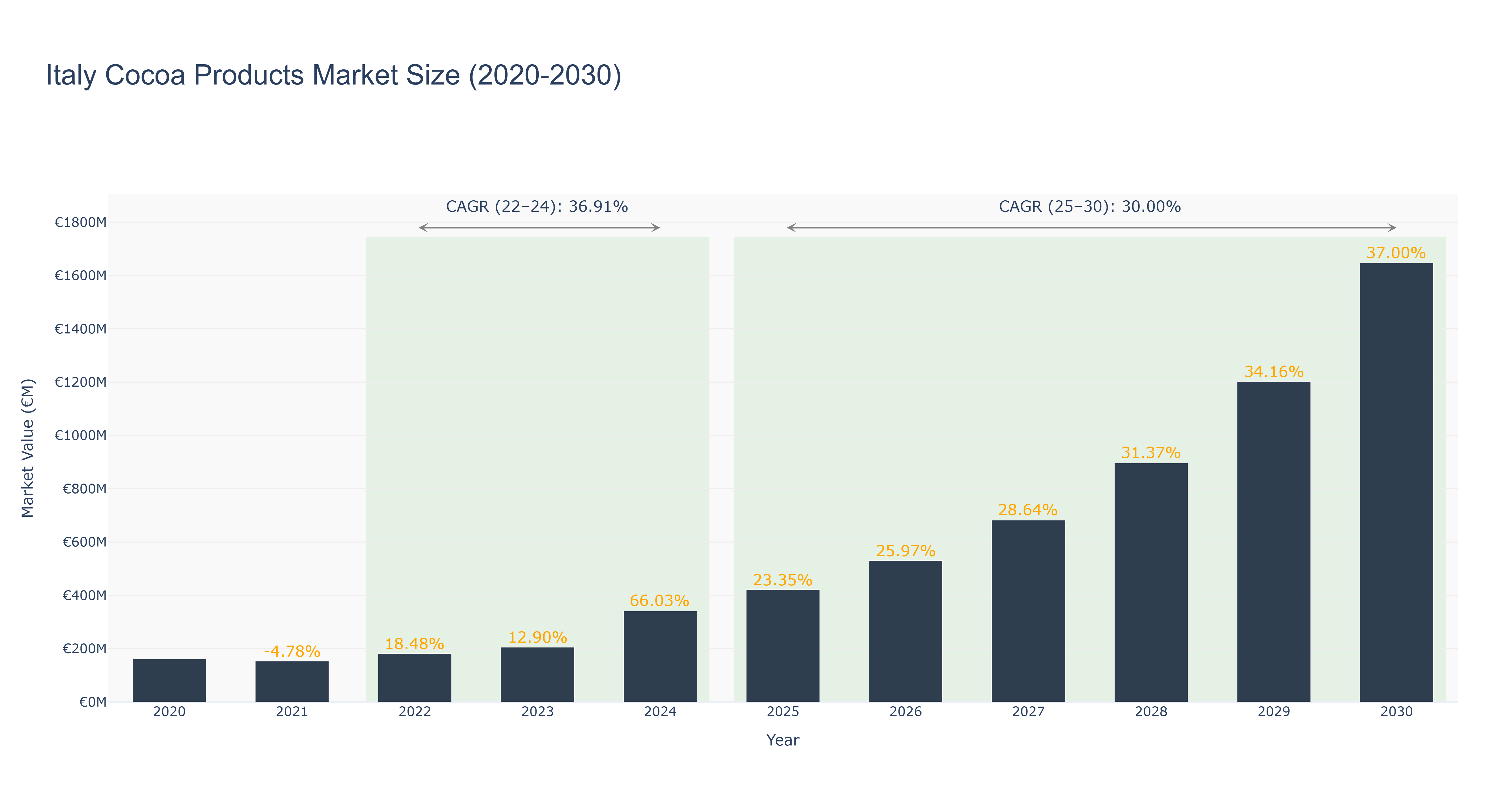
The Italy Cocoa Products Market experienced significant fluctuations in the actual years from 2020 to 2024, peaking at €341.30 million in 2024, reflecting a remarkable growth rate of 66.03% from the previous year. During this period, the market saw a decline in 2021, followed by a robust recovery in 2022 and 2023, fueled by increasing consumer demand for premium chocolate products and the growing popularity of cocoa-based snacks. Looking ahead, the forecasted market values indicate a continued upward trajectory, with projected sizes reaching €1.65 billion by 2030, supported by a compound annual growth rate (CAGR) of 30.00% from 2025 to 2030. Key drivers include innovative product development, rising health awareness associated with cocoa, and the expansion of e-commerce platforms enhancing market accessibility. These trends suggest a dynamic growth environment for stakeholders in the Italian cocoa products sector.
Italy Cocoa Products Market: Production & Trade Performance (2019-2025)
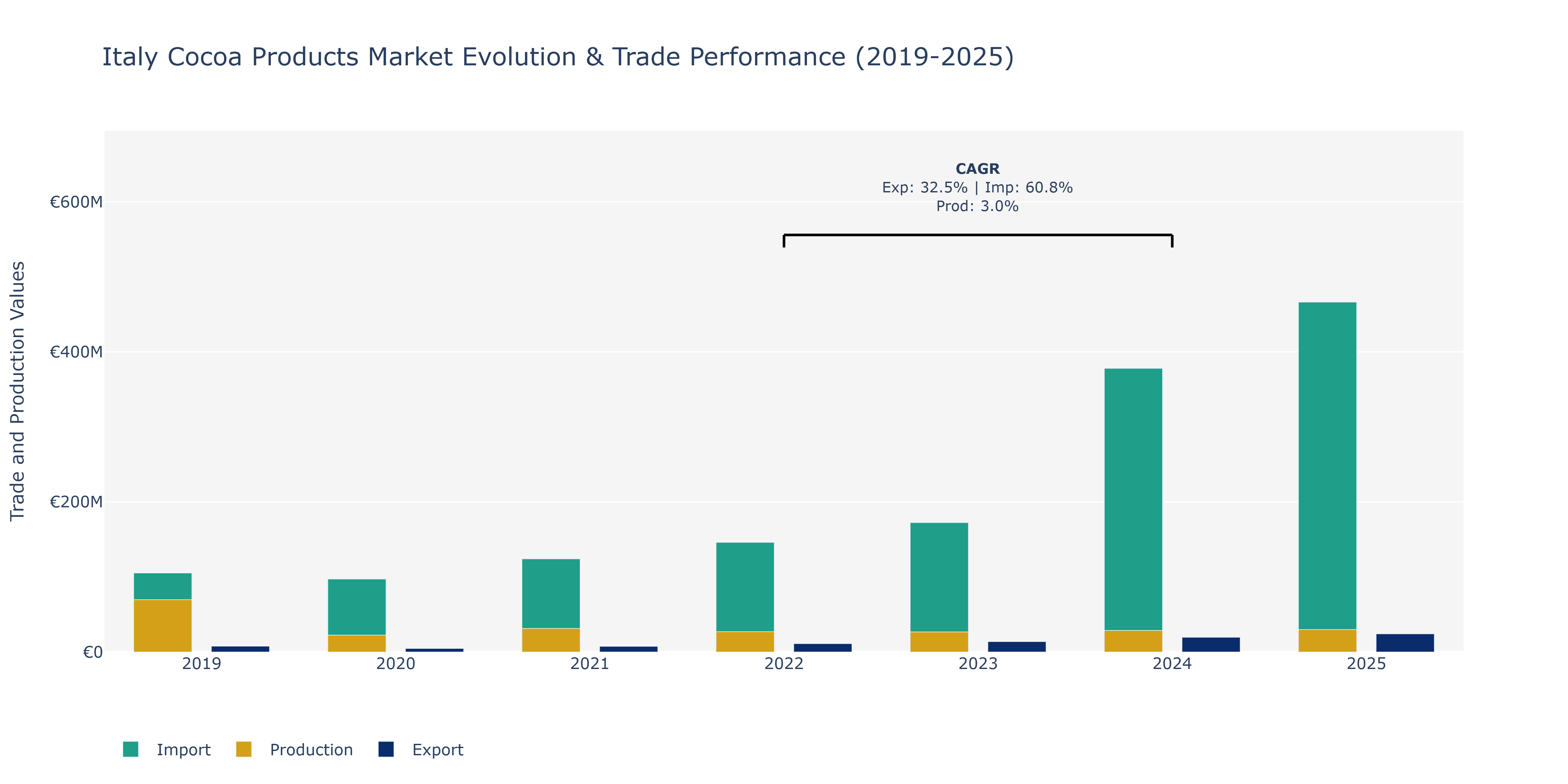
Between 2019 and 2025, Italy's Cocoa Products Market saw dynamic shifts in Exports, Imports, and Production. Exports experienced substantial growth, starting at €7.83 million in 2019 and peaking at €24.32 million in 2025. This rise can be attributed to an increasing global demand for Italian cocoa products known for their quality and unique flavors. Imports also surged significantly from €105.31 million in 2019 to €466.41 million in 2025, indicating a growing reliance on international markets for raw materials or specific product types. In contrast, Production fluctuated during this period, reaching its highest point in 2025 at €29.89 million, possibly influenced by internal factors like production capacity adjustments or supply chain optimizations. Overall, Italy's Cocoa Products Market showcases a strong export-oriented approach backed by a steady increase in imports to meet market demands and maintain competitiveness in the global cocoa industry.
Italy Cocoa Products Market Synopsis
The cocoa products market in Italy includes a wide range of chocolate products, cocoa-based beverages, and cocoa confectionery items. Italy has a rich tradition of chocolate making, and the market is characterized by the presence of both artisanal and industrial chocolate producers. Consumer preferences for premium and gourmet chocolate products drive innovation and competition in the cocoa products market.
Drivers of the market
The cocoa products market in Italy benefits from the growing consumption of chocolate products and cocoa-based beverages in the country. Factors such as changing consumer lifestyles, increasing disposable income, and the rising trend of indulgence drive the demand for cocoa products in Italy. The presence of renowned chocolate manufacturers and confectionery brands further boosts market growth. Moreover, product innovation, such as the introduction of sugar-free and organic cocoa products, caters to the evolving preferences of health-conscious consumers. Additionally, marketing initiatives and promotional campaigns highlighting the premium quality and unique flavors of Italy cocoa products contribute to market expansion.
Challenges of the market
The cocoa products market in Italy is challenged by rising raw material costs and shifting consumer preferences. Increasing cocoa prices affect the cost of production for various cocoa products, including chocolate, cocoa butter, and cocoa powder. Moreover, consumers are increasingly looking for products that are both high-quality and ethically sourced, pushing manufacturers to invest in sustainability initiatives and certifications. The competition from other confectionery and snack products also puts pressure on cocoa product manufacturers to innovate and differentiate their offerings.
Government Policy of the market
The Italy government has policies in place to support the cocoa products market, including measures to ensure high standards of quality and sustainability. There are regulations to prevent adulteration and to promote the use of pure cocoa ingredients. Financial incentives are provided for companies that invest in sustainable sourcing and production practices. Additionally, there are promotional campaigns to enhance the global reputation of Italy cocoa products.
Key Highlights of the Report:
- Italy Cocoa Products Market Outlook
- Market Size of Italy Cocoa Products Market, 2024
- Forecast of Italy Cocoa Products Market, 2031
- Historical Data and Forecast of Italy Cocoa Products Revenues & Volume for the Period 2018 - 2031
- Italy Cocoa Products Market Trend Evolution
- Italy Cocoa Products Market Drivers and Challenges
- Italy Cocoa Products Price Trends
- Italy Cocoa Products Porter's Five Forces
- Italy Cocoa Products Industry Life Cycle
- Historical Data and Forecast of Italy Cocoa Products Market Revenues & Volume By Type for the Period 2018 - 2031
- Historical Data and Forecast of Italy Cocoa Products Market Revenues & Volume By Cocoa Beans for the Period 2018 - 2031
- Historical Data and Forecast of Italy Cocoa Products Market Revenues & Volume By Cocoa Butter for the Period 2018 - 2031
- Historical Data and Forecast of Italy Cocoa Products Market Revenues & Volume By Cocoa Powder & Cake for the Period 2018 - 2031
- Historical Data and Forecast of Italy Cocoa Products Market Revenues & Volume By Cocoa Paste & Liquor for the Period 2018 - 2031
- Historical Data and Forecast of Italy Cocoa Products Market Revenues & Volume By Chocolate for the Period 2018 - 2031
- Historical Data and Forecast of Italy Cocoa Products Market Revenues & Volume By Application for the Period 2018 - 2031
- Historical Data and Forecast of Italy Cocoa Products Market Revenues & Volume By Confectionery for the Period 2018 - 2031
- Historical Data and Forecast of Italy Cocoa Products Market Revenues & Volume By Food & Beverages for the Period 2018 - 2031
- Historical Data and Forecast of Italy Cocoa Products Market Revenues & Volume By Cosmetics for the Period 2018 - 2031
- Historical Data and Forecast of Italy Cocoa Products Market Revenues & Volume By Pharmaceutical for the Period 2018 - 2031
- Italy Cocoa Products Import Export Trade Statistics
- Market Opportunity Assessment By Type
- Market Opportunity Assessment By Application
- Italy Cocoa Products Top Companies Market Share
- Italy Cocoa Products Competitive Benchmarking By Technical and Operational Parameters
- Italy Cocoa Products Company Profiles
- Italy Cocoa Products Key Strategic Recommendations






































