Italy Computer Graphics Market Size & Growth Rate (2026-2032)
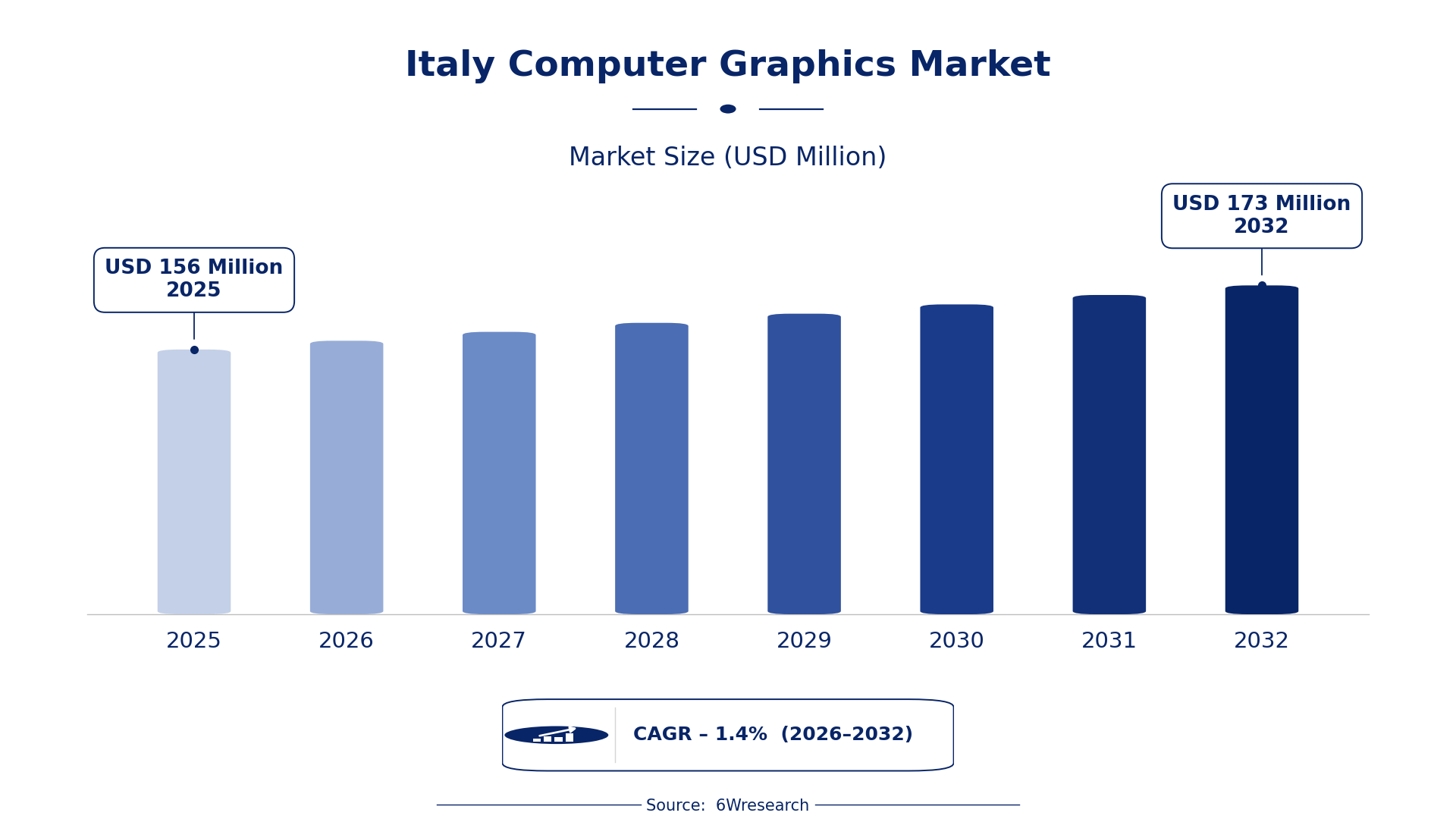
The Italy Computer Graphics Market was estimated at USD 156 Million in 2025 and is projected to reach USD 173 Million by 2032, growing at a CAGR of 1.4% from 2026 to 2032.
Italy Computer Graphics Market Synopsis
The demand for innovative computer graphics solutions in Italy is driven by a booming digital entertainment sector, particularly in gaming and animation. Local companies are increasingly focusing on creating visually stunning experiences, catering to both domestic and international markets.
The architectural visualization segment is also gaining traction, as architects and developers seek to present their projects with high-quality graphics. This trend highlights the necessity for advanced software and hardware that can meet the unique requirements of diverse industries.
Italy Computer Graphics Market Year-wise Growth Rate and Key Drivers
This graph illustrates the annual growth rates of the Italy Computer Graphics Market from 2021 to 2032, highlighting a steady upward trajectory and projected expansion over the forecast period.
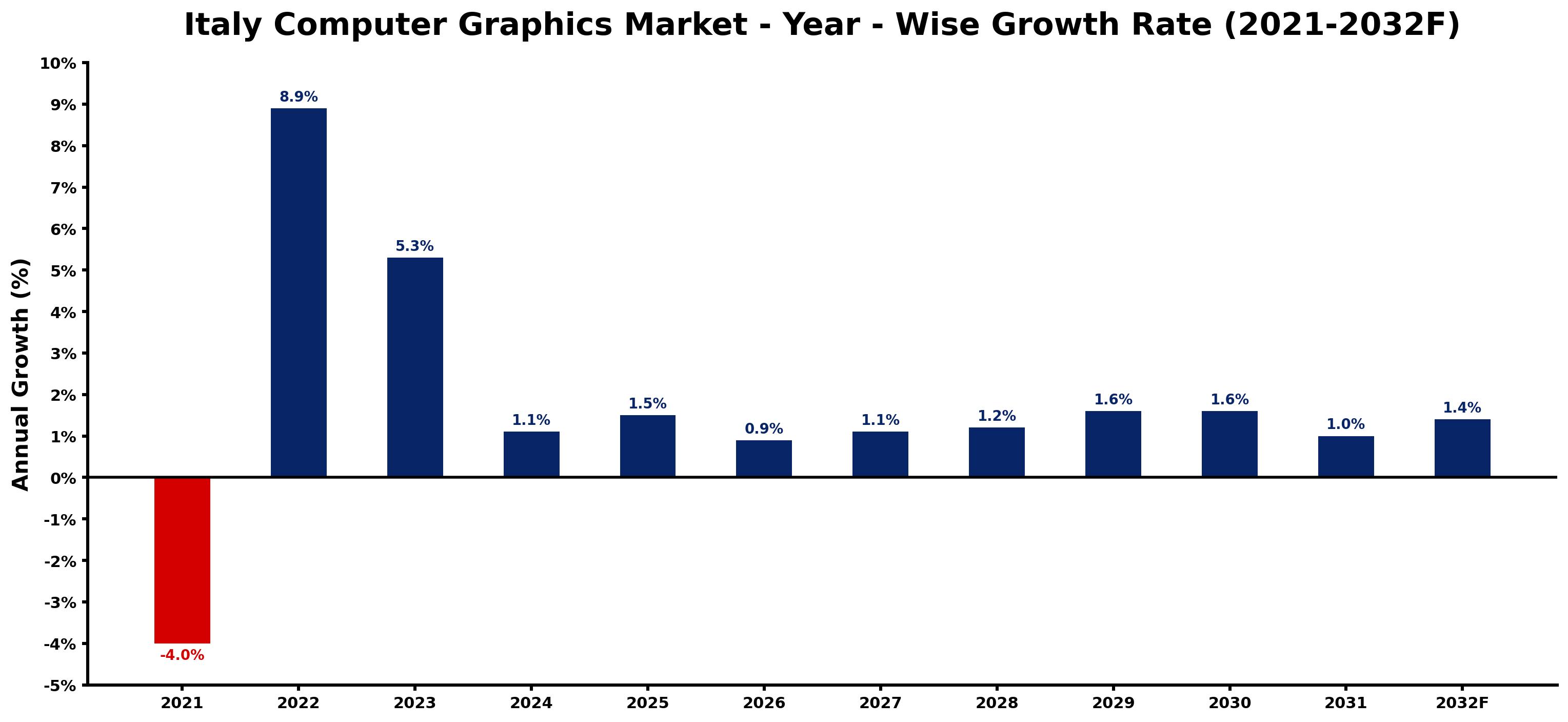
The table below presents the year‑wise growth rates along with the key drivers influencing the market
| Year | Growth Rate | Major Drivers |
| 2021 | -4.0% | Reduced art funding from MIBACT affecting projects |
| 2022 | 8.9% | Increased demand for digital content in entertainment sector. |
| 2023 | 5.3% | Adoption of AR/VR technologies in education and training. |
| 2024 | 1.1% | Growth of local animation and game development studios. |
| 2025 | 1.5% | Government incentives for digital innovation in creatives. |
| 2026 | 0.9% | Rise in remote collaboration tools for creators. |
| 2027 | 1.1% | Higher investments in cultural heritage digitalization projects. |
| 2028 | 1.2% | Emergence of 3D printing applications in design industries. |
| 2029 | 1.6% | Educational reforms integrating computer graphics in curricula. |
| 2030 | 1.6% | Improved local software development capabilities in graphics. |
| 2031 | 1.0% | Increase in film production utilizing computer-generated imagery. |
| 2032 | 1.4% | Enhancements in GPU technology adoption by local firms. |
Note: Market size estimations and growth projections presented in this report are based on 6Wresearch's proprietary forecasting methodology, utilizing the latest available industry data, government publications, and primary research inputs.
Italy Computer Graphics Market Key Takeaways
Below are some of the specific key takeaways from the market, including:
- The market is experiencing steady growth, driven by the demand for visually appealing content.
- Increased adoption of VR and AR technologies is shaping the future of computer graphics.
- Investment in R&D is crucial for companies to keep pace with technological advancements.
- Strong government support through policies and initiatives encourages innovation in the sector.
- Competition among domestic and international players necessitates differentiation through quality and service.
Evaluation of Restraints in Italy Computer Graphics Market
The Italy Computer Graphics Market grapples with significant restraints that can hinder its growth. One of the most pressing challenges is the rapid pace of technological change. Companies must continuously invest in new tools and solutions to stay relevant, which can strain financial resources. on top of that, as the market becomes saturated, players face intense competition, leading to pricing pressures that can squeeze margins. This environment necessitates a strategic focus on innovation and customer service to maintain a competitive edge.
Italy Computer Graphics Market Trends
Notable trends in the Italy Computer Graphics Market include the integration of AI in graphic design tools, allowing for automation and enhanced creativity. The rise of remote working has also accelerated the need for cloud-based graphics solutions, making collaboration easier among teams. Additionally, the increasing popularity of 3D modeling in various sectors is pushing companies to develop more sophisticated graphic software.
Italy Computer Graphics Market Opportunities
Opportunities abound in niche markets such as virtual reality training programs for industries like healthcare and education. As organizations increasingly recognize the value of immersive experiences, demand for high-quality graphics will rise. on top of that, cross-industry collaborations could lead to innovative applications of computer graphics, unlocking new revenue streams for proactive companies.
Government Initiatives in the Italy Computer Graphics Market
The Italian government actively fosters growth in the computer graphics sector, emphasizing innovation and digital transformation. This supportive regulatory environment is crucial for local businesses aiming to enhance their capabilities and compete globally. Through various initiatives, the government aims to boost R&D and collaboration between academic institutions and industry stakeholders.
- A recently completed initiative introduced tax incentives for companies investing in R&D related to computer graphics technologies.
- A current project focuses on establishing partnerships between universities and tech firms to enhance talent development in graphics design.
- Upcoming plans include a nationwide program aimed at upgrading digital infrastructure to support the growing demands of the graphics industry.
- Ongoing support for digitalization efforts across various sectors is expected to enhance the adoption of graphics technologies.
Future Insights of the Italy Computer Graphics Market
Looking ahead to 2026-2032, the Italy Computer Graphics Market is set to evolve significantly. As consumer expectations for visually engaging content rise, companies that can innovate will thrive. The integration of machine learning and AI will likely redefine workflows, making graphics creation more efficient. on top of that, as sectors like gaming and architectural visualization continue to expand, businesses are encouraged to explore new technologies to meet evolving demands.
Italy Computer Graphics Market Latest Developments
Recent developments in the Italy Computer Graphics Market reflect a dynamic environment focused on innovation and collaboration. As the market continues to grow, companies are launching new initiatives to enhance their offerings and expand their market presence.
- A major technology vendor launched a next-generation graphics rendering software in early 2025, enhancing the capabilities for animation and gaming developers.
- An ongoing partnership between leading design firms and tech startups aims to create advanced visualization tools, expected to yield results by mid-2026.
- A recent workshop series focused on best practices for integrating AR in design processes was completed in late 2025, attracting significant participation.
- Upcoming initiatives include a rollout of an AI-driven graphic design tool planned for late 2026, which aims to simplify complex design tasks.
Italy Computer Graphics Market - Key Attractiveness of the Report
- 10 Years of Market Numbers
- Historical Data Starting from 2022 to 2025
- Base Year: 2025
- Forecast Data until 2032
- Key Performance Indicators Impacting the Market
- Major Upcoming Developments and Projects
The Italian government supports the sector through tax incentives for R&D, fostering innovation and collaboration between academia and industry.
Key Highlights of the Report:
- Italy Computer Graphics Market Outlook
- Market Size of Italy Computer Graphics Market, 2025
- Forecast of Italy Computer Graphics Market, 2032
- Historical Data and Forecast of Italy Computer Graphics Revenues & Volume for the Period 2022-2032F
- Italy Computer Graphics Market Trend Evolution
- Italy Computer Graphics Market Drivers and Challenges
- Italy Computer Graphics Price Trends
- Italy Computer Graphics Porter's Five Forces
- Italy Computer Graphics Industry Life Cycle
- Historical Data and Forecast of Italy Computer Graphics Market Revenues & Volume By Software for the Period 2022-2032F
- Historical Data and Forecast of Italy Computer Graphics Market Revenues & Volume By CAD/CAM for the Period 2022-2032F
- Historical Data and Forecast of Italy Computer Graphics Market Revenues & Volume By Visualization/Simulation for the Period 2022-2032F
- Historical Data and Forecast of Italy Computer Graphics Market Revenues & Volume By Digital video for the Period 2022-2032F
- Historical Data and Forecast of Italy Computer Graphics Market Revenues & Volume By Imaging for the Period 2022-2032F
- Historical Data and Forecast of Italy Computer Graphics Market Revenues & Volume By Modeling/Animation for the Period 2022-2032F
- Historical Data and Forecast of Italy Computer Graphics Market Revenues & Volume By End-User for the Period 2022-2032F
- Historical Data and Forecast of Italy Computer Graphics Market Revenues & Volume By Enterprise for the Period 2022-2032F
- Historical Data and Forecast of Italy Computer Graphics Market Revenues & Volume By SMB Worldwide Forecasts & Analysis 2022-2032F for the Period 2022-2032F
- Historical Data and Forecast of Italy Computer Graphics Market Revenues & Volume By Service for the Period 2022-2032F
- Historical Data and Forecast of Italy Computer Graphics Market Revenues & Volume By Consulting for the Period 2022-2032F
- Historical Data and Forecast of Italy Computer Graphics Market Revenues & Volume By Training & Support for the Period 2022-2032F
- Historical Data and Forecast of Italy Computer Graphics Market Revenues & Volume By Integration for the Period 2022-2032F
- Historical Data and Forecast of Italy Computer Graphics Market Revenues & Volume By Verticals for the Period 2022-2032F
- Historical Data and Forecast of Italy Computer Graphics Market Revenues & Volume By Aerospace and defense for the Period 2022-2032F
- Historical Data and Forecast of Italy Computer Graphics Market Revenues & Volume By Automobile for the Period 2022-2032F
- Historical Data and Forecast of Italy Computer Graphics Market Revenues & Volume By Entertainment and Advertising for the Period 2022-2032F
- Historical Data and Forecast of Italy Computer Graphics Market Revenues & Volume By Academia and Education for the Period 2022-2032F
- Historical Data and Forecast of Italy Computer Graphics Market Revenues & Volume By Healthcare for the Period 2022-2032F
- Historical Data and Forecast of Italy Computer Graphics Market Revenues & Volume By Manufacturing for the Period 2022-2032F
- Historical Data and Forecast of Italy Computer Graphics Market Revenues & Volume By Architecture, Building and Construction for the Period 2022-2032F
- Historical Data and Forecast of Italy Computer Graphics Market Revenues & Volume By Others for the Period 2022-2032F
- Italy Computer Graphics Import Export Trade Statistics
- Market Opportunity Assessment By Software
- Market Opportunity Assessment By End-User
- Market Opportunity Assessment By Service
- Market Opportunity Assessment By Verticals
- Italy Computer Graphics Top Companies Market Share
- Italy Computer Graphics Competitive Benchmarking By Technical and Operational Parameters
- Italy Computer Graphics Company Profiles
- Italy Computer Graphics Key Strategic Recommendations






































