Italy Contactless Payment Market Size & Growth Rate (2026-2032)
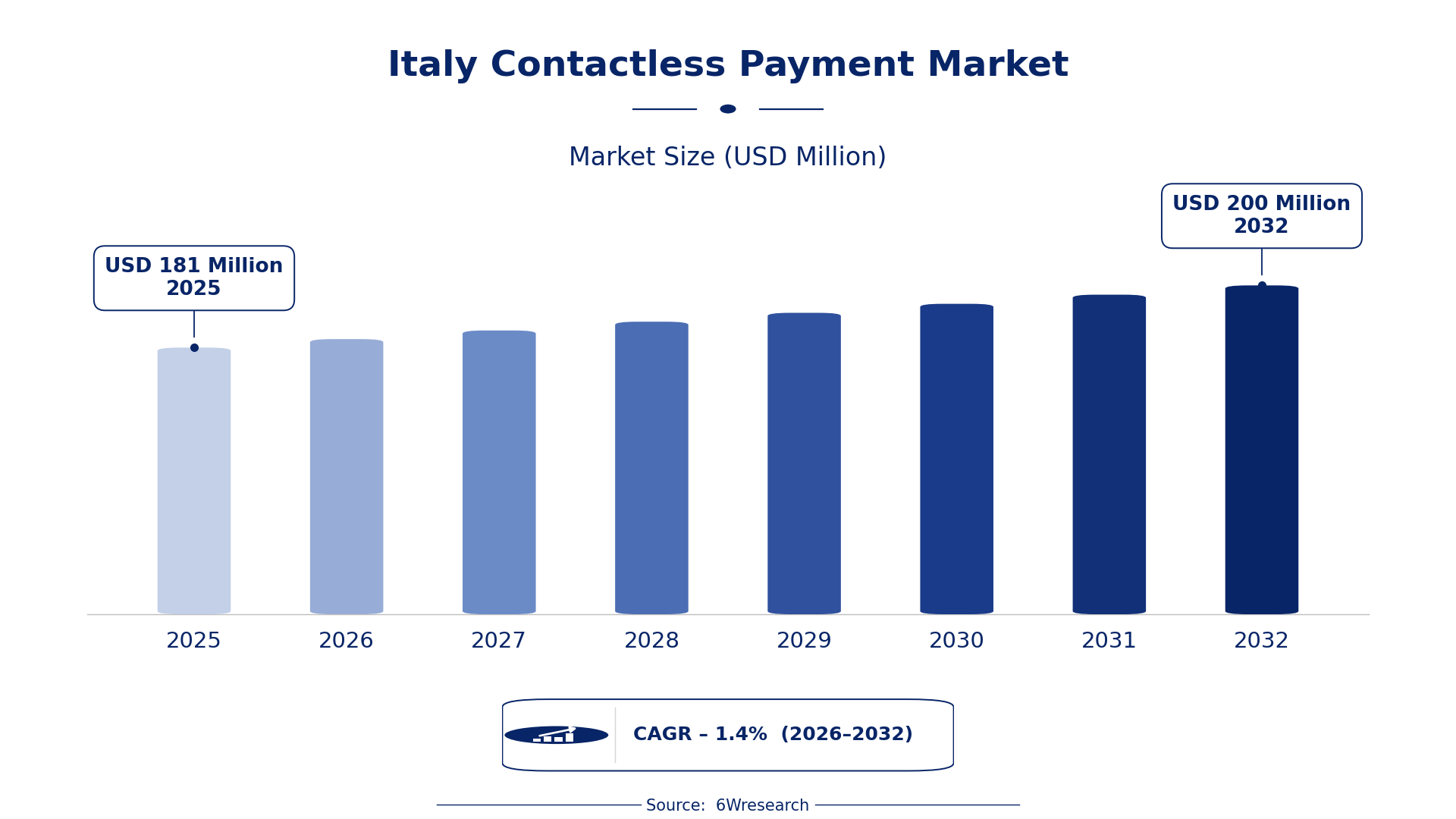
The Italy Contactless Payment Market was estimated at USD 181 Million in 2025 and is projected to reach USD 200 Million by 2032, growing at a CAGR of 1.4% from 2026 to 2032.
Italy Contactless Payment Market Synopsis
The demand for contactless payment solutions in Italy is surging, with consumers increasingly favoring quick and secure transactions over traditional cash methods. The proliferation of contactless-enabled cards, mobile wallets, and wearables has significantly reshaped how transactions are conducted across various sectors.
Retailers and financial institutions are actively promoting contactless payment options, creating a conducive environment for market growth. Government initiatives aimed at enhancing digital payment systems are also playing a crucial role in fostering consumer confidence and expanding the reach of contactless payment technologies.
Italy Contactless Payment Market Year-wise Growth Rate and Key Drivers
This graph illustrates the annual growth rates of the Italy Contactless Payment Market from 2021 to 2032, highlighting a steady upward trajectory and projected expansion over the forecast period.
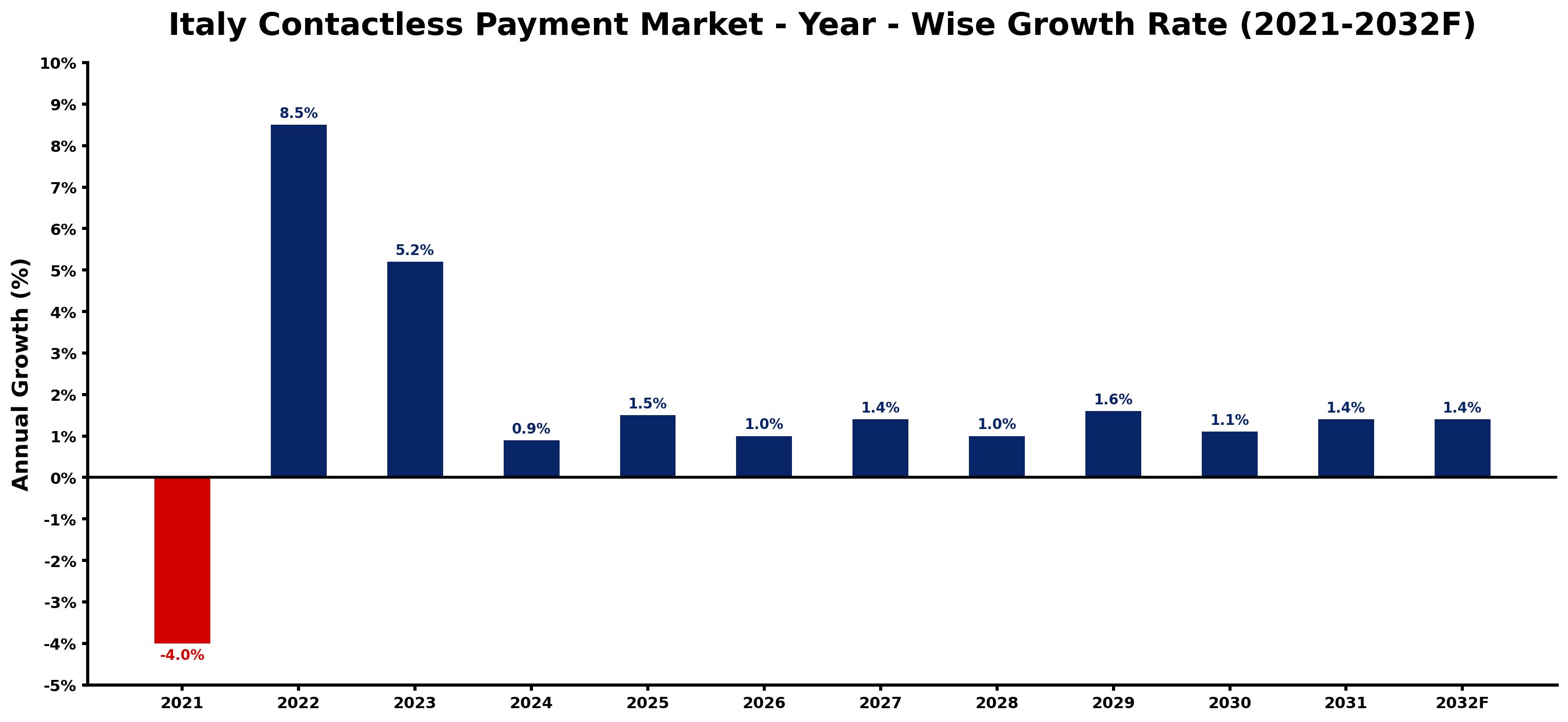
The table below presents the year‑wise growth rates along with the key drivers influencing the market
| Year | Growth Rate | Major Drivers |
| 2021 | -4.0% | Slow adoption due to local consumer trust issues. |
| 2022 | 8.5% | Cashless Italy initiative boosting digital payment adoption |
| 2023 | 5.2% | Increased smartphone penetration enhancing contactless usage |
| 2024 | 0.9% | EU regulations promoting mobile payment innovations |
| 2025 | 1.5% | Rise in e-commerce transactions driving contactless receipts |
| 2026 | 1.0% | Popularity of loyalty programs encouraging contactless transactions |
| 2027 | 1.4% | Tourism recovery fueling demand for digital payments |
| 2028 | 1.0% | Local businesses adopting tap-to-pay technology for efficiency |
| 2029 | 1.6% | Increased focus on cybersecurity in digital payments |
| 2030 | 1.1% | Bank partnerships promoting contactless solutions in retail |
| 2031 | 1.4% | Digital wallet adoption rising among younger demographics |
| 2032 | 1.4% | Government incentives for businesses to implement contactless options |
Note: Market size estimations and growth projections presented in this report are based on 6Wresearch's proprietary forecasting methodology, utilizing the latest available industry data, government publications, and primary research inputs.
Italy Contactless Payment Market Key Takeaways
Below are some of the specific key takeaways from the market, including:
- Consumer preference is shifting towards cashless transactions, driving the adoption of contactless payment methods.
- Government policies supporting digital payments are enhancing the security and reliability of contactless transactions.
- Retailers are incentivizing contactless payments to improve customer experience and streamline operations.
- Despite growth, there are still concerns regarding security and privacy among some consumers.
- Investment in infrastructure is essential for the widespread acceptance of contactless payment solutions.
Evaluation of Restraints in Italy Contactless Payment Market
Despite the positive trajectory, the Italy Contactless Payment Market faces several challenges. One primary concern is the lingering apprehension regarding the security of contactless transactions. While technology has advanced significantly, some consumers remain wary of potential fraud and data breaches. on top of that, the need for substantial investment in POS terminals and NFC-enabled devices can be a barrier for smaller retailers, limiting the overall market growth.
Additionally, achieving widespread acceptance of contactless payments requires standardization across different payment networks, which can complicate the market dynamics. Regulatory compliance also poses a challenge as businesses must navigate various requirements that can vary significantly from one jurisdiction to another.
Italy Contactless Payment Market Trends
A few key trends are shaping the demand for contactless payments in Italy. The integration of advanced technologies like biometric authentication is gaining traction, enhancing security and user confidence. on top of that, the rise of e-commerce has accelerated the adoption of contactless payment methods, as consumers seek quick and efficient checkout experiences.
There is also an increasing trend of retailers bundling contactless payments with loyalty programs to enhance customer engagement. As mobile wallets become more ubiquitous, the intersection of contactless payments with digital marketing strategies is on track to create new opportunities for businesses.
Italy Contactless Payment Market Opportunities
The Italy Contactless Payment Market presents numerous opportunities for growth and investment. One notable area is the expansion of contactless payment acceptance in sectors like transportation and hospitality, where the demand for efficient payment solutions is on the rise. on top of that, as consumers become more comfortable with mobile wallets, there is potential for fintech companies to innovate and offer tailored solutions that cater to specific customer needs.
on top of that, partnerships between financial institutions and technology providers can drive advancements in payment security, making the market more attractive to consumers. The ongoing digital transformation across industries also opens the door for enhanced integration of contactless payment solutions into everyday transactions.
Government Initiatives in the Italy Contactless Payment Market
The Italian government is actively shaping the Contactless Payment Market through a range of initiatives aimed at modernizing the payment ecosystem. By promoting digital payment solutions, the government is not only enhancing financial inclusion but also ensuring that transactions are secure and efficient. Regulatory measures are in place to establish standards that bolster consumer confidence in contactless payment technologies.
- A national digital infrastructure upgrade programme launched in early 2025 aims to improve connectivity and support contactless payment acceptance across urban and rural areas.
- Currently underway is a public awareness campaign encouraging consumers to adopt contactless payment methods, focusing on security and convenience.
- Planned for the upcoming year is a regulatory framework that will mandate encryption standards for contactless transactions, enhancing security measures.
- Collaborative initiatives with technology providers are expected to expand the acceptance of contactless payments in transportation by mid-2026.
Future Insights of the Italy Contactless Payment Market
Looking ahead, the Italy Contactless Payment Market is set to evolve significantly from 2026 to 2032. As consumer habits continue to shift towards cashless transactions, the demand for contactless payment solutions will likely increase. The integration of new technologies, such as artificial intelligence for fraud detection and enhanced user experiences, will play a critical role in shaping market dynamics.
Investment in infrastructure will be pivotal, especially as regulatory frameworks become more defined. As financial institutions and retailers adapt to these changes, we can expect a more secure and efficient payment environment that will drive further adoption of contactless technologies across various sectors.
Italy Contactless Payment Market Latest Developments
Recent activity in the Italy Contactless Payment Market indicates a strong push towards greater integration of contactless technologies. Over the past year, several initiatives and partnerships have emerged, signaling a robust commitment to enhancing payment solutions. Stakeholders across the ecosystem are increasingly focused on improving consumer experiences while ensuring security.
- In early 2025, a leading regional operator launched a new mobile wallet service that integrates contactless payment options, enhancing user convenience and engagement.
- An initiative that began in Q3 2025 is currently underway, focusing on upgrading POS terminals across major retail chains to support NFC technology.
- By mid-2026, a partnership between local banks and fintech firms is expected to introduce advanced security features for contactless transactions, addressing consumer concerns.
- A rollout planned for late 2026 will introduce contactless payment options in public transportation systems across major cities, streamlining commuter payments.
Italy Contactless Payment Market - Key Attractiveness of the Report
- 10 Years of Market Numbers
- Historical Data Starting from 2022 to 2025
- Base Year: 2025
- Forecast Data until 2032
- Key Performance Indicators Impacting the Market
- Major Upcoming Developments and Projects
Key Highlights of the Report:
- Italy Contactless Payment Market Outlook
- Market Size of Italy Contactless Payment Market, 2025
- Forecast of Italy Contactless Payment Market, 2032
- Historical Data and Forecast of Italy Contactless Payment Revenues & Volume for the Period 2022-2032F
- Italy Contactless Payment Market Trend Evolution
- Italy Contactless Payment Market Drivers and Challenges
- Italy Contactless Payment Price Trends
- Italy Contactless Payment Porter's Five Forces
- Italy Contactless Payment Industry Life Cycle
- Historical Data and Forecast of Italy Contactless Payment Market Revenues & Volume By Component for the Period 2022-2032F
- Historical Data and Forecast of Italy Contactless Payment Market Revenues & Volume By Hardware for the Period 2022-2032F
- Historical Data and Forecast of Italy Contactless Payment Market Revenues & Volume By Solutions for the Period 2022-2032F
- Historical Data and Forecast of Italy Contactless Payment Market Revenues & Volume By Services for the Period 2022-2032F
- Historical Data and Forecast of Italy Contactless Payment Market Revenues & Volume By Vertical for the Period 2022-2032F
- Historical Data and Forecast of Italy Contactless Payment Market Revenues & Volume By Retail for the Period 2022-2032F
- Historical Data and Forecast of Italy Contactless Payment Market Revenues & Volume By Hospitality for the Period 2022-2032F
- Historical Data and Forecast of Italy Contactless Payment Market Revenues & Volume By Healthcare for the Period 2022-2032F
- Historical Data and Forecast of Italy Contactless Payment Market Revenues & Volume By Energy and Utilities for the Period 2022-2032F
- Historical Data and Forecast of Italy Contactless Payment Market Revenues & Volume By Transportation and Logistics for the Period 2022-2032F
- Historical Data and Forecast of Italy Contactless Payment Market Revenues & Volume By BFSI for the Period 2022-2032F
- Historical Data and Forecast of Italy Contactless Payment Market Revenues & Volume By Others (Government, telecommunications, and education) for the Period 2022-2032F
- Italy Contactless Payment Import Export Trade Statistics
- Market Opportunity Assessment By Component
- Market Opportunity Assessment By Vertical
- Italy Contactless Payment Top Companies Market Share
- Italy Contactless Payment Competitive Benchmarking By Technical and Operational Parameters
- Italy Contactless Payment Company Profiles
- Italy Contactless Payment Key Strategic Recommendations






































