Italy Digital Lending Market Size & Growth Rate (2026-2032)
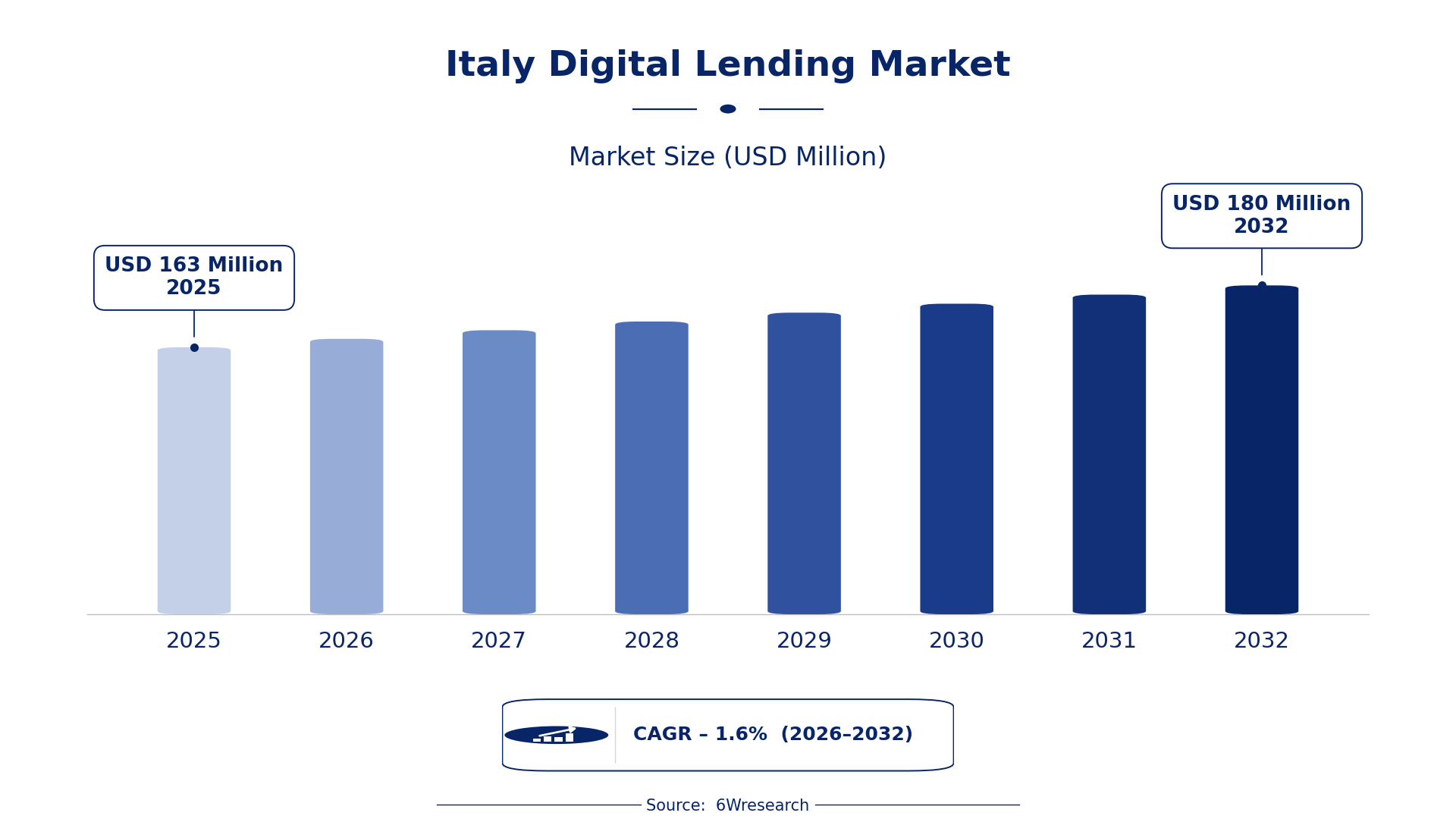
The Italy Digital Lending Market was estimated at USD 163 Million in 2025 and is projected to reach USD 180 Million by 2032, growing at a CAGR of 1.6% from 2026 to 2032.
Italy Digital Lending Market Synopsis
The Italy Digital Lending Market is witnessing a remarkable shift, fueled by the rise of fintech solutions and changing consumer behaviors. With increasing smartphone usage and internet access, more individuals and businesses are turning to digital platforms for their borrowing needs, seeking convenience and speed.
This market is not just a trend; it's a response to the inadequacies of traditional banking systems. Digital lenders are stepping in to fill gaps, offering services that are tailored to modern demands. As technology continues to advance, the integration of AI and machine learning is making the lending process faster and more efficient, reshaping the financial landscape in Italy.
Italy Digital Lending Market Year-wise Growth Rate and Key Drivers
This graph illustrates the annual growth rates of the Italy Digital Lending Market from 2021 to 2032, highlighting a steady upward trajectory and projected expansion over the forecast period.
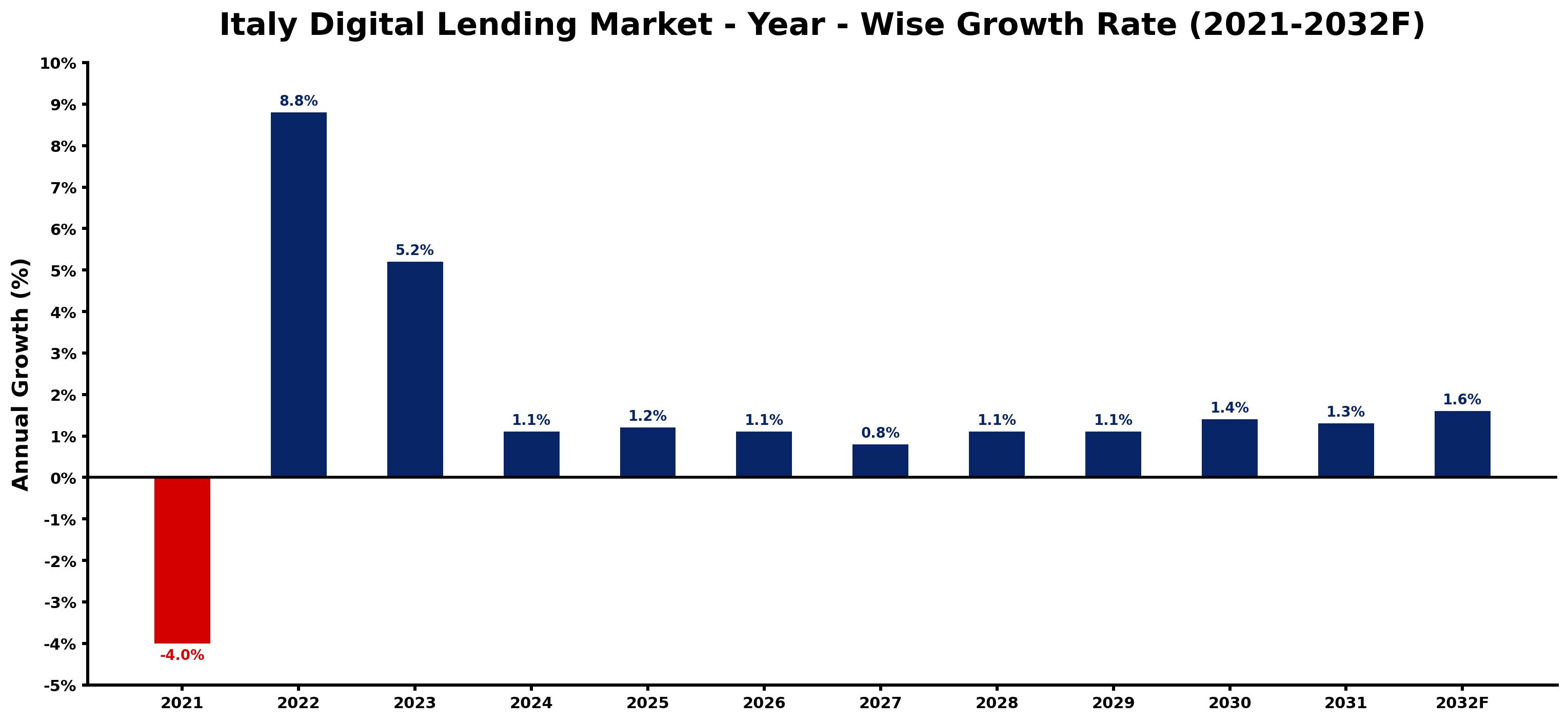
The table below presents the year‑wise growth rates along with the key drivers influencing the market
| Year | Growth Rate | Major Drivers |
| 2021 | -4.0% | COVID-19 restrictions hindered lending operations in Italy. |
| 2022 | 8.8% | Increasing regulatory support from Bank of Italy |
| 2023 | 5.2% | Growing adoption of e-commerce boosting personal loans |
| 2024 | 1.1% | Rise in fintech startups enhancing digital lending solutions |
| 2025 | 1.2% | Government incentives improving access to credit facilities |
| 2026 | 1.1% | Increased digitalization in banking services across Italy |
| 2027 | 0.8% | Demand for instant credit solutions from consumers rising |
| 2028 | 1.1% | Emergence of AI-driven platforms for loan approvals |
| 2029 | 1.1% | Enhanced collaboration between banks and fintech firms |
| 2030 | 1.4% | Policy reforms encouraging online personal finance management |
| 2031 | 1.3% | Youth population driving demand for digital lending options |
| 2032 | 1.6% | Growing emphasis on financial inclusion initiatives by regulators |
Note: Market size estimations and growth projections presented in this report are based on 6Wresearch's proprietary forecasting methodology, utilizing the latest available industry data, government publications, and primary research inputs.
Italy Digital Lending Market Key Takeaways
Below are some of the specific key takeaways from the market, including:
- Digital lending is becoming the preferred choice for many consumers due to its convenience and efficiency.
- The market is witnessing a notable increase in peer-to-peer lending platforms that directly connect borrowers and investors.
- Technological innovations, particularly in AI and machine learning, are enhancing risk assessment and credit scoring.
- Regulatory bodies are actively working to establish frameworks that promote innovation while ensuring consumer protection.
- Investment opportunities are growing, particularly in areas like digital banks and fintech startups focused on lending solutions.
Evaluation of Restraints in Italy Digital Lending Market
Several factors are limiting the full potential of the Italy Digital Lending Market. One of the most pressing issues is the complex regulatory environment, which can create barriers for new entrants and slow down innovation. Compliance with stringent regulations demands significant resources and expertise, often posing challenges for smaller fintech companies.
Another restraint involves customer trust and awareness. While digital solutions are gaining traction, a segment of the population remains skeptical about online lending platforms. Building credibility and ensuring robust cybersecurity measures are crucial steps in overcoming these hurdles and encouraging broader adoption.
Italy Digital Lending Market Trends
The trend towards digitalization in Italy's lending market is unmistakable. Consumers are increasingly favoring platforms that offer quick loan approvals and flexible repayment options. Additionally, the growth of mobile applications is facilitating easier access to financial products, making it a key driver of market expansion.
There's also a significant shift towards personalized lending solutions, with fintech companies using advanced data analytics to tailor offerings to individual needs. This focus on customization is fostering a more customer-centric approach, which is likely to shape the future of digital lending in Italy.
Italy Digital Lending Market Opportunities
The potential for growth in the Italy Digital Lending Market is substantial. As consumer preferences shift towards online services, fintech companies can capitalize on this trend by developing innovative lending products that cater to diverse demographics. The ongoing digital transformation in the financial services sector creates a fertile ground for new players.
Investors should consider opportunities in niche segments such as micro-lending and specialized peer-to-peer platforms. The government's support for digitalization initiatives further enhances the attractiveness of this market, making it an appealing landscape for investment.
Government Initiatives in the Italy Digital Lending Market
The Italian government is actively shaping the digital lending market through various regulatory frameworks and initiatives. These efforts aim to create a balanced environment that encourages innovation while safeguarding consumer rights. By establishing clear guidelines, authorities are ensuring transparency and fostering trust among users.
- A regulatory framework introduced in 2023 mandating clear disclosure of loan terms and interest rates, enhancing consumer protection.
- Ongoing initiatives to monitor compliance with anti-money laundering laws, which aim to bolster financial stability in digital lending.
- A recently completed public awareness campaign to educate consumers on the benefits and risks of digital lending platforms.
- Current discussions about a new program designed to support fintech innovation through grants and incentives for startups in the sector.
- A planned initiative expected to launch in 2025 to streamline the regulatory process for new digital lending platforms.
Future Insights of the Italy Digital Lending Market
Looking ahead to 2026-2032, the Italy Digital Lending Market appears set for substantial advancement. The convergence of technology and finance will likely lead to more sophisticated lending solutions, with an emphasis on data-driven decision-making. As consumer expectations continue to evolve, lenders will need to innovate rapidly to stay competitive.
on top of that, the regulatory landscape will play a critical role in shaping the future of this market. Ongoing government support for digital initiatives is expected to facilitate growth, while a strong focus on consumer protection will help foster trust in digital lending solutions.
Italy Digital Lending Market Latest Developments
In the past year, the Italy Digital Lending Market has seen a flurry of activity as fintechs and traditional banks adapt to changing consumer demands. Recent developments indicate a shift towards greater collaboration between players in the financial sector, aimed at enhancing customer experience.
- A leading fintech company launched a new platform in early 2025, providing instant credit decisions using advanced AI algorithms.
- An initiative that began in mid-2025 and remains underway focuses on integrating blockchain technology for improved loan security and transparency.
- A major technology vendor announced plans for a partnership with a digital bank in Q2 2025 to enhance mobile lending solutions.
- A rollout expected to begin in the second half of 2026 aims to introduce new regulatory compliance tools for emerging fintech firms.
- A collaborative project launched in early 2025 aims to increase digital literacy among potential borrowers, enhancing awareness of lending options.
Italy Digital Lending Market - Key Attractiveness of the Report
- 10 Years of Market Numbers
- Historical Data Starting from 2022 to 2025
- Base Year: 2025
- Forecast Data until 2032
- Key Performance Indicators Impacting the Market
- Major Upcoming Developments and Projects
Key Highlights of the Report:
- Italy Digital Lending Market Outlook
- Market Size of Italy Digital Lending Market, 2025
- Forecast of Italy Digital Lending Market, 2032
- Historical Data and Forecast of Italy Digital Lending Revenues & Volume for the Period 2022-2032F
- Italy Digital Lending Market Trend Evolution
- Italy Digital Lending Market Drivers and Challenges
- Italy Digital Lending Price Trends
- Italy Digital Lending Porter's Five Forces
- Italy Digital Lending Industry Life Cycle
- Historical Data and Forecast of Italy Digital Lending Market Revenues & Volume By Offering for the Period 2022-2032F
- Historical Data and Forecast of Italy Digital Lending Market Revenues & Volume By Solutions for the Period 2022-2032F
- Historical Data and Forecast of Italy Digital Lending Market Revenues & Volume By Services for the Period 2022-2032F
- Historical Data and Forecast of Italy Digital Lending Market Revenues & Volume By Deployment Mode for the Period 2022-2032F
- Historical Data and Forecast of Italy Digital Lending Market Revenues & Volume By Cloud for the Period 2022-2032F
- Historical Data and Forecast of Italy Digital Lending Market Revenues & Volume By On-premises for the Period 2022-2032F
- Historical Data and Forecast of Italy Digital Lending Market Revenues & Volume By End User for the Period 2022-2032F
- Historical Data and Forecast of Italy Digital Lending Market Revenues & Volume By Banks for the Period 2022-2032F
- Historical Data and Forecast of Italy Digital Lending Market Revenues & Volume By Credit Unions for the Period 2022-2032F
- Historical Data and Forecast of Italy Digital Lending Market Revenues & Volume By NBFCs for the Period 2022-2032F
- Italy Digital Lending Import Export Trade Statistics
- Market Opportunity Assessment By Offering
- Market Opportunity Assessment By Deployment Mode
- Market Opportunity Assessment By End User
- Italy Digital Lending Top Companies Market Share
- Italy Digital Lending Competitive Benchmarking By Technical and Operational Parameters
- Italy Digital Lending Company Profiles
- Italy Digital Lending Key Strategic Recommendations






































