Italy Flash Led Market Size, Share & Growth Rate
The Italy Flash Led Market was estimated at USD 182 Million in 2025 and is projected to reach USD 200 Million by 2032, growing at a CAGR of 1.4% from 2026 to 2032. This growth is primarily driven by the rising demand for energy-efficient lighting solutions across multiple sectors including automotive and consumer electronics. The increasing emphasis on sustainability and the shift towards advanced LED technologies are further propelling this upward trajectory.
Italy Flash Led Market Year-wise Growth Rate and Key Drivers
This graph highlights how the Italy Flash Led Market has steadily grown over the years, supported by major growth factors.
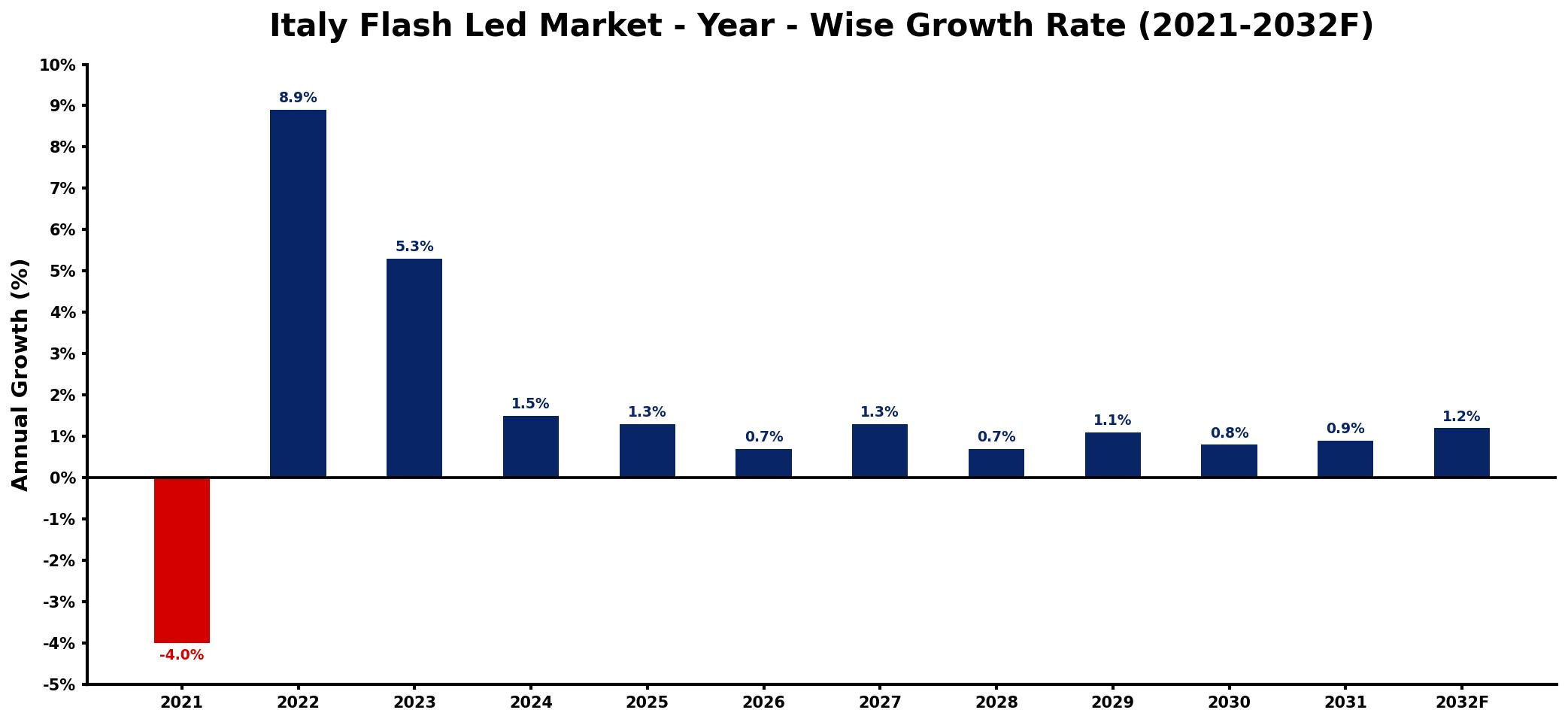
The table below presents the year‑wise growth rates along with the key drivers influencing the market
| Year | Growth Rate | Major Drivers |
| 2021 | -4.0% | decreased consumer demand for technology |
| 2022 | 8.9% | increased investment in renewable energy |
| 2023 | 5.3% | growing popularity of smart homes |
| 2024 | 1.5% | expansion of urban infrastructure projects |
| 2025 | 1.3% | rising focus on energy efficiency |
| 2026 | 0.7% | increased adoption of automation solutions |
| 2027 | 1.3% | growing demand for outdoor lighting |
| 2028 | 0.7% | enhanced product quality standards |
| 2029 | 1.1% | increased use in automotive applications |
| 2030 | 0.8% | growing interest in aesthetic design |
| 2031 | 0.9% | rising demand for portable solutions |
| 2032 | 1.2% | increased focus on sustainability initiatives |
Note: Market size estimations and growth projections presented in this report are based on 6Wresearch's proprietary forecasting methodology, utilizing the latest available industry data, government publications, and primary research inputs.
Italy Flash Led Market Synopsis
The dominant force reshaping the Italy Flash LED market is the urgent need for energy-efficient solutions, as consumers and businesses prioritize sustainability. This shift is being fueled by technological innovations that enhance the performance and durability of Flash LEDs, making them a preferred choice for applications in smartphones, automotive lighting, and other electronic devices.
Moreover, the rising consumer awareness regarding energy conservation is playing a pivotal role in driving demand. With significant advancements in LED technology resulting in more compact, high-performance products, the market is positioned for robust growth as it aligns with evolving consumer expectations and regulatory requirements.
Italy Flash Led Market Key Takeaways
- The Italy Flash LED market is poised for steady growth, driven by rising consumer demand for energy-efficient lighting solutions.
- Technological advancements are leading to more compact and high-performance Flash LED products, expanding their application scope.
- Custom lighting solutions are increasingly sought after to meet specific industry needs, enhancing market competition.
- Growing awareness of environmental benefits is pushing the market towards more sustainable lighting practices.
- Investments in Flash LED technology are likely to yield significant returns as sustainability remains a priority across sectors.
Evaluation of Restraints in Italy Flash Led Market
While the Italy Flash LED market presents numerous opportunities, it is not without its constraints. One major challenge is the intense competition among both domestic and international players, leading to pressure on pricing strategies and profit margins. Companies must continually adapt to rapid technological advancements, which necessitates ongoing investment in research and development. Additionally, the landscape is shaped by stringent regulatory standards aimed at ensuring safety and environmental compliance, further complicating market navigation. Changing consumer preferences can also introduce uncertainties, necessitating agility and foresight among manufacturers and suppliers to stay ahead of the curve.
Italy Flash Led Market Trends
The Italy Flash LED market is currently witnessing several trends that are shaping its future. The increasing integration of smart technologies into lighting solutions is one such trend, enhancing functionality and efficiency. Furthermore, the expansion of applications beyond traditional sectors into areas like advertising and smart city projects is driving demand. There is also a marked increase in consumer preference for personalized lighting experiences, prompting manufacturers to innovate and offer customized Flash LED products. The overall trend towards environmentally-friendly products continues to gain momentum, further solidifying the Flash LEDs role in the sustainable lighting revolution.
Italy Flash Led Market Opportunities
Investors in the Italy Flash LED market have multiple avenues for growth, particularly due to the ongoing shift toward energy-efficient lighting solutions. The demand for Flash LEDs is on the rise in various applications including automotive, consumer electronics, and even architectural lighting, offering lucrative prospects for manufacturers and suppliers. Furthermore, with governmental policies emphasizing sustainability, companies that align with these initiatives stand to benefit from incentives and subsidies. The continuous innovation in LED technology also opens doors for investment in new product development, ensuring long-term growth potential within the market.
Government Initiatives in the Italy Flash Led Market
The Italian government is actively promoting energy efficiency and sustainability through various policies impacting the Flash LED market. Regulations mandating adherence to specific energy efficiency standards for LED products have been implemented. Additionally, there are incentives available for businesses and consumers adopting energy-efficient lighting solutions, which include Flash LEDs. The government's commitment to reducing carbon emissions and fostering environmentally friendly practices in the lighting industry ensures that companies in this sector remain aligned with national sustainability goals and can leverage available support mechanisms.
Future Insights of the Italy Flash Led Market
Looking ahead to 2026-2032, the Italy Flash LED market is expected to thrive, underpinned by a growing awareness of energy conservation and a shift toward long-lasting lighting solutions. Continuous advancements in LED technology will contribute to improved performance and cost-effectiveness, further spurring market growth. The increasing integration of Flash LEDs into smart lighting systems will also be a significant driver, as businesses and consumers alike seek innovative solutions to meet their lighting needs. This landscape will create a multitude of opportunities for manufacturers to enhance their product offerings and capitalize on evolving consumer preferences.
Italy Flash Led Market Latest Developments (2025 - 2026)
In recent months, the Italy Flash LED market has witnessed significant developments, particularly in the area of technology integration. Companies are increasingly focusing on smart lighting solutions that enhance energy efficiency and user control. Collaborations among industry stakeholders aimed at developing innovative LED products have also been notable. Regulatory changes are encouraging more manufacturers to comply with stringent energy efficiency standards, which aligns with broader national sustainability goals. Overall, these developments are steering the market toward a future marked by greater innovation and adaptability.
Italy Flash Led Market - Key Attractiveness of the Report
- 10 Years of Market Numbers
- Historical Data Starting from 2022 to 2025
- Base Year: 2025
- Forecast Data until 2032
- Key Performance Indicators Impacting the Market
- Major Upcoming Developments and Projects
Key Highlights of the Report:
- Italy Flash Led Market Outlook
- Market Size of Italy Flash Led Market, 2025
- Forecast of Italy Flash Led Market, 2032
- Historical Data and Forecast of Italy Flash Led Revenues & Volume for the Period 2022-2032F
- Italy Flash Led Market Trend Evolution
- Italy Flash Led Market Drivers and Challenges
- Italy Flash Led Price Trends
- Italy Flash Led Porter's Five Forces
- Italy Flash Led Industry Life Cycle
- Historical Data and Forecast of Italy Flash Led Market Revenues & Volume By Power Consumption for the Period 2022-2032F
- Historical Data and Forecast of Italy Flash Led Market Revenues & Volume By Less than 1 A for the Period 2022-2032F
- Historical Data and Forecast of Italy Flash Led Market Revenues & Volume By More than or Equal to 1 A for the Period 2022-2032F
- Historical Data and Forecast of Italy Flash Led Market Revenues & Volume By Types for the Period 2022-2032F
- Historical Data and Forecast of Italy Flash Led Market Revenues & Volume By Smartphone for the Period 2022-2032F
- Historical Data and Forecast of Italy Flash Led Market Revenues & Volume By Feature phone for the Period 2022-2032F
- Historical Data and Forecast of Italy Flash Led Market Revenues & Volume By Other for the Period 2022-2032F
- Italy Flash Led Import Export Trade Statistics
- Market Opportunity Assessment By Power Consumption
- Market Opportunity Assessment By Types
- Italy Flash Led Top Companies Market Share
- Italy Flash Led Competitive Benchmarking By Technical and Operational Parameters
- Italy Flash Led Company Profiles
- Italy Flash Led Key Strategic Recommendations






































