Italy Food Packaging Market Summary
The italy food packaging market was estimated at USD 186 Million in 2025 and is projected to reach USD 205 Million by 2032, growing at a CAGR of 1.3% from 2026 to 2032.
Italy Food Packaging Market Year-wise Growth Rate and Key Drivers
This graph highlights how the Italy Food Packaging Market has steadily grown over the past five years, supported by major growth factors.
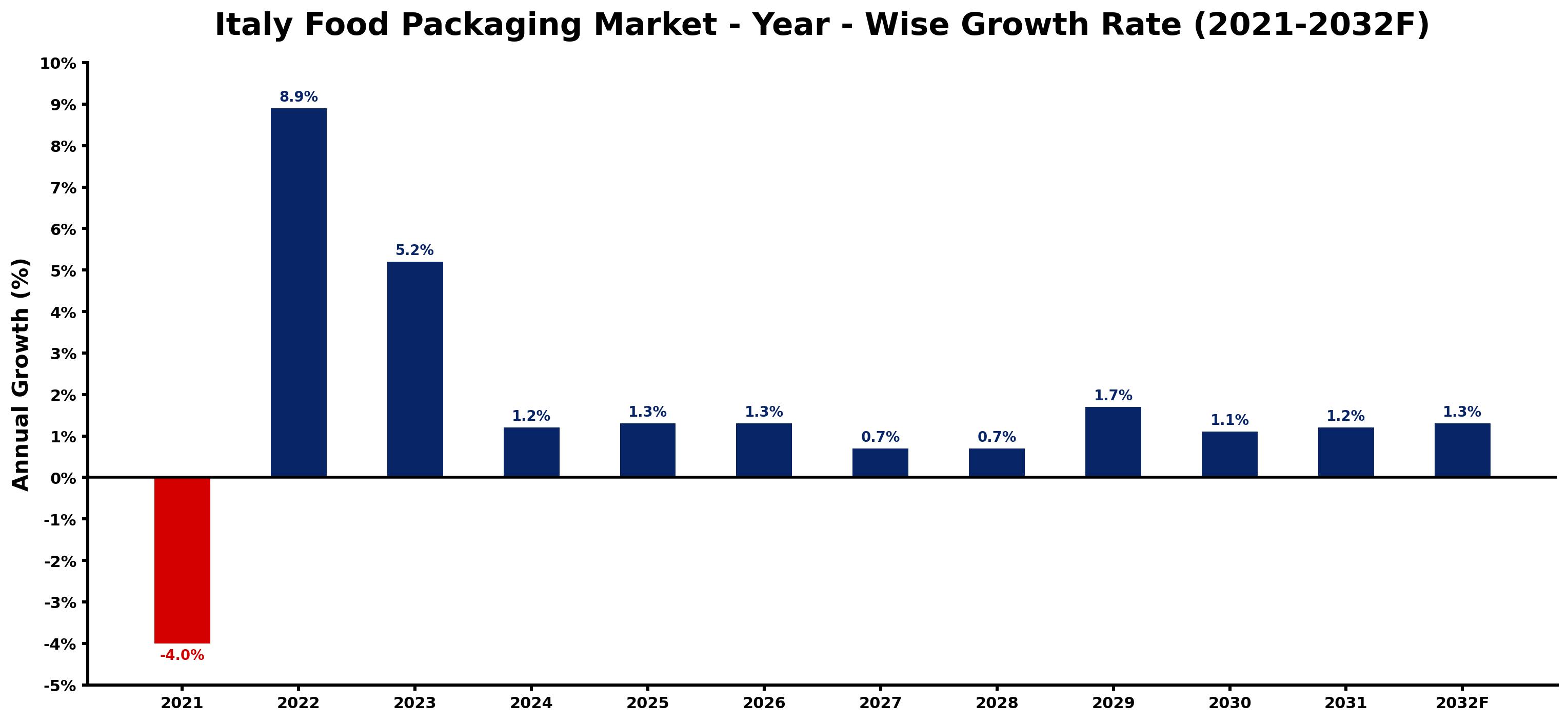
The table below presents the year wise growth rates along with the key drivers influencing the market
| Year | Growth Rate | Major Drivers |
| 2021 | -4.0% | Shifting consumer preferences towards sustainable packaging diminished demand for traditional food packaging solutions. |
| 2022 | 8.9% | Local food producers increasingly emphasized eco-friendly and biodegradable packaging options. |
| 2023 | 5.2% | Major retailers adopted stringent sustainability goals, influencing packaging supply chain choices. |
| 2024 | 1.2% | E-commerce expansion necessitated innovative packaging designs for safe product transport. |
| 2025 | 1.3% | Increased competition among brands pushed for differentiation in packaging aesthetics and functionality. |
| 2026 | 1.3% | Technological innovations in production processes improved efficiency and material utilization rates. |
| 2027 | 0.7% | Health-conscious consumers demanded clear ingredient labeling on food packaging products. |
| 2028 | 0.7% | Partnerships between packaging companies and food brands drove customization and innovation. |
| 2029 | 1.7% | Rising concerns about food waste highlighted the importance of protective packaging solutions. |
| 2030 | 1.1% | Sustainable packaging certifications gained importance in consumer purchasing decisions. |
| 2031 | 1.2% | Urbanization trends prompted shifts in packaging formats to suit city lifestyles. |
| 2032 | 1.3% | Consumer education about environmental impacts influenced packaging material choices significantly. |
Note - Market size estimations and growth projections presented in this report are based on 6Wresearch's advanced forecasting approach, validated with industry datasets as of June 2026.
Italy Food Packaging Market Synopsis
The Italy Food Packaging Market is projected to reach 1.3% and witness significant growth during the forecast period (2026-2032). This growth trajectory can largely be attributed to several interconnected factors that are influencing the dynamics of the market. An increasing consumer preference for convenience and ready-to-eat products, coupled with rising disposable incomes, is driving demand for specialized food packaging solutions. Furthermore, ongoing innovations in packaging materials and designs are offering brands the opportunity to differentiate their products in a competitive marketplace.
Italy Food Packaging Market Growth Drivers
A range of growth drivers is propelling the Italy food packaging market forward. The increasing urban population has led to a proliferation of restaurants and supermarkets, which in turn has increased the availability of packaged food items. These establishments are increasingly opting for versatile and cost-effective flexible packaging solutions, recognizing their efficiency in storage and transportation. Additionally, higher disposable incomes among consumers are facilitating a shift towards premium packaged food products, further stimulating the sector. With growing environmental concerns, manufacturers are innovating with sustainable materials, addressing both consumer desires for eco-friendly options and regulatory compliance.
- Urbanization in Italy is fostering greater demand for packaged food products, contributing to market expansion.
- Rising disposable incomes are leading consumers to choose premium packaged goods, influencing purchasing behaviors.
- Technological advancements in food packaging are enhancing product shelf life and safety.
- The popularity of on-the-go meals is driving demand for portable and convenient packaging solutions.
- Increased health consciousness among consumers is prompting demand for packaging that preserves food quality without harmful substances.
Italy Food Packaging Market Trends and Opportunities
The Italy food packaging market is witnessing several notable trends. One of the prominent trends is the shift towards flexible packaging, which is gaining traction due to its cost-effectiveness and sustainability profile. Manufacturers are increasingly focusing on biodegradable and recyclable materials to meet consumer demand for environmentally friendly options. Additionally, there is an observable trend towards innovations in smart packaging technologies that enhance food safety and tracking through intelligent labeling systems. These advancements present significant opportunities for stakeholders looking to capitalize on consumer trends favoring convenience and eco-responsibility, fostering long-term growth in the sector.
- The adoption of flexible packaging is on the rise, driven by its advantages in cost and versatility.
- Smart packaging technologies are becoming increasingly incorporated to improve food safety and traceability.
- There is a growing interest in biodegradable and recyclable packaging solutions among consumers and producers alike.
- Technological advancements in packaging design are enhancing brand visibility and product appeal.
- Collaboration between packaging manufacturers and food producers is fostering innovation in sustainability efforts.
Italy Food Packaging Market Challenges and Restraints
Despite the positive growth outlook, the Italy food packaging market faces several challenges. High production costs associated with adopting advanced materials and technologies can act as a deterrent for smaller manufacturers. Moreover, stringent environmental regulations are compelling entities to adapt swiftly, often incurring additional costs. Concerns regarding health risks linked to certain packaging materials have made consumers wary, affecting overall market acceptance. Furthermore, the fluctuations in raw material prices contribute to unpredictability in production and pricing strategies.
- High production costs related to innovative packaging solutions can hinder smaller market players.
- Stringent regulations on environmental sustainability demand compliance, presenting challenges to manufacturers.
- Consumer apprehensions regarding health risks associated with certain packaging materials can affect market dynamics.
- Fluctuating prices of raw materials contribute to unpredictability in the packaging market.
- Competition from alternative packaging solutions can pose a threat to traditional food packaging methods.
Italy Food Packaging Market Government Investment and Initiatives
The Italian government has recognized the significance of sustainable development within the food packaging sector and is actively promoting initiatives aimed at fostering innovation and environmental responsibility. Through various policies, the government encourages manufacturers to adopt sustainable practices by providing incentives for research and development in eco-friendly packaging solutions. Additionally, recent regulations aimed at reducing single-use plastics have spurred investments in biodegradable alternatives, enabling a transition to more sustainable packaging options. These initiatives not only support environmental objectives but also stimulate market growth by aligning with consumer demand for eco-conscious products.
Italy Food Packaging Market Latest Developments (May 2025 - June 2026)
In the timeframe from May 2025 to June 2026, the Italy food packaging market has experienced notable shifts, particularly in response to changing consumer preferences and regulatory environments. The industry has seen an uptick in investment focused on sustainable materials, aligning with heightened consumer awareness about environmental impacts. Innovations in smart packaging technology have also gained momentum, driven by increasing demand for more efficient supply chain solutions. Regulatory changes aiming at reducing plastic use have prompted manufacturers to pivot towards alternative materials, showcasing the adaptability of the sector in an evolving marketplace.
Italy Food Packaging Market - Key Attractiveness of the Report
- 10 Years of Market Numbers
- Historical Data Starting from 2022 to 2025
- Base Year: 2025
- Forecast Data until 2032
- Key Performance Indicators Impacting the Market
- Major Upcoming Developments and Projects
Key Highlights of the Report:
- Italy Food Packaging Market Outlook
- Market Size of Italy Food Packaging Market, 2025
- Forecast of Italy Food Packaging Market, 2032F
- Historical Data and Forecast of Italy Food Packaging Revenues & Volume for the Period 2022-2032F
- Italy Food Packaging Market Trend Evolution
- Italy Food Packaging Market Drivers and Challenges
- Italy Food Packaging Price Trends
- Italy Food Packaging Porter's Five Forces
- Italy Food Packaging Industry Life Cycle
- Historical Data and Forecast of Italy Food Packaging Market Revenues & Volume By Material Types for the Period 2022-2032F
- Historical Data and Forecast of Italy Food Packaging Market Revenues & Volume By Paper & board for the Period 2022-2032F
- Historical Data and Forecast of Italy Food Packaging Market Revenues & Volume By Plastic for the Period 2022-2032F
- Historical Data and Forecast of Italy Food Packaging Market Revenues & Volume By Metal for the Period 2022-2032F
- Historical Data and Forecast of Italy Food Packaging Market Revenues & Volume By Glass for the Period 2022-2032F
- Historical Data and Forecast of Italy Food Packaging Market Revenues & Volume By Others for the Period 2022-2032F
- Historical Data and Forecast of Italy Food Packaging Market Revenues & Volume By Product Types for the Period 2022-2032F
- Historical Data and Forecast of Italy Food Packaging Market Revenues & Volume By Rigid for the Period 2022-2032F
- Historical Data and Forecast of Italy Food Packaging Market Revenues & Volume By Semi-Rigid for the Period 2022-2032F
- Historical Data and Forecast of Italy Food Packaging Market Revenues & Volume By Flexible for the Period 2022-2032F
- Historical Data and Forecast of Italy Food Packaging Market Revenues & Volume By Applications for the Period 2022-2032F
- Historical Data and Forecast of Italy Food Packaging Market Revenues & Volume By Bakery & Confectionary for the Period 2022-2032F
- Historical Data and Forecast of Italy Food Packaging Market Revenues & Volume By Dairy Products for the Period 2022-2032F
- Historical Data and Forecast of Italy Food Packaging Market Revenues & Volume By Fruits & Vegetables for the Period 2022-2032F
- Historical Data and Forecast of Italy Food Packaging Market Revenues & Volume By Meat, Poultry, & Seafood for the Period 2022-2032F
- Historical Data and Forecast of Italy Food Packaging Market Revenues & Volume By Sauces & Dressings for the Period 2022-2032F
- Historical Data and Forecast of Italy Food Packaging Market Revenues & Volume By Others for the Period 2022-2032F
- Italy Food Packaging Import Export Trade Statistics
- Market Opportunity Assessment By Material Types
- Market Opportunity Assessment By Product Types
- Market Opportunity Assessment By Applications
- Italy Food Packaging Top Companies Market Share
- Italy Food Packaging Competitive Benchmarking By Technical and Operational Parameters
- Italy Food Packaging Company Profiles
- Italy Food Packaging Key Strategic Recommendations






































