Italy Food Processing & Handling Equipment Market Summary
The italy food processing & handling equipment market was estimated at USD 182 Million in 2025 and is projected to reach USD 201 Million by 2032, growing at a CAGR of 1.4% from 2026 to 2032.
Italy Food Processing & Handling Equipment Market Year-wise Growth Rate and Key Drivers
This graph highlights how the Italy Food Processing & Handling Equipment Market has steadily grown over the past five years, supported by major growth factors.
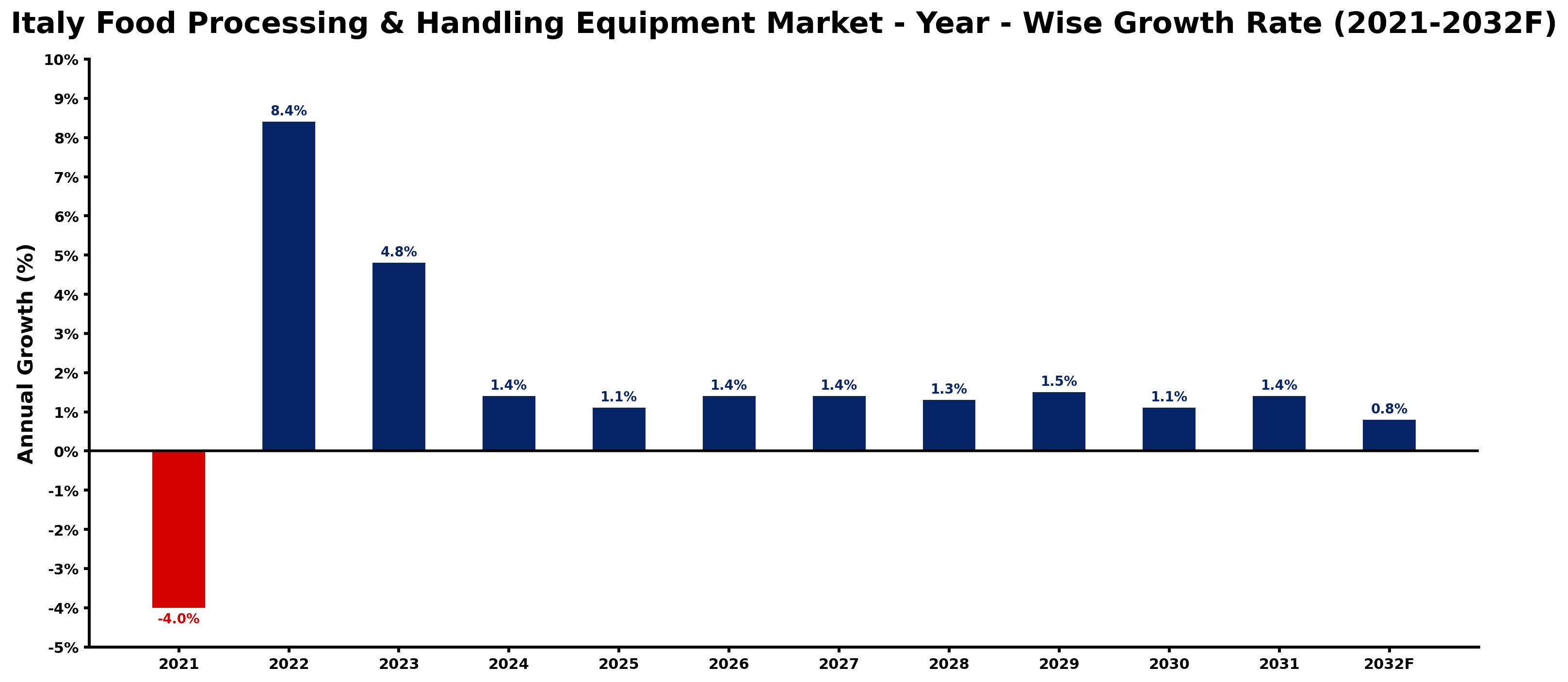
The table below presents the year wise growth rates along with the key drivers influencing the market
| Year | Growth Rate | Major Drivers |
| 2021 | -4.0% | Supply chain disruptions from the pandemic hindered equipment availability, resulting in decreased investment in food processing. |
| 2022 | 8.4% | Manufacturers adjusted to supply chain disruptions, emphasizing local sourcing strategies. |
| 2023 | 4.8% | Increased focus on sustainability influenced equipment choices among food producers. |
| 2024 | 1.4% | The Italian culinary reputation boosted demand for high-quality processing equipment. |
| 2025 | 1.1% | Emerging technologies began reshaping production workflows, enhancing operational efficiency. |
| 2026 | 1.4% | Consumer preferences shifted towards healthier options, urging innovation in processing methods. |
| 2027 | 1.4% | Automation adoption increased as labor shortages impacted operational capabilities significantly. |
| 2028 | 1.3% | Investment in food safety standards prompted upgrades in handling equipment across sectors. |
| 2029 | 1.5% | The rising trend of e-commerce in food distribution expanded processing requirements. |
| 2030 | 1.1% | Aging infrastructure drove needs for modernization in food processing capabilities. |
| 2031 | 1.4% | Collaboration between tech firms and food companies led to revolutionary processing solutions. |
| 2032 | 0.8% | Integration of artificial intelligence in equipment improved predictive maintenance and efficiency. |
Note - Market size estimations and growth projections presented in this report are based on 6Wresearch's advanced forecasting approach, validated with industry datasets as of June 2026.
Italy Food Processing & Handling Equipment Market Synopsis
The Italy Food Processing Handling Equipment Market is projected to reach 1.4% and witness significant growth during the forecast period (2026-2032). This market's expansion is fueled by increasing technological advancements, a surge in processed food demand, and a heightened focus on operational efficiency within food production systems. The landscape is characterized by diverse equipment types, including mixers, blenders, slicers, packaging machinery, and sterilization systems, all designed to optimize the food processing chain.
Italy Food Processing & Handling Equipment Market Growth Drivers
Several factors are propelling the growth of the Italy Food Processing & Handling Equipment Market. Firstly, technological advancements are enabling manufacturers to introduce innovative equipment that enhances processing efficiency and ensures greater food safety. Secondly, the increasing consumer preference for ready-to-eat and convenience foods is driving the demand for more sophisticated processing solutions. Additionally, a robust domestic food processing industry necessitates the adoption of advanced equipment to achieve high-quality standards and meet consumer expectations.
- The rise in processed food consumption in Italy is significantly influencing the market as consumers increasingly seek convenience and variety in their diets.
- Technological innovation plays a pivotal role, with automation and artificial intelligence becoming essential tools to enhance production efficiency and reduce labor costs.
- Regulatory compliance regarding food safety and hygiene is compelling manufacturers to invest in modern equipment that adheres to stringent standards.
- There is a growing emphasis on sustainability, pushing companies to adopt energy-efficient and waste-reducing technologies, aligning with environmental goals.
- As food products become more diverse, the need for modular and customizable equipment is becoming crucial, allowing manufacturers to cater to varying market needs.
Italy Food Processing & Handling Equipment Market Challenges and Restraints
Despite its positive trajectory, the Italy Food Processing & Handling Equipment Market faces several challenges. Competition from international manufacturers is intensifying, as these players often benefit from scale economies and lower production costs. Rising raw material costs further complicate the landscape, impacting profit margins for domestic equipment manufacturers. Additionally, the continuous evolution of consumer preferences requires businesses to adapt rapidly, increasing the pressure to innovate effectively.
- Intensifying competition from global players can lead to pricing pressures, making it challenging for local companies to maintain their market share.
- Increasing raw material costs present a significant challenge, requiring manufacturers to find cost-effective alternatives without compromising quality.
- Stringent regulations regarding food safety and quality necessitate ongoing investments in compliance, diverting resources from innovation.
- The fast-paced evolution in consumer tastes demands rapid adaptation from producers, posing a challenge for companies to keep up with market trends.
- Investments in R&D to maintain technological competitiveness are essential but can be burdensome for companies with limited financial flexibility.
Italy Food Processing & Handling Equipment Market Investment Opportunities
The Italy Food Processing & Handling Equipment Market is ripe with investment opportunities, particularly in the context of increasing demands for automation and efficiency within the sector. Companies are increasingly looking to invest in cutting-edge technologies such as robotics and IoT solutions that can enhance production capabilities while ensuring food safety standards are met. The market's trajectory suggests a strong need for advanced packaging, preservation, and storage solutions that align with evolving consumer preferences. As the emphasis on sustainability grows, investments in energy-efficient equipment and waste reduction technologies are anticipated to gain traction, providing significant returns in the long run.
- Investment in automation technologies can significantly improve production efficiency, laying the groundwork for long-term growth in food production capabilities.
- Capitalizing on sustainability trends by developing energy-efficient and eco-friendly equipment can attract environmentally conscious consumers and companies alike.
- The integration of smart technologies and IoT in food processing equipment presents opportunities for enhanced monitoring and operational effectiveness.
- There is potential for collaboration between technology providers and food manufacturers, leading to innovative solutions that address shared challenges in processing.
- Emerging sectors such as plant-based food processing offer new avenues for equipment manufacturers to introduce tailored solutions that meet specific market demands.
Italy Food Processing & Handling Equipment Market Government Investment and Initiatives
Government policies in Italy play a pivotal role in shaping the Food Processing & Handling Equipment Market. Regulations focused on food safety, such as the Hazard Analysis and Critical Control Points (HACCP) framework, ensure that the industry adheres to high hygiene and safety standards. The government is actively promoting technological innovation within the sector through various funding programs and incentives aimed at fostering advanced equipment adoption. Initiatives that enhance compliance with food safety standards not only protect public health but also promote competitiveness among manufacturers, ensuring the market remains dynamic and resilient.
- The implementation of HACCP and similar regulations establishes rigorous standards that govern food safety and safe handling practices.
- Government incentives encourage local manufacturers to invest in modern, efficient equipment that meets environmental and operational benchmarks.
- Public spending on food safety research supports the development of cutting-edge technologies that enhance quality assurance in food processing.
- Partnerships between the government and industry stakeholders promote knowledge sharing and innovation, aligning resources toward common goals.
- Support for sustainability initiatives reflects governmental commitment, encouraging practices that reduce the food industry's environmental impact.
Italy Food Processing & Handling Equipment Market Latest Developments (May 2025 - June 2026)
Recent developments in the Italy Food Processing & Handling Equipment Market reflect a broader industry shift focused on automation and sustainability. Organizations are increasingly adopting advanced robotics and AI-driven solutions to streamline operations and enhance productivity. Furthermore, there is a discernable trend toward modular equipment that can be customized to fit the specific needs of food manufacturers, enabling greater flexibility in production processes. Sustainability initiatives are also gaining traction, with many companies prioritizing equipment that reduces energy consumption and waste outputs, aligning with global environmental goals.
Italy Food Processing & Handling Equipment Market - Key Attractiveness of the Report
- 10 Years of Market Numbers
- Historical Data Starting from 2022 to 2025
- Base Year: 2025
- Forecast Data until 2032
- Key Performance Indicators Impacting the Market
- Major Upcoming Developments and Projects
Key Highlights of the Report:
- Italy Food Processing & Handling Equipment Market Outlook
- Market Size of Italy Food Processing & Handling Equipment Market, 2025
- Forecast of Italy Food Processing & Handling Equipment Market, 2032F
- Historical Data and Forecast of Italy Food Processing & Handling Equipment Revenues & Volume for the Period 2022-2032F
- Italy Food Processing & Handling Equipment Market Trend Evolution
- Italy Food Processing & Handling Equipment Market Drivers and Challenges
- Italy Food Processing & Handling Equipment Price Trends
- Italy Food Processing & Handling Equipment Porter's Five Forces
- Italy Food Processing & Handling Equipment Industry Life Cycle
- Historical Data and Forecast of Italy Food Processing & Handling Equipment Market Revenues & Volume By Equipment Type for the Period 2022-2032F
- Historical Data and Forecast of Italy Food Processing & Handling Equipment Market Revenues & Volume By Food Processing equipment for the Period 2022-2032F
- Historical Data and Forecast of Italy Food Processing & Handling Equipment Market Revenues & Volume By Foodservice equipment for the Period 2022-2032F
- Historical Data and Forecast of Italy Food Processing & Handling Equipment Market Revenues & Volume By Food Packaging equipment for the Period 2022-2032F
- Historical Data and Forecast of Italy Food Processing & Handling Equipment Market Revenues & Volume By Application for the Period 2022-2032F
- Historical Data and Forecast of Italy Food Processing & Handling Equipment Market Revenues & Volume By Bakery & confectionery products for the Period 2022-2032F
- Historical Data and Forecast of Italy Food Processing & Handling Equipment Market Revenues & Volume By Meat & poultry products for the Period 2022-2032F
- Historical Data and Forecast of Italy Food Processing & Handling Equipment Market Revenues & Volume By Dairy products for the Period 2022-2032F
- Historical Data and Forecast of Italy Food Processing & Handling Equipment Market Revenues & Volume By Alcoholic beverages for the Period 2022-2032F
- Historical Data and Forecast of Italy Food Processing & Handling Equipment Market Revenues & Volume By Non-alcoholic beverages for the Period 2022-2032F
- Historical Data and Forecast of Italy Food Processing & Handling Equipment Market Revenues & Volume By Fish & seafood products for the Period 2022-2032F
- Historical Data and Forecast of Italy Food Processing & Handling Equipment Market Revenues & Volume By Others? for the Period 2022-2032F
- Historical Data and Forecast of Italy Food Processing & Handling Equipment Market Revenues & Volume By Form for the Period 2022-2032F
- Historical Data and Forecast of Italy Food Processing & Handling Equipment Market Revenues & Volume By Solid for the Period 2022-2032F
- Historical Data and Forecast of Italy Food Processing & Handling Equipment Market Revenues & Volume By Liquid for the Period 2022-2032F
- Historical Data and Forecast of Italy Food Processing & Handling Equipment Market Revenues & Volume By Semi-solid for the Period 2022-2032F
- Italy Food Processing & Handling Equipment Import Export Trade Statistics
- Market Opportunity Assessment By Equipment Type
- Market Opportunity Assessment By Application
- Market Opportunity Assessment By Form
- Italy Food Processing & Handling Equipment Top Companies Market Share
- Italy Food Processing & Handling Equipment Competitive Benchmarking By Technical and Operational Parameters
- Italy Food Processing & Handling Equipment Company Profiles
- Italy Food Processing & Handling Equipment Key Strategic Recommendations






































