Italy Gamification in Education Market Size & Growth Rate (2026-2032)
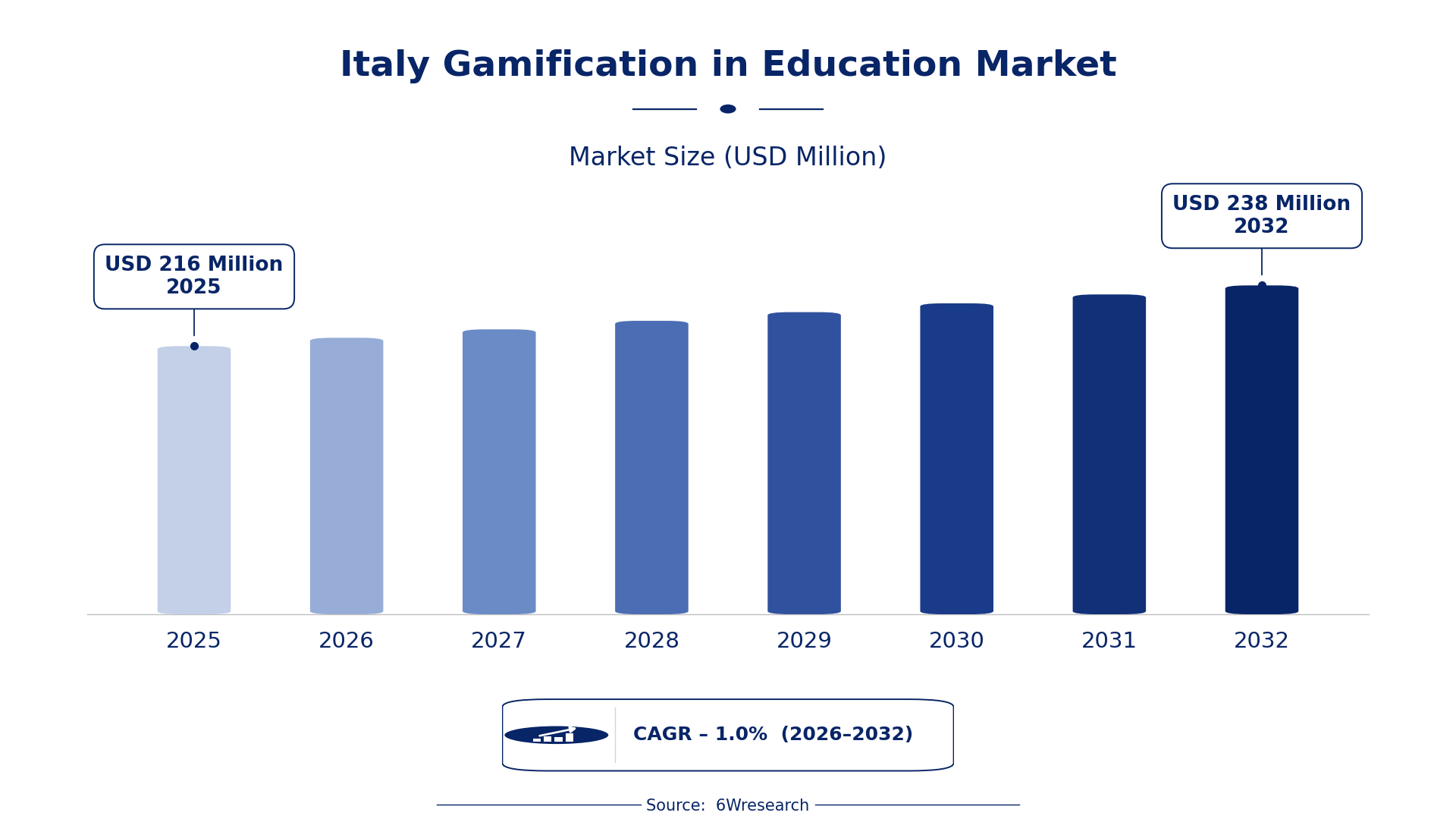
The Italy Gamification in Education Market was estimated at USD 216 Million in 2025 and is projected to reach USD 238 Million by 2032, growing at a CAGR of 1.0% from 2026 to 2032.
Italy Gamification in Education Market Synopsis
The integration of technology within the educational framework is the foremost driving force behind the Italy Gamification in Education Market. As institutions increasingly seek to enhance student participation and learning outcomes, gamification has become an essential strategy.
This market is characterized by a growing number of tailored gamified learning platforms and applications that align with the Italian educational system. Schools and universities are recognizing the value of engaging students through interactive content, thus propelling market expansion.
Italy Gamification in Education Market Year-wise Growth Rate and Key Drivers
This graph illustrates the annual growth rates of the Italy Gamification in Education Market from 2021 to 2032, highlighting a steady upward trajectory and projected expansion over the forecast period.
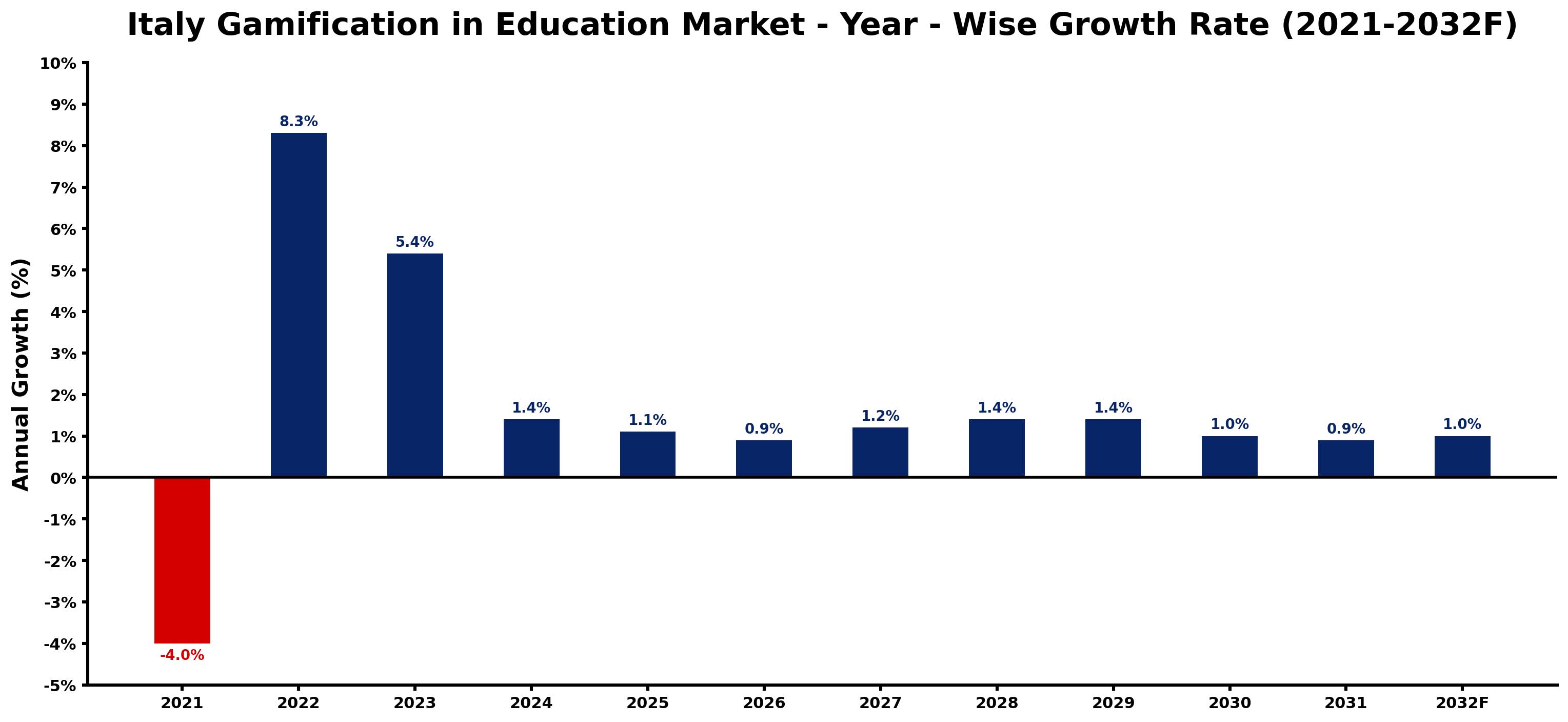
The table below presents the year‑wise growth rates along with the key drivers influencing the market
| Year | Growth Rate | Major Drivers |
| 2021 | -4.0% | Italian Ministry of Education funding cuts for digital tools |
| 2022 | 8.3% | Increased funding for digital education from Italian government |
| 2023 | 5.4% | Rise in student preparation for digital literacy assessments |
| 2024 | 1.4% | Adoption of gamified learning in regional school curricula |
| 2025 | 1.1% | Popularity of AI-driven educational platforms in Italy |
| 2026 | 0.9% | Local tech start-ups developing tailored gamification solutions |
| 2027 | 1.2% | National policy promoting innovative teaching methods in schools |
| 2028 | 1.4% | Growing interest in interactive content by educators |
| 2029 | 1.4% | Partnerships between universities and game developers flourishing |
| 2030 | 1.0% | Increased focus on soft skill development in education |
| 2031 | 0.9% | Surge in mobile education app usage among students |
| 2032 | 1.0% | Collaborations between edtech firms and Italian education boards |
Note: Market size estimations and growth projections presented in this report are based on 6Wresearch's proprietary forecasting methodology, utilizing the latest available industry data, government publications, and primary research inputs.
Italy Gamification in Education Market Key Takeaways
Below are some of the specific key takeaways from the market, including:
- Government policies are increasingly supportive of gamification in education, with funding initiatives to promote digital tools.
- Schools are adopting gamified solutions to address the shift towards online and hybrid learning environments.
- The demand for personalized educational experiences is driving innovation in gamification strategies.
- Partnerships between educational institutions and technology providers are on the rise, enhancing resource availability.
- Investment opportunities are emerging in developing custom applications tailored to the needs of Italian educators and students.
Evaluation of Restraints in Italy Gamification in Education Market
Despite the positive trends, the Italy Gamification in Education Market faces notable challenges. Resistance from educators and institutions accustomed to traditional teaching methods hampers the widespread adoption of gamified learning. Additionally, many schools lack the necessary resources to implement effective gamification strategies, and concerns regarding the alignment of gamified content with educational standards persist. Continuous professional development for educators is crucial but often overlooked, further impeding the market's potential.
Italy Gamification in Education Market Trends
Several trends are shaping the future of the Italy Gamification in Education Market. The rise of e-learning platforms has led to a heightened interest in interactive learning solutions. Gamification techniques such as quizzes, badges, and leaderboards are becoming commonplace as educators seek to improve engagement levels. The impact of the COVID-19 pandemic has also accelerated the adoption of remote learning tools, necessitating innovative gamification methods to maintain student interest and motivation.
Italy Gamification in Education Market Opportunities
There are numerous investment opportunities in this market, particularly for companies focusing on the development of gamified platforms that cater to the unique requirements of the Italian education system. Educational institutions are increasingly open to adopting gamification strategies to boost student engagement, presenting lucrative avenues for technology providers. Collaborations with educational technology startups that create tailored gamified experiences can also yield significant returns, as the emphasis on digital learning continues to grow.
Government Initiatives in the Italy Gamification in Education Market
The Italian government is actively promoting the integration of gamification in education through various initiatives. Public policy is focusing on enhancing digital education, aiming to modernize teaching methods and improve overall educational quality. These initiatives are crucial for creating an environment conducive to the adoption of gamification strategies across schools.
- A recently completed initiative launched by the Ministry of Education aimed at funding schools to adopt digital tools, including gamified platforms.
- Currently underway is a nationwide campaign to increase digital literacy among educators, focusing on training teachers in gamification techniques.
- A planned public-private partnership is expected to introduce advanced gamified learning resources to schools by 2027.
- The government is also developing a regulatory framework to support the standardization of gamified educational content in alignment with curriculum goals.
Future Insights of the Italy Gamification in Education Market
Looking ahead, the Italy Gamification in Education Market is likely to witness steady growth driven by a persistent demand for engaging learning solutions. The ongoing evolution of e-learning platforms will continue to provide fertile ground for gamified applications. As educational institutions increasingly recognize the importance of personalized learning experiences, gamification strategies are expected to play an integral role in enhancing student performance and retention rates. This trajectory indicates a promising future for stakeholders invested in this space.
Italy Gamification in Education Market Latest Developments
Recent developments in the Italy Gamification in Education Market illustrate a dynamic shift towards innovative educational practices. Over the past year, various stakeholders have been actively engaged in enhancing gamified learning experiences, reflecting a growing commitment to technology in education.
- An initiative that began in early 2025 focused on integrating gamification into STEM education, currently gaining traction in several pilot schools.
- A major educational technology vendor launched a gamified assessment tool in Q3 2025 that is already being adopted by universities across Italy.
- Currently ongoing is a collaborative project between schools and tech startups aimed at developing custom gamified learning modules tailored to the Italian curriculum.
- Upcoming in mid-2026, a government-backed program will roll out new funding for educational institutions to implement gamification strategies effectively.
Italy Gamification in Education Market - Key Attractiveness of the Report
- 10 Years of Market Numbers
- Historical Data Starting from 2022 to 2025
- Base Year: 2025
- Forecast Data until 2032
- Key Performance Indicators Impacting the Market
- Major Upcoming Developments and Projects
Key Highlights of the Report:
- Italy Gamification in Education Market Outlook
- Market Size of Italy Gamification in Education Market, 2025
- Forecast of Italy Gamification in Education Market, 2032
- Historical Data and Forecast of Italy Gamification in Education Revenues & Volume for the Period 2022-2032F
- Italy Gamification in Education Market Trend Evolution
- Italy Gamification in Education Market Drivers and Challenges
- Italy Gamification in Education Price Trends
- Italy Gamification in Education Porter's Five Forces
- Italy Gamification in Education Industry Life Cycle
- Historical Data and Forecast of Italy Gamification in Education Market Revenues & Volume By Offering for the Period 2022-2032F
- Historical Data and Forecast of Italy Gamification in Education Market Revenues & Volume By Software for the Period 2022-2032F
- Historical Data and Forecast of Italy Gamification in Education Market Revenues & Volume By Services for the Period 2022-2032F
- Historical Data and Forecast of Italy Gamification in Education Market Revenues & Volume By End User for the Period 2022-2032F
- Historical Data and Forecast of Italy Gamification in Education Market Revenues & Volume By Academic for the Period 2022-2032F
- Historical Data and Forecast of Italy Gamification in Education Market Revenues & Volume By Corporate Training for the Period 2022-2032F
- Historical Data and Forecast of Italy Gamification in Education Market Revenues & Volume By Deployment Mode for the Period 2022-2032F
- Historical Data and Forecast of Italy Gamification in Education Market Revenues & Volume By Cloud for the Period 2022-2032F
- Historical Data and Forecast of Italy Gamification in Education Market Revenues & Volume By On-Premises for the Period 2022-2032F
- Italy Gamification in Education Import Export Trade Statistics
- Market Opportunity Assessment By Offering
- Market Opportunity Assessment By End User
- Market Opportunity Assessment By Deployment Mode
- Italy Gamification in Education Top Companies Market Share
- Italy Gamification in Education Competitive Benchmarking By Technical and Operational Parameters
- Italy Gamification in Education Company Profiles
- Italy Gamification in Education Key Strategic Recommendations






































