Italy Glycerol Market Size (2020-2030)
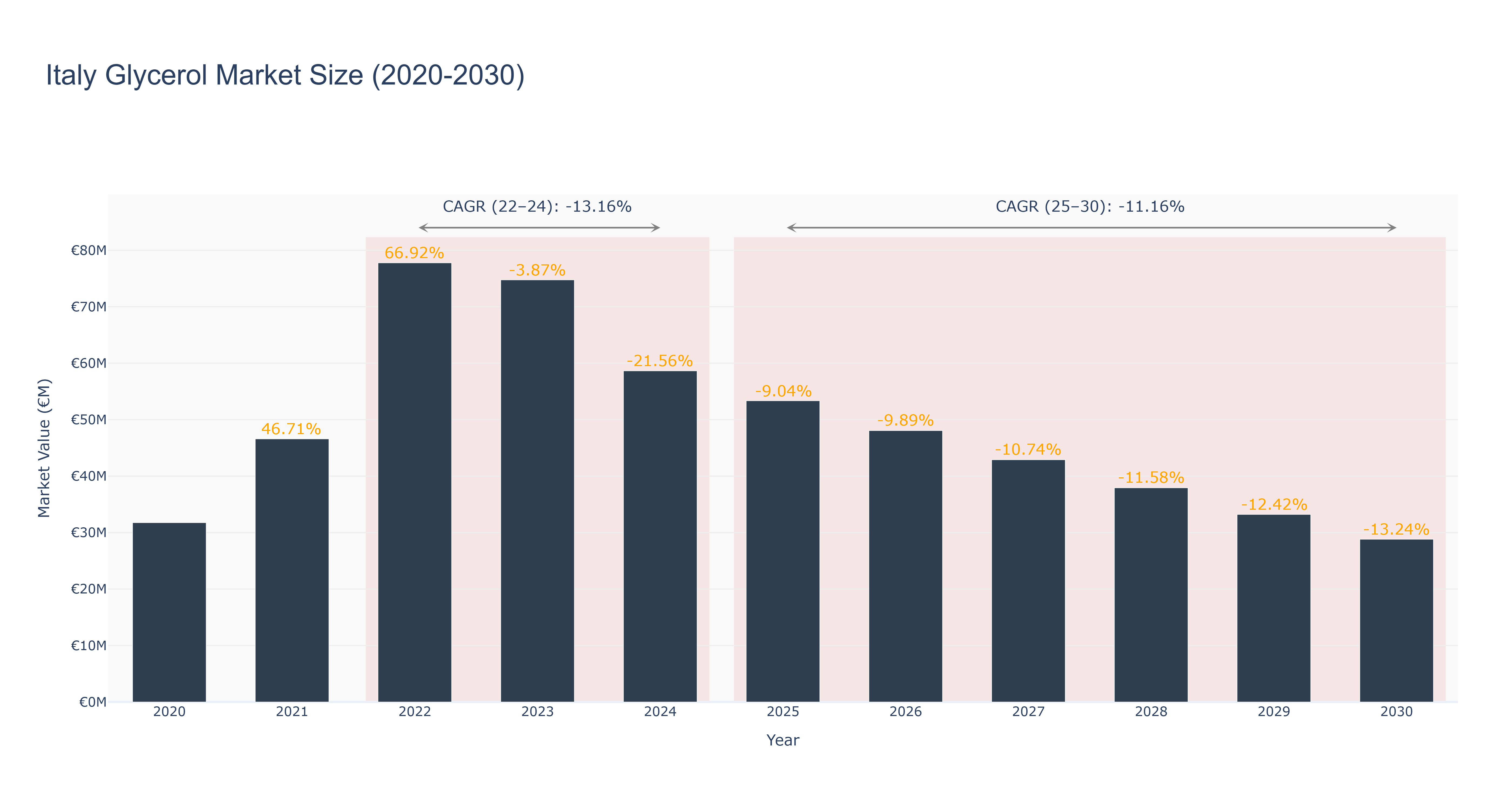
Italy's Glycerol Market experienced a peak market size of €77.77 million in 2022, followed by a decline to €28.82 million in 2030. The actual market size decreased from €77.77 million in 2022 to €58.64 million in 2024, with a negative CAGR of -13.16% during 2022-24. From 2025 to 2030, the forecasted market size is expected to continue declining with a CAGR of -11.16%. The market downturn can be attributed to factors like changing consumer preferences, regulatory challenges, and increasing competition. Looking ahead, Italy's Glycerol Market is expected to focus on sustainable production methods and diversification of product offerings to adapt to market dynamics. Recent developments in eco-friendly packaging solutions and collaborations with biofuel industries are set to drive innovation and growth in the market. Industry drivers for the Italy Glycerol Market include increasing awareness about sustainability, rising demand for natural ingredients in various industries, and government initiatives promoting green technologies.
Italy Glycerol Market: Production & Trade Performance (2019-2025)
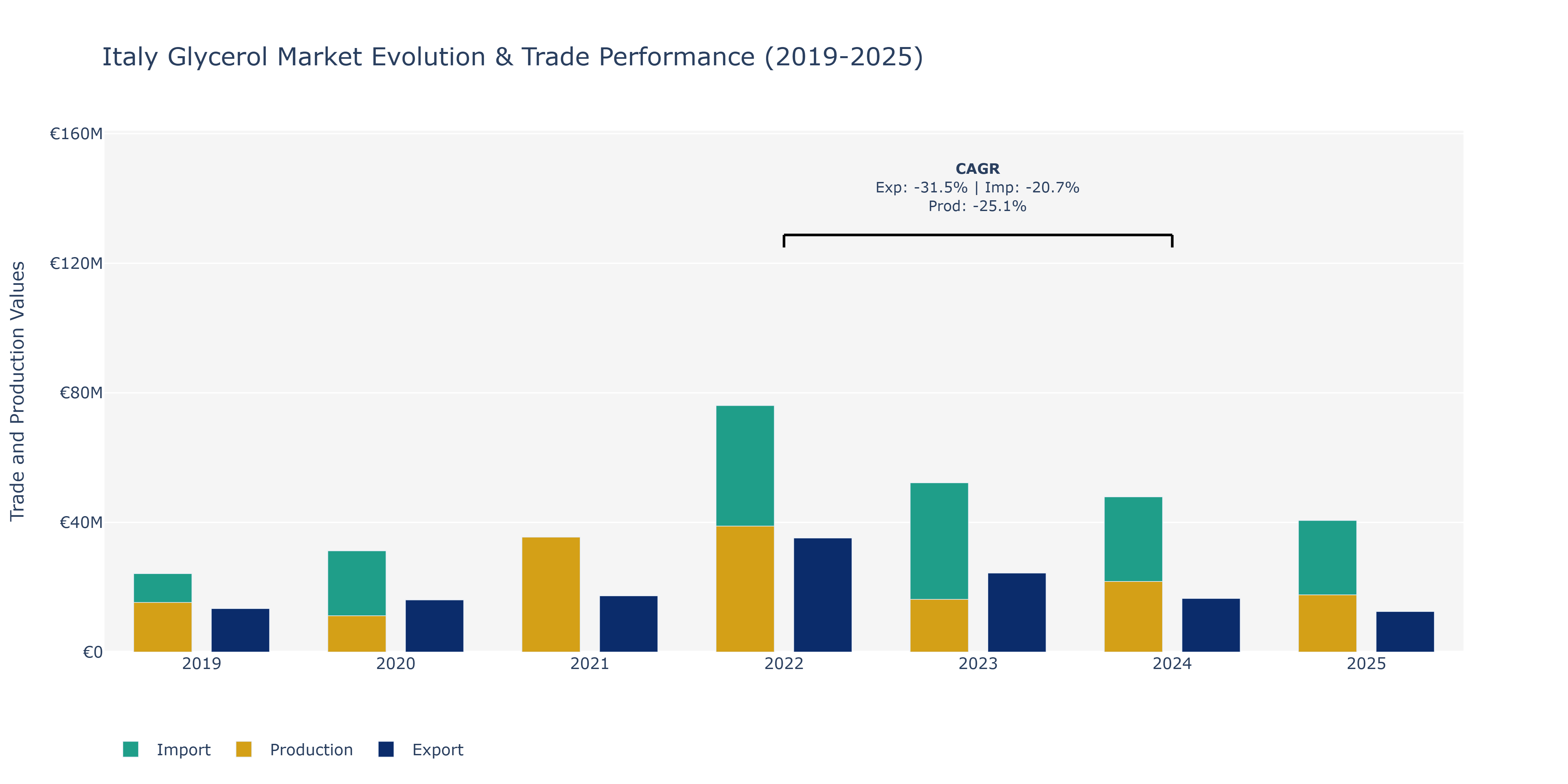
Between 2019 and 2025, the Italy Glycerol Market experienced various trends in exports, imports, and production. Exports saw a peak in 2022, reaching €35.2 million, possibly due to increased global demand or competitive pricing strategies. However, by 2025, exports had decreased to €12.51 million, highlighting potential shifts in international trade dynamics or fluctuations in demand. Imports followed a similar pattern, peaking at €76.07 million in 2022 and then declining to €40.6 million in 2025. This decrease could be attributed to changes in domestic consumption patterns or efforts to promote local production. Production levels fluctuated notably, with a significant increase in 2021 to €35.48 million, possibly driven by advancements in production technologies or capital investments but decreasing to €17.66 million by 2025, indicating potential challenges in maintaining high output levels. The market may benefit from strategies that enhance competitiveness and sustainability to navigate fluctuations in global market conditions.
Italy Glycerol Market Synopsis
Italy glycerol market is expanding, driven by its use in chemical, pharmaceutical, and food industries. Glycerol, a byproduct of biodiesel production, is valued for its versatility and eco-friendliness. The market benefits from the increasing demand for sustainable raw materials and the growth of the biofuel industry.
Drivers of the market
The Italy Glycerol Market is witnessing growth due to its applications in the production of chemicals, pharmaceuticals, and personal care products. Glycerol serves as a key raw material for the synthesis of glycerides, surfactants, and polyols, driving its demand in industrial processes, formulations, and end-use applications across Italy chemical and consumer goods industries.
Challenges of the market
The glycerol market in Italy faces challenges related to the fluctuating availability and prices of raw materials, particularly those linked to biodiesel production. Ensuring consistent quality and purity of glycerol is essential for its use in pharmaceuticals, cosmetics, and food industries. The market also contends with competition from synthetic alternatives and the need to adhere to strict regulatory standards. Environmental concerns and the push towards sustainable production practices add additional layers of complexity to the market.
Government Policy of the market
Italy government promotes sustainable production and use of glycerol through policies supporting bio-based industries, renewable energy, and green chemistry. Measures include incentives for biodiesel production, regulations on glycerol quality and purity standards, and support for research and development in glycerol-based products and applications.
Key Highlights of the Report:
- Italy Glycerol Market Outlook
- Market Size of Italy Glycerol Market, 2024
- Forecast of Italy Glycerol Market, 2031
- Historical Data and Forecast of Italy Glycerol Revenues & Volume for the Period 2018 - 2031
- Italy Glycerol Market Trend Evolution
- Italy Glycerol Market Drivers and Challenges
- Italy Glycerol Price Trends
- Italy Glycerol Porter's Five Forces
- Italy Glycerol Industry Life Cycle
- Historical Data and Forecast of Italy Glycerol Market Revenues & Volume By Source for the Period 2018 - 2031
- Historical Data and Forecast of Italy Glycerol Market Revenues & Volume By Biodiesel for the Period 2018 - 2031
- Historical Data and Forecast of Italy Glycerol Market Revenues & Volume By Fatty Alcohols for the Period 2018 - 2031
- Historical Data and Forecast of Italy Glycerol Market Revenues & Volume By Fatty Acids for the Period 2018 - 2031
- Historical Data and Forecast of Italy Glycerol Market Revenues & Volume By Soap for the Period 2018 - 2031
- Historical Data and Forecast of Italy Glycerol Market Revenues & Volume By Type for the Period 2018 - 2031
- Historical Data and Forecast of Italy Glycerol Market Revenues & Volume By Crude for the Period 2018 - 2031
- Historical Data and Forecast of Italy Glycerol Market Revenues & Volume By Refined for the Period 2018 - 2031
- Historical Data and Forecast of Italy Glycerol Market Revenues & Volume By End-use for the Period 2018 - 2031
- Historical Data and Forecast of Italy Glycerol Market Revenues & Volume By Food & Beverage for the Period 2018 - 2031
- Historical Data and Forecast of Italy Glycerol Market Revenues & Volume By Pharmaceutical for the Period 2018 - 2031
- Historical Data and Forecast of Italy Glycerol Market Revenues & Volume By Nutraceutical for the Period 2018 - 2031
- Historical Data and Forecast of Italy Glycerol Market Revenues & Volume By Personal Care & Cosmetics for the Period 2018 - 2031
- Historical Data and Forecast of Italy Glycerol Market Revenues & Volume By Industrial for the Period 2018 - 2031
- Historical Data and Forecast of Italy Glycerol Market Revenues & Volume By Others for the Period 2018 - 2031
- Italy Glycerol Import Export Trade Statistics
- Market Opportunity Assessment By Source
- Market Opportunity Assessment By Type
- Market Opportunity Assessment By End-use
- Italy Glycerol Top Companies Market Share
- Italy Glycerol Competitive Benchmarking By Technical and Operational Parameters
- Italy Glycerol Company Profiles
- Italy Glycerol Key Strategic Recommendations






































