Italy Hand Carts & Trolleys Market Summary
The italy hand carts & trolleys market was estimated at USD 156 Million in 2025 and is projected to reach USD 173 Million by 2032, growing at a CAGR of 0.9% from 2026 to 2032.
Italy Hand Carts & Trolleys Market Year-wise Growth Rate and Key Drivers
This graph highlights how the Italy Hand Carts & Trolleys Market has steadily grown over the past five years, supported by major growth factors.
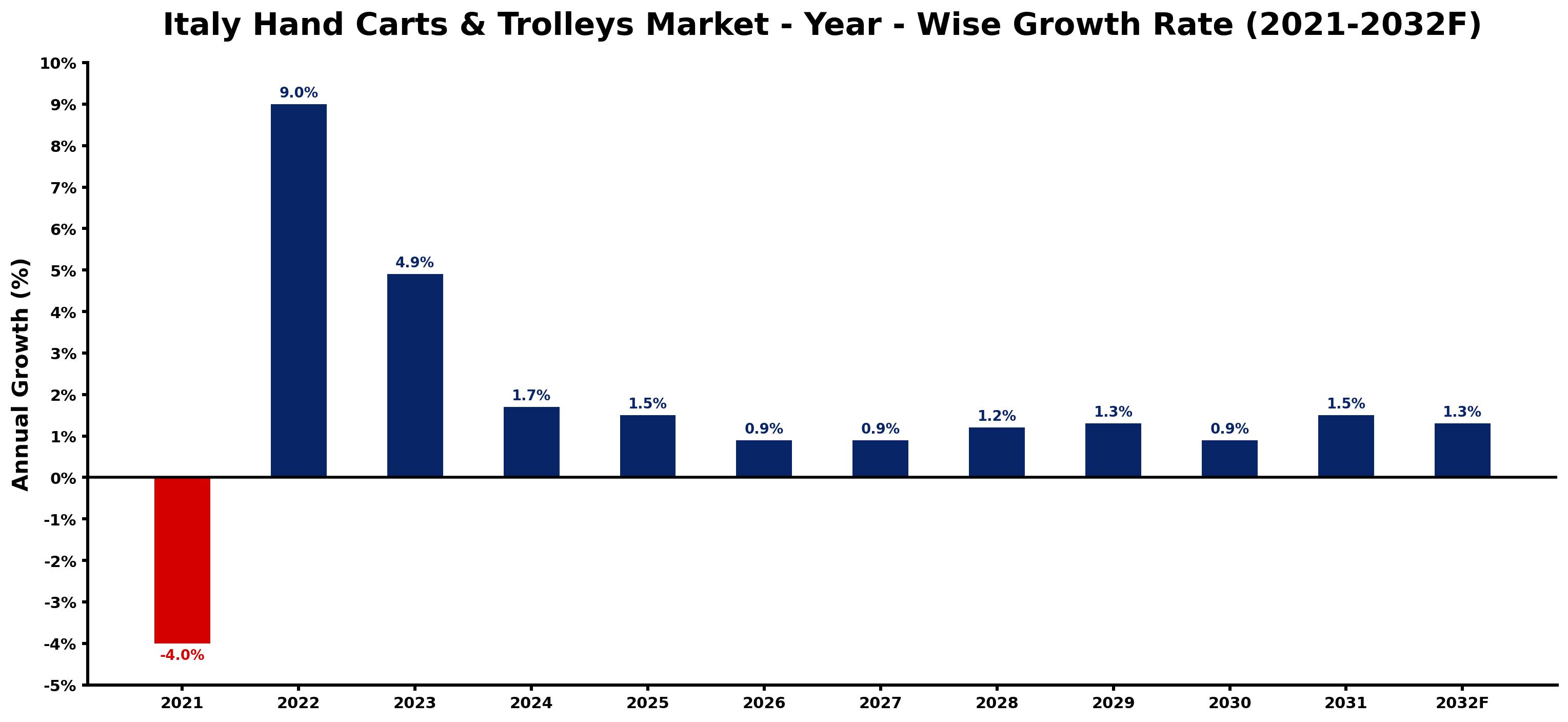
The table below presents the year wise growth rates along with the key drivers influencing the market
| Year | Growth Rate | Major Drivers |
| 2021 | -4.0% | Supply chain disruptions hindered availability, leading to decreased sales in the hand carts and trolleys sector. |
| 2022 | 9.0% | Rising interest in eco-friendly materials encouraged sustainable production of hand carts and trolleys. |
| 2023 | 4.9% | Urbanization trends increased demand for compact, versatile transportation solutions in metropolitan areas. |
| 2024 | 1.7% | Retailers expanded outdoor and event logistics, boosting sales of portable hand carts significantly. |
| 2025 | 1.5% | Technological integrations, such as GPS tracking, enhanced functionality and appeal of trolleys. |
| 2026 | 0.9% | Increased online shopping habits led consumers to seek efficient last-mile delivery options. |
| 2027 | 0.9% | Catering businesses adopted trolleys for outdoor events, emphasizing mobility in service delivery. |
| 2028 | 1.2% | Movement towards local sourcing emphasized the need for efficient transport of goods. |
| 2029 | 1.3% | Climate considerations pushed manufacturers to focus on lightweight, durable materials for carts. |
| 2030 | 0.9% | Trade shows in Italy highlighted innovative designs, fostering competition among manufacturers. |
| 2031 | 1.5% | Urban logistics partnerships emerged, providing rental options for businesses needing flexibility. |
| 2032 | 1.3% | Post-COVID trends emphasized long-term investments in versatile transportation solutions for growth. |
Note - Market size estimations and growth projections presented in this report are based on 6Wresearch's advanced forecasting approach, validated with industry datasets as of June 2026.
Italy Hand Carts & Trolleys Market Synopsis
The Italy Hand Carts Trolleys Market is projected to reach 0.9% and witness significant growth during the forecast period (2026-2032). This growth can be attributed to the rising demands from various sectors, including hospitality, retail, food and beverage, and transportation industries. Innovations in product design and material technology, particularly the introduction of mobile storage solutions, have further bolstered market expansion. As manufacturers embrace advanced materials, particularly lightweight options, the potential for enhanced product efficiency and functionality is significant.
Italy Hand Carts & Trolleys Market Growth Drivers
The drivers behind the growth of the Italy Hand Carts & Trolleys Market are multifaceted. Key factors include:
- Increased demand in the hospitality sector, where efficient material handling solutions are essential for operational effectiveness and customer service.
- Expansion within the retail sector, where retailers seek durable and flexible transport solutions for inventory management and customer engagements.
- Growth in the food and beverage industry, necessitating specialized carts that enhance efficiency in logistics and delivery systems.
- The transportation sector's need for advanced handling equipment to streamline operations and reduce manual labor.
- Technological advancements leading to the development of innovative products, such as eco-friendly options made from recycled materials, which attract environmentally conscious consumers.
Italy Hand Carts & Trolleys Market Trends and Opportunities
Emerging trends within the Italy Hand Carts & Trolleys Market present numerous opportunities for stakeholders. The increasing focus on sustainability has prompted manufacturers to explore environmentally friendly materials. This shift is not only appealing to eco-conscious businesses but also aligns with stringent regulatory standards. The rise of e-commerce has further fueled the need for efficient logistics solutions, highlighting opportunities for innovation.
- The market is witnessing a shift towards lightweight and foldable designs that facilitate better transportation and storage, catering to urban environments.
- There is a growing interest in ergonomic designs, which enhance user comfort and reduce physical strain during usage.
- Customization is becoming prevalent, with businesses seeking tailored solutions that meet specific operational requirements.
- The adoption of digital technologies for tracking and managing inventory using smart carts is on the rise, driving efficiency.
- Collaboration between manufacturers and logistics providers is increasing to develop integrated solutions that optimize overall performance.
Italy Hand Carts & Trolleys Market Challenges and Restraints
Despite the positive outlook, the Italy Hand Carts & Trolleys Market faces challenges that could hinder its growth trajectory. Key impediments include:
- Rising labor costs are placing additional financial pressure on manufacturers, impacting pricing strategies and profit margins.
- Stringent environmental regulations are compelling manufacturers to invest significantly in compliance measures, which can be financially burdensome.
- The market is experiencing heightened competition, requiring continuous innovation to retain market share.
- Supply chain disruptions have been exacerbated by global economic uncertainties, potentially affecting product availability and delivery timelines.
- The differentiation of products in a saturated market can be challenging, making it difficult for new entrants to establish a foothold.
Italy Hand Carts & Trolleys Market Government Investment and Initiatives
Government policies in Italy play a significant role in shaping the Hand Carts & Trolleys Market. Investment in infrastructure and support for local manufacturers are key areas of focus. The government has initiated various programs aimed at enhancing logistics and supply chain efficiency. This includes funding for research and development projects focused on innovative transportation solutions, and incentives for companies that prioritize sustainability. Furthermore, initiatives aimed at promoting recycling and waste reduction have encouraged the adoption of eco-friendly materials in the production of hand carts and trolleys.
Italy Hand Carts & Trolleys Market Latest Developments (May 2025 - June 2026)
Recent developments in the Italy Hand Carts & Trolleys Market indicate a dynamic evolution in response to consumer and industry demands. Manufacturers are increasingly adopting advanced manufacturing techniques that enhance product performance while reducing environmental impact. The market has seen a focus on developing smart solutions that incorporate IoT technology, thus improving logistics management and operational efficiency. Additionally, collaborations among key stakeholders have strengthened the supply chain, enabling more streamlined operations and faster product delivery to end users.
Italy Hand Carts & Trolleys Market - Key Attractiveness of the Report
- 10 Years of Market Numbers
- Historical Data Starting from 2022 to 2025
- Base Year: 2025
- Forecast Data until 2032
- Key Performance Indicators Impacting the Market
- Major Upcoming Developments and Projects
Key Highlights of the Report:
- Italy Hand Carts & Trolleys Market Outlook
- Market Size of Italy Hand Carts & Trolleys Market, 2025
- Forecast of Italy Hand Carts & Trolleys Market, 2032F
- Historical Data and Forecast of Italy Hand Carts & Trolleys Revenues & Volume for the Period 2022-2032F
- Italy Hand Carts & Trolleys Market Trend Evolution
- Italy Hand Carts & Trolleys Market Drivers and Challenges
- Italy Hand Carts & Trolleys Price Trends
- Italy Hand Carts & Trolleys Porter's Five Forces
- Italy Hand Carts & Trolleys Industry Life Cycle
- Historical Data and Forecast of Italy Hand Carts & Trolleys Market Revenues & Volume By Types for the Period 2022-2032F
- Historical Data and Forecast of Italy Hand Carts & Trolleys Market Revenues & Volume By Steel Hand Truck for the Period 2022-2032F
- Historical Data and Forecast of Italy Hand Carts & Trolleys Market Revenues & Volume By Aluminium Hand Truck for the Period 2022-2032F
- Historical Data and Forecast of Italy Hand Carts & Trolleys Market Revenues & Volume By Applications for the Period 2022-2032F
- Historical Data and Forecast of Italy Hand Carts & Trolleys Market Revenues & Volume By Online Sales for the Period 2022-2032F
- Historical Data and Forecast of Italy Hand Carts & Trolleys Market Revenues & Volume By Offline Sales for the Period 2022-2032F
- Italy Hand Carts & Trolleys Import Export Trade Statistics
- Market Opportunity Assessment By Types
- Market Opportunity Assessment By Applications
- Italy Hand Carts & Trolleys Top Companies Market Share
- Italy Hand Carts & Trolleys Competitive Benchmarking By Technical and Operational Parameters
- Italy Hand Carts & Trolleys Company Profiles
- Italy Hand Carts & Trolleys Key Strategic Recommendations






































