Italy Helicopter Market Size, Share & Growth Rate
The Italy Helicopter Market was estimated at USD 167 Million in 2025 and is projected to reach USD 185 Million by 2032, growing at a CAGR of 1.5% from 2026 to 2032. This growth trajectory is fueled by increasing demand for helicopters across various sectors, including tourism and emergency medical services. Furthermore, advancements in helicopter technology and a robust focus on eco-friendly aviation practices are set to enhance operational efficiencies and attract investments.
Italy Helicopter Market Year-wise Growth Rate and Key Drivers
This graph highlights how the Italy Helicopter Market has steadily grown over the years, supported by major growth factors.
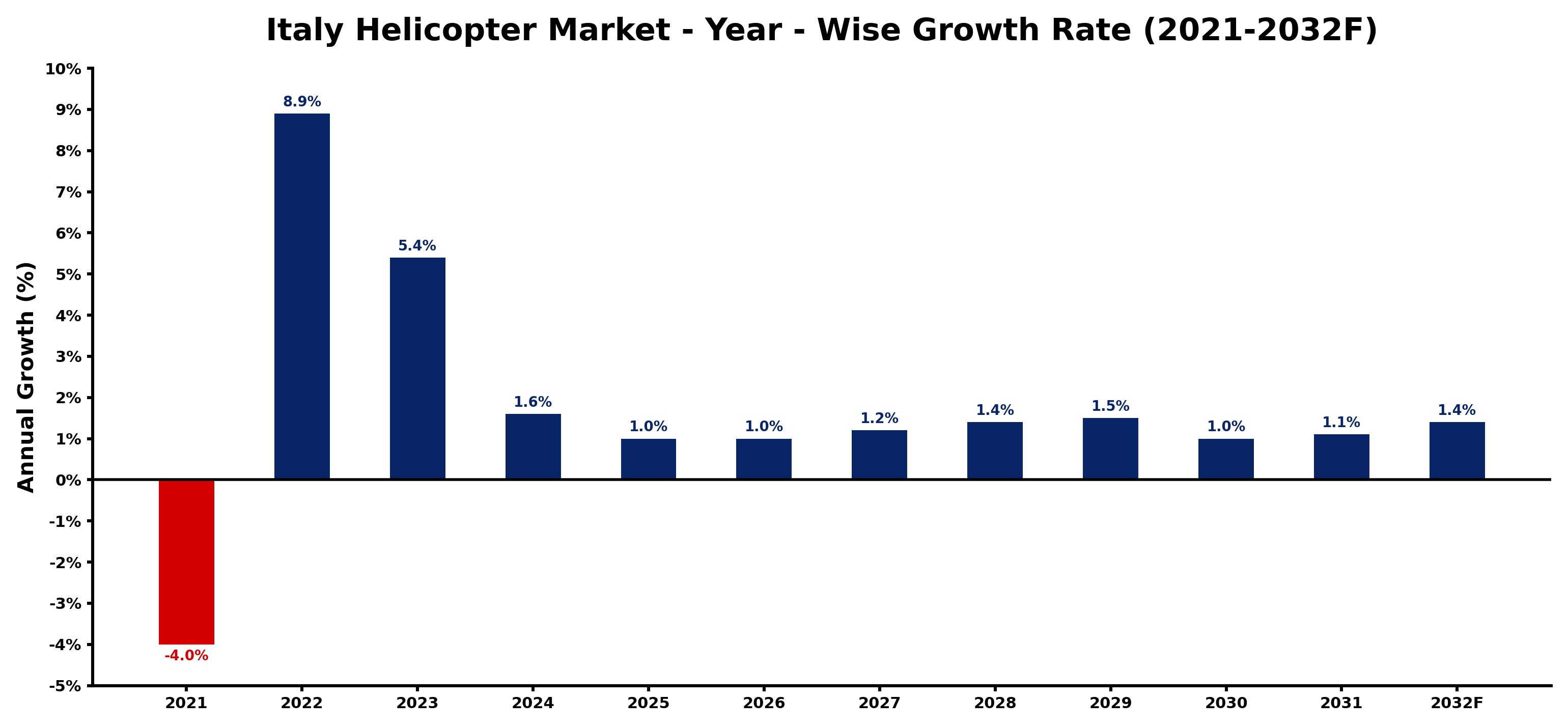
The table below presents the year‑wise growth rates along with the key drivers influencing the market
| Year | Growth Rate | Major Drivers |
| 2021 | -4.0% | Supply chain disruptions delayed helicopter component production schedules significantly |
| 2022 | 8.9% | New manufacturing facilities boost rotorcraft component production capabilities |
| 2023 | 5.4% | Modernization of manufacturing facilities boosts helicopter component production capacity |
| 2024 | 1.6% | Government funding boosts rotorcraft production facility upgrades in Italy |
| 2025 | 1.0% | Advanced avionics systems adoption boosted helicopter manufacturing productivity |
| 2026 | 1.0% | Defense contracts stimulate helicopter component manufacturing demand across Italy |
| 2027 | 1.2% | Domestic helicopter manufacturers adopt advanced avionics technology for competitive edge |
| 2028 | 1.4% | Improved helicopter assembly facilities boost local manufacturing investments |
| 2029 | 1.5% | Helicopter component manufacturers enhance production efficiency through automation |
| 2030 | 1.0% | Increased demand for advanced composites drives helicopter component manufacturing efficiency |
| 2031 | 1.1% | Domestic helicopter maintenance contracts boosted parts manufacturing and supply chains |
| 2032 | 1.4% | New helicopter assembly lines boost domestic production capacity significantly |
Note - Market size estimations and growth projections presented in this report are based on 6Wresearch’s advanced forecasting approach, validated with industry datasets as of June 2026.
Italy Helicopter Market Synopsis
In recent years, the Italy helicopter market has experienced significant momentum, driven by a surge in demand for versatile rotorcraft solutions. As economic conditions stabilize, the market is poised to capitalize on burgeoning sectors such as tourism and medical services, expanding its footprint in both commercial and military applications.
Looking ahead, the market is expected to embrace modernization and innovation in response to evolving consumer needs and regulatory frameworks. As Italian operators adapt to these dynamics, the shift towards sustainable helicopter solutions will define the future landscape of the industry.
Italy Helicopter Market Key Takeaways
- The market is driven by rising demand for helicopters in tourism, emergency services, and corporate travel.
- Technological advancements are leading to safer and more efficient rotorcraft designs.
- Investment opportunities are emerging in offshore operations and medical emergency services.
- Government policies focus on safety, sustainability, and regulatory compliance.
- The market's growth is tempered by economic uncertainties and competition from alternative transport modes.
Evaluation of Restraints in Italy Helicopter Market
Despite its potential, the Italy helicopter market faces several restraints that could inhibit growth. Stringent regulatory frameworks pose significant hurdles, particularly concerning safety certifications and operational permissions. Economic uncertainties, exacerbated by fluctuating fuel prices and broader geopolitical factors, may impact consumer confidence and operational costs. Moreover, the increasing availability of alternative modes of transportation, such as high-speed trains and well-developed road networks, intensifies competition, compelling helicopter service providers to differentiate their offerings actively.
Italy Helicopter Market Trends
Current trends in the Italy helicopter market include a marked shift towards the utilization of helicopters for urban mobility solutions, including VIP transport and sightseeing tours. In addition, there is a growing emphasis on safety and environmental sustainability, prompting operators to adopt modern rotorcraft that align with eco-friendly standards. Technological advancements, such as improved fuel efficiency and extended operational ranges, are also shaping customer preferences and influencing purchasing decisions.
Italy Helicopter Market Opportunities
The Italy helicopter market presents substantial investment opportunities across various domains. In particular, the burgeoning tourism sector offers a fertile ground for helicopter sightseeing services, catering to both domestic and international travelers. The critical need for timely emergency medical services provides another promising avenue for growth. Furthermore, the country's extensive coastline supports offshore operations, including oil and gas exploration and maritime surveillance, creating additional prospects for helicopter operators aiming to broaden their service portfolios.
Government Initiatives in the Italy Helicopter Market
Italian government initiatives surrounding the helicopter market are centered on enhancing safety standards, regulatory compliance, and operational efficiency. The Italian Civil Aviation Authority (ENAC) plays a pivotal role in overseeing helicopter certifications and pilot licensing, which reinforces the commitment to safe air travel. Additionally, public funding initiatives are being directed towards research and development in helicopter technology, fostering collaborations between industry stakeholders and academic institutions to promote innovation and sustainability within the sector.
Future Insights of the Italy Helicopter Market
The future outlook for the Italy helicopter market is optimistic, with steady growth anticipated through 2032. As demand surges for helicopters in civil applications, particularly in medical and corporate sectors, operators must adapt to emerging technologies that prioritize environmental sustainability. Simultaneously, ongoing modernization efforts in the defense sector will likely contribute to market expansion. By navigating regulatory challenges and leveraging advancements in rotorcraft capabilities, the Italian helicopter market is well-positioned for a progressive future.
Italy Helicopter Market Latest Developments (May 2025 - June 2026)
The Italy helicopter market is witnessing significant developments focused on innovation and modernization. Industry stakeholders are increasingly investing in the research and development of advanced rotorcraft that integrate cutting-edge technology for enhanced operational efficiencies. Additionally, collaborations between private and public sectors are yielding new initiatives aimed at improving the sustainability of helicopter operations. This period is marked by a transition towards more eco-friendly models as demand for green aviation solutions continues to escalate.
Italy Helicopter Market - Key Attractiveness of the Report
- 10 Years of Market Numbers
- Historical Data Starting from 2022 to 2025
- Base Year: 2025
- Forecast Data until 2032
- Key Performance Indicators Impacting the Market
- Major Upcoming Developments and Projects
Key Highlights of the Report:
- Italy Helicopter Market Outlook
- Market Size of Italy Helicopter Market, 2025
- Forecast of Italy Helicopter Market, 2032
- Historical Data and Forecast of Italy Helicopter Revenues & Volume for the Period 2022-2032F
- Italy Helicopter Market Trend Evolution
- Italy Helicopter Market Drivers and Challenges
- Italy Helicopter Price Trends
- Italy Helicopter Porter's Five Forces
- Italy Helicopter Industry Life Cycle
- Historical Data and Forecast of Italy Helicopter Market Revenues & Volume By End-users for the Period 2022-2032F
- Historical Data and Forecast of Italy Helicopter Market Revenues & Volume By Commercial for the Period 2022-2032F
- Historical Data and Forecast of Italy Helicopter Market Revenues & Volume By Military for the Period 2022-2032F
- Historical Data and Forecast of Italy Helicopter Market Revenues & Volume By Component for the Period 2022-2032F
- Historical Data and Forecast of Italy Helicopter Market Revenues & Volume By Aerostructures/Airframes for the Period 2022-2032F
- Historical Data and Forecast of Italy Helicopter Market Revenues & Volume By Rotary System for the Period 2022-2032F
- Historical Data and Forecast of Italy Helicopter Market Revenues & Volume By Engine for the Period 2022-2032F
- Historical Data and Forecast of Italy Helicopter Market Revenues & Volume By Undercarriage for the Period 2022-2032F
- Historical Data and Forecast of Italy Helicopter Market Revenues & Volume By Avionics for the Period 2022-2032F
- Historical Data and Forecast of Italy Helicopter Market Revenues & Volume By Cabin Interiors for the Period 2022-2032F
- Historical Data and Forecast of Italy Helicopter Market Revenues & Volume By Environmental Control System for the Period 2022-2032F
- Historical Data and Forecast of Italy Helicopter Market Revenues & Volume By Sales Channels for the Period 2022-2032F
- Historical Data and Forecast of Italy Helicopter Market Revenues & Volume By OEM for the Period 2022-2032F
- Historical Data and Forecast of Italy Helicopter Market Revenues & Volume By Maintenance for the Period 2022-2032F
- Historical Data and Forecast of Italy Helicopter Market Revenues & Volume By Repair for the Period 2022-2032F
- Historical Data and Forecast of Italy Helicopter Market Revenues & Volume By Overhaul for the Period 2022-2032F
- Italy Helicopter Import Export Trade Statistics
- Market Opportunity Assessment By End-users
- Market Opportunity Assessment By Component
- Market Opportunity Assessment By Sales Channels
- Italy Helicopter Top Companies Market Share
- Italy Helicopter Competitive Benchmarking By Technical and Operational Parameters
- Italy Helicopter Company Profiles
- Italy Helicopter Key Strategic Recommendations






































