Italy IoT Security Market Size & Growth Rate (2026-2032)
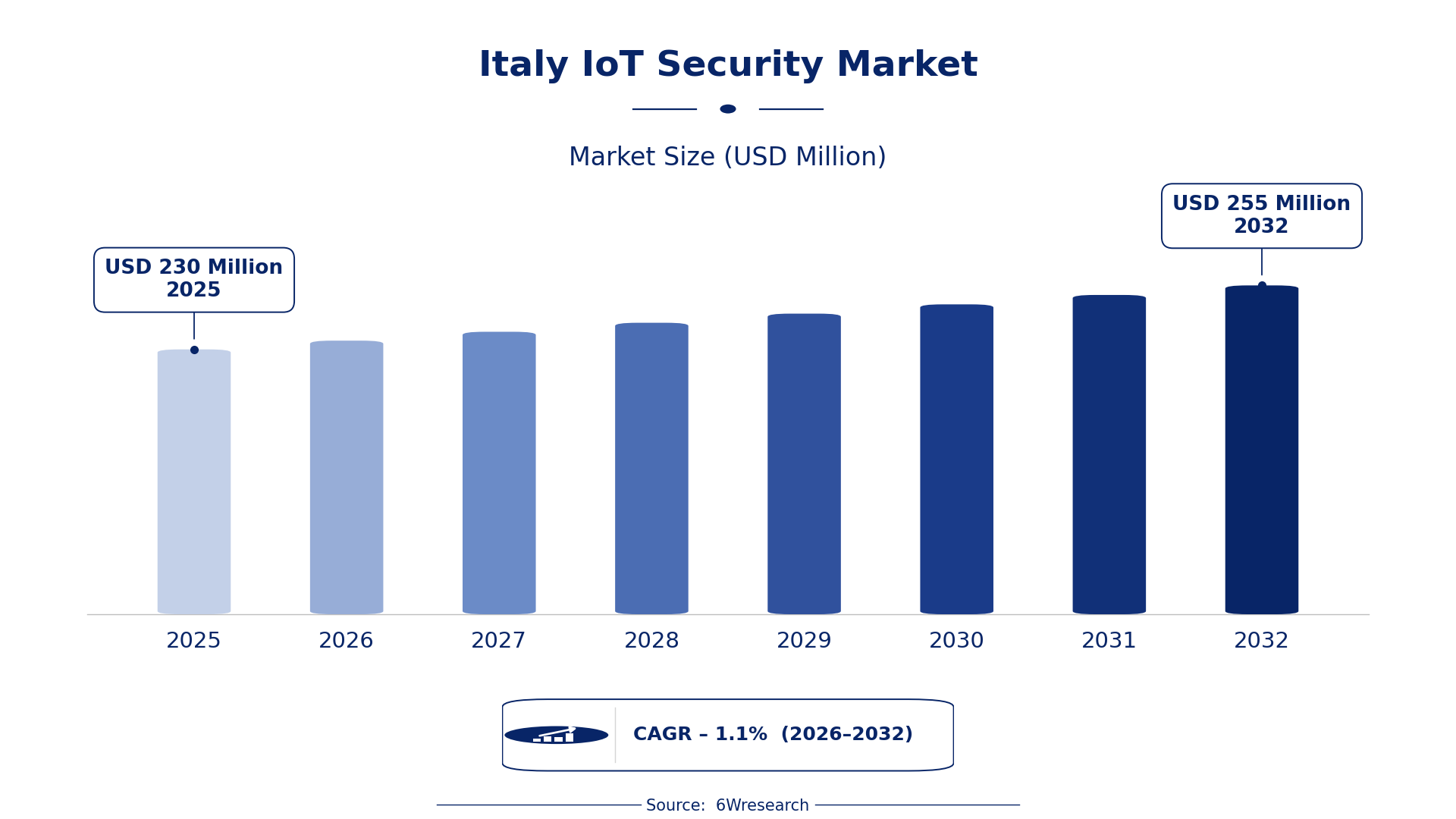
The Italy IoT Security Market was estimated at USD 230 Million in 2025 and is projected to reach USD 255 Million by 2032, growing at a CAGR of 1.1% from 2026 to 2032.
Italy IoT Security Market Synopsis
The primary force shaping the Italy IoT Security Market is the escalating concern over cybersecurity threats. As businesses increasingly rely on interconnected devices, the demand for robust security solutions to protect sensitive data and maintain operational integrity is more pressing than ever.
Regulatory mandates also play a crucial role, compelling organizations to enhance their security frameworks. Compliance with stringent data protection laws drives investments in encryption, authentication, and threat detection technologies, which are vital for safeguarding the growing array of IoT devices.
Italy IoT Security Market Year-wise Growth Rate and Key Drivers
This graph illustrates the annual growth rates of the Italy IoT Security Market from 2021 to 2032, highlighting a steady upward trajectory and projected expansion over the forecast period.
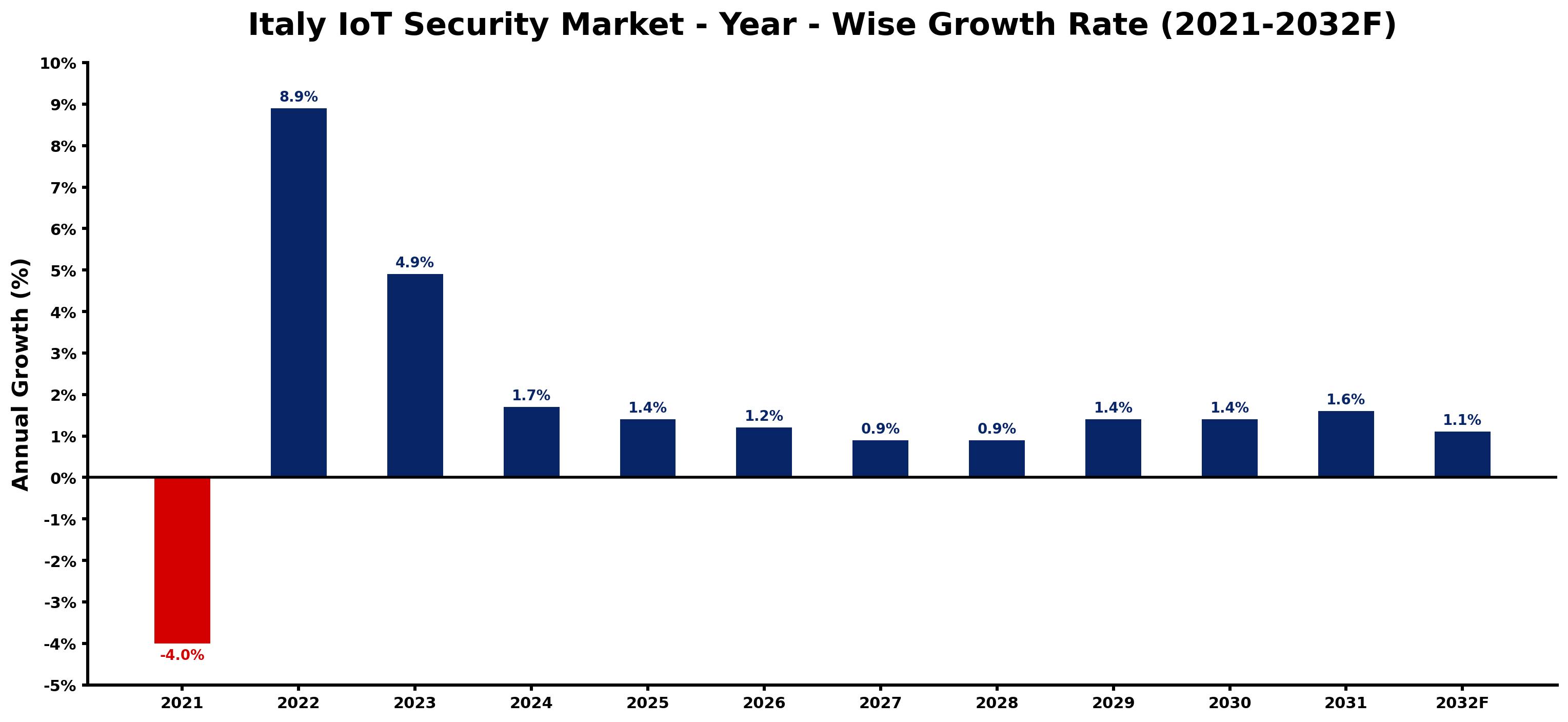
The table below presents the year‑wise growth rates along with the key drivers influencing the market
| Year | Growth Rate | Major Drivers |
| 2021 | -4.0% | Delayed regulatory framework from AGID stalling project approvals. |
| 2022 | 8.9% | EU GDPR compliance drives demand for IoT security solutions. |
| 2023 | 4.9% | Rise in smart home devices increases cybersecurity needs. |
| 2024 | 1.7% | Italian government promotes industry 4.0 IoT security initiatives. |
| 2025 | 1.4% | Local businesses adopting IoT devices spur security investments. |
| 2026 | 1.2% | Increased focus on data protection laws enhances market growth. |
| 2027 | 0.9% | Cyberattacks on critical infrastructure heighten security awareness. |
| 2028 | 0.9% | Healthcare IoT adoption drives regulatory security requirements. |
| 2029 | 1.4% | Telecom upgrades boost secure IoT network deployments. |
| 2030 | 1.4% | Growing concern over personal data safety promotes solutions. |
| 2031 | 1.6% | Investment in smart city projects drives IoT security demand. |
| 2032 | 1.1% | Rising awareness of digital identity protection fuels interest. |
Note: Market size estimations and growth projections presented in this report are based on 6Wresearch's proprietary forecasting methodology, utilizing the latest available industry data, government publications, and primary research inputs.
Italy IoT Security Market Key Takeaways
Below are some of the specific key takeaways from the market, including:
- The growing sophistication of cyber threats is leading to increased investments in IoT security solutions.
- Regulatory compliance is a major driver for companies to adopt comprehensive security measures.
- The complexity of protecting diverse IoT ecosystems presents unique challenges for organizations.
- Financial incentives from the government are supporting the development of advanced security technologies.
- Emerging technologies such as AI and machine learning are being integrated into IoT security solutions.
Evaluation of Restraints in Italy IoT Security Market
The Italy IoT Security Market faces several restraints that hinder its growth trajectory. One major limitation is the rapidly evolving nature of cyber threats, which can outpace existing security measures. Organizations often struggle with the complexity and cost of implementing comprehensive security protocols across a wide range of devices. on top of that, there’s a constant tension between ensuring robust security and maintaining the usability of IoT systems. Compliance with stringent regulations, particularly GDPR, necessitates ongoing updates and monitoring, adding further strain on resources.
Italy IoT Security Market Trends
Recent trends indicate a shift toward integrating artificial intelligence and machine learning into IoT security frameworks. These technologies enhance threat detection capabilities, allowing for real-time responses to potential breaches. Additionally, there’s a growing focus on developing security standards specifically tailored for IoT devices, driven by industry collaborations and regulatory pressures. The adoption of cloud-based security solutions is also rising, as organizations look for scalable options to protect their interconnected ecosystems.
Italy IoT Security Market Opportunities
The opportunities within the Italy IoT Security Market are substantial. As businesses continue to adopt IoT technologies, the need for security solutions will only intensify. Companies that can provide innovative, user-friendly security offerings will have a significant advantage. on top of that, partnerships between tech firms and regulatory bodies can lead to the development of more effective security standards and practices. The increasing demand for smart city initiatives also opens avenues for comprehensive security solutions to protect urban infrastructures.
Government Initiatives in the Italy IoT Security Market
The Italian government is actively shaping the IoT security market through various initiatives aimed at enhancing cybersecurity measures. The regulatory environment is becoming increasingly stringent, reflecting the necessity for robust protections against cyber threats. This proactive posture ensures that businesses are held to high security standards while also fostering innovation in security solutions.
- A national cybersecurity strategy was launched in 2023 to bolster IoT security frameworks across all sectors.
- Current initiatives include a public-private partnership aimed at developing advanced security technologies for IoT devices, which is underway.
- The government is promoting educational programs to raise awareness about IoT security risks and best practices.
- A planned regulatory framework expected to be introduced by 2026 will mandate comprehensive security assessments for IoT networks.
- Financial grants are being provided to startups focusing on innovative security solutions for IoT ecosystems.
Future Insights of the Italy IoT Security Market
Looking ahead to 2026-2032, the Italy IoT Security Market is set to experience steady growth, driven by ongoing cybersecurity threats and regulatory pressures. As more organizations integrate IoT technologies, the demand for effective security solutions will continue to rise. Companies that invest in next-generation security technologies and adapt to the evolving landscape will find themselves well-positioned to capture market share. The emphasis on compliance will also create avenues for growth, as organizations seek to align with new regulations.
Italy IoT Security Market Latest Developments
In the past 12-14 months, the Italy IoT Security Market has seen a flurry of activity, reflecting the urgent need for enhanced cybersecurity measures. Various stakeholders are making strides in developing solutions that address the unique challenges posed by interconnected devices.
- A major technology vendor launched a comprehensive IoT security platform in Q3 2025, designed to integrate seamlessly with existing systems.
- An initiative that began in early 2025 focuses on creating standardized security protocols for smart home devices and remains ongoing.
- A collaboration between leading cybersecurity firms and academic institutions is currently underway to develop innovative threat detection algorithms.
- Upcoming regulatory changes anticipated by late 2026 are expected to reshape compliance requirements for IoT security.
- A pilot program aimed at improving the security of IoT devices in healthcare settings has recently been initiated, with positive early feedback.
Italy IoT Security Market - Key Attractiveness of the Report
- 10 Years of Market Numbers
- Historical Data Starting from 2022 to 2025
- Base Year: 2025
- Forecast Data until 2032
- Key Performance Indicators Impacting the Market
- Major Upcoming Developments and Projects
Key Highlights of the Report:
- Italy IoT Security Market Outlook
- Market Size of Italy IoT Security Market, 2025
- Forecast of Italy IoT Security Market, 2032
- Historical Data and Forecast of Italy IoT Security Revenues & Volume for the Period 2022-2032F
- Italy IoT Security Market Trend Evolution
- Italy IoT Security Market Drivers and Challenges
- Italy IoT Security Price Trends
- Italy IoT Security Porter's Five Forces
- Italy IoT Security Industry Life Cycle
- Historical Data and Forecast of Italy IoT Security Market Revenues & Volume By Type for the Period 2022-2032F
- Historical Data and Forecast of Italy IoT Security Market Revenues & Volume By Network Security for the Period 2022-2032F
- Historical Data and Forecast of Italy IoT Security Market Revenues & Volume By Endpoint Security for the Period 2022-2032F
- Historical Data and Forecast of Italy IoT Security Market Revenues & Volume By Application Security for the Period 2022-2032F
- Historical Data and Forecast of Italy IoT Security Market Revenues & Volume By Cloud Security for the Period 2022-2032F
- Historical Data and Forecast of Italy IoT Security Market Revenues & Volume By Other Security Types for the Period 2022-2032F
- Historical Data and Forecast of Italy IoT Security Market Revenues & Volume By Deployment Mode for the Period 2022-2032F
- Historical Data and Forecast of Italy IoT Security Market Revenues & Volume By Small and Medium Enterprises for the Period 2022-2032F
- Historical Data and Forecast of Italy IoT Security Market Revenues & Volume By Large Enterprises for the Period 2022-2032F
- Historical Data and Forecast of Italy IoT Security Market Revenues & Volume By Component for the Period 2022-2032F
- Historical Data and Forecast of Italy IoT Security Market Revenues & Volume By Solutions for the Period 2022-2032F
- Historical Data and Forecast of Italy IoT Security Market Revenues & Volume By Services for the Period 2022-2032F
- Historical Data and Forecast of Italy IoT Security Market Revenues & Volume By Solution for the Period 2022-2032F
- Historical Data and Forecast of Italy IoT Security Market Revenues & Volume By Identity and Access Management for the Period 2022-2032F
- Historical Data and Forecast of Italy IoT Security Market Revenues & Volume By Data Encryption and Tokenization for the Period 2022-2032F
- Historical Data and Forecast of Italy IoT Security Market Revenues & Volume By Intrusion Detection System/Intrusion Prevention System for the Period 2022-2032F
- Historical Data and Forecast of Italy IoT Security Market Revenues & Volume By Device Authentication and Management for the Period 2022-2032F
- Historical Data and Forecast of Italy IoT Security Market Revenues & Volume By Secure Communications for the Period 2022-2032F
- Historical Data and Forecast of Italy IoT Security Market Revenues & Volume By PKI Lifecycle Management for the Period 2022-2032F
- Historical Data and Forecast of Italy IoT Security Market Revenues & Volume By Distributed Denial of Service Protection for the Period 2022-2032F
- Historical Data and Forecast of Italy IoT Security Market Revenues & Volume By Security Analytics for the Period 2022-2032F
- Historical Data and Forecast of Italy IoT Security Market Revenues & Volume By Application Area for the Period 2022-2032F
- Historical Data and Forecast of Italy IoT Security Market Revenues & Volume By Smart Manufacturing for the Period 2022-2032F
- Historical Data and Forecast of Italy IoT Security Market Revenues & Volume By Smart Energy and Utilities for the Period 2022-2032F
- Historical Data and Forecast of Italy IoT Security Market Revenues & Volume By Connected Logistics for the Period 2022-2032F
- Historical Data and Forecast of Italy IoT Security Market Revenues & Volume By Smart Home and Consumer Electronics for the Period 2022-2032F
- Historical Data and Forecast of Italy IoT Security Market Revenues & Volume By Connected Healthcare for the Period 2022-2032F
- Historical Data and Forecast of Italy IoT Security Market Revenues & Volume By Smart Government and Defense for the Period 2022-2032F
- Historical Data and Forecast of Italy IoT Security Market Revenues & Volume By Smart Retail for the Period 2022-2032F
- Historical Data and Forecast of Italy IoT Security Market Revenues & Volume By Other Application Areas for the Period 2022-2032F
- Historical Data and Forecast of Italy IoT Security Market Revenues & Volume By Organization Size for the Period 2022-2032F
- Historical Data and Forecast of Italy IoT Security Market Revenues & Volume By Small and Medium-sized Enterprises for the Period 2022-2032F
- Historical Data and Forecast of Italy IoT Security Market Revenues & Volume By Large Enterprises for the Period 2022-2032F
- Historical Data and Forecast of Italy IoT Security Market Revenues & Volume By Service for the Period 2022-2032F
- Historical Data and Forecast of Italy IoT Security Market Revenues & Volume By Professional Services for the Period 2022-2032F
- Historical Data and Forecast of Italy IoT Security Market Revenues & Volume By Managed Services for the Period 2022-2032F
- Italy IoT Security Import Export Trade Statistics
- Market Opportunity Assessment By Type
- Market Opportunity Assessment By Deployment Mode
- Market Opportunity Assessment By Component
- Market Opportunity Assessment By Solution
- Market Opportunity Assessment By Application Area
- Market Opportunity Assessment By Organization Size
- Market Opportunity Assessment By Service
- Italy IoT Security Top Companies Market Share
- Italy IoT Security Competitive Benchmarking By Technical and Operational Parameters
- Italy IoT Security Company Profiles
- Italy IoT Security Key Strategic Recommendations






































