Italy Logistics Automation Market Size & Growth Rate (2026-2032)
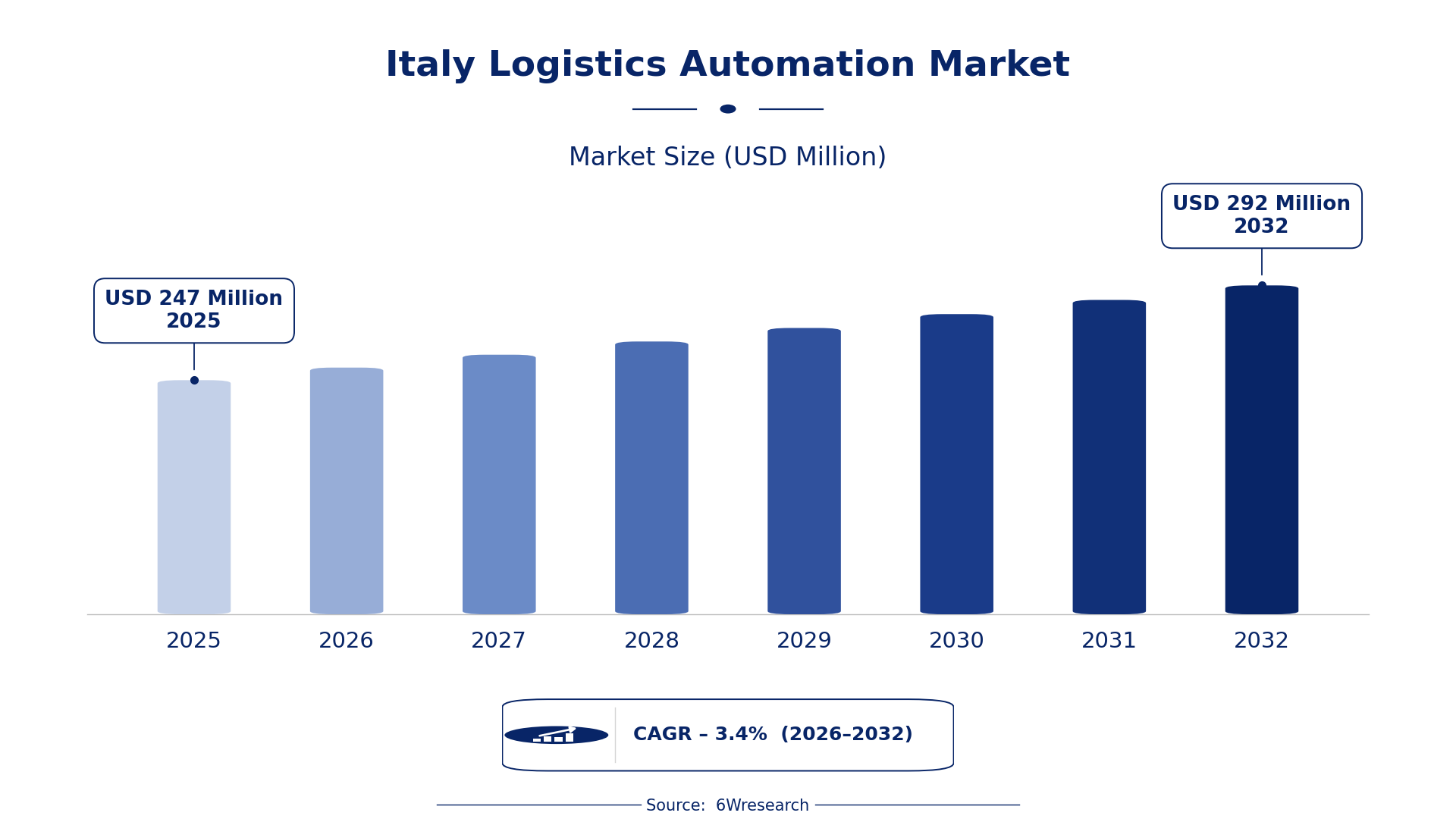
The Italy Logistics Automation Market was estimated at USD 247 Million in 2025 and is projected to reach USD 292 Million by 2032, growing at a CAGR of 3.4% from 2026 to 2032.
Italy Logistics Automation Market Synopsis
The logistics automation sector in Italy is witnessing a surge driven by the mounting demand for precision in supply chain operations. Key industries such as e-commerce and manufacturing are increasingly investing in automated solutions to enhance their operational efficiency, reduce delays, and meet consumer expectations for faster deliveries.
As businesses look to optimize their logistics processes, technologies like robotics, AI, and IoT are becoming integral. The adoption of automated storage and retrieval systems (AS/RS) and warehouse management systems (WMS) is notable, reflecting a shift towards advanced, tech-driven supply chain management.
Italy Logistics Automation Market Year-wise Growth Rate and Key Drivers
This graph illustrates the annual growth rates of the Italy Logistics Automation Market from 2021 to 2032, highlighting a steady upward trajectory and projected expansion over the forecast period.
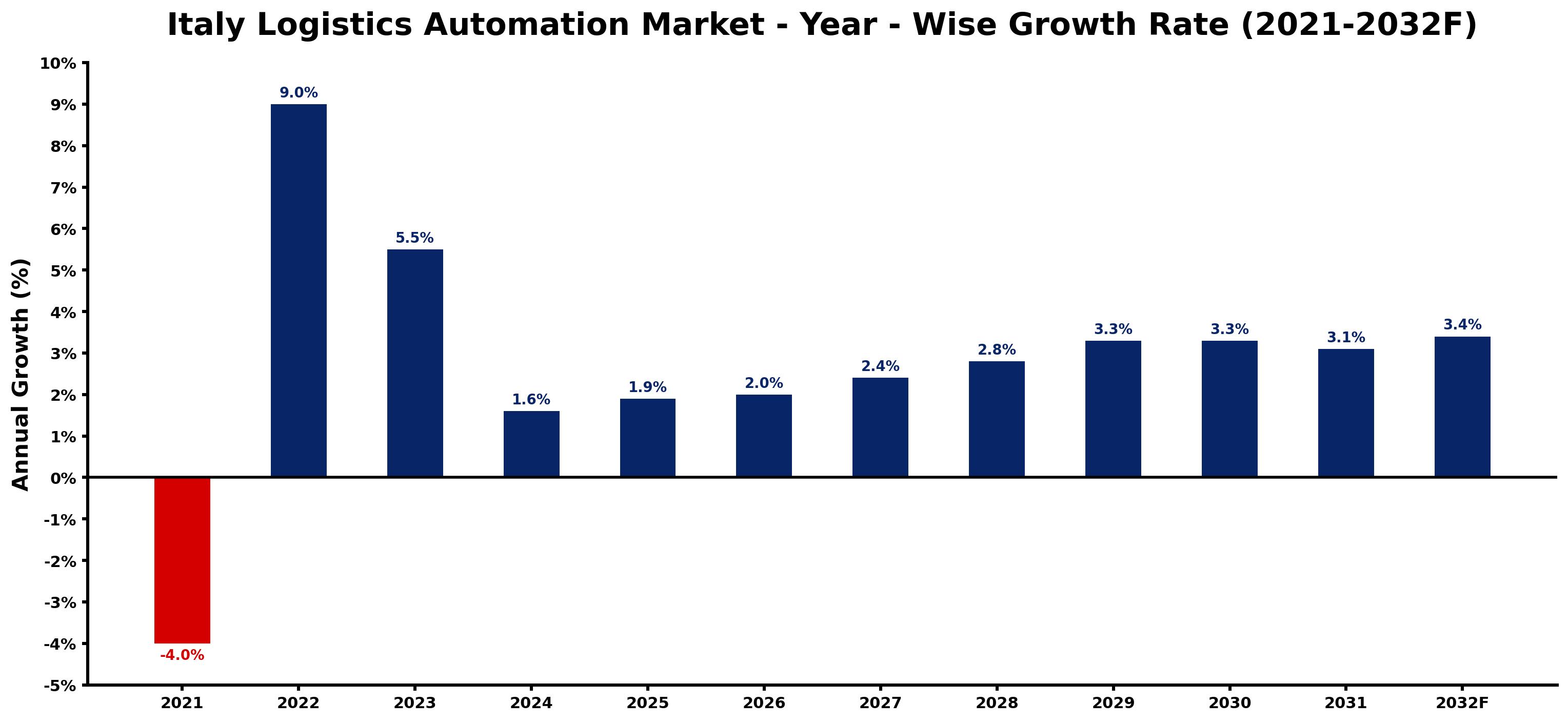
The table below presents the year‑wise growth rates along with the key drivers influencing the market
| Year | Growth Rate | Major Drivers |
| 2021 | -4.0% | Delays in infrastructure investments by Italian government |
| 2022 | 9.0% | Investment in logistics infrastructure under Italy's National Recovery Plan. |
| 2023 | 5.5% | Increased adoption of RFID tracking in supply chain management. |
| 2024 | 1.6% | Growth in e-commerce driving need for efficient logistics automation. |
| 2025 | 1.9% | Regional push for digital logistics solutions in Lombardy. |
| 2026 | 2.0% | Collaborations between universities and logistics firms on automation research. |
| 2027 | 2.4% | Government support for smart logistics initiatives in urban areas. |
| 2028 | 2.8% | Rise of fintech solutions enhancing logistics payment processing. |
| 2029 | 3.3% | Increased logistics efficiency due to Italy's Green Deal initiatives. |
| 2030 | 3.3% | Focus on improving last-mile delivery technologies in urban centers. |
| 2031 | 3.1% | Growing emphasis on sustainability in logistics through automation. |
| 2032 | 3.4% | Emergence of autonomous vehicles for urban logistics operations. |
Note: Market size estimations and growth projections presented in this report are based on 6Wresearch's proprietary forecasting methodology, utilizing the latest available industry data, government publications, and primary research inputs.
Italy Logistics Automation Market Key Takeaways
Below are some of the specific key takeaways from the market, including:
- Growing integration of AI and IoT technologies in logistics operations enhances real-time tracking and efficiency.
- Increased focus on reducing labor costs drives the adoption of robotics and automation solutions.
- Warehouse and distribution centers are optimizing operations through advanced automated systems.
- Government support through funding and regulatory frameworks boosts market growth.
- Challenges related to high implementation costs and system reliability are impacting broader adoption.
Evaluation of Restraints in Italy Logistics Automation Market
While the Italy Logistics Automation Market is on an upward trajectory, it faces real challenges. High production and implementation costs deter many small to medium-sized enterprises from investing in automation technologies. on top of that, ensuring the accuracy and reliability of these systems across various logistics applications remains a concern. As traditional supply chain practices evolve, the market also grapples with the need to promote the benefits of automation effectively and address regulatory requirements that may hinder swift adoption.
Italy Logistics Automation Market Trends
The current trend in the Italy Logistics Automation Market indicates a strong push towards automation as companies prioritize efficiency. The rise of e-commerce has intensified the demand for automated systems capable of managing increased order volumes. Sustainability is also becoming a focal point, with companies seeking eco-friendly automation solutions to align with global environmental standards. Another trend is the increasing collaboration between technology providers and logistics firms, enhancing system integration and functionality.
Italy Logistics Automation Market Opportunities
Opportunities abound for stakeholders in the Italy Logistics Automation Market. The demand for faster and more reliable delivery solutions is a catalyst for investment in automation technologies. Companies focusing on the development of cost-effective, scalable automation solutions will likely find significant market interest. on top of that, as regulatory frameworks evolve to support modernization, businesses can capitalize on government incentives aimed at enhancing supply chain efficiency.
Government Initiatives in the Italy Logistics Automation Market
Government policy is increasingly shaping the Italy Logistics Automation Market, with a focus on modernizing supply chain infrastructure and promoting industrial automation. Recent initiatives aim to streamline logistics operations, enhance competitiveness, and reduce operational costs across sectors.
- A recently completed initiative focused on funding logistics infrastructure development, enhancing connectivity between key distribution centers.
- Currently underway is a national program promoting the adoption of automated technologies in small and medium enterprises through financial incentives.
- A planned regulatory framework expected to be introduced in 2026 aims to standardize automation practices in logistics, ensuring compliance and efficiency.
- In 2025, a government-sponsored research initiative was launched to explore the potential of AI and robotics in improving logistics operations.
- A future initiative is expected to expand training programs for workforce skills in logistics automation, set to commence in 2027.
Future Insights of the Italy Logistics Automation Market
Looking ahead to 2026-2032, the Italy Logistics Automation Market is set to evolve significantly. The integration of advanced technologies such as AI, robotics, and IoT will reshape logistics processes, driving greater efficiency and responsiveness. As more companies recognize the competitive edge provided by automation, we can expect a steady increase in investments, particularly in e-commerce and distribution sectors. Regulatory support will further catalyze this growth, paving the way for a more automated and efficient logistics environment.
Italy Logistics Automation Market Latest Developments
The past 12-14 months have seen dynamic developments in the Italy Logistics Automation Market, with many businesses exploring innovative automation solutions. The focus has been primarily on enhancing operational efficiency and meeting the growing demands of consumers.
- A major technology vendor launched a new robotic picking system in early 2025, enhancing accuracy in warehouse operations.
- In mid-2025, a leading regional operator initiated a partnership with an AI firm to integrate machine learning capabilities into their logistics management systems, currently ongoing.
- A planned rollout of an automated fleet management system is expected to begin in late 2026, aiming to optimize transportation logistics.
- By Q1 2026, a consortium of logistics companies is set to pilot a shared warehouse automation platform to improve resource utilization.
- A recent investment initiative aims to upgrade existing logistics infrastructure to accommodate more automated processes, targeting completion by mid-2026.
Italy Logistics Automation Market - Key Attractiveness of the Report
- 10 Years of Market Numbers
- Historical Data Starting from 2022 to 2025
- Base Year: 2025
- Forecast Data until 2032
- Key Performance Indicators Impacting the Market
- Major Upcoming Developments and Projects
Key Highlights of the Report:
- Italy Logistics Automation Market Outlook
- Market Size of Italy Logistics Automation Market, 2025
- Forecast of Italy Logistics Automation Market, 2032
- Historical Data and Forecast of Italy Logistics Automation Revenues & Volume for the Period 2022-2032F
- Italy Logistics Automation Market Trend Evolution
- Italy Logistics Automation Market Drivers and Challenges
- Italy Logistics Automation Price Trends
- Italy Logistics Automation Porter's Five Forces
- Italy Logistics Automation Industry Life Cycle
- Historical Data and Forecast of Italy Logistics Automation Market Revenues & Volume By Function for the Period 2022-2032F
- Historical Data and Forecast of Italy Logistics Automation Market Revenues & Volume By Inventory and Storage Management for the Period 2022-2032F
- Historical Data and Forecast of Italy Logistics Automation Market Revenues & Volume By Transportation logistics for the Period 2022-2032F
- Historical Data and Forecast of Italy Logistics Automation Market Revenues & Volume By Vertical for the Period 2022-2032F
- Historical Data and Forecast of Italy Logistics Automation Market Revenues & Volume By Retail & eCommerce for the Period 2022-2032F
- Historical Data and Forecast of Italy Logistics Automation Market Revenues & Volume By Manufacturing for the Period 2022-2032F
- Historical Data and Forecast of Italy Logistics Automation Market Revenues & Volume By Healthcare & Pharmaceuticals for the Period 2022-2032F
- Historical Data and Forecast of Italy Logistics Automation Market Revenues & Volume By Food & Beverages for the Period 2022-2032F
- Historical Data and Forecast of Italy Logistics Automation Market Revenues & Volume By Automotive for the Period 2022-2032F
- Historical Data and Forecast of Italy Logistics Automation Market Revenues & Volume By Aerospace and Defense for the Period 2022-2032F
- Historical Data and Forecast of Italy Logistics Automation Market Revenues & Volume By Chemicals for the Period 2022-2032F
- Historical Data and Forecast of Italy Logistics Automation Market Revenues & Volume By Other Verticals (paper and printing, and textiles and clothing) for the Period 2022-2032F
- Historical Data and Forecast of Italy Logistics Automation Market Revenues & Volume By Organization Size for the Period 2022-2032F
- Historical Data and Forecast of Italy Logistics Automation Market Revenues & Volume By SMES for the Period 2022-2032F
- Historical Data and Forecast of Italy Logistics Automation Market Revenues & Volume By Large Enterprises for the Period 2022-2032F
- Historical Data and Forecast of Italy Logistics Automation Market Revenues & Volume By Logistics Type for the Period 2022-2032F
- Historical Data and Forecast of Italy Logistics Automation Market Revenues & Volume By Sales Logistics for the Period 2022-2032F
- Historical Data and Forecast of Italy Logistics Automation Market Revenues & Volume By Production Logistics for the Period 2022-2032F
- Historical Data and Forecast of Italy Logistics Automation Market Revenues & Volume By Recovery Logistics for the Period 2022-2032F
- Historical Data and Forecast of Italy Logistics Automation Market Revenues & Volume By Procurement Logistics for the Period 2022-2032F
- Historical Data and Forecast of Italy Logistics Automation Market Revenues & Volume By Software Application for the Period 2022-2032F
- Historical Data and Forecast of Italy Logistics Automation Market Revenues & Volume By Inventory Management for the Period 2022-2032F
- Historical Data and Forecast of Italy Logistics Automation Market Revenues & Volume By Order Management for the Period 2022-2032F
- Historical Data and Forecast of Italy Logistics Automation Market Revenues & Volume By Yard Management for the Period 2022-2032F
- Historical Data and Forecast of Italy Logistics Automation Market Revenues & Volume By Shipping Management for the Period 2022-2032F
- Historical Data and Forecast of Italy Logistics Automation Market Revenues & Volume By Labor Management for the Period 2022-2032F
- Historical Data and Forecast of Italy Logistics Automation Market Revenues & Volume By Vendor Management for the Period 2022-2032F
- Historical Data and Forecast of Italy Logistics Automation Market Revenues & Volume By Customer Support for the Period 2022-2032F
- Italy Logistics Automation Import Export Trade Statistics
- Market Opportunity Assessment By Function
- Market Opportunity Assessment By Vertical
- Market Opportunity Assessment By Organization Size
- Market Opportunity Assessment By Logistics Type
- Market Opportunity Assessment By Software Application
- Italy Logistics Automation Top Companies Market Share
- Italy Logistics Automation Competitive Benchmarking By Technical and Operational Parameters
- Italy Logistics Automation Company Profiles
- Italy Logistics Automation Key Strategic Recommendations






































