Italy Methyl Cellulose Market: Import Trend Analysis
In 2024, Italy import trend for the methyl cellulose Market: Import Trend Analysis showed a steady increase. Imports of methyl cellulose into Italy grew consistently throughout the year, reflecting a growing demand for this product within the country.
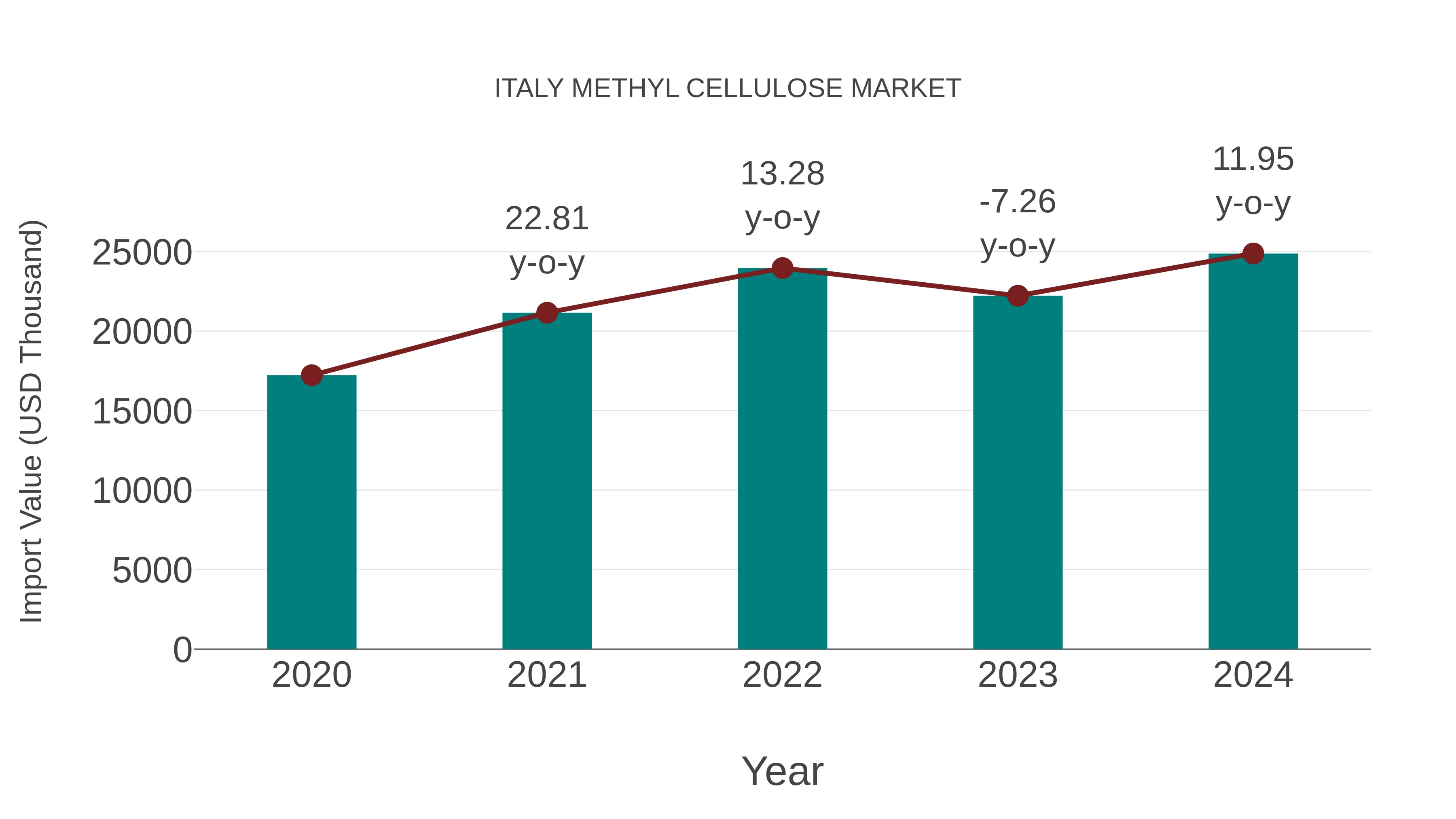
Italy Methyl Cellulose Market Overview
The Italy methyl cellulose market is experiencing steady growth driven by increasing demand across various industries such as food and beverages, pharmaceuticals, construction, and personal care. Methyl cellulose, a versatile and cost-effective derivative of cellulose, is widely used as a thickener, stabilizer, emulsifier, and film-former in various applications. In Italy, the food industry is a major consumer of methyl cellulose due to its functional properties such as texture improvement, water retention, and fat replacement in low-fat products. Additionally, the construction industry is witnessing an upsurge in the usage of methyl cellulose in cement-based materials for improved workability and water retention. The market is characterized by the presence of key players offering a diverse range of methyl cellulose products to cater to the evolving needs of different end-user industries.
Italy Methyl Cellulose Market Trends
Currently, the Italy methyl cellulose market is experiencing growth driven by the increasing demand for construction materials, pharmaceuticals, and food products. In the construction industry, methyl cellulose is widely used as a thickener and water retention agent in cement-based products, contributing to the market`s expansion. Additionally, the pharmaceutical sector is utilizing methyl cellulose in drug formulations due to its binding and disintegration properties. In the food industry, methyl cellulose is gaining popularity as a food additive, improving texture and stability in various products. The market is also witnessing innovation in product development, with manufacturers focusing on enhancing the properties and applications of methyl cellulose to meet the evolving needs of different industries, further fueling market growth.
Italy Methyl Cellulose Market Challenges
In the Italy methyl cellulose market, challenges are primarily related to the increasing competition from alternative products, fluctuating raw material prices, and stringent regulations regarding the use of chemicals in various industries. The market faces pressure from the availability of substitutes that offer similar functionalities at competitive prices, leading to pricing pressures for methyl cellulose manufacturers. Additionally, the volatility in raw material prices, especially cellulose, impacts the production costs and ultimately the pricing of methyl cellulose products. Furthermore, the stringent regulations in Italy and the European Union regarding the use of chemicals in industries such as construction, food, and pharmaceuticals pose compliance challenges for methyl cellulose manufacturers, requiring them to invest in sustainable and environmentally friendly production practices to meet regulatory standards.
Italy Methyl Cellulose Market Investment Opportunities
In the Italy methyl cellulose market, there are several investment opportunities worth considering. Methyl cellulose, a versatile polymer used in various industries such as construction, pharmaceuticals, food and beverages, and cosmetics, is witnessing a growing demand due to its unique properties like thickening, binding, and film-forming. Investing in companies involved in the production and distribution of methyl cellulose or those utilizing it in their products can be lucrative. Additionally, with increasing focus on sustainable and eco-friendly products, investing in research and development of bio-based methyl cellulose can be a strategic move. As Italy`s economy continues to recover post-pandemic, the methyl cellulose market is poised for growth, making it an attractive investment opportunity for those looking to capitalize on the evolving market trends.
Italy Methyl Cellulose Market Government Policy
In Italy, government policies related to the methyl cellulose market are focused on ensuring product safety, quality, and environmental sustainability. The Italian government has implemented regulations and standards to control the manufacturing, labeling, and distribution of methyl cellulose products to safeguard consumer health and interests. These policies also aim to promote fair competition among manufacturers and ensure market transparency. Additionally, there is a growing emphasis on environmental protection, with regulations in place to encourage the use of sustainable production practices and the reduction of carbon emissions in the methyl cellulose industry. Overall, the government`s policies in Italy regarding the methyl cellulose market are geared towards fostering a safe, competitive, and environmentally responsible industry.
Italy Methyl Cellulose Market Future Outlook
The future outlook for the Italy methyl cellulose market appears positive with steady growth projected over the coming years. Factors such as increasing demand from industries like construction, pharmaceuticals, and food & beverages are expected to drive market expansion. Methyl cellulose`s versatile properties, including its use as a thickening agent, emulsifier, and stabilizer, will continue to fuel its adoption in various applications. Furthermore, the growing focus on sustainable and eco-friendly products is likely to boost the demand for methyl cellulose as it is a biodegradable and non-toxic compound. As a result, Italian manufacturers and suppliers of methyl cellulose are anticipated to witness opportunities for innovation, product development, and market expansion in the foreseeable future.
Key Highlights of the Report:
- Italy Methyl Cellulose Market Outlook
- Market Size of Italy Methyl Cellulose Market,2025
- Forecast of Italy Methyl Cellulose Market, 2032
- Historical Data and Forecast of Italy Methyl Cellulose Revenues & Volume for the Period 2022-2032F
- Italy Methyl Cellulose Market Trend Evolution
- Italy Methyl Cellulose Market Drivers and Challenges
- Italy Methyl Cellulose Price Trends
- Italy Methyl Cellulose Porter's Five Forces
- Italy Methyl Cellulose Industry Life Cycle
- Historical Data and Forecast of Italy Methyl Cellulose Market Revenues & Volume By Type for the Period 2022-2032F
- Historical Data and Forecast of Italy Methyl Cellulose Market Revenues & Volume By Powder for the Period 2022-2032F
- Historical Data and Forecast of Italy Methyl Cellulose Market Revenues & Volume By Granules for the Period 2022-2032F
- Historical Data and Forecast of Italy Methyl Cellulose Market Revenues & Volume By Liquid for the Period 2022-2032F
- Historical Data and Forecast of Italy Methyl Cellulose Market Revenues & Volume By Application for the Period 2022-2032F
- Historical Data and Forecast of Italy Methyl Cellulose Market Revenues & Volume By Pharmaceuticals for the Period 2022-2032F
- Historical Data and Forecast of Italy Methyl Cellulose Market Revenues & Volume By Food Additives for the Period 2022-2032F
- Historical Data and Forecast of Italy Methyl Cellulose Market Revenues & Volume By Coatings for the Period 2022-2032F
- Historical Data and Forecast of Italy Methyl Cellulose Market Revenues & Volume By End Use for the Period 2022-2032F
- Historical Data and Forecast of Italy Methyl Cellulose Market Revenues & Volume By Construction for the Period 2022-2032F
- Historical Data and Forecast of Italy Methyl Cellulose Market Revenues & Volume By Personal Care for the Period 2022-2032F
- Historical Data and Forecast of Italy Methyl Cellulose Market Revenues & Volume By Paper & Textiles for the Period 2022-2032F
- Historical Data and Forecast of Italy Methyl Cellulose Market Revenues & Volume By Purity Level for the Period 2022-2032F
- Historical Data and Forecast of Italy Methyl Cellulose Market Revenues & Volume By High Purity for the Period 2022-2032F
- Historical Data and Forecast of Italy Methyl Cellulose Market Revenues & Volume By Industrial Grade for the Period 2022-2032F
- Historical Data and Forecast of Italy Methyl Cellulose Market Revenues & Volume By Low Purity for the Period 2022-2032F
- Historical Data and Forecast of Italy Methyl Cellulose Market Revenues & Volume By Manufacturing Process for the Period 2022-2032F
- Historical Data and Forecast of Italy Methyl Cellulose Market Revenues & Volume By Etherification for the Period 2022-2032F
- Historical Data and Forecast of Italy Methyl Cellulose Market Revenues & Volume By Hydroxypropylation for the Period 2022-2032F
- Historical Data and Forecast of Italy Methyl Cellulose Market Revenues & Volume By Others for the Period 2022-2032F
- Italy Methyl Cellulose Import Export Trade Statistics
- Market Opportunity Assessment By Type
- Market Opportunity Assessment By Application
- Market Opportunity Assessment By End Use
- Market Opportunity Assessment By Purity Level
- Market Opportunity Assessment By Manufacturing Process
- Italy Methyl Cellulose Top Companies Market Share
- Italy Methyl Cellulose Competitive Benchmarking By Technical and Operational Parameters
- Italy Methyl Cellulose Company Profiles
- Italy Methyl Cellulose Key Strategic Recommendations






































