Italy Milk Chocolate Market Size (2020-2030)
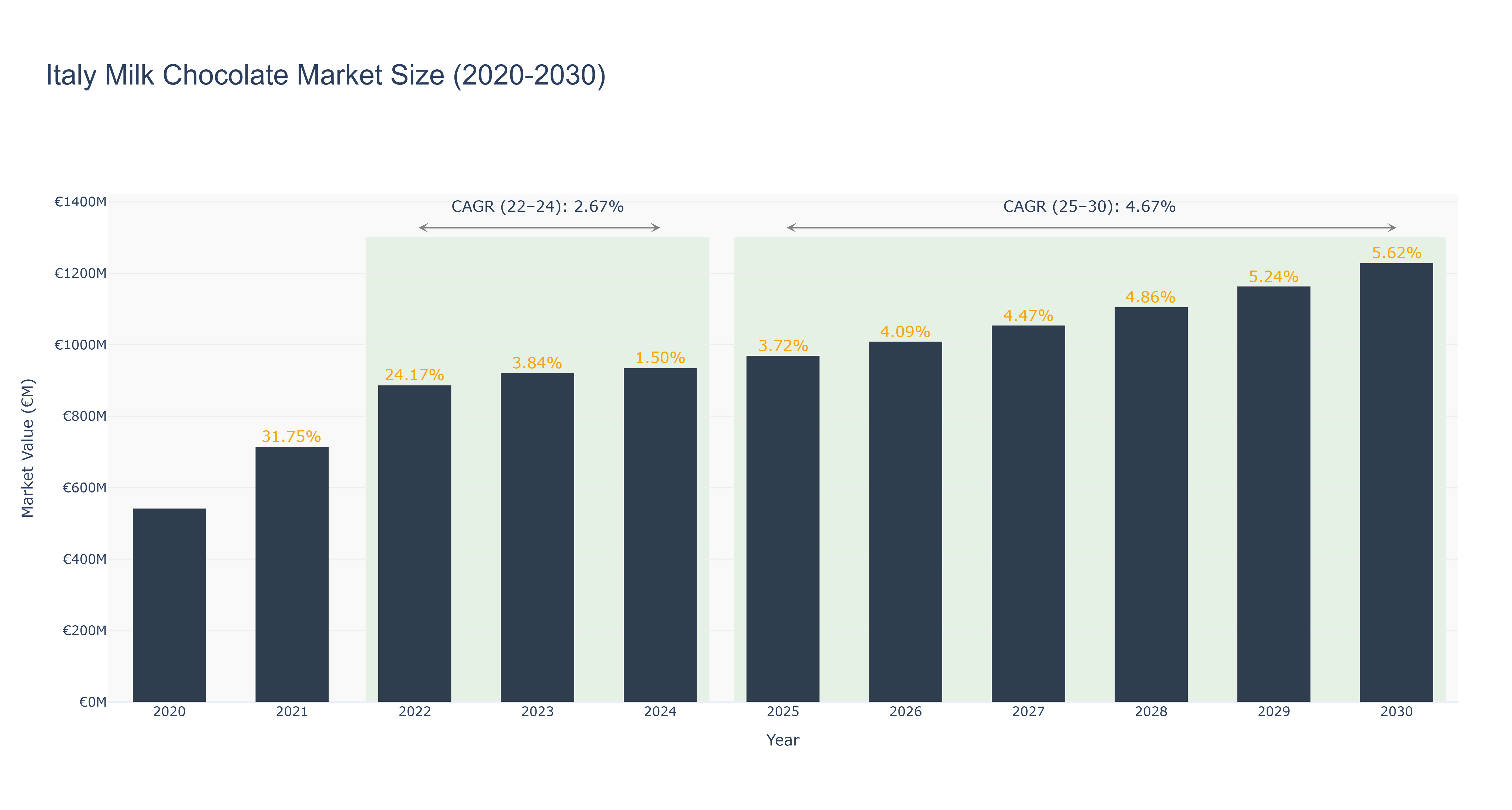
The Italy Milk Chocolate Market demonstrated robust growth from 2021 to 2022, peaking at a market size of €887.19 million in 2022, with a notable growth rate of 24.17%. However, growth slowed significantly in 2023 and 2024, with actual market sizes of €921.30 million and €935.12 million, respectively, reflecting a CAGR of 2.67% for the period from 2022 to 2024. Looking ahead, the market is projected to regain momentum with a forecasted CAGR of 4.67% between 2025 and 2030, ultimately reaching €1.23 billion by 2030. This anticipated growth is likely driven by increasing consumer demand for premium chocolate products, innovations in flavor and health-oriented formulations, and a growing trend of sustainability within the industry. As manufacturers invest in sustainability initiatives and product diversification, the market is poised for a more resilient performance over the next several years.
Italy Milk Chocolate Market: Production & Trade Performance (2019-2025)
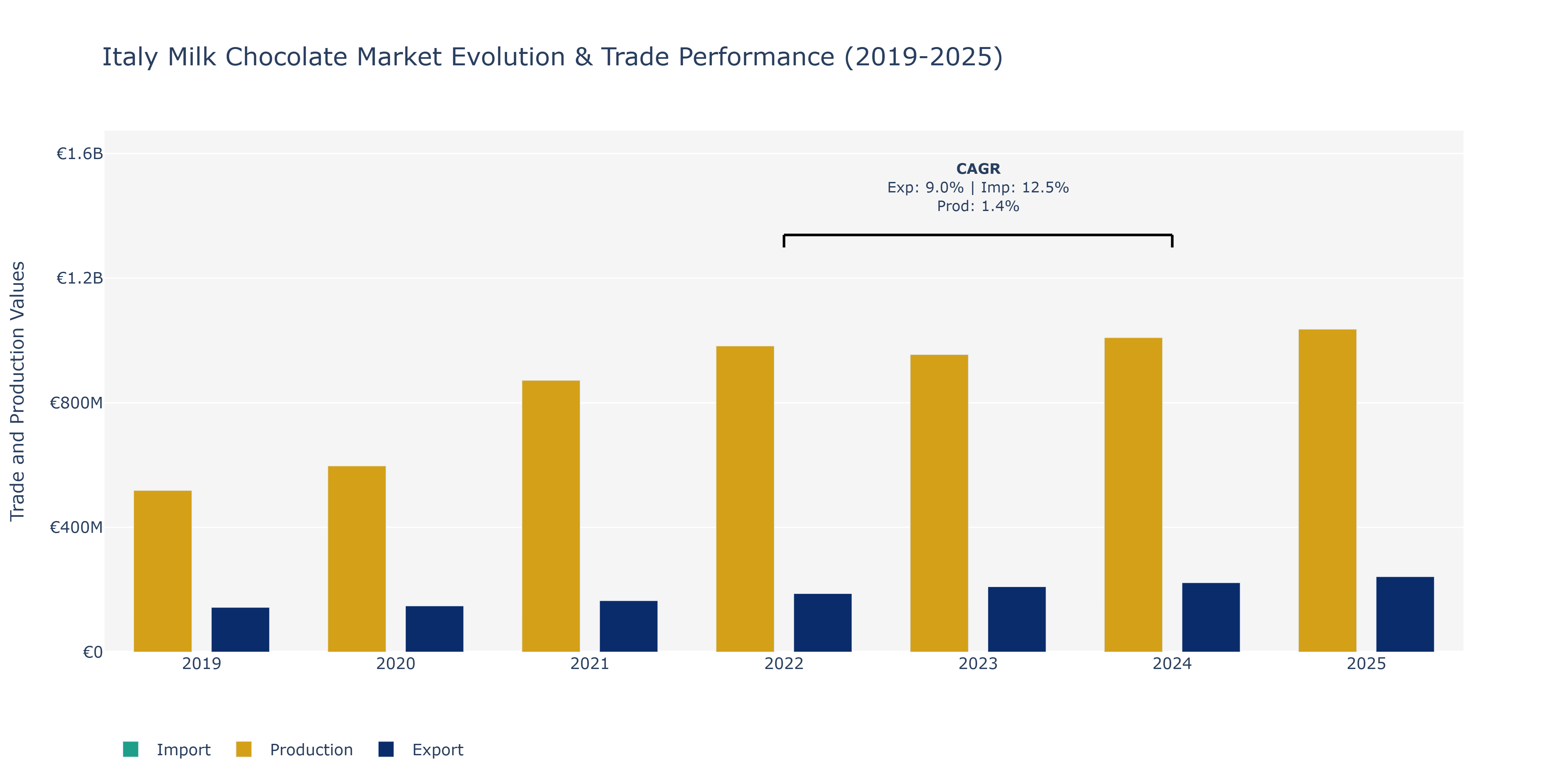
In the Italy Milk Chocolate Market, from 2019 to 2025, exports saw consistent growth year on year, starting at €143.47 million in 2019 and reaching €241.92 million in 2025, reflecting an upward trajectory driven by increasing demand for Italian milk chocolate products globally. Imports also increased steadily, with figures climbing from €103.87 million in 2019 to €158.99 million in 2025, indicating a parallel rise in domestic consumption of foreign milk chocolate varieties. Production levels surged from €518.74 million in 2019 to €1.04 billion in 2025, demonstrating the market's robust manufacturing capabilities. The peak in production coincided with the peak in exports. The uptick in imports suggests a growing appetite for diverse milk chocolate offerings among Italian consumers, potentially influenced by a rising interest in international flavors and premium products. This trend aligns with the evolving consumer preferences for high-quality and ethically sourced chocolate products, encouraging manufacturers to enhance production capacities to meet increasing demand.
Italy Milk Chocolate Market Synopsis
Italy milk chocolate market is expanding, driven by the strong demand for high-quality and premium chocolate products. Milk chocolate is a popular confectionery item, enjoyed by consumers of all ages. The market benefits from the country`s rich tradition of chocolate making, increasing consumer preference for indulgent treats, and innovations in product formulations that cater to health-conscious and gourmet consumers.
Drivers of the market
Italy milk chocolate market is propelled by factors such as changing consumer preferences, innovation in product offerings, and the growing popularity of premium chocolate products. Milk chocolate, characterized by its creamy texture and sweet taste, remains a favorite among consumers, driving demand across various distribution channels including supermarkets, convenience stores, and online platforms. The drivers for the milk chocolate market include indulgence-seeking consumer behavior, product diversification strategies by manufacturers, and the perception of chocolate as a comfort food and affordable luxury.
Challenges of the market
In the Italy Milk Chocolate Market, companies face challenges related to consumer preferences, ingredient sourcing, and market competition. Milk chocolate is a popular confectionery product made from cocoa, milk solids, and sugar, enjoyed by consumers of all ages. However, challenges such as meeting changing consumer demands for premium and ethically sourced ingredients, addressing concerns about sugar content and health implications, and competing with alternative chocolate varieties such as dark chocolate and plant-based alternatives pose hurdles for milk chocolate manufacturers and suppliers in Italy. Moreover, adapting to evolving dietary trends, flavor preferences, and packaging innovations while maintaining product quality and brand reputation adds complexity to the milk chocolate market landscape.
Government Policy of the market
In the milk chocolate market, Italy government policies focus on food safety, quality standards, and agricultural sustainability. Regulations may address chocolate labeling requirements, ingredient specifications, and production processes to ensure consumer protection and market transparency. Financial incentives and subsidies may be available for cocoa farmers, chocolate manufacturers, and small-scale producers investing in sustainable farming practices, product innovation, and market development. Additionally, the government collaborates with industry associations, consumer advocacy groups, and international organizations to promote fair trade practices, environmental stewardship, and innovation in the milk chocolate sector.
Key Highlights of the Report:
- Italy Milk Chocolate Market Outlook
- Market Size of Italy Milk Chocolate Market, 2025
- Forecast of Italy Milk Chocolate Market, 2032
- Historical Data and Forecast of Italy Milk Chocolate Revenues & Volume for the Period 2022-2032F
- Italy Milk Chocolate Market Trend Evolution
- Italy Milk Chocolate Market Drivers and Challenges
- Italy Milk Chocolate Price Trends
- Italy Milk Chocolate Porter's Five Forces
- Italy Milk Chocolate Industry Life Cycle
- Historical Data and Forecast of Italy Milk Chocolate Market Revenues & Volume By Type for the Period 2022-2032F
- Historical Data and Forecast of Italy Milk Chocolate Market Revenues & Volume By Nuts Milk Chocolate for the Period 2022-2032F
- Historical Data and Forecast of Italy Milk Chocolate Market Revenues & Volume By Liqueur Milk Chocolate for the Period 2022-2032F
- Historical Data and Forecast of Italy Milk Chocolate Market Revenues & Volume By Other for the Period 2022-2032F
- Historical Data and Forecast of Italy Milk Chocolate Market Revenues & Volume By Distribution Channel for the Period 2022-2032F
- Historical Data and Forecast of Italy Milk Chocolate Market Revenues & Volume By Supermarkets/Hypermarkets for the Period 2022-2032F
- Historical Data and Forecast of Italy Milk Chocolate Market Revenues & Volume By Specialty Stores for the Period 2022-2032F
- Historical Data and Forecast of Italy Milk Chocolate Market Revenues & Volume By Convenience Stores for the Period 2022-2032F
- Historical Data and Forecast of Italy Milk Chocolate Market Revenues & Volume By Online Stores for the Period 2022-2032F
- Historical Data and Forecast of Italy Milk Chocolate Market Revenues & Volume By Others for the Period 2022-2032F
- Historical Data and Forecast of Italy Milk Chocolate Market Revenues & Volume By Application for the Period 2022-2032F
- Historical Data and Forecast of Italy Milk Chocolate Market Revenues & Volume By Residential for the Period 2022-2032F
- Historical Data and Forecast of Italy Milk Chocolate Market Revenues & Volume By Commercial for the Period 2022-2032F
- Italy Milk Chocolate Import Export Trade Statistics
- Market Opportunity Assessment By Type
- Market Opportunity Assessment By Distribution Channel
- Market Opportunity Assessment By Application
- Italy Milk Chocolate Top Companies Market Share
- Italy Milk Chocolate Competitive Benchmarking By Technical and Operational Parameters
- Italy Milk Chocolate Company Profiles
- Italy Milk Chocolate Key Strategic Recommendations






































