Italy Payment Security Market Size & Growth Rate (2026-2032)
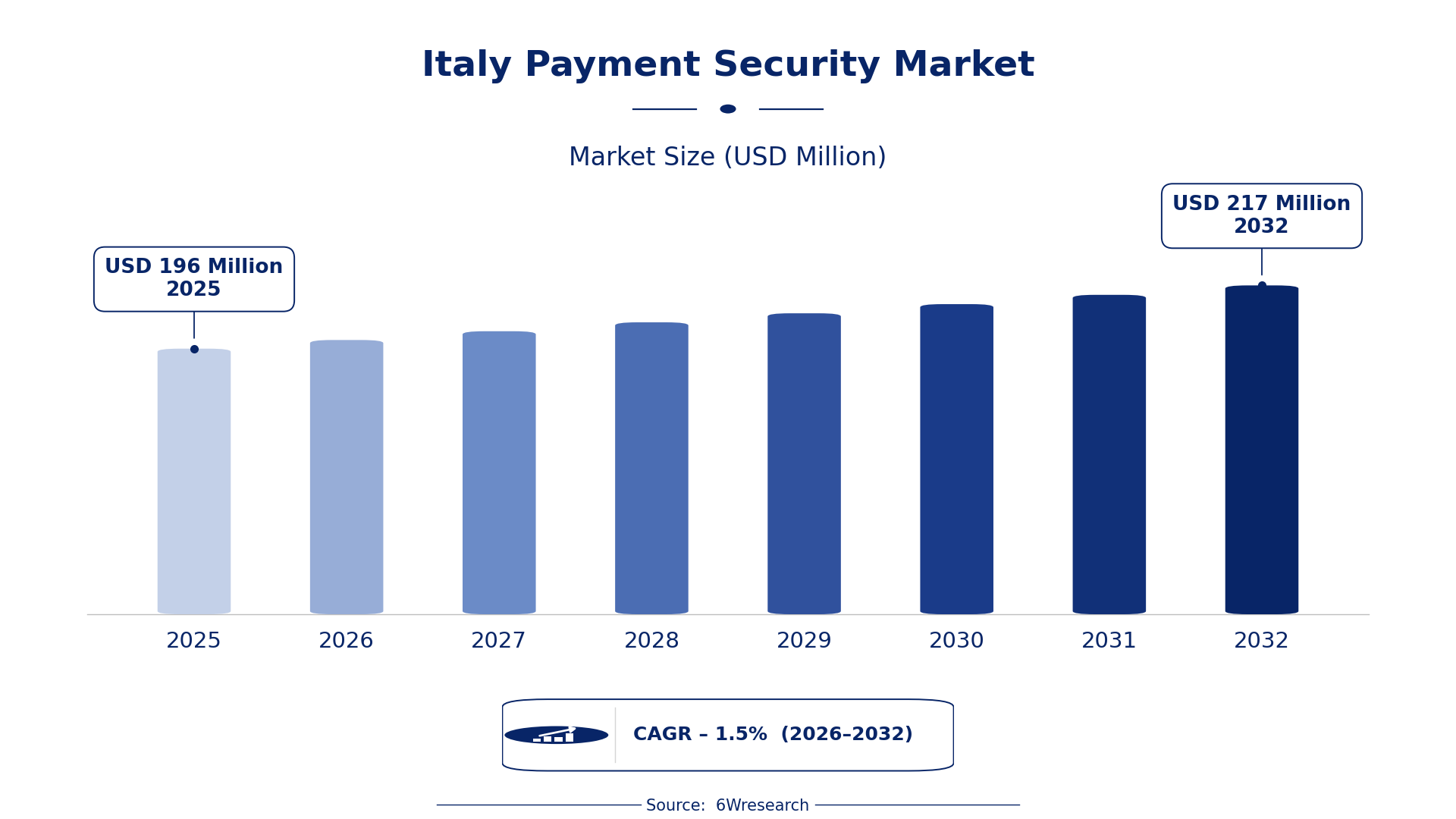
The Italy Payment Security Market was estimated at USD 196 Million in 2025 and is projected to reach USD 217 Million by 2032, growing at a CAGR of 1.5% from 2026 to 2032.
Italy Payment Security Market Synopsis
The Italy Payment Security Market has witnessed steady growth, propelled by the surge in digital payments and heightened awareness around security threats. However, the focus is now shifting toward innovative solutions that not only secure transactions but also enhance user experience.
As e-commerce continues to flourish, the demand for advanced security protocols has intensified. Consumers and businesses are increasingly prioritizing security in their payment processes, leading to a competitive environment that fosters continuous technological advancements.
Italy Payment Security Market Year-wise Growth Rate and Key Drivers
This graph illustrates the annual growth rates of the Italy Payment Security Market from 2021 to 2032, highlighting a steady upward trajectory and projected expansion over the forecast period.
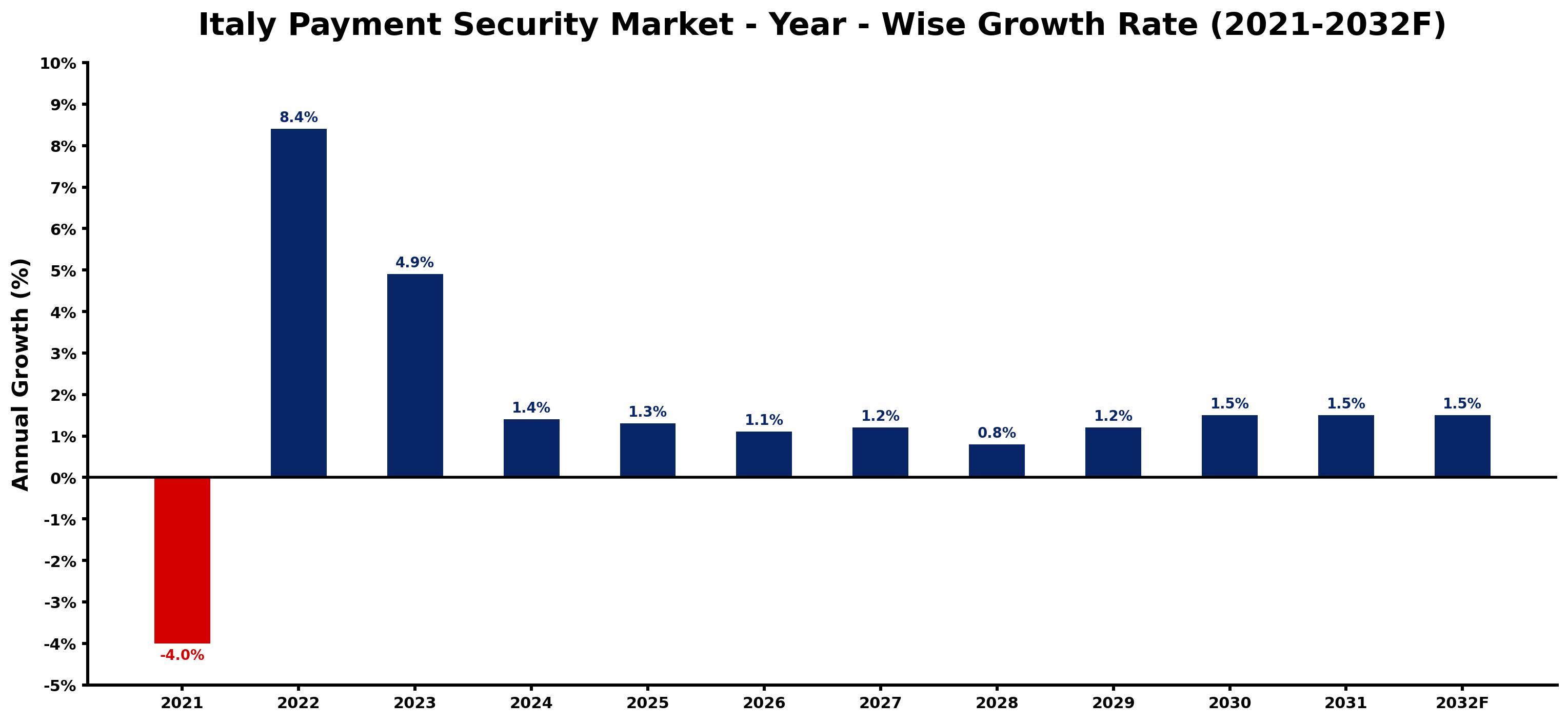
The table below presents the year‑wise growth rates along with the key drivers influencing the market
| Year | Growth Rate | Major Drivers |
| 2021 | -4.0% | PSD2 compliance challenges hindered payment innovation adoption. |
| 2022 | 8.4% | Stricter PCI compliance requirements by Italian regulators. |
| 2023 | 4.9% | Increasing investments in biometric authentication technologies. |
| 2024 | 1.4% | Rising e-commerce transaction volumes fueling security needs. |
| 2025 | 1.3% | Government initiatives promoting digital payment safety standards. |
| 2026 | 1.1% | Growing awareness of online fraud among Italian businesses. |
| 2027 | 1.2% | Adoption of GDPR prompting enhanced data protection measures. |
| 2028 | 0.8% | Increased collaboration between banks on fraud prevention. |
| 2029 | 1.2% | Emergence of fintech startups driving innovation in security. |
| 2030 | 1.5% | Strengthened cybersecurity partnerships among Italian tech firms. |
| 2031 | 1.5% | Increased consumer trust in digital payment platforms. |
| 2032 | 1.5% | Local cybersecurity training programs boosting skilled workforce. |
Note: Market size estimations and growth projections presented in this report are based on 6Wresearch's proprietary forecasting methodology, utilizing the latest available industry data, government publications, and primary research inputs.
Italy Payment Security Market Key Takeaways
Below are some of the specific key takeaways from the market, including:
- The rising adoption of digital payment methods is a primary growth driver.
- Strong demand for advanced authentication and fraud prevention solutions is evident.
- Compliance with regulatory standards is shaping investment strategies.
- Biometric authentication and tokenization are gaining traction among consumers and businesses alike.
- Cybersecurity investments are increasingly critical to maintain consumer trust and data integrity.
Evaluation of Restraints in Italy Payment Security Market
A key restraint in the Italy Payment Security Market is the escalating sophistication of cyber threats. As digital payment options proliferate, the vulnerabilities in security measures become more apparent. Companies must remain proactive, continuously evolving their security protocols to mitigate risks effectively. The regulatory landscape, including compliance with the EU's General Data Protection Regulation (GDPR), further complicates the security framework, necessitating ongoing investments in technology and training.
Italy Payment Security Market Trends
The market is witnessing a pronounced trend towards implementing multi-layered security measures, integrating techniques like encryption and tokenization to bolster transaction security. Additionally, the use of machine learning for real-time fraud detection is emerging as a significant development, enabling quicker responses to potential threats. Companies are also increasingly focusing on user-centric solutions, ensuring that security measures do not compromise the convenience of transactions.
Italy Payment Security Market Opportunities
With the ongoing expansion of the digital payment ecosystem, there are promising investment opportunities, particularly in sectors focusing on innovative security solutions. Companies that specialize in cutting-edge encryption technologies, fraud detection systems, and compliant security services are likely to benefit from the growing emphasis on secure transactions. on top of that, partnerships with fintech firms can provide synergistic advantages as the market continues to evolve.
Government Initiatives in the Italy Payment Security Market
Government policy plays a crucial role in shaping the Italy Payment Security Market. The regulatory framework is designed to enhance online payment security and protect consumer data. This proactive stance facilitates innovation while ensuring robust consumer protections are in place, which is essential for fostering trust in digital financial transactions.
- A regulatory framework introduced in 2025 mandating two-factor authentication for electronic transactions.
- Current initiatives include a public awareness campaign aimed at educating consumers about secure online payment practices.
- A national cybersecurity strategy launched recently focuses on improving the resilience of payment systems against cyber threats.
- A planned regulatory review is expected in 2026 to assess the effectiveness of existing payment security measures.
- Ongoing collaborations between public agencies and private entities to enhance infrastructure supporting secure payment technologies.
Future Insights of the Italy Payment Security Market
Looking ahead to 2026-2032, the Italy Payment Security Market is set to grow as digital transactions become even more prevalent. Increased regulatory scrutiny will drive companies to adopt more sophisticated security measures. The consumer demand for seamless, secure payment experiences will influence technological innovations, solidifying the need for investment in advanced security solutions. As the landscape shifts, organizations prioritizing security will enjoy a competitive edge.
Italy Payment Security Market Latest Developments
In the past year, there has been a marked increase in industry activity within the Italy Payment Security Market. Companies are responding to both emerging threats and regulatory changes by enhancing their service offerings. Investment in cybersecurity technologies is intensifying as organizations recognize the critical nature of safeguarding consumer data.
- A major technology vendor launched an upgraded fraud detection system in early 2025 that incorporates machine learning algorithms for enhanced performance.
- A regional operator initiated an ongoing project to implement end-to-end encryption for all mobile payment transactions, improving security for consumers.
- A partnership between a leading fintech company and a cybersecurity firm was announced in Q1 2025, aiming to develop integrated payment security solutions.
- A public initiative is underway, expected to conclude by mid-2026, focusing on enhancing the security protocols of e-commerce platforms.
- Future plans include a rollout scheduled for 2027 that will introduce biometric authentication at retail payment terminals across Italy.
Italy Payment Security Market - Key Attractiveness of the Report
- 10 Years of Market Numbers
- Historical Data Starting from 2022 to 2025
- Base Year: 2025
- Forecast Data until 2032
- Key Performance Indicators Impacting the Market
- Major Upcoming Developments and Projects
The Payment Services Directive 2 (PSD2) mandates strong customer authentication for electronic transactions, significantly affecting how payment security is managed in Italy. Additionally, adherence to the EU’s GDPR adds complexity to data protection in payment processes.
Key Highlights of the Report:
- Italy Payment Security Market Outlook
- Market Size of Italy Payment Security Market, 2025
- Forecast of Italy Payment Security Market, 2032
- Historical Data and Forecast of Italy Payment Security Revenues & Volume for the Period 2022-2032F
- Italy Payment Security Market Trend Evolution
- Italy Payment Security Market Drivers and Challenges
- Italy Payment Security Price Trends
- Italy Payment Security Porter's Five Forces
- Italy Payment Security Industry Life Cycle
- Historical Data and Forecast of Italy Payment Security Market Revenues & Volume By Solution for the Period 2022-2032F
- Historical Data and Forecast of Italy Payment Security Market Revenues & Volume By Encryption for the Period 2022-2032F
- Historical Data and Forecast of Italy Payment Security Market Revenues & Volume By Tokenization for the Period 2022-2032F
- Historical Data and Forecast of Italy Payment Security Market Revenues & Volume By Fraud Detection for the Period 2022-2032F
- Historical Data and Forecast of Italy Payment Security Market Revenues & Volume By Prevention for the Period 2022-2032F
- Historical Data and Forecast of Italy Payment Security Market Revenues & Volume By Service for the Period 2022-2032F
- Historical Data and Forecast of Italy Payment Security Market Revenues & Volume By Integration for the Period 2022-2032F
- Historical Data and Forecast of Italy Payment Security Market Revenues & Volume By Support for the Period 2022-2032F
- Historical Data and Forecast of Italy Payment Security Market Revenues & Volume By Consulting for the Period 2022-2032F
- Historical Data and Forecast of Italy Payment Security Market Revenues & Volume By Organization Size for the Period 2022-2032F
- Historical Data and Forecast of Italy Payment Security Market Revenues & Volume By Large Enterprises for the Period 2022-2032F
- Historical Data and Forecast of Italy Payment Security Market Revenues & Volume By SMEs for the Period 2022-2032F
- Historical Data and Forecast of Italy Payment Security Market Revenues & Volume By Industry Vertical for the Period 2022-2032F
- Italy Payment Security Import Export Trade Statistics
- Market Opportunity Assessment By Solution
- Market Opportunity Assessment By Service
- Market Opportunity Assessment By Organization Size
- Market Opportunity Assessment By Industry Vertical
- Italy Payment Security Top Companies Market Share
- Italy Payment Security Competitive Benchmarking By Technical and Operational Parameters
- Italy Payment Security Company Profiles
- Italy Payment Security Key Strategic Recommendations






































