Global Payment Security Market Highlights
| Market Size (2025) | USD 24.2 Billion |
| Forecast Size (2032) | USD 61.3 Billion |
| CAGR | 20.70% |
| Base Year | 2025 |
| Forecast Period | 2026-2032 |
| Largest Region | North America |
| Fastest Growing Region | Asia |
| Largest Segment | Fraud Detection |
| Fastest Growing Segment | Tokenization |
| Leading Companies | Visa, Mastercard, PayPal, IBM, Thales |
Global Payment Security Market Size & Growth Rate (2026-2032)
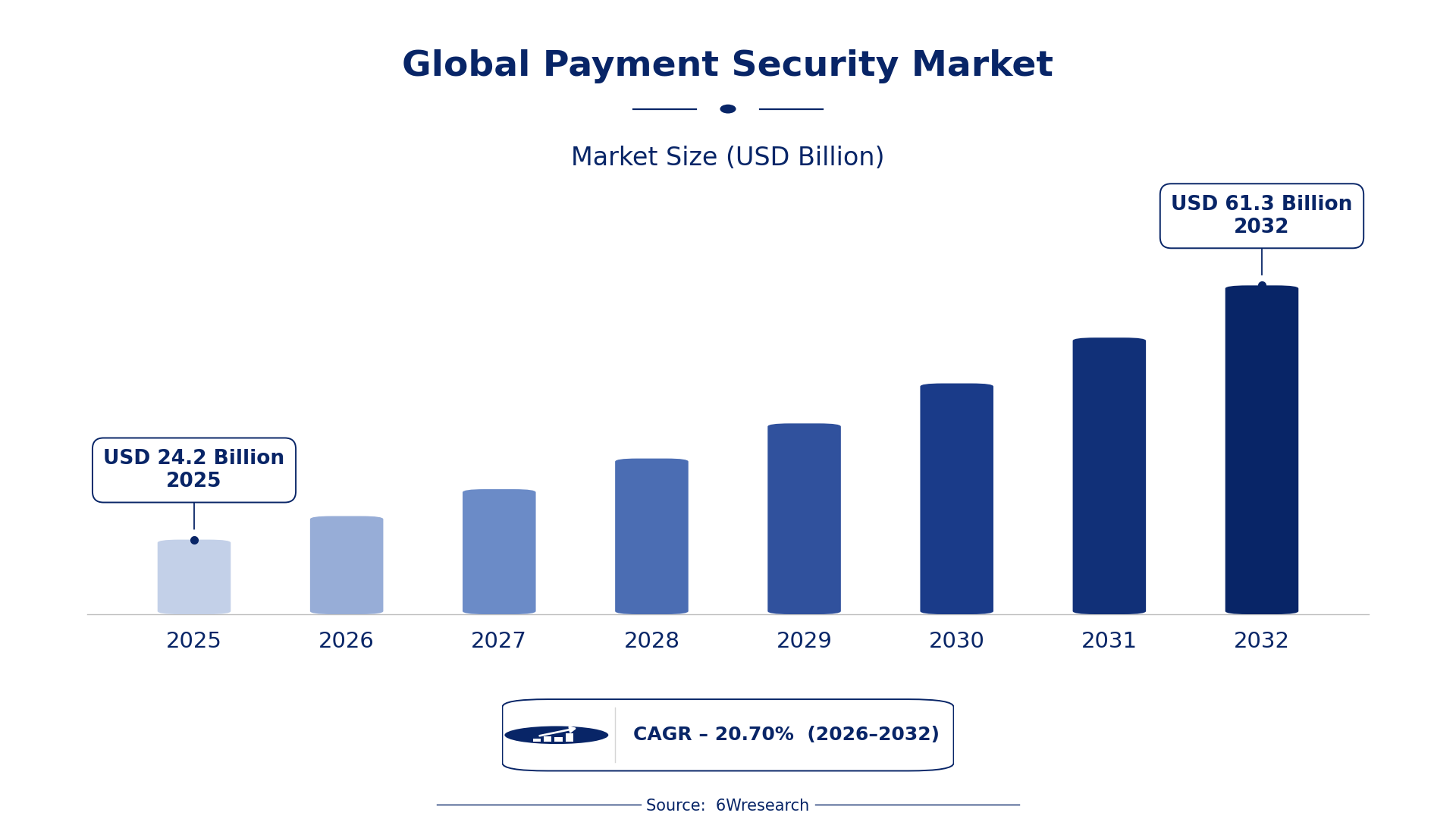
The Global Payment Security Market was estimated at USD 24.2 Billion in 2025 and is projected to reach USD 61.3 Billion by 2032, growing at a CAGR of 20.70% from 2026 to 2032.
Global Payment Security Market Synopsis
Currently, the Global Payment Security Market is undergoing a substantial transformation in response to the escalating challenges posed by cyber threats. Financial institutions and e-commerce platforms are adapting to new security paradigms, driven largely by the growth of contactless and digital payment methods. This scenario necessitates advanced protective measures for payment data and transaction integrity.
The market plays a pivotal role in maintaining the trust of consumers and businesses alike, particularly in sectors like retail, banking, and healthcare, where secure transactions are paramount. Moreover, as regulatory frameworks tighten globally, organizations are compelled to enhance their security protocols, setting the stage for robust demand for innovative security solutions.
Global Payment Security Market Year-wise Growth Rate and Key Drivers
This graph illustrates the annual growth rates of the Global Payment Security Market from 2022 to 2032, highlighting a steady upward trajectory and projected expansion over the forecast period.
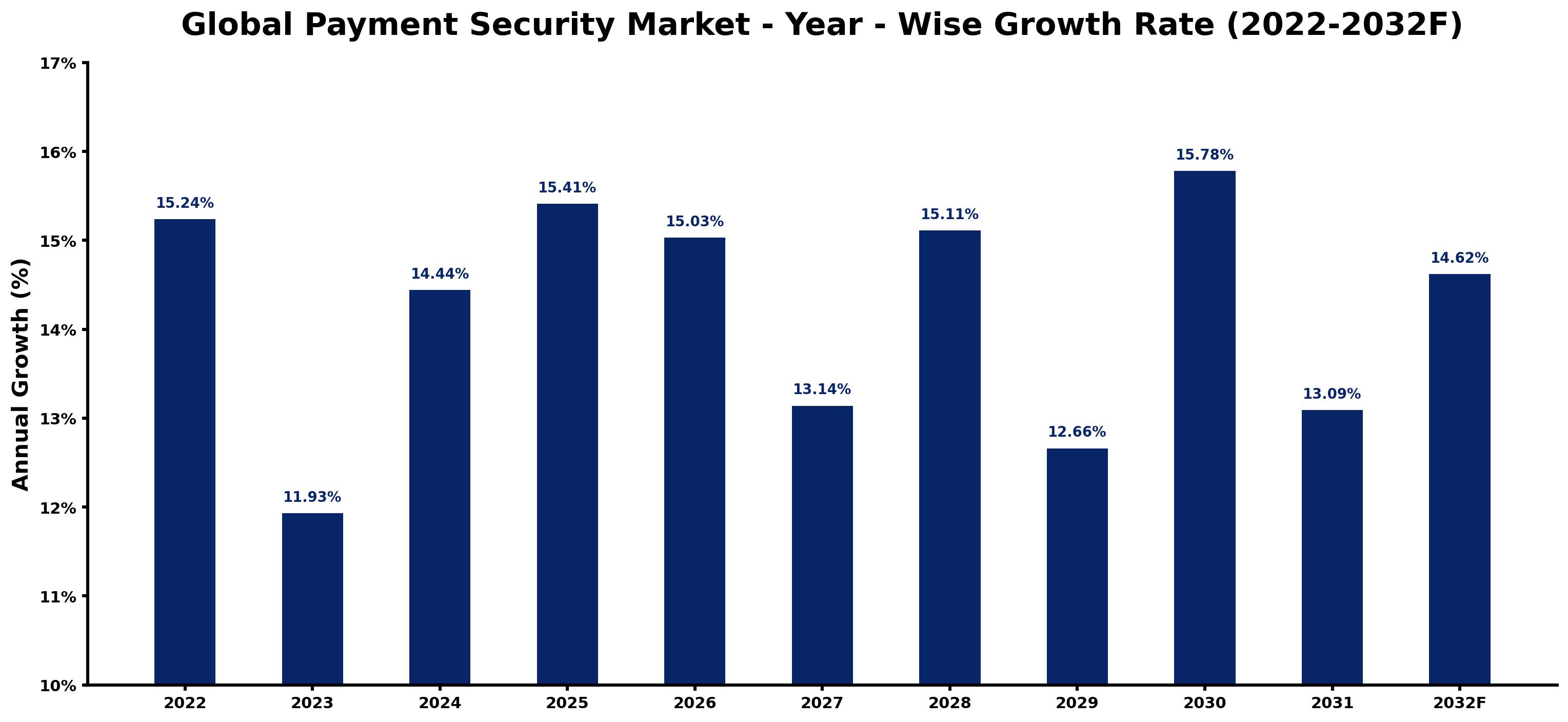
The table below presents the year‑wise growth rates along with the key drivers influencing the market
| Year | Growth Rate (%) | Major Drivers |
| 2022 | 15.24 | The rise in digital banking usage has heightened demand for payment security measures. |
| 2023 | 11.93 | A shift toward better supply chain integration enhances payment security implementations. |
| 2024 | 14.44 | Enabling advanced skill development in cybersecurity professionals strengthens payment security frameworks. |
| 2025 | 15.41 | Blockchain technology significantly enhances transaction security within the global payment ecosystem. |
| 2026 | 15.03 | Emerging regulatory changes are driving increased investment in payment security infrastructure. |
| 2027 | 13.14 | In Europe, sustainability initiatives are prompting banks to improve payment security practices. |
| 2028 | 15.11 | Fintech companies are aggressively adopting innovative payment security solutions to maintain competitiveness. |
| 2029 | 12.66 | Changing consumer preferences for secure transactions are reshaping payment security strategies. |
| 2030 | 15.78 | Financial institutions are pursuing mergers to enhance their payment security capabilities. |
| 2031 | 13.09 | As input costs for cybersecurity solutions fluctuate, firms are adapting their payment security budgets. |
| 2032 | 14.62 | Payment processors are expanding their networks to enhance regional payment security offerings. |
Note - Market size estimations and growth projections presented in this report are based on 6Wresearch's proprietary research methodology, combining internal industry data, secondary research, and primary validation, updated periodically to reflect current market conditions. As markets evolve rapidly, figures for certain industries may vary slightly and are intended as informed estimates rather than absolute figures. For the most current market sizing, we recommend validating figures with a 6Wresearch analyst.
Global Payment Security Market Key Takeaways
Below are some of the specific key takeaways from the market, including:
- The market for fraud detection solutions was valued at approximately 45% of total market share in 2025, underscoring its leading position in the Global Payment Security Market.
- Tokenization services are projected to exhibit a remarkable CAGR of 25% from 2026 to 2032, indicating strong demand growth.
- Organizations such as Visa and Mastercard are investing heavily in AI-driven security technology, with anticipated investments exceeding $3 billion by 2026.
- The retail sector represents one of the largest segments, accounting for about 35% of the market share, driven by the ongoing shift towards digital payment solutions.
Evaluation of Restraints in Global Payment Security Market
The Global Payment Security Market faces notable challenges that could hinder growth. A primary restraint is the increasing sophistication of cyberattacks, which remains a formidable obstacle. The average cost of a data breach is estimated at approximately $4.24 million, significantly impacting organizations' operational budgets and resources allocated for security. For example, in 2020, several high-profile breaches in various sectors prompted regulatory bodies to impose stringent compliance measures, such as adherence to the Payment Card Industry Data Security Standard (PCI DSS), creating further pressure on businesses to invest in more robust security measures.
Global Payment Security Market Trends
A shift toward biometric authentication is emerging as a dominant trend, with companies like IBM introducing integrated biometric solutions that enhance account security and user convenience. This trend is evidenced by predictions indicating that biometric payment solutions will reach a market size of $12.8 billion by 2027.
In addition, the cloud adoption trend is reshaping the payment security landscape. Businesses are increasingly opting for cloud-based security solutions that offer flexibility and scalability. A clear example is PayPal's initiative to strengthen cloud security services by increasing its cloud investments to $1 billion by 2024. Such initiatives signify a robust shift towards adopting more resilient infrastructures to combat cybersecurity threats.
Global Payment Security Market Opportunities
Emerging markets present substantial revenue opportunities for the Global Payment Security Market. For instance, Asia, with its burgeoning e-commerce sector, is expected to witness a surge in demand for secure payment options, estimated to create a market potential of approximately $7 billion by 2026. This scenario is further amplified by the increasing prevalence of mobile wallets and contactless payment methods.
Moreover, the automotive sector is on the verge of expanding into payment security with vehicle-to-everything (V2X) payment systems. This innovative approach is paving the way for companies like Tesla to explore integrated payment solutions, anticipated to generate an incremental revenue potential of $2 billion by 2025. These developments underline the dynamic nature of opportunities in enhancing secure payment mechanisms.
Global Payment Security Market by Solution
Within the Global Payment Security Market, Fraud Detection leads the sector with an approximate market share of 45% as of 2025. The fastest-growing segment is Tokenization, projected to achieve a CAGR of 25% from 2026 to 2032. Fraud Detection remains dominant due to its essential role in mitigating losses for businesses by identifying and addressing security threats swiftly. Meanwhile, Tokenization is gaining traction, primarily due to its ability to ensure transaction security without compromising sensitive information during digital exchanges, making it particularly appealing for online retailers.
Global Payment Security Market by Service
In the service landscape of the Global Payment Security Market, Integration services hold the largest share, approximately 50% in 2025. Consultation services represent the fastest-growing segment, expected to expand at a CAGR of 22% from 2026 to 2032. The prominence of Integration stems from its necessity in establishing cohesive security systems across various platforms, while Consultation is rapidly growing due to the rising demand for tailored security frameworks. Organizations seek expert guidance to navigate the complexities of implementing stringent security protocols and compliance measures.
Global Payment Security Market by Organization Size
Among different organization sizes, Large Enterprises command the largest share, estimated at around 70% in 2025. Conversely, SMEs are forecasted to be the fastest-growing segment, with a CAGR of 21% from 2026 to 2032. Large Enterprises typically benefit from considerable resources to implement comprehensive payment security measures. However, as SMEs increasingly adopt digital payment solutions, their demand for cost-effective security solutions is projected to elevate significantly, creating new market opportunities for security vendors targeting smaller businesses.
Global Payment Security Market by Region
North America currently represents the largest region, holding approximately 48% market share in 2025, driven by a high concentration of financial and e-commerce companies adopting advanced payment security solutions. In contrast, Asia is anticipated to be the fastest-growing region, with a CAGR of 22% from 2026 to 2032. This growth is fueled by rising internet penetration, the proliferation of mobile payment platforms, and an increasing focus on combating fraud in burgeoning markets.
Government Initiatives in the Global Payment Security Market
The regulatory landscape for the Global Payment Security Market is rapidly evolving, driven by the need to enhance consumer confidence and protect sensitive financial data. Governments globally are implementing various initiatives aimed at securing digital transactions and improving overall payment security frameworks.
- The European Union's General Data Protection Regulation (GDPR), enacted in May 2018, has mandated stricter data privacy requirements, impacting payment security protocols across member states.
- The Financial Crime Enforcement Network (FinCEN) in the U.S. launched an initiative in January 2021 to enhance regulations on cryptocurrency exchanges, emphasizing transparent reporting to protect against cyber fraud.
- India's Digital Payment Security Policy, announced in February 2023, outlines measures to secure payment transactions nationally, aiming to foster trust in digital payments by enhancing security protocols.
- The Payment Systems Regulator (PSR) in the UK is currently in the process of proposing new guidelines to strengthen oversight of payment service providers to combat fraudulent activities, with expected implementation in 2024.
Future Insights of the Global Payment Security Market
The trajectory of the Global Payment Security Market is increasingly shaped by the dual forces of regulatory compliance and technological advancement. As organizations navigate stricter regulations like the General Data Protection Regulation (GDPR), they are investing in more advanced security frameworks. For instance, Visa's commitment to enhancing AI-driven technologies signals a shift towards automating fraud detection processes, improving response times, and reducing potential losses in real-time transactions. The market is set for transformative changes, aligning product offerings with emerging threats and compliance requirements through 2032.
Global Payment Security Market Latest Developments
Several recent developments in the Global Payment Security Market illustrate the proactive measures companies are employing to fortify their security offerings. These initiatives reflect a strategic emphasis on both technological enhancements and market adaptability.
- In March 2023, PayPal launched a new fraud prevention tool that utilizes machine learning to enhance transaction security and reduce false declines, thereby increasing user trust and satisfaction.
- Visa is currently developing a blockchain-based identity verification system, anticipated for deployment in late 2024, aiming to simplify compliance and enhance security during transactions.
- Mastercard has recently expanded its partnership with leading cloud providers in 2023 to integrate cloud security solutions across its payment platforms, demonstrating an effort to leverage scalability and adaptability in data protection.
- IBM is enhancing its AI capabilities with an emphasis on real-time threat detection, having completed substantial upgrades to its Watson Fraud and Risk Management systems as of February 2023.
Global Payment Security Market Key Players and Industry Positioning
The competitive structure of the Global Payment Security Market is characterized by a mix of consolidation and specialization, where large players dominate but niche providers are rapidly gaining traction through innovative solutions. This dynamic allows companies to differentiate their offerings by focusing on advanced technologies, security compliance, and customer-centric approaches.
| Leading Company | Core Strength | Strategic Focus |
|---|---|---|
| Visa | Strong brand reputation with vast global reach | Integrating blockchain for security innovation |
| Mastercard | Robust partnerships enhancing technology integration | Expanding cloud security offerings |
| PayPal | User-friendly payment solutions with a focus on mobile | Investing in machine learning for fraud prevention |
| IBM | Advanced capabilities in analytics and AI | Enhancing real-time threat detection systems |
| Thales | Expertise in data encryption and tokenization | Focusing on securing IoT and digital identities |
Key players are uniquely positioned to capitalize on emerging market opportunities, leveraging their strengths to develop solutions that meet evolving security needs.
Key Attractiveness of the Report
- 10 Years of Market Numbers
- Historical Data Starting from 2022 to 2025
- Base Year: 2025
- Forecast Data until 2032
- Key Performance Indicators Impacting the Market
- Major Upcoming Developments and Projects
Key Highlights of the Report:
- Global Payment Security Market Outlook
- Market Size of Global Payment Security Market, 2025
- Forecast of Global Payment Security Market, 2032
- Historical Data and Forecast of Global Payment Security Revenues & Volume for the Period 2022-2032
- Global Payment Security Market Trend Evolution
- Global Payment Security Market Drivers and Challenges
- Global Payment Security Price Trends
- Global Payment Security Porter's Five Forces
- Global Payment Security Industry Life Cycle
- Historical Data and Forecast of Global Payment Security Market Revenues & Volume
- Historical Data and Forecast of Global Payment Security Market Revenues & Volume By Solution for the Period 2022-2032
- Historical Data and Forecast of Global Payment Security Market Revenues & Volume By Encryption for the Period 2022-2032
- Historical Data and Forecast of Global Payment Security Market Revenues & Volume By Tokenization for the Period 2022-2032
- Historical Data and Forecast of Global Payment Security Market Revenues & Volume By Fraud Detection for the Period 2022-2032
- Historical Data and Forecast of Global Payment Security Market Revenues & Volume By Prevention for the Period 2022-2032
- Historical Data and Forecast of Global Payment Security Market Revenues & Volume By Service for the Period 2022-2032
- Historical Data and Forecast of Global Payment Security Market Revenues & Volume By Integration for the Period 2022-2032
- Historical Data and Forecast of Global Payment Security Market Revenues & Volume By Support for the Period 2022-2032
- Historical Data and Forecast of Global Payment Security Market Revenues & Volume By Consulting for the Period 2022-2032
- Historical Data and Forecast of Global Payment Security Market Revenues & Volume By Organization Size for the Period 2022-2032
- Historical Data and Forecast of Global Payment Security Market Revenues & Volume By Large Enterprises for the Period 2022-2032
- Historical Data and Forecast of Global Payment Security Market Revenues & Volume By SMEs for the Period 2022-2032
- Historical Data and Forecast of Global Payment Security Market Revenues & Volume By Industry Vertical for the Period 2022-2032
- Historical Data and Forecast of North America Payment Security Market Revenues & Volume By Solution for the Period 2022-2032
- Historical Data and Forecast of North America Payment Security Market Revenues & Volume By Encryption for the Period 2022-2032
- Historical Data and Forecast of North America Payment Security Market Revenues & Volume By Tokenization for the Period 2022-2032
- Historical Data and Forecast of North America Payment Security Market Revenues & Volume By Fraud Detection for the Period 2022-2032
- Historical Data and Forecast of North America Payment Security Market Revenues & Volume By Prevention for the Period 2022-2032
- Historical Data and Forecast of North America Payment Security Market Revenues & Volume By Service for the Period 2022-2032
- Historical Data and Forecast of North America Payment Security Market Revenues & Volume By Integration for the Period 2022-2032
- Historical Data and Forecast of North America Payment Security Market Revenues & Volume By Support for the Period 2022-2032
- Historical Data and Forecast of North America Payment Security Market Revenues & Volume By Consulting for the Period 2022-2032
- Historical Data and Forecast of North America Payment Security Market Revenues & Volume By Organization Size for the Period 2022-2032
- Historical Data and Forecast of North America Payment Security Market Revenues & Volume By Large Enterprises for the Period 2022-2032
- Historical Data and Forecast of North America Payment Security Market Revenues & Volume By SMEs for the Period 2022-2032
- Historical Data and Forecast of North America Payment Security Market Revenues & Volume By Industry Vertical for the Period 2022-2032
- Historical Data and Forecast of United States of America Payment Security Market Revenues & Volume for the Period 2022-2032
- Historical Data and Forecast of Canada Payment Security Market Revenues & Volume for the Period 2022-2032
- Historical Data and Forecast of Rest of North America Payment Security Market Revenues & Volume for the Period 2022-2032
- Historical Data and Forecast of Latin America (LATAM) Payment Security Market Revenues & Volume By Solution for the Period 2022-2032
- Historical Data and Forecast of Latin America (LATAM) Payment Security Market Revenues & Volume By Encryption for the Period 2022-2032
- Historical Data and Forecast of Latin America (LATAM) Payment Security Market Revenues & Volume By Tokenization for the Period 2022-2032
- Historical Data and Forecast of Latin America (LATAM) Payment Security Market Revenues & Volume By Fraud Detection for the Period 2022-2032
- Historical Data and Forecast of Latin America (LATAM) Payment Security Market Revenues & Volume By Prevention for the Period 2022-2032
- Historical Data and Forecast of Latin America (LATAM) Payment Security Market Revenues & Volume By Service for the Period 2022-2032
- Historical Data and Forecast of Latin America (LATAM) Payment Security Market Revenues & Volume By Integration for the Period 2022-2032
- Historical Data and Forecast of Latin America (LATAM) Payment Security Market Revenues & Volume By Support for the Period 2022-2032
- Historical Data and Forecast of Latin America (LATAM) Payment Security Market Revenues & Volume By Consulting for the Period 2022-2032
- Historical Data and Forecast of Latin America (LATAM) Payment Security Market Revenues & Volume By Organization Size for the Period 2022-2032
- Historical Data and Forecast of Latin America (LATAM) Payment Security Market Revenues & Volume By Large Enterprises for the Period 2022-2032
- Historical Data and Forecast of Latin America (LATAM) Payment Security Market Revenues & Volume By SMEs for the Period 2022-2032
- Historical Data and Forecast of Latin America (LATAM) Payment Security Market Revenues & Volume By Industry Vertical for the Period 2022-2032
- Historical Data and Forecast of Brazil Payment Security Market Revenues & Volume for the Period 2022-2032
- Historical Data and Forecast of Mexico Payment Security Market Revenues & Volume for the Period 2022-2032
- Historical Data and Forecast of Argentina Payment Security Market Revenues & Volume for the Period 2022-2032
- Historical Data and Forecast of Rest of LATAM Payment Security Market Revenues & Volume for the Period 2022-2032
- Historical Data and Forecast of Asia Payment Security Market Revenues & Volume By Solution for the Period 2022-2032
- Historical Data and Forecast of Asia Payment Security Market Revenues & Volume By Encryption for the Period 2022-2032
- Historical Data and Forecast of Asia Payment Security Market Revenues & Volume By Tokenization for the Period 2022-2032
- Historical Data and Forecast of Asia Payment Security Market Revenues & Volume By Fraud Detection for the Period 2022-2032
- Historical Data and Forecast of Asia Payment Security Market Revenues & Volume By Prevention for the Period 2022-2032
- Historical Data and Forecast of Asia Payment Security Market Revenues & Volume By Service for the Period 2022-2032
- Historical Data and Forecast of Asia Payment Security Market Revenues & Volume By Integration for the Period 2022-2032
- Historical Data and Forecast of Asia Payment Security Market Revenues & Volume By Support for the Period 2022-2032
- Historical Data and Forecast of Asia Payment Security Market Revenues & Volume By Consulting for the Period 2022-2032
- Historical Data and Forecast of Asia Payment Security Market Revenues & Volume By Organization Size for the Period 2022-2032
- Historical Data and Forecast of Asia Payment Security Market Revenues & Volume By Large Enterprises for the Period 2022-2032
- Historical Data and Forecast of Asia Payment Security Market Revenues & Volume By SMEs for the Period 2022-2032
- Historical Data and Forecast of Asia Payment Security Market Revenues & Volume By Industry Vertical for the Period 2022-2032
- Historical Data and Forecast of China Payment Security Market Revenues & Volume for the Period 2022-2032
- Historical Data and Forecast of India Payment Security Market Revenues & Volume for the Period 2022-2032
- Historical Data and Forecast of Japan Payment Security Market Revenues & Volume for the Period 2022-2032
- Historical Data and Forecast of Rest of Asia Payment Security Market Revenues & Volume for the Period 2022-2032
- Historical Data and Forecast of Africa Payment Security Market Revenues & Volume By Solution for the Period 2022-2032
- Historical Data and Forecast of Africa Payment Security Market Revenues & Volume By Encryption for the Period 2022-2032
- Historical Data and Forecast of Africa Payment Security Market Revenues & Volume By Tokenization for the Period 2022-2032
- Historical Data and Forecast of Africa Payment Security Market Revenues & Volume By Fraud Detection for the Period 2022-2032
- Historical Data and Forecast of Africa Payment Security Market Revenues & Volume By Prevention for the Period 2022-2032
- Historical Data and Forecast of Africa Payment Security Market Revenues & Volume By Service for the Period 2022-2032
- Historical Data and Forecast of Africa Payment Security Market Revenues & Volume By Integration for the Period 2022-2032
- Historical Data and Forecast of Africa Payment Security Market Revenues & Volume By Support for the Period 2022-2032
- Historical Data and Forecast of Africa Payment Security Market Revenues & Volume By Consulting for the Period 2022-2032
- Historical Data and Forecast of Africa Payment Security Market Revenues & Volume By Organization Size for the Period 2022-2032
- Historical Data and Forecast of Africa Payment Security Market Revenues & Volume By Large Enterprises for the Period 2022-2032
- Historical Data and Forecast of Africa Payment Security Market Revenues & Volume By SMEs for the Period 2022-2032
- Historical Data and Forecast of Africa Payment Security Market Revenues & Volume By Industry Vertical for the Period 2022-2032
- Historical Data and Forecast of South Africa Payment Security Market Revenues & Volume for the Period 2022-2032
- Historical Data and Forecast of Nigeria Payment Security Market Revenues & Volume for the Period 2022-2032
- Historical Data and Forecast of Egypt Payment Security Market Revenues & Volume for the Period 2022-2032
- Historical Data and Forecast of Rest of Africa Payment Security Market Revenues & Volume for the Period 2022-2032
- Historical Data and Forecast of Europe Payment Security Market Revenues & Volume By Solution for the Period 2022-2032
- Historical Data and Forecast of Europe Payment Security Market Revenues & Volume By Encryption for the Period 2022-2032
- Historical Data and Forecast of Europe Payment Security Market Revenues & Volume By Tokenization for the Period 2022-2032
- Historical Data and Forecast of Europe Payment Security Market Revenues & Volume By Fraud Detection for the Period 2022-2032
- Historical Data and Forecast of Europe Payment Security Market Revenues & Volume By Prevention for the Period 2022-2032
- Historical Data and Forecast of Europe Payment Security Market Revenues & Volume By Service for the Period 2022-2032
- Historical Data and Forecast of Europe Payment Security Market Revenues & Volume By Integration for the Period 2022-2032
- Historical Data and Forecast of Europe Payment Security Market Revenues & Volume By Support for the Period 2022-2032
- Historical Data and Forecast of Europe Payment Security Market Revenues & Volume By Consulting for the Period 2022-2032
- Historical Data and Forecast of Europe Payment Security Market Revenues & Volume By Organization Size for the Period 2022-2032
- Historical Data and Forecast of Europe Payment Security Market Revenues & Volume By Large Enterprises for the Period 2022-2032
- Historical Data and Forecast of Europe Payment Security Market Revenues & Volume By SMEs for the Period 2022-2032
- Historical Data and Forecast of Europe Payment Security Market Revenues & Volume By Industry Vertical for the Period 2022-2032
- Historical Data and Forecast of United Kingdom Payment Security Market Revenues & Volume for the Period 2022-2032
- Historical Data and Forecast of France Payment Security Market Revenues & Volume for the Period 2022-2032
- Historical Data and Forecast of Germany Payment Security Market Revenues & Volume for the Period 2022-2032
- Historical Data and Forecast of Rest of Europe Payment Security Market Revenues & Volume for the Period 2022-2032
- Historical Data and Forecast of Middle East Payment Security Market Revenues & Volume By Solution for the Period 2022-2032
- Historical Data and Forecast of Middle East Payment Security Market Revenues & Volume By Encryption for the Period 2022-2032
- Historical Data and Forecast of Middle East Payment Security Market Revenues & Volume By Tokenization for the Period 2022-2032
- Historical Data and Forecast of Middle East Payment Security Market Revenues & Volume By Fraud Detection for the Period 2022-2032
- Historical Data and Forecast of Middle East Payment Security Market Revenues & Volume By Prevention for the Period 2022-2032
- Historical Data and Forecast of Middle East Payment Security Market Revenues & Volume By Service for the Period 2022-2032
- Historical Data and Forecast of Middle East Payment Security Market Revenues & Volume By Integration for the Period 2022-2032
- Historical Data and Forecast of Middle East Payment Security Market Revenues & Volume By Support for the Period 2022-2032
- Historical Data and Forecast of Middle East Payment Security Market Revenues & Volume By Consulting for the Period 2022-2032
- Historical Data and Forecast of Middle East Payment Security Market Revenues & Volume By Organization Size for the Period 2022-2032
- Historical Data and Forecast of Middle East Payment Security Market Revenues & Volume By Large Enterprises for the Period 2022-2032
- Historical Data and Forecast of Middle East Payment Security Market Revenues & Volume By SMEs for the Period 2022-2032
- Historical Data and Forecast of Middle East Payment Security Market Revenues & Volume By Industry Vertical for the Period 2022-2032
- Historical Data and Forecast of Saudi Arabia Payment Security Market Revenues & Volume for the Period 2022-2032
- Historical Data and Forecast of UAE Payment Security Market Revenues & Volume for the Period 2022-2032
- Historical Data and Forecast of Turkey Payment Security Market Revenues & Volume for the Period 2022-2032
- Historical Data and Forecast of Rest of Middle East Payment Security Market Revenues & Volume for the Period 2022-2032
- Global Payment Security Market - Key Performance Indicators
- Global Payment Security Market - Import Export Trade Statistics
- Global Payment Security Market - Opportunity Assessment By Countries
- Global Payment Security Market - Opportunity Assessment By Solution
- Global Payment Security Market - Opportunity Assessment By Service
- Global Payment Security Market - Opportunity Assessment By Organization Size
- Global Payment Security Market - Opportunity Assessment By Industry Vertical
- Global Payment Security Market - Top Companies Market Share
- Global Payment Security Market - Top Companies Profiles
- Global Payment Security Market - Comparison of Players in Technical and Operating Parameters
- Global Payment Security Market - Strategic Recommendations
Markets Covered
The Global Payment Security Market report provides a detailed analysis of the following market segments:
By Regions and Countries:
- North America
- Europe
- LATAM
- Middle East
- Asia
- Africa
By Solution:
- Encryption
- Tokenization
- Fraud Detection
- Prevention
By Service:
- Integration
- Support
- Consulting
By Organization Size:
- Large Enterprises
- SMEs






































