Japan Payment Security Market Size & Growth Rate (2026-2032)
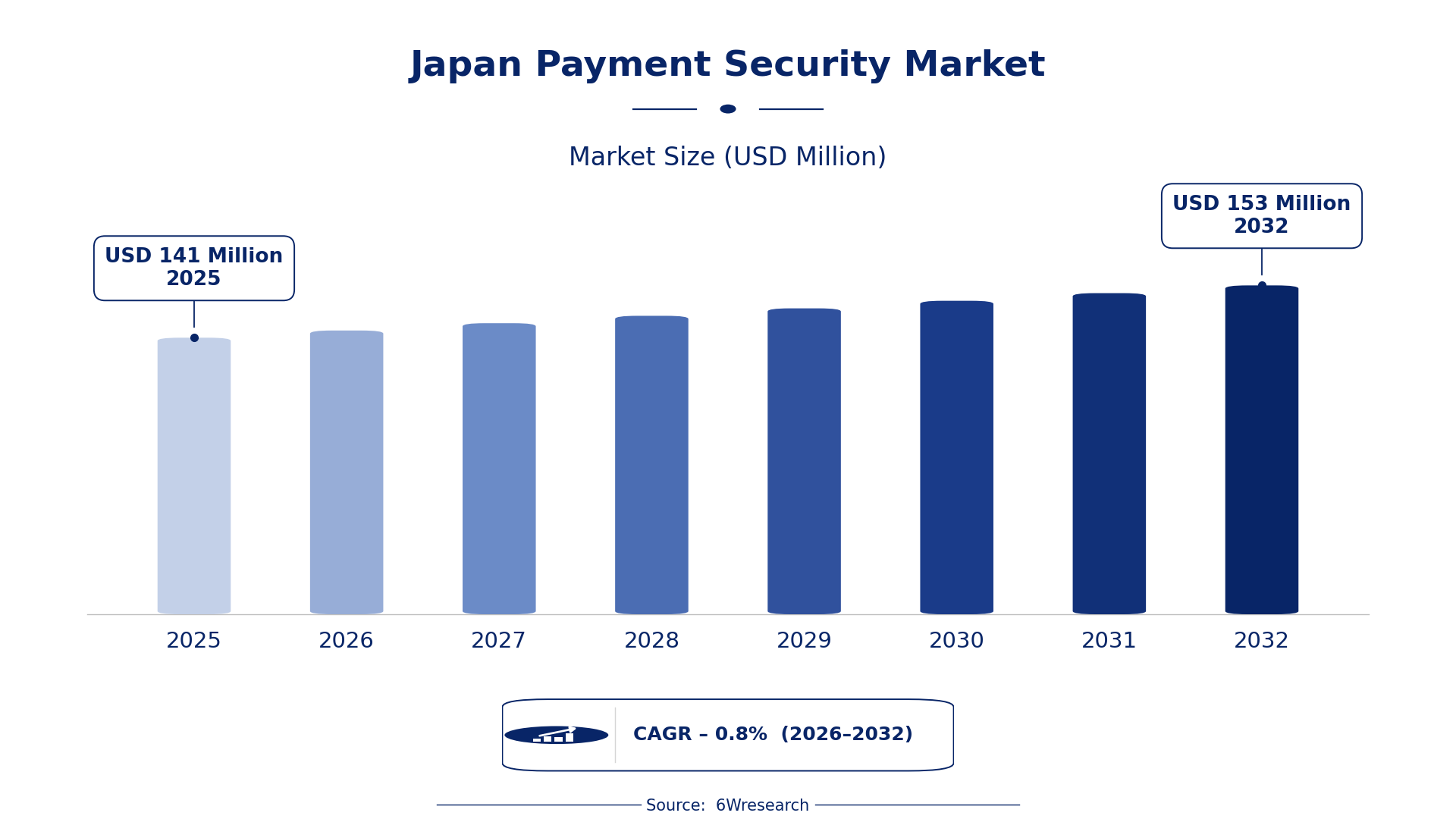
The Japan Payment Security Market was estimated at USD 141 Million in 2025 and is projected to reach USD 153 Million by 2032, growing at a CAGR of 0.8% from 2026 to 2032.
Japan Payment Security Market Synopsis
The surge in cyber threats is the most potent force shaping the Japan Payment Security Market. With an expanding number of digital transactions, businesses are increasingly investing in advanced security measures to protect sensitive financial data.
Regulatory compliance is equally pivotal, influencing how organizations approach payment security. The stringent standards set forth by the Japanese government compel businesses to adopt robust security frameworks, reinforcing their commitment to safeguarding customer information.
Japan Payment Security Market Year-wise Growth Rate and Key Drivers
This graph illustrates the annual growth rates of the Japan Payment Security Market from 2021 to 2032, highlighting a steady upward trajectory and projected expansion over the forecast period.
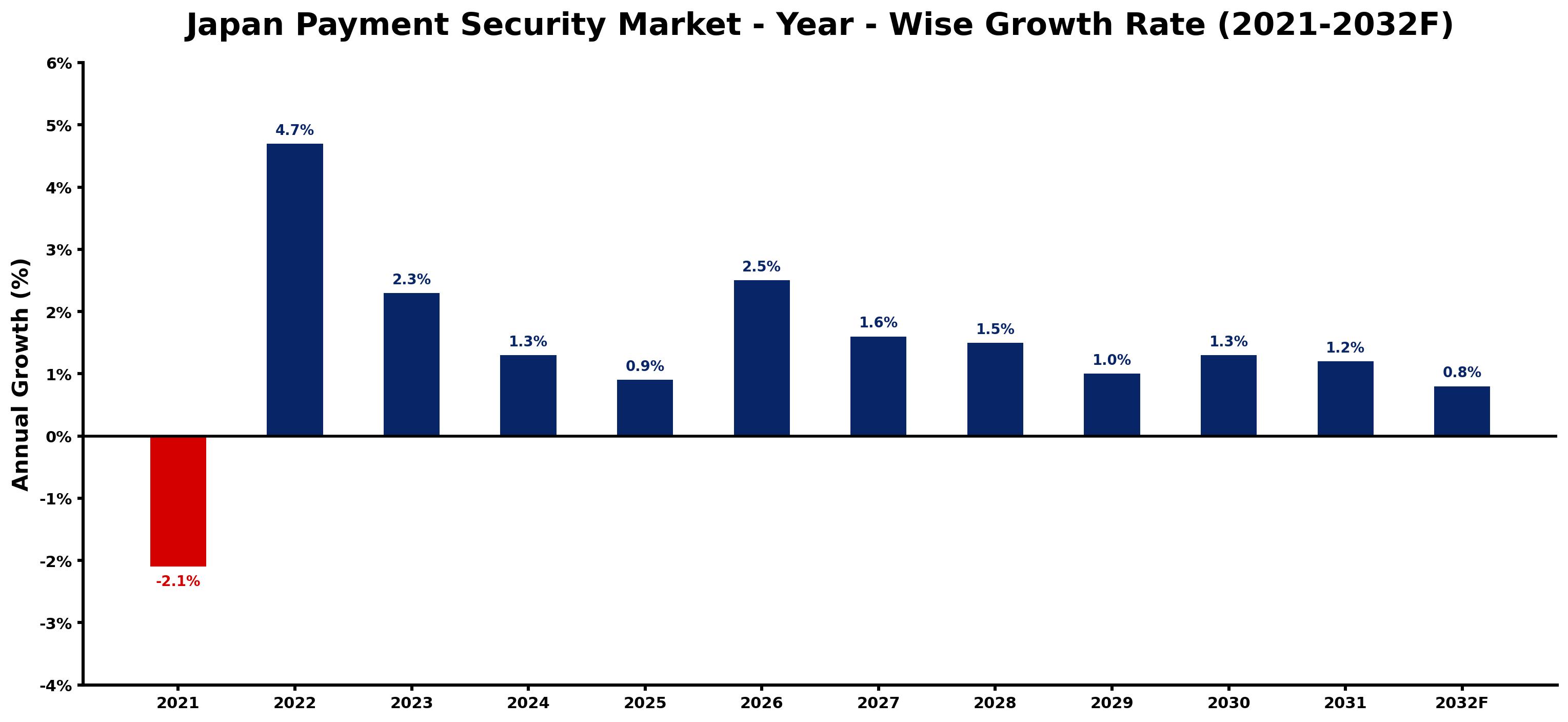
The table below presents the year‑wise growth rates along with the key drivers influencing the market
| Year | Growth Rate | Major Drivers |
| 2021 | -2.1% | Regulatory changes by Financial Services Agency stifled innovation. |
| 2022 | 4.7% | Rise in online shopping driving payment security investments. |
| 2023 | 2.3% | Government initiatives promoting digital payment safety standards. |
| 2024 | 1.3% | Increased focus on data privacy regulations enhancing security measures. |
| 2025 | 0.9% | Adoption of biometric authentication by major banks increasing trust. |
| 2026 | 2.5% | Implementation of PSD2 enhancing safe payment practices. |
| 2027 | 1.6% | Growing tech-savvy population demanding secure online transactions. |
| 2028 | 1.5% | Strengthening cybersecurity frameworks enhancing overall transaction security. |
| 2029 | 1.0% | Increased fraud cases prompting stronger security measures from businesses. |
| 2030 | 1.3% | Investment in AI-driven fraud detection solutions gaining traction. |
| 2031 | 1.2% | Supportive regulatory environment incentivizing secure payment innovations. |
| 2032 | 0.8% | Continued emphasis on safeguarding consumer data in transactions. |
Note: Market size estimations and growth projections presented in this report are based on 6Wresearch's proprietary forecasting methodology, utilizing the latest available industry data, government publications, and primary research inputs.
Japan Payment Security Market Key Takeaways
Below are some of the specific key takeaways from the market, including:
- Cybersecurity threats are escalating, pushing businesses to adopt cutting-edge payment security solutions.
- Regulatory compliance is becoming a primary driver for investment in secure payment transactions.
- Technological advancements such as biometrics and tokenization are gaining traction in the market.
- Mobile payments and e-commerce growth are significantly increasing the demand for security solutions.
- Investment opportunities in biometric authentication technologies present a promising growth avenue.
Evaluation of Restraints in Japan Payment Security Market
The Japan Payment Security Market encounters notable constraints primarily from the sophistication of cyber threats. Organizations struggle to keep pace with rapidly evolving tactics used by cybercriminals, complicating the security landscape. Compliance with strict regulations can also be burdensome, as companies must continuously adapt their security frameworks to meet changing legal standards. Additionally, there is often a trade-off between stringent security measures and user experience, making it challenging for companies to strike the right balance. Addressing these issues necessitates ongoing investment in both technology and personnel, which can be a significant hurdle for smaller enterprises.
Japan Payment Security Market Trends
The current trend in the Japan Payment Security Market showcases a shift towards biometric authentication technologies. Fingerprint scanning, facial recognition, and voice authentication are gaining traction as effective methods to enhance security. on top of that, organizations are increasingly investing in tokenization and encryption techniques to secure sensitive payment data.
Real-time monitoring systems are also being prioritized to swiftly detect and respond to potential fraud, which complements the growing emphasis on robust encryption methods. These trends reflect a broader strategy of enhancing security while simultaneously accommodating the rising adoption of mobile payments and e-commerce transactions.
Japan Payment Security Market Opportunities
The Japan Payment Security Market is ripe with investment opportunities, particularly within biometric authentication technologies. As the country increasingly shifts toward cashless transactions, solutions that provide stronger security protocols are essential. Companies specializing in advanced biometrics stand to benefit from this trend, as consumers and businesses alike seek to bolster security in payment systems. Additionally, there is a growing demand for tokenization services and encryption technologies tailored to protect online transaction data, positioning these areas as key focal points for investment.
Government Initiatives in the Japan Payment Security Market
Government policy plays a crucial role in shaping the Japan Payment Security Market, emphasizing the importance of secure payment systems. Regulatory frameworks are focused on safeguarding consumer data, fostering public trust, and ensuring the integrity of the financial sector. The Japanese government is increasingly pushing initiatives aimed at strengthening cybersecurity and enhancing the payment security infrastructure.
- A national initiative to promote the adoption of the Payment Card Industry Data Security Standard (PCI DSS) was completed in early 2025, enhancing the baseline security protocols for businesses handling cardholder information.
- The Act on Prevention of Transfer of Criminal Proceeds, currently in effect, mandates financial institutions to implement stringent anti-money laundering measures, reinforcing security during payment transactions.
- Plans for a comprehensive public-private partnership to develop next-gen payment security technologies are underway, expected to be rolled out by mid-2026.
- An ongoing review of compliance regulations is set to refine existing frameworks, ensuring they align with contemporary cyber threats and industry best practices.
Future Insights of the Japan Payment Security Market
Looking ahead to 2026-2032, the Japan Payment Security Market is set for steady growth. The increasing reliance on digital payment channels will likely fuel demand for sophisticated security solutions. Companies will need to invest in advanced technologies like biometrics and encryption to protect sensitive information effectively. With ongoing regulatory developments, organizations will continue to prioritize compliance, further driving the adoption of innovative security measures. As cyber threats evolve, so too will the strategies employed to combat them, leading to a more secure payment ecosystem in Japan.
Japan Payment Security Market Latest Developments
Recent developments within the Japan Payment Security Market reflect a significant focus on enhancing security protocols. Organizations are actively investing in cutting-edge technologies to address rising concerns about data breaches and fraud.
- A leading technology vendor launched an enhanced biometric authentication system in early 2025, significantly improving user security for mobile payments.
- An initiative to upgrade payment encryption standards is currently underway, aiming for completion by late 2025 to meet growing compliance demands.
- Partnerships between financial institutions and cybersecurity firms are ongoing, targeting the development of AI-driven fraud detection tools.
- A planned rollout for a nationwide cybersecurity awareness campaign to educate consumers about secure payment practices is expected to begin in Q1 2026.
Japan Payment Security Market - Key Attractiveness of the Report
- 10 Years of Market Numbers
- Historical Data Starting from 2022 to 2025
- Base Year: 2025
- Forecast Data until 2032
- Key Performance Indicators Impacting the Market
- Major Upcoming Developments and Projects
Key Highlights of the Report:
- Japan Payment Security Market Outlook
- Market Size of Japan Payment Security Market, 2025
- Forecast of Japan Payment Security Market, 2032
- Historical Data and Forecast of Japan Payment Security Revenues & Volume for the Period 2022-2032F
- Japan Payment Security Market Trend Evolution
- Japan Payment Security Market Drivers and Challenges
- Japan Payment Security Price Trends
- Japan Payment Security Porter's Five Forces
- Japan Payment Security Industry Life Cycle
- Historical Data and Forecast of Japan Payment Security Market Revenues & Volume By Solution for the Period 2022-2032F
- Historical Data and Forecast of Japan Payment Security Market Revenues & Volume By Encryption for the Period 2022-2032F
- Historical Data and Forecast of Japan Payment Security Market Revenues & Volume By Tokenization for the Period 2022-2032F
- Historical Data and Forecast of Japan Payment Security Market Revenues & Volume By Fraud Detection for the Period 2022-2032F
- Historical Data and Forecast of Japan Payment Security Market Revenues & Volume By Prevention for the Period 2022-2032F
- Historical Data and Forecast of Japan Payment Security Market Revenues & Volume By Service for the Period 2022-2032F
- Historical Data and Forecast of Japan Payment Security Market Revenues & Volume By Integration for the Period 2022-2032F
- Historical Data and Forecast of Japan Payment Security Market Revenues & Volume By Support for the Period 2022-2032F
- Historical Data and Forecast of Japan Payment Security Market Revenues & Volume By Consulting for the Period 2022-2032F
- Historical Data and Forecast of Japan Payment Security Market Revenues & Volume By Organization Size for the Period 2022-2032F
- Historical Data and Forecast of Japan Payment Security Market Revenues & Volume By Large Enterprises for the Period 2022-2032F
- Historical Data and Forecast of Japan Payment Security Market Revenues & Volume By SMEs for the Period 2022-2032F
- Historical Data and Forecast of Japan Payment Security Market Revenues & Volume By Industry Vertical for the Period 2022-2032F
- Japan Payment Security Import Export Trade Statistics
- Market Opportunity Assessment By Solution
- Market Opportunity Assessment By Service
- Market Opportunity Assessment By Organization Size
- Market Opportunity Assessment By Industry Vertical
- Japan Payment Security Top Companies Market Share
- Japan Payment Security Competitive Benchmarking By Technical and Operational Parameters
- Japan Payment Security Company Profiles
- Japan Payment Security Key Strategic Recommendations






































