Egypt Payment Security Market Size & Growth Rate (2026-2032)
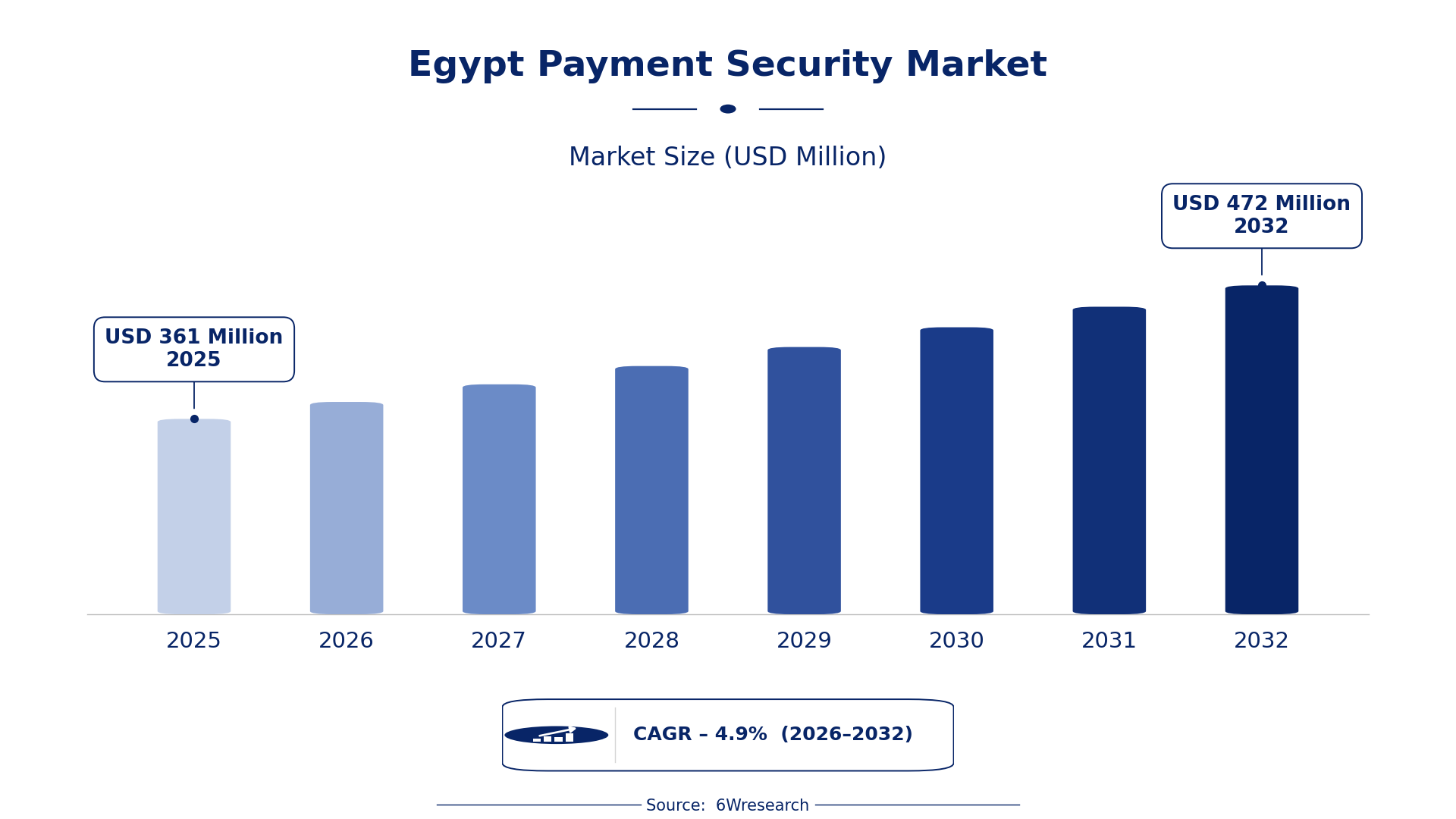
The Egypt Payment Security Market was estimated at USD 361 Million in 2025 and is projected to reach USD 472 Million by 2032, growing at a CAGR of 4.9% from 2026 to 2032.
Egypt Payment Security Market Synopsis
The Egypt Payment Security Market is on an upward trajectory, fueled by a surge in digital transactions. E-commerce is expanding rapidly, driving businesses to adopt enhanced security measures to protect sensitive consumer data.
Government backing for cashless transactions, combined with growing public awareness about cybersecurity threats, further accelerates the demand for secure payment solutions. Companies are increasingly implementing technologies such as encryption and biometric authentication to safeguard financial transactions.
Egypt Payment Security Market Year-wise Growth Rate and Key Drivers
This graph illustrates the annual growth rates of the Egypt Payment Security Market from 2021 to 2032, highlighting a steady upward trajectory and projected expansion over the forecast period.
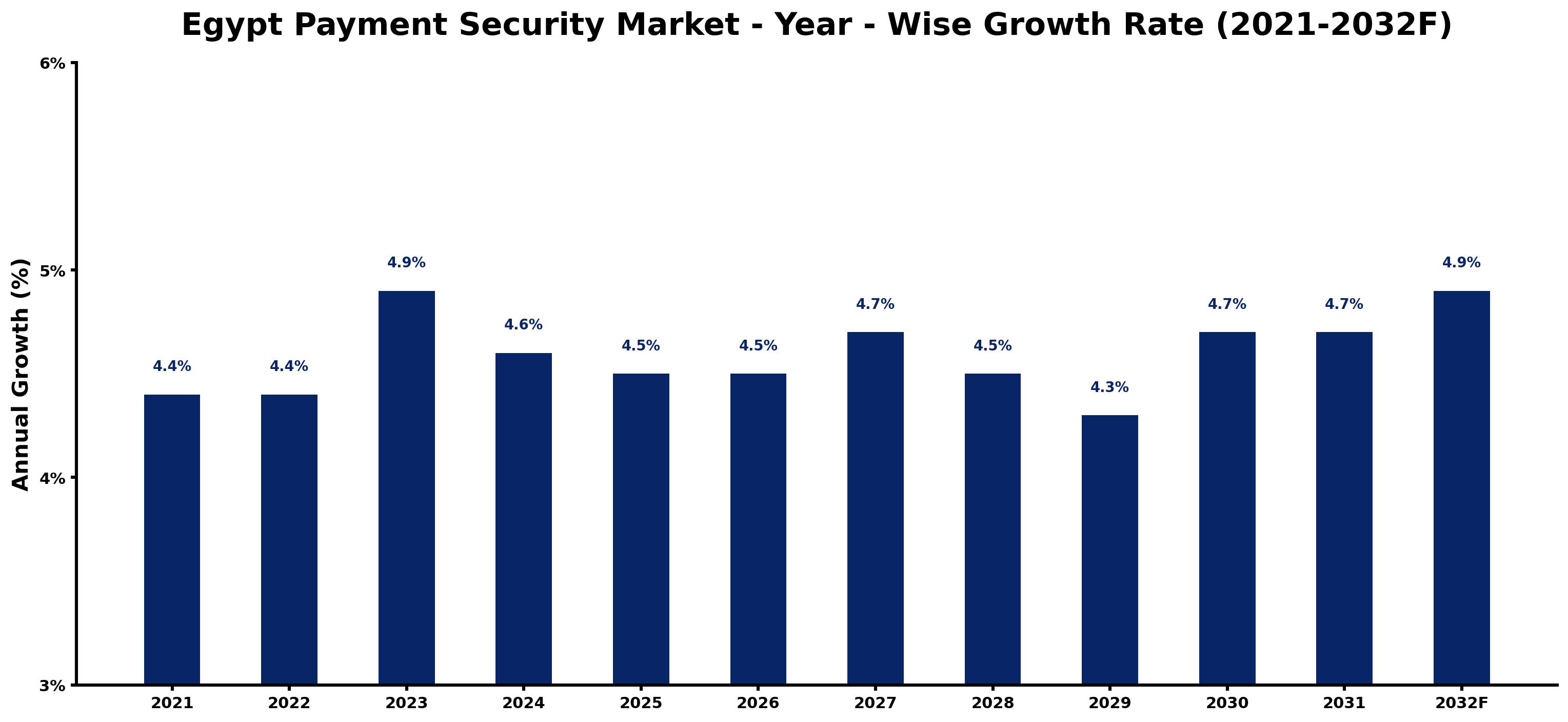
The table below presents the year‑wise growth rates along with the key drivers influencing the market
| Year | Growth Rate | Major Drivers |
| 2021 | 4.4% | Central Bank of Egypt's Cashless Initiative program launch |
| 2022 | 4.4% | Rising e-commerce adoption driving cybersecurity investments |
| 2023 | 4.9% | Implementation of data protection laws boosting compliance needs |
| 2024 | 4.6% | Government funding for fintech innovations in security solutions |
| 2025 | 4.5% | Growth in contactless payment options requiring enhanced security |
| 2026 | 4.5% | Increased cyber threats prompting security technology upgrades |
| 2027 | 4.7% | Consumer awareness of fraud risks elevating security focus |
| 2028 | 4.5% | Investment in digital identity solutions by national banks |
| 2029 | 4.3% | Partnerships with tech firms for advanced encryption techniques |
| 2030 | 4.7% | Digital transformation strategies emphasizing secure payment ecosystems |
| 2031 | 4.7% | Regulatory bodies pushing for stricter security standards |
| 2032 | 4.9% | Development of biometric payment systems enhancing security measures |
Note: Market size estimations and growth projections presented in this report are based on 6Wresearch's proprietary forecasting methodology, utilizing the latest available industry data, government publications, and primary research inputs.
Egypt Payment Security Market Key Takeaways
Below are some of the specific key takeaways from the market, including:
- The market is witnessing a notable transition towards digital payments and advanced security technologies.
- Mobile payments are becoming a driving force behind the demand for payment security solutions.
- Regulatory initiatives are fostering a culture of compliance and enhancing payment security standards.
- The rise in awareness about cyber threats is compelling businesses to invest in robust payment security measures.
- Fraud detection and prevention are critical components of the market's growth strategy.
Evaluation of Restraints in Egypt Payment Security Market
Despite promising growth, the Egypt Payment Security Market faces notable obstacles. A significant portion of transactions still occurs in cash, limiting the transition to secure digital payment methods. Many consumers remain unaware of the advantages of secure payment options, which hampers widespread adoption. This lack of awareness must be addressed through targeted educational initiatives to highlight the importance of cybersecurity. on top of that, increasing incidents of cyber fraud are a pressing concern, necessitating strong preventative measures from service providers.
Egypt Payment Security Market Trends
One of the most apparent trends is the shift towards mobile and contactless payments, which demand higher levels of security. Technologies such as tokenization are gaining traction to mitigate risks associated with online transactions. Biometric authentication is emerging as a preferred method for identity verification, catering to the user demand for convenience and security. Companies are increasingly integrating AI-driven analytics to enhance fraud detection capabilities, creating a more secure transaction environment.
Egypt Payment Security Market Opportunities
The demand for payment security solutions presents numerous opportunities for growth. As e-commerce continues to flourish, businesses need to ensure secure payment channels to maintain customer trust. The rise in digital banking and fintech solutions creates avenues for service providers to offer tailored security measures. Investment in awareness campaigns regarding secure payment methods could significantly increase market penetration, while regulatory compliance requirements create a need for innovative solutions.
Government Initiatives in the Egypt Payment Security Market
Government initiatives are critical in shaping the Egypt Payment Security Market. The Central Bank of Egypt and other regulatory bodies are actively promoting a cashless economy through legislation and guidelines aimed at enhancing payment security standards. These policies are pivotal in establishing a secure financial environment that benefits businesses and consumers alike.
- A recently completed Payment Systems and Electronic Payment Law establishes a legal framework for electronic transactions.
- Current efforts include the rollout of security guidelines by the Central Bank of Egypt for payment service providers.
- Ongoing campaigns aim to educate the public on the importance of cybersecurity in financial transactions.
- Upcoming initiatives will focus on expanding access to digital payment platforms to further encourage cashless transactions.
Future Insights of the Egypt Payment Security Market
Looking ahead, the Egypt Payment Security Market is set to thrive as digital payments become more embedded in everyday transactions. The push for comprehensive security measures will escalate, driven by the increasing frequency of cyberattacks. As technology advances, solutions will evolve, integrating sophisticated authentication methods and real-time fraud detection mechanisms. Consumer demand for safe and efficient payment systems will remain a cornerstone for market growth through 2032.
Egypt Payment Security Market Latest Developments
Recent activity in the Egypt Payment Security Market reflects a commitment to enhancing security protocols amidst rising cyber threats. Companies are focusing on deploying cutting-edge technologies to protect consumer data and boost transaction safety.
- A leading technology vendor launched a new encryption service in Q3 2025, enhancing transaction security for e-commerce platforms.
- An initiative aimed at integrating biometric authentication into mobile payment applications is currently underway, expected to be completed by mid-2026.
- A major partnership between two security firms was established in early 2025 to develop advanced fraud detection systems, now in the pilot phase.
- A government-led campaign to improve awareness about secure payment methods is ongoing and has garnered positive public response since 2025.
Egypt Payment Security Market - Key Attractiveness of the Report
- 10 Years of Market Numbers
- Historical Data Starting from 2022 to 2025
- Base Year: 2025
- Forecast Data until 2032
- Key Performance Indicators Impacting the Market
- Major Upcoming Developments and Projects
Key Highlights of the Report:
- Egypt Payment Security Market Outlook
- Market Size of Egypt Payment Security Market, 2025
- Forecast of Egypt Payment Security Market, 2032
- Historical Data and Forecast of Egypt Payment Security Revenues & Volume for the Period 2022-2032F
- Egypt Payment Security Market Trend Evolution
- Egypt Payment Security Market Drivers and Challenges
- Egypt Payment Security Price Trends
- Egypt Payment Security Porter's Five Forces
- Egypt Payment Security Industry Life Cycle
- Historical Data and Forecast of Egypt Payment Security Market Revenues & Volume By Solution for the Period 2022-2032F
- Historical Data and Forecast of Egypt Payment Security Market Revenues & Volume By Encryption for the Period 2022-2032F
- Historical Data and Forecast of Egypt Payment Security Market Revenues & Volume By Tokenization for the Period 2022-2032F
- Historical Data and Forecast of Egypt Payment Security Market Revenues & Volume By Fraud Detection for the Period 2022-2032F
- Historical Data and Forecast of Egypt Payment Security Market Revenues & Volume By Prevention for the Period 2022-2032F
- Historical Data and Forecast of Egypt Payment Security Market Revenues & Volume By Service for the Period 2022-2032F
- Historical Data and Forecast of Egypt Payment Security Market Revenues & Volume By Integration for the Period 2022-2032F
- Historical Data and Forecast of Egypt Payment Security Market Revenues & Volume By Support for the Period 2022-2032F
- Historical Data and Forecast of Egypt Payment Security Market Revenues & Volume By Consulting for the Period 2022-2032F
- Historical Data and Forecast of Egypt Payment Security Market Revenues & Volume By Organization Size for the Period 2022-2032F
- Historical Data and Forecast of Egypt Payment Security Market Revenues & Volume By Large Enterprises for the Period 2022-2032F
- Historical Data and Forecast of Egypt Payment Security Market Revenues & Volume By SMEs for the Period 2022-2032F
- Historical Data and Forecast of Egypt Payment Security Market Revenues & Volume By Industry Vertical for the Period 2022-2032F
- Egypt Payment Security Import Export Trade Statistics
- Market Opportunity Assessment By Solution
- Market Opportunity Assessment By Service
- Market Opportunity Assessment By Organization Size
- Market Opportunity Assessment By Industry Vertical
- Egypt Payment Security Top Companies Market Share
- Egypt Payment Security Competitive Benchmarking By Technical and Operational Parameters
- Egypt Payment Security Company Profiles
- Egypt Payment Security Key Strategic Recommendations






































