Nigeria Payment Security Market Size & Growth Rate (2026-2032)
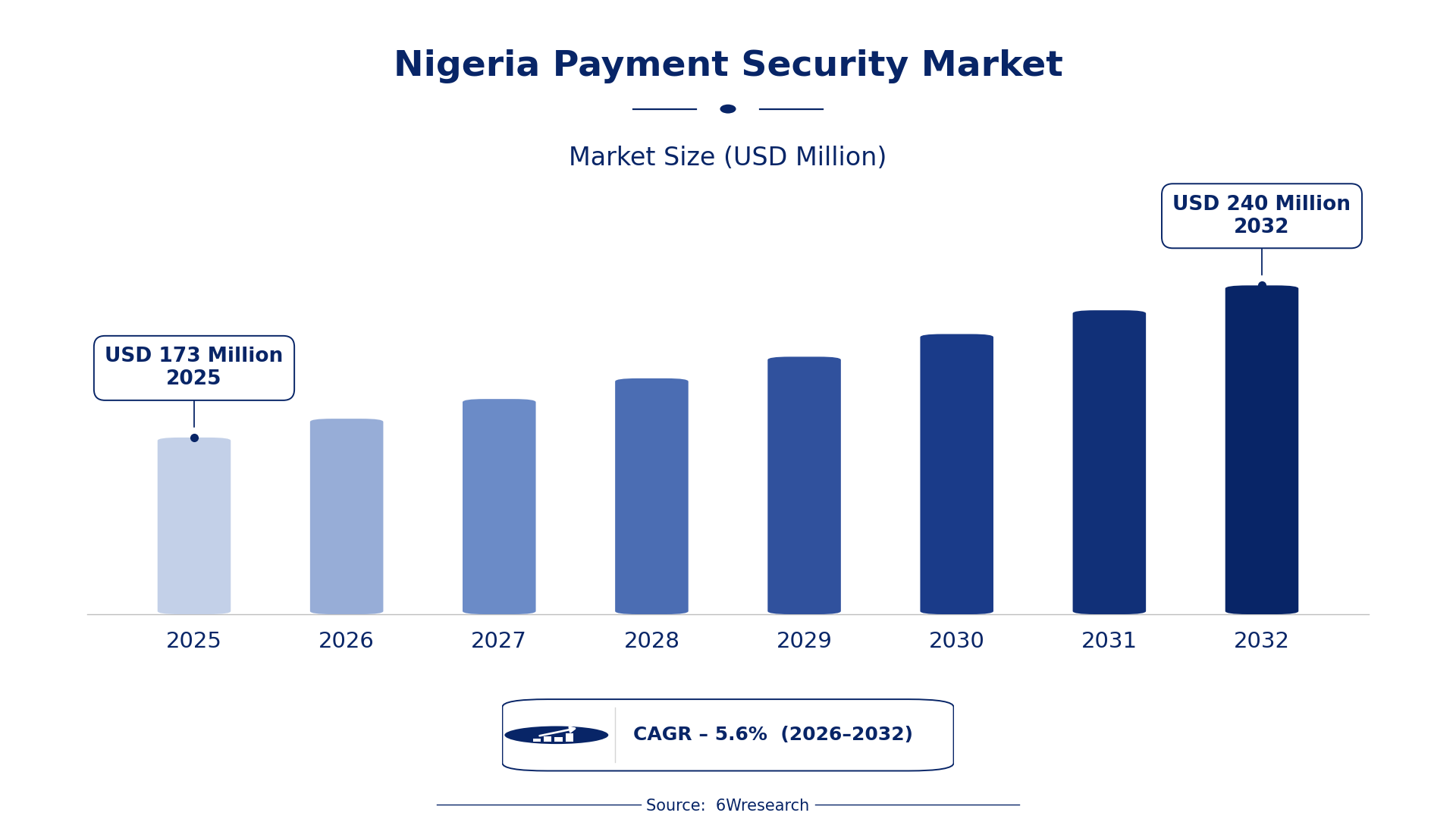
The Nigeria Payment Security Market was estimated at USD 173 Million in 2025 and is projected to reach USD 240 Million by 2032, growing at a CAGR of 5.6% from 2026 to 2032.
Nigeria Payment Security Market Synopsis
The Nigeria Payment Security Market has become increasingly crucial as digital payment solutions gain traction across the nation. This growing reliance on electronic transactions has heightened the demand for advanced security measures that can effectively combat rising cyber threats.
Businesses and consumers alike are recognizing the necessity of secure payment transactions. This shift is driving demand for sophisticated technologies like encryption and biometric authentication, as stakeholders strive to protect sensitive financial information in an evolving digital economy.
Nigeria Payment Security Market Year-wise Growth Rate and Key Drivers
This graph illustrates the annual growth rates of the Nigeria Payment Security Market from 2021 to 2032, highlighting a steady upward trajectory and projected expansion over the forecast period.
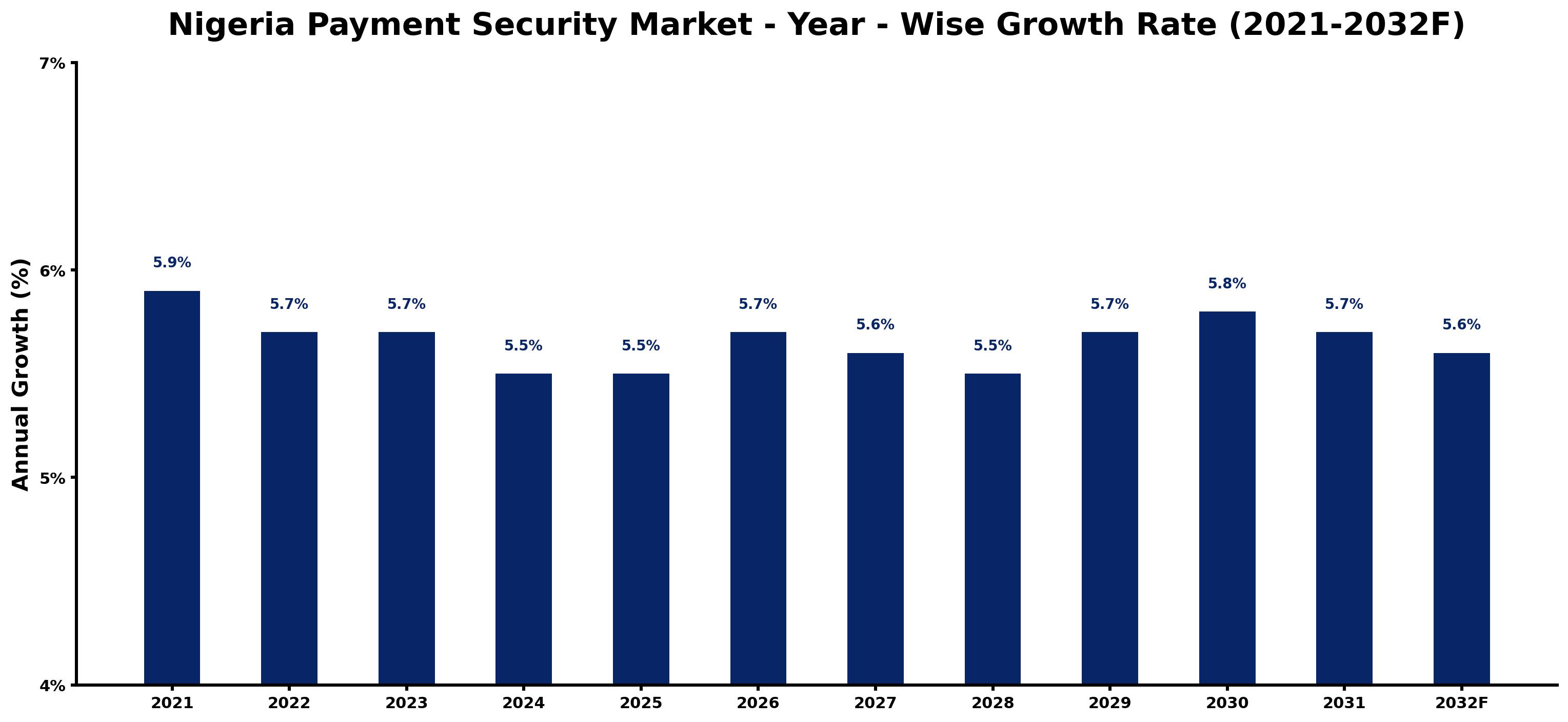
The table below presents the year‑wise growth rates along with the key drivers influencing the market
| Year | Growth Rate | Major Drivers |
| 2021 | 5.9% | Central Bank of Nigeria's eNaira boosting digital transactions. |
| 2022 | 5.7% | Rising mobile payment adoption enhancing fraud prevention requirements. |
| 2023 | 5.7% | Regulatory upgrades targeting cybercrime increasing investment in security. |
| 2024 | 5.5% | Increased e-commerce activity raising demand for payment authentication. |
| 2025 | 5.5% | Growth of fintech startups demanding robust security solutions. |
| 2026 | 5.7% | Consumer protection laws enhancing need for payment security. |
| 2027 | 5.6% | Partnerships between banks and tech firms improving security frameworks. |
| 2028 | 5.5% | Government initiatives promoting cashless transactions elevating risks. |
| 2029 | 5.7% | Digital identity verification mandates driving security investments. |
| 2030 | 5.8% | Emergence of local cybersecurity firms strengthening market landscape. |
| 2031 | 5.7% | Increased cross-border transactions urging stronger fraud defenses. |
| 2032 | 5.6% | Technological advancements in biometric security boosting consumer confidence. |
Note: Market size estimations and growth projections presented in this report are based on 6Wresearch's proprietary forecasting methodology, utilizing the latest available industry data, government publications, and primary research inputs.
Nigeria Payment Security Market Key Takeaways
Below are some of the specific key takeaways from the market, including:
- The market is seeing a surge in demand for payment security solutions due to increasing online transactions.
- Biometric authentication is becoming a preferred method for enhancing payment security measures.
- Regulatory initiatives are reinforcing the importance of adhering to security standards in electronic payment systems.
- Investment in advanced technologies for fraud detection is on the rise across financial institutions.
- Opportunities exist for integrated solutions that offer comprehensive protection across various payment channels.
Evaluation of Restraints in Nigeria Payment Security Market
The market faces several challenges that could hinder its potential. One of the most pressing issues is the prevalence of cyber threats, which continue to target electronic payment systems. As digital transactions expand, so does the risk associated with them, especially given the existing lack of awareness about security measures among many consumers. on top of that, insufficient investment in infrastructure and regulatory enforcement compounds these vulnerabilities, making it critical for stakeholders to prioritize robust security frameworks.
Nigeria Payment Security Market Trends
Emerging trends in the Nigeria Payment Security Market reveal a clear shift toward more advanced security protocols. The adoption of biometric authentication systems is gaining momentum, reflecting a broader global trend toward user-friendly yet secure payment methods. Concurrently, financial institutions are increasingly implementing AI and machine learning technologies to proactively identify and mitigate fraud. This technological integration is indicative of a growing recognition of the sophisticated nature of modern cyber threats.
Nigeria Payment Security Market Opportunities
The market presents substantial growth opportunities, particularly for vendors offering integrated payment security solutions. With heightened consumer awareness regarding the importance of securing financial transactions, businesses are seeking comprehensive security measures that protect against a variety of threats. Collaboration between financial institutions and cybersecurity firms is becoming essential, creating pathways for innovative solutions that can effectively address the challenges posed by evolving cyber threats.
Government Initiatives in the Nigeria Payment Security Market
Government policies in Nigeria play a significant role in shaping the payment security environment. The Central Bank of Nigeria (CBN) is actively driving initiatives aimed at enhancing the security of electronic payment systems, thereby fostering greater trust among consumers and businesses. Regulatory measures are being strengthened to create a secure payment ecosystem, making it a priority for stakeholders.
- A regulatory framework introduced by the CBN in 2023 mandates the adoption of tokenization and encryption technologies by financial institutions.
- The Nigeria Electronic Fraud Forum (NeFF), established to facilitate collaboration among industry players, is currently operational and working to combat electronic fraud.
- A national awareness campaign launched in 2024 aims to educate businesses and consumers about payment security best practices.
- Ongoing CBN inspections are being conducted to ensure compliance with payment security standards set forth in the new regulations.
- A planned public-private initiative expected to commence in 2026 aims to enhance cybersecurity infrastructure across key financial sectors.
Future Insights of the Nigeria Payment Security Market
Looking ahead to 2026-2032, the Nigeria Payment Security Market is set to evolve rapidly. As digital payment methods continue to proliferate, the demand for effective security solutions will intensify. The interplay of regulatory developments and increased investment in technology will further shape the market dynamics. Stakeholders must stay ahead of the curve, adapting to emerging threats while capitalizing on the opportunities that arise from a more security-conscious consumer base.
Nigeria Payment Security Market Latest Developments
Recent developments within the Nigeria Payment Security Market reflect a strong focus on innovation and compliance. Over the past year, organizations have ramped up efforts to enhance their security protocols, responding to the growing threat of cybercrime while aligning with new regulatory standards.
- A major technology vendor launched a comprehensive payment security solution in Q1 2025 that incorporates advanced biometric authentication features.
- In early 2025, several banks began implementing a new encryption framework to better protect customer data during transactions.
- A joint initiative between the CBN and industry leaders is currently underway to bolster the regulatory guidelines surrounding electronic payments.
- Upcoming in mid-2026, a campaign promoting cybersecurity literacy among consumers and businesses is expected to roll out across major urban centers.
Nigeria Payment Security Market - Key Attractiveness of the Report
- 10 Years of Market Numbers
- Historical Data Starting from 2022 to 2025
- Base Year: 2025
- Forecast Data until 2032
- Key Performance Indicators Impacting the Market
- Major Upcoming Developments and Projects
Key Highlights of the Report:
- Nigeria Payment Security Market Outlook
- Market Size of Nigeria Payment Security Market, 2025
- Forecast of Nigeria Payment Security Market, 2032
- Historical Data and Forecast of Nigeria Payment Security Revenues & Volume for the Period 2022-2032F
- Nigeria Payment Security Market Trend Evolution
- Nigeria Payment Security Market Drivers and Challenges
- Nigeria Payment Security Price Trends
- Nigeria Payment Security Porter's Five Forces
- Nigeria Payment Security Industry Life Cycle
- Historical Data and Forecast of Nigeria Payment Security Market Revenues & Volume By Solution for the Period 2022-2032F
- Historical Data and Forecast of Nigeria Payment Security Market Revenues & Volume By Encryption for the Period 2022-2032F
- Historical Data and Forecast of Nigeria Payment Security Market Revenues & Volume By Tokenization for the Period 2022-2032F
- Historical Data and Forecast of Nigeria Payment Security Market Revenues & Volume By Fraud Detection for the Period 2022-2032F
- Historical Data and Forecast of Nigeria Payment Security Market Revenues & Volume By Prevention for the Period 2022-2032F
- Historical Data and Forecast of Nigeria Payment Security Market Revenues & Volume By Service for the Period 2022-2032F
- Historical Data and Forecast of Nigeria Payment Security Market Revenues & Volume By Integration for the Period 2022-2032F
- Historical Data and Forecast of Nigeria Payment Security Market Revenues & Volume By Support for the Period 2022-2032F
- Historical Data and Forecast of Nigeria Payment Security Market Revenues & Volume By Consulting for the Period 2022-2032F
- Historical Data and Forecast of Nigeria Payment Security Market Revenues & Volume By Organization Size for the Period 2022-2032F
- Historical Data and Forecast of Nigeria Payment Security Market Revenues & Volume By Large Enterprises for the Period 2022-2032F
- Historical Data and Forecast of Nigeria Payment Security Market Revenues & Volume By SMEs for the Period 2022-2032F
- Historical Data and Forecast of Nigeria Payment Security Market Revenues & Volume By Industry Vertical for the Period 2022-2032F
- Nigeria Payment Security Import Export Trade Statistics
- Market Opportunity Assessment By Solution
- Market Opportunity Assessment By Service
- Market Opportunity Assessment By Organization Size
- Market Opportunity Assessment By Industry Vertical
- Nigeria Payment Security Top Companies Market Share
- Nigeria Payment Security Competitive Benchmarking By Technical and Operational Parameters
- Nigeria Payment Security Company Profiles
- Nigeria Payment Security Key Strategic Recommendations






































