Kenya Payment Security Market Size & Growth Rate (2026-2032)
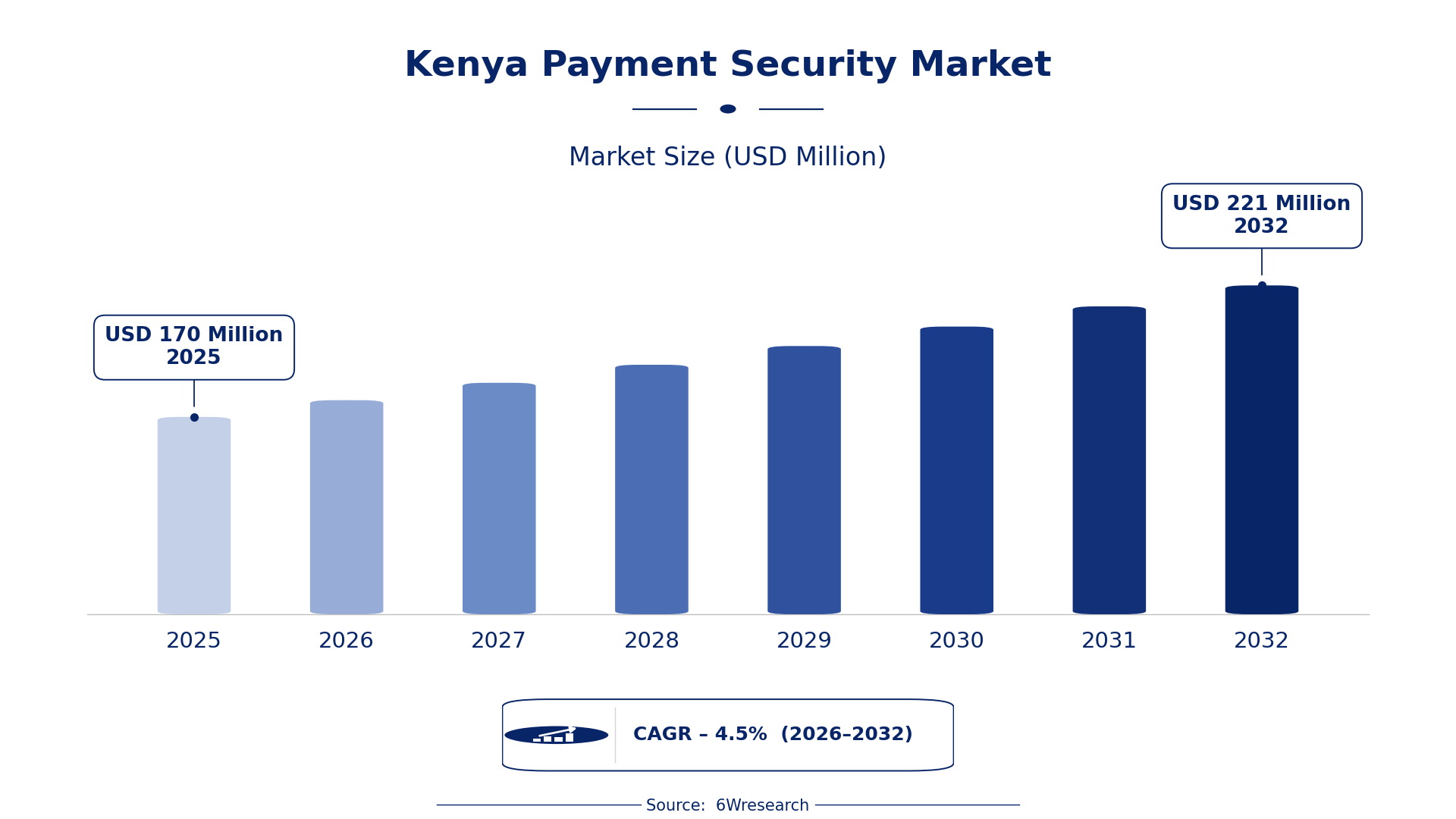
The Kenya Payment Security Market was estimated at USD 170 Million in 2025 and is projected to reach USD 221 Million by 2032, growing at a CAGR of 4.5% from 2026 to 2032.
Kenya Payment Security Market Synopsis
The rapid rise of e-commerce in Kenya is creating an urgent demand for effective payment security solutions. As consumers increasingly opt for online transactions, the need to safeguard financial information from cyber threats has never been more critical.
Simultaneously, the landscape is marked by heightened regulatory scrutiny aimed at improving data protection measures. Businesses are now prioritizing investments in advanced security technologies, including encryption and biometric authentication, to maintain consumer trust and comply with emerging regulations.
Kenya Payment Security Market Year-wise Growth Rate and Key Drivers
This graph illustrates the annual growth rates of the Kenya Payment Security Market from 2021 to 2032, highlighting a steady upward trajectory and projected expansion over the forecast period.
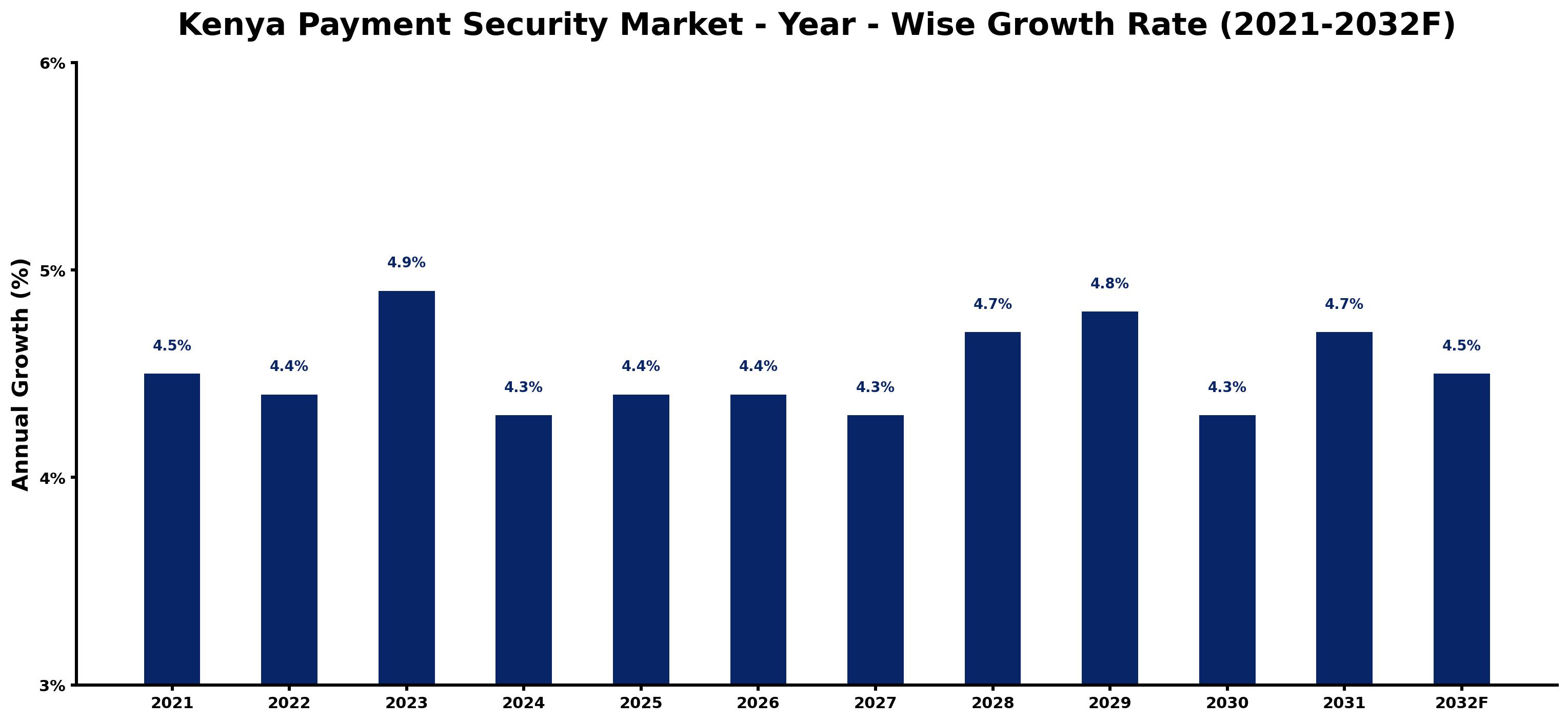
The table below presents the year‑wise growth rates along with the key drivers influencing the market
| Year | Growth Rate | Major Drivers |
| 2021 | 4.5% | Central Bank of Kenya promoting secure digital transactions. |
| 2022 | 4.4% | Growing fintech startups enhancing payment security offerings. |
| 2023 | 4.9% | Increased mobile wallet penetration boosting cybersecurity focus. |
| 2024 | 4.3% | Government initiatives for strict KYC compliance in payments. |
| 2025 | 4.4% | Rising cybercrime incidents driving investment in security solutions. |
| 2026 | 4.4% | Enhanced regulations around data protection in payments. |
| 2027 | 4.3% | Growing adoption of e-commerce necessitating secure payment methods. |
| 2028 | 4.7% | Mobile money platforms integrating advanced fraud detection systems. |
| 2029 | 4.8% | Local partnerships enhancing cybersecurity innovations for payments. |
| 2030 | 4.3% | Regulatory focus on consumer protection fueling security investments. |
| 2031 | 4.7% | Economic growth driving digital finance security concerns. |
| 2032 | 4.5% | Increased awareness of cybersecurity risks among users. |
Note: Market size estimations and growth projections presented in this report are based on 6Wresearch's proprietary forecasting methodology, utilizing the latest available industry data, government publications, and primary research inputs.
Kenya Payment Security Market Key Takeaways
Below are some of the specific key takeaways from the market, including:
- The market is driven by the surge in digital payment adoption and increasing cyber threats.
- Key security technologies gaining traction include encryption, tokenization, and biometric authentication.
- Regulatory pressures are prompting organizations to enhance their payment security measures.
- Investment opportunities exist in cybersecurity solutions aimed at businesses and consumers.
- Rising awareness of cybersecurity is influencing consumer behavior towards more secure payment options.
Evaluation of Restraints in Kenya Payment Security Market
Despite promising growth, the Kenya Payment Security Market faces notable constraints. A key issue is the limited penetration of advanced security technologies among businesses, particularly small and medium enterprises that struggle with high implementation costs. Inadequate regulatory frameworks and a general lack of consumer awareness further exacerbate the risk landscape. These elements combine to create a situation where the rapid growth in digital transactions is met with increasing vulnerabilities, compelling the need for comprehensive action among stakeholders.
Kenya Payment Security Market Trends
The demand for sophisticated payment security solutions is rising sharply, directly correlating with the expanding digital payment ecosystem. Biometric authentication methods are becoming a preferred choice, reflecting a shift toward personalized security measures. As regulatory frameworks evolve, organizations are compelled to invest in advanced technologies to meet compliance standards. This trend underscores a collective movement toward integrated security solutions, aiming to foster consumer confidence in online transactions.
Kenya Payment Security Market Opportunities
Significant growth opportunities exist within the Kenya Payment Security Market, particularly for investment in cybersecurity service providers. Businesses developing advanced security features, such as fraud detection systems and biometric verification technologies, stand to benefit substantially. The overall market for secure payment platforms is also expanding, providing a fertile ground for innovative companies eager to address the growing demand for secure digital transactions.
Government Initiatives in the Kenya Payment Security Market
Government action is crucial in shaping the Kenya Payment Security Market, with several initiatives underway to enhance security and consumer confidence. The Central Bank of Kenya has taken steps to establish regulatory frameworks that safeguard electronic payment systems, ensuring a structured approach to cybersecurity in the financial sector.
- A regulatory framework implemented in 2024 mandates all payment service providers to adhere to updated cybersecurity guidelines.
- The Central Bank is currently overseeing a national awareness campaign aimed at educating businesses and consumers on secure payment practices.
- A public-private partnership is expected to launch in 2026, focusing on enhancing the cybersecurity infrastructure across various sectors.
- The introduction of a comprehensive data protection policy is planned for 2027, aimed at regulating how businesses handle sensitive financial information.
- A recent initiative has introduced EMV chip technology, which has been adopted by local banks to reduce card fraud.
Future Insights of the Kenya Payment Security Market
Looking ahead to 2026-2032, the Kenya Payment Security Market is set for continuous expansion. This growth will be fueled by a sustained push for digital payment solutions and an increasing emphasis on cybersecurity. The market will likely see further integration of advanced security technologies, such as artificial intelligence-driven fraud detection, aimed at countering evolving cyber threats. Regulatory measures will play a significant role in shaping market dynamics, ensuring that security standards keep pace with technological advances and consumer expectations.
Kenya Payment Security Market Latest Developments
In the past year, the Kenya Payment Security Market has seen a flurry of activity aimed at enhancing security protocols and consumer trust. This momentum reflects the urgent need to address cybersecurity vulnerabilities amid rapid digital transformation.
- A major technology vendor announced the rollout of a cutting-edge encryption service in Q1 2025, enhancing security for digital transactions across multiple platforms.
- An ongoing initiative is expected to upgrade payment security protocols for mobile banking applications, aiming for completion by mid-2026.
- A partnership formed in late 2025 between leading banks and cybersecurity firms focuses on developing fraud detection systems that leverage machine learning.
- A planned expansion of biometric payment systems is expected to begin in early 2026, enhancing user verification processes at retail locations.
- A new cyber resilience training program for businesses has been launched, aimed at bolstering internal security measures against potential threats.
Kenya Payment Security Market - Key Attractiveness of the Report
- 10 Years of Market Numbers
- Historical Data Starting from 2022 to 2025
- Base Year: 2025
- Forecast Data until 2032
- Key Performance Indicators Impacting the Market
- Major Upcoming Developments and Projects
Key Highlights of the Report:
- Kenya Payment Security Market Outlook
- Market Size of Kenya Payment Security Market, 2025
- Forecast of Kenya Payment Security Market, 2032
- Historical Data and Forecast of Kenya Payment Security Revenues & Volume for the Period 2022-2032F
- Kenya Payment Security Market Trend Evolution
- Kenya Payment Security Market Drivers and Challenges
- Kenya Payment Security Price Trends
- Kenya Payment Security Porter's Five Forces
- Kenya Payment Security Industry Life Cycle
- Historical Data and Forecast of Kenya Payment Security Market Revenues & Volume By Solution for the Period 2022-2032F
- Historical Data and Forecast of Kenya Payment Security Market Revenues & Volume By Encryption for the Period 2022-2032F
- Historical Data and Forecast of Kenya Payment Security Market Revenues & Volume By Tokenization for the Period 2022-2032F
- Historical Data and Forecast of Kenya Payment Security Market Revenues & Volume By Fraud Detection for the Period 2022-2032F
- Historical Data and Forecast of Kenya Payment Security Market Revenues & Volume By Prevention for the Period 2022-2032F
- Historical Data and Forecast of Kenya Payment Security Market Revenues & Volume By Service for the Period 2022-2032F
- Historical Data and Forecast of Kenya Payment Security Market Revenues & Volume By Integration for the Period 2022-2032F
- Historical Data and Forecast of Kenya Payment Security Market Revenues & Volume By Support for the Period 2022-2032F
- Historical Data and Forecast of Kenya Payment Security Market Revenues & Volume By Consulting for the Period 2022-2032F
- Historical Data and Forecast of Kenya Payment Security Market Revenues & Volume By Organization Size for the Period 2022-2032F
- Historical Data and Forecast of Kenya Payment Security Market Revenues & Volume By Large Enterprises for the Period 2022-2032F
- Historical Data and Forecast of Kenya Payment Security Market Revenues & Volume By SMEs for the Period 2022-2032F
- Historical Data and Forecast of Kenya Payment Security Market Revenues & Volume By Industry Vertical for the Period 2022-2032F
- Kenya Payment Security Import Export Trade Statistics
- Market Opportunity Assessment By Solution
- Market Opportunity Assessment By Service
- Market Opportunity Assessment By Organization Size
- Market Opportunity Assessment By Industry Vertical
- Kenya Payment Security Top Companies Market Share
- Kenya Payment Security Competitive Benchmarking By Technical and Operational Parameters
- Kenya Payment Security Company Profiles
- Kenya Payment Security Key Strategic Recommendations






































