Germany Payment Security Market Size & Growth Rate (2026-2032)
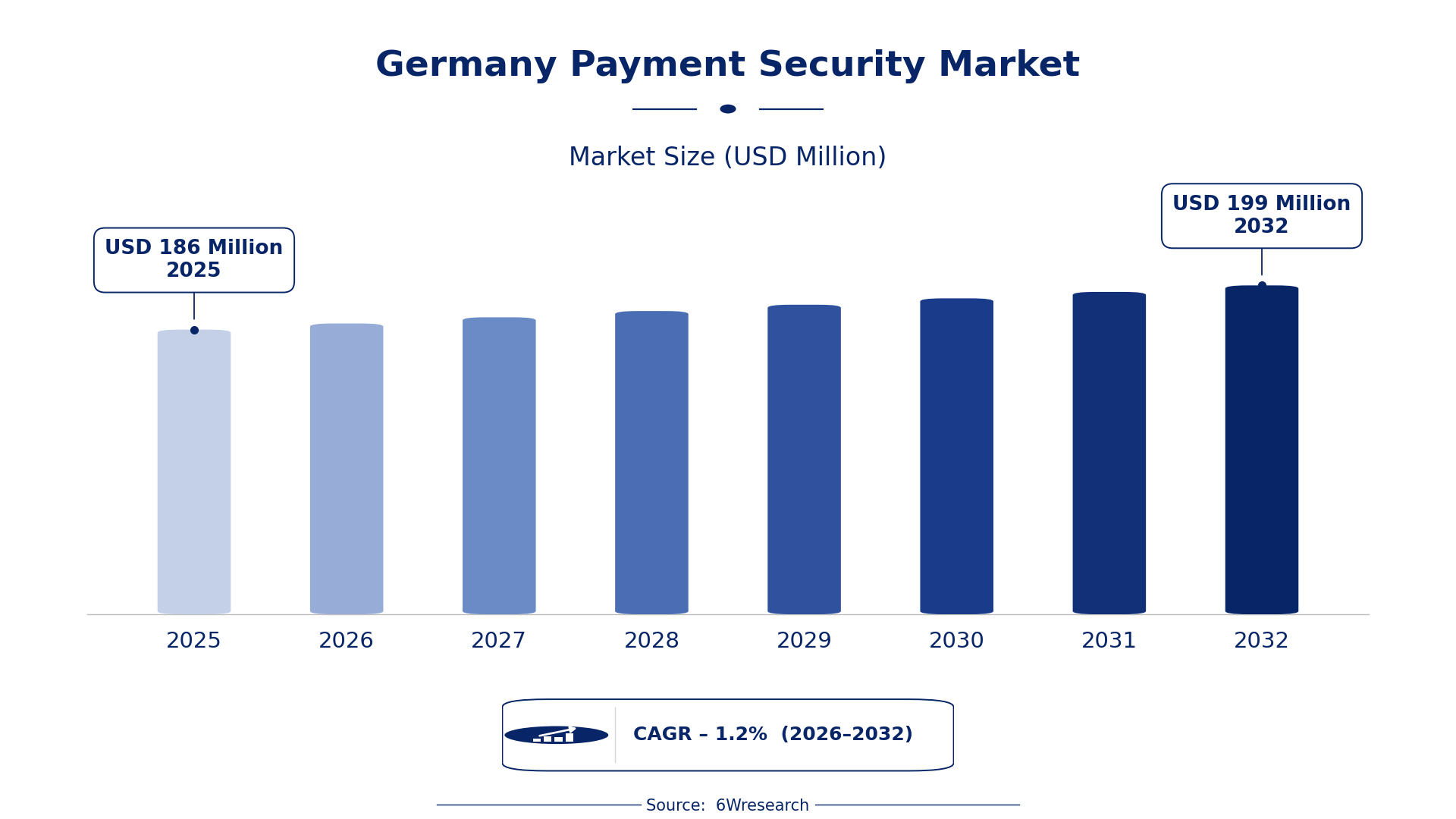
The Germany Payment Security Market was estimated at USD 186 Million in 2025 and is projected to reach USD 199 Million by 2032, growing at a CAGR of 1.2% from 2026 to 2032.
Germany Payment Security Market Synopsis
The Germany Payment Security Market is increasingly shaped by the surge in online payment transactions and escalating concerns over data breaches. Businesses and consumers alike are realizing that robust security measures are essential in maintaining trust, particularly as fraud schemes grow more sophisticated.
Regulatory frameworks such as the EU's GDPR and PSD2 are compelling organizations to prioritize secure payment systems. This trend is driving investments in advanced technologies, fostering a landscape rich with innovation and necessary adaptations to meet evolving cyber threats.
Germany Payment Security Market Year-wise Growth Rate and Key Drivers
This graph illustrates the annual growth rates of the Germany Payment Security Market from 2021 to 2032, highlighting a steady upward trajectory and projected expansion over the forecast period.
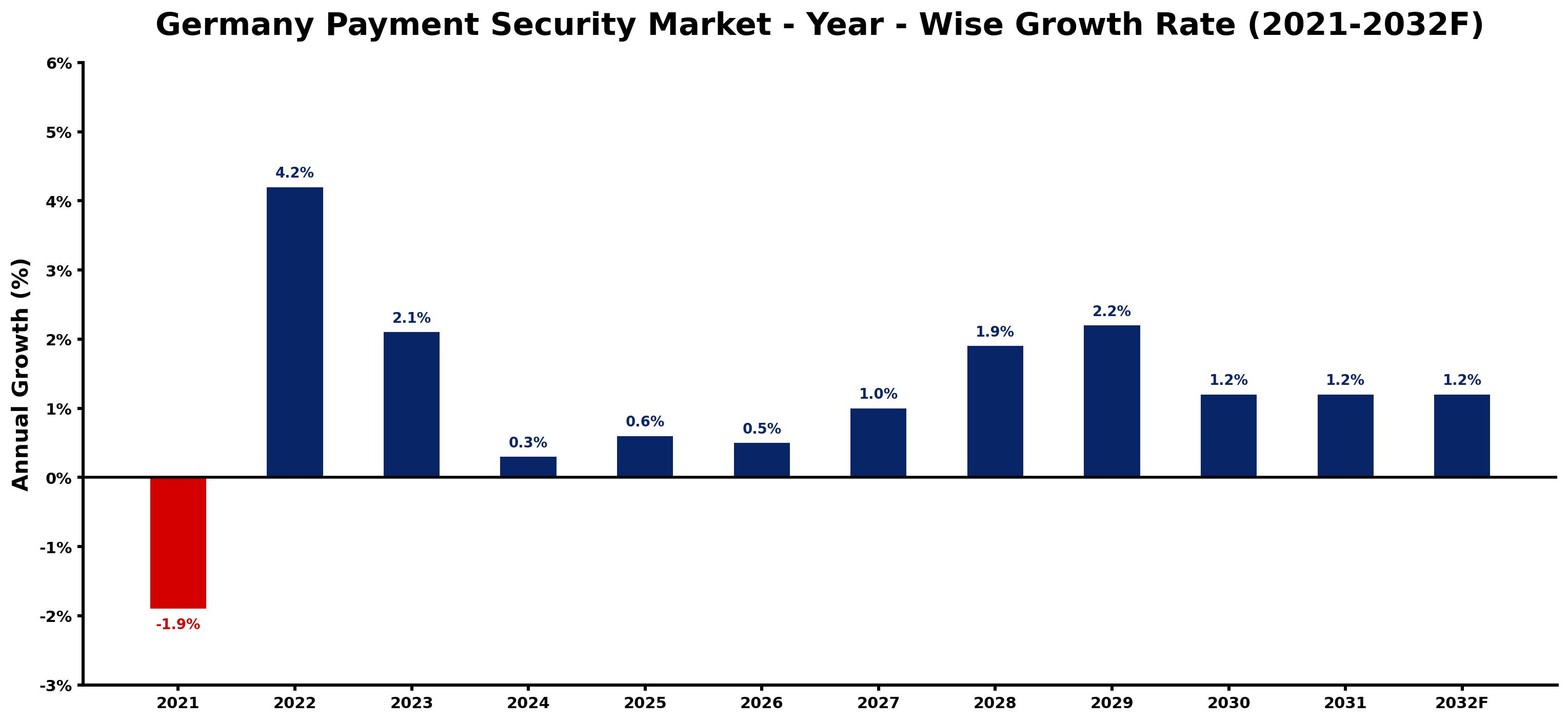
The table below presents the year‑wise growth rates along with the key drivers influencing the market
| Year | Growth Rate | Major Drivers |
| 2021 | -1.9% | GDPR enforcement led to increased compliance costs. |
| 2022 | 4.2% | BaFin's stricter regulations on digital payment security |
| 2023 | 2.1% | Increased adoption of PSD2 enhancing consumer trust |
| 2024 | 0.3% | Growing digital transactions driven by e-commerce growth |
| 2025 | 0.6% | Regulatory frameworks promoting secure payment technologies |
| 2026 | 0.5% | Surge in contactless payment methods post-pandemic |
| 2027 | 1.0% | Heightened cybersecurity concerns among consumers and businesses |
| 2028 | 1.9% | Investment in fintech innovation boosting payment security solutions |
| 2029 | 2.2% | Collaboration between banks on cybersecurity best practices |
| 2030 | 1.2% | Rise in digital wallets requiring enhanced security measures |
| 2031 | 1.2% | Regulatory support for secure online transactions in Germany |
| 2032 | 1.2% | Growing awareness of data protection laws among users |
Note: Market size estimations and growth projections presented in this report are based on 6Wresearch's proprietary forecasting methodology, utilizing the latest available industry data, government publications, and primary research inputs.
Germany Payment Security Market Key Takeaways
Below are some of the specific key takeaways from the market, including:
- The market is increasingly influenced by stringent data protection regulations.
- There is a notable shift towards technologies such as tokenization and biometric authentication.
- Investment in payment security technologies is rising, driven by growing e-commerce activities.
- Cyber threats are evolving, necessitating constant innovation in security solutions.
- Companies are prioritizing compliance with regulatory standards to avoid penalties and enhance consumer trust.
Evaluation of Restraints in Germany Payment Security Market
Despite its growth potential, the Germany Payment Security Market faces challenges, primarily due to the sophistication of cyber threats that outpace traditional security measures. Organizations must continuously adapt to new techniques employed by cybercriminals. The regulatory environment also presents hurdles; strict compliance with standards such as GDPR can complicate operational processes. Companies need to strike a balance between maintaining security and ensuring an efficient user experience, which is easier said than done. This balancing act can slow down the pace of implementation for new technologies and security measures.
Germany Payment Security Market Trends
An uptick in digital payment methods is prompting businesses to reevaluate their security strategies. Enhanced focus on tokenization and encryption signifies a move away from traditional payment methods. on top of that, the rise of mobile payments and contactless transactions is pushing merchants to implement advanced security protocols that safeguard sensitive information. These trends emphasize a proactive approach to payment security, with companies investing in innovative technologies to stay ahead of potential threats.
Germany Payment Security Market Opportunities
Investors looking for lucrative prospects in the Germany Payment Security Market can find fertile ground in cybersecurity solutions tailored for online transactions. The demand for fraud detection tools and biometric authentication systems is particularly strong, offering significant potential for growth. Companies focusing on creating secure payment gateways and real-time transaction monitoring solutions stand to benefit immensely from the ongoing shift to digital payments. R&D initiatives aimed at enhancing security technologies are also likely to yield fruitful investment avenues.
Government Initiatives in the Germany Payment Security Market
Germany's regulatory landscape plays a critical role in shaping the Payment Security Market. With a focus on consumer protection and data security, the government has instituted rigorous regulations that affect payment service providers. These initiatives are central to fostering a secure environment for digital transactions, creating a framework that mandates compliance and encourages innovation.
- A regulatory framework established under the Payment Services Directive 2 (PSD2) mandates strong customer authentication for electronic payments, implemented in late 2022.
- Currently underway is a nationwide initiative focused on strengthening cybersecurity standards across the financial sector, expected to conclude in early 2026.
- A planned national strategy to enhance digital transaction security, aiming for rollout by mid-2027, emphasizes collaboration between the public and private sectors.
- Ongoing efforts by the German Federal Financial Supervisory Authority (BaFin) to monitor and enforce compliance among payment service providers bolster the security framework.
- A recently launched awareness campaign targeting consumers educates them about secure online payment practices and identifying potential fraud.
Future Insights of the Germany Payment Security Market
Looking ahead, the Germany Payment Security Market is set for steady growth as digital payment methods become entrenched in everyday transactions. Businesses will continue to prioritize security, prompted by regulatory demands and the increasing awareness of cyber threats. As technology advances, we can expect a wave of innovation, with an emphasis on security measures that enhance customer trust while keeping pace with the evolving nature of threats. The market will increasingly favor solutions that provide agility and responsiveness to the ever-changing landscape of cyber risks.
Germany Payment Security Market Latest Developments
In the past year, the Germany Payment Security Market has witnessed notable advancements that signal a commitment to enhancing security in digital transactions. Companies are rapidly adopting new technologies that address rising consumer concerns regarding payment security.
- A major technology vendor launched an advanced encryption solution aimed at protecting sensitive transaction data, successfully rolled out in Q1 2025.
- An initiative initiated in late 2025 is focused on integrating machine learning algorithms for fraud detection in real-time, currently underway and showing promising initial results.
- In mid-2025, a consortium of fintech companies initiated a joint venture to develop a secure payment gateway, with an official launch planned for Q3 2026.
- A regulatory update issued by BaFin in early 2025 has prompted payment service providers to enhance compliance measures, with implementation currently ongoing.
- Upcoming in 2026 is a nationwide training program aimed at educating businesses about the latest cybersecurity threats and effective security measures, set to commence in early 2026.
Germany Payment Security Market - Key Attractiveness of the Report
- 10 Years of Market Numbers
- Historical Data Starting from 2022 to 2025
- Base Year: 2025
- Forecast Data until 2032
- Key Performance Indicators Impacting the Market
- Major Upcoming Developments and Projects
Key Highlights of the Report:
- Germany Payment Security Market Outlook
- Market Size of Germany Payment Security Market, 2025
- Forecast of Germany Payment Security Market, 2032
- Historical Data and Forecast of Germany Payment Security Revenues & Volume for the Period 2022-2032F
- Germany Payment Security Market Trend Evolution
- Germany Payment Security Market Drivers and Challenges
- Germany Payment Security Price Trends
- Germany Payment Security Porter's Five Forces
- Germany Payment Security Industry Life Cycle
- Historical Data and Forecast of Germany Payment Security Market Revenues & Volume By Solution for the Period 2022-2032F
- Historical Data and Forecast of Germany Payment Security Market Revenues & Volume By Encryption for the Period 2022-2032F
- Historical Data and Forecast of Germany Payment Security Market Revenues & Volume By Tokenization for the Period 2022-2032F
- Historical Data and Forecast of Germany Payment Security Market Revenues & Volume By Fraud Detection for the Period 2022-2032F
- Historical Data and Forecast of Germany Payment Security Market Revenues & Volume By Prevention for the Period 2022-2032F
- Historical Data and Forecast of Germany Payment Security Market Revenues & Volume By Service for the Period 2022-2032F
- Historical Data and Forecast of Germany Payment Security Market Revenues & Volume By Integration for the Period 2022-2032F
- Historical Data and Forecast of Germany Payment Security Market Revenues & Volume By Support for the Period 2022-2032F
- Historical Data and Forecast of Germany Payment Security Market Revenues & Volume By Consulting for the Period 2022-2032F
- Historical Data and Forecast of Germany Payment Security Market Revenues & Volume By Organization Size for the Period 2022-2032F
- Historical Data and Forecast of Germany Payment Security Market Revenues & Volume By Large Enterprises for the Period 2022-2032F
- Historical Data and Forecast of Germany Payment Security Market Revenues & Volume By SMEs for the Period 2022-2032F
- Historical Data and Forecast of Germany Payment Security Market Revenues & Volume By Industry Vertical for the Period 2022-2032F
- Germany Payment Security Import Export Trade Statistics
- Market Opportunity Assessment By Solution
- Market Opportunity Assessment By Service
- Market Opportunity Assessment By Organization Size
- Market Opportunity Assessment By Industry Vertical
- Germany Payment Security Top Companies Market Share
- Germany Payment Security Competitive Benchmarking By Technical and Operational Parameters
- Germany Payment Security Company Profiles
- Germany Payment Security Key Strategic Recommendations






































