Italy Pipe Market Size (2020-2030)
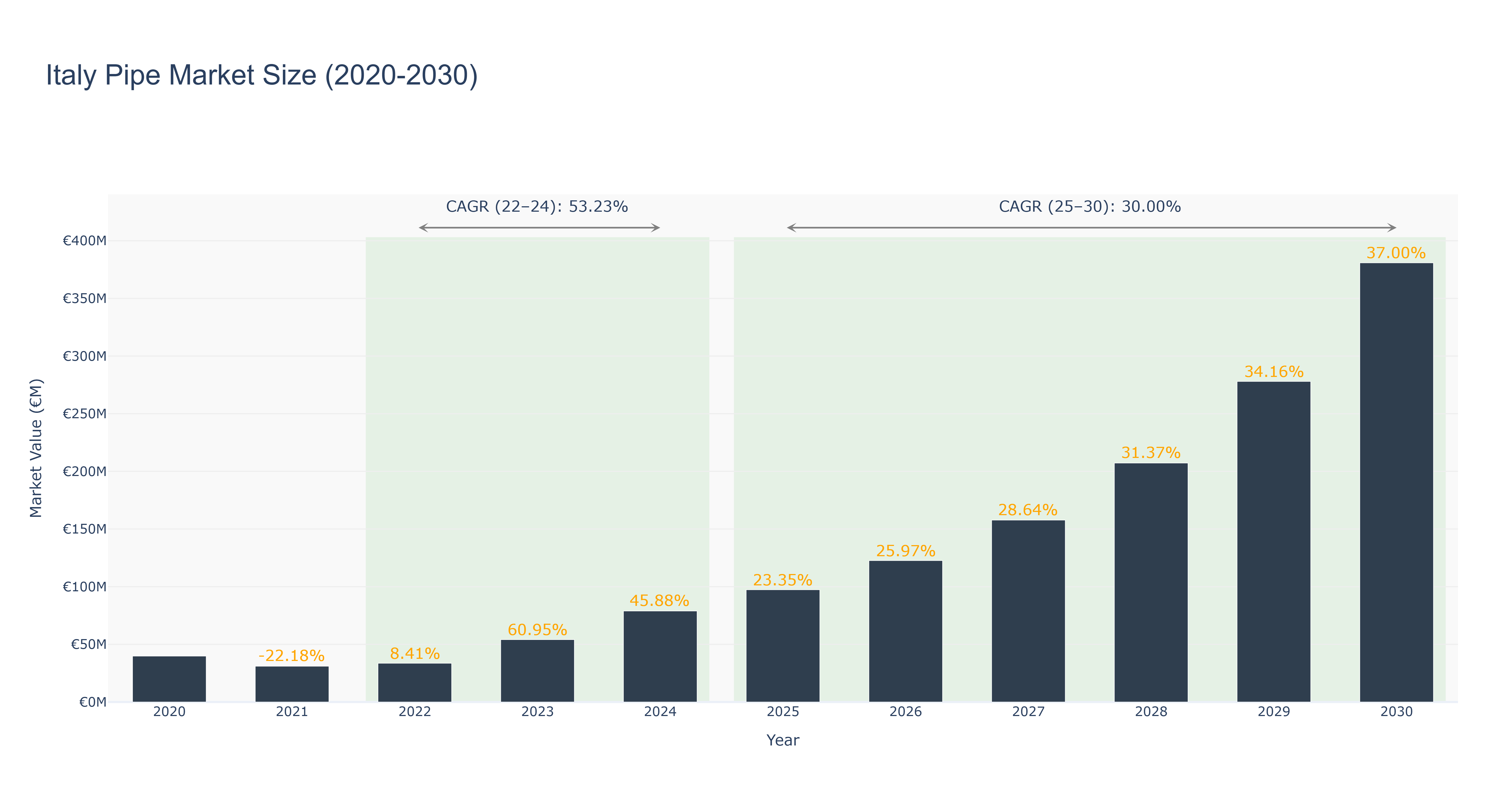
Italy Pipe Market has seen significant growth over the past few years. The market peaked in 2030 at €380.84 million, showing a continuous upward trend. From 2020 to 2024, the market size increased steadily from €39.83 million to €78.90 million, driven by infrastructure development and increasing demand for pipes in various sectors. The forecasted market size from 2025 to 2030 is projected to continue this growth trajectory, with a CAGR of 30.0%. The CAGR for the period 2022-24 was an impressive 53.23%, indicating a period of rapid expansion. The market's growth can be attributed to technological advancements, government investments in infrastructure projects, and the increasing adoption of sustainable piping solutions. Looking ahead, Italy is set to embark on a national pipeline project aimed at enhancing the country's water distribution network, providing further growth opportunities for the pipe market.
Italy Pipe Market: Production & Trade Performance (2019-2025)
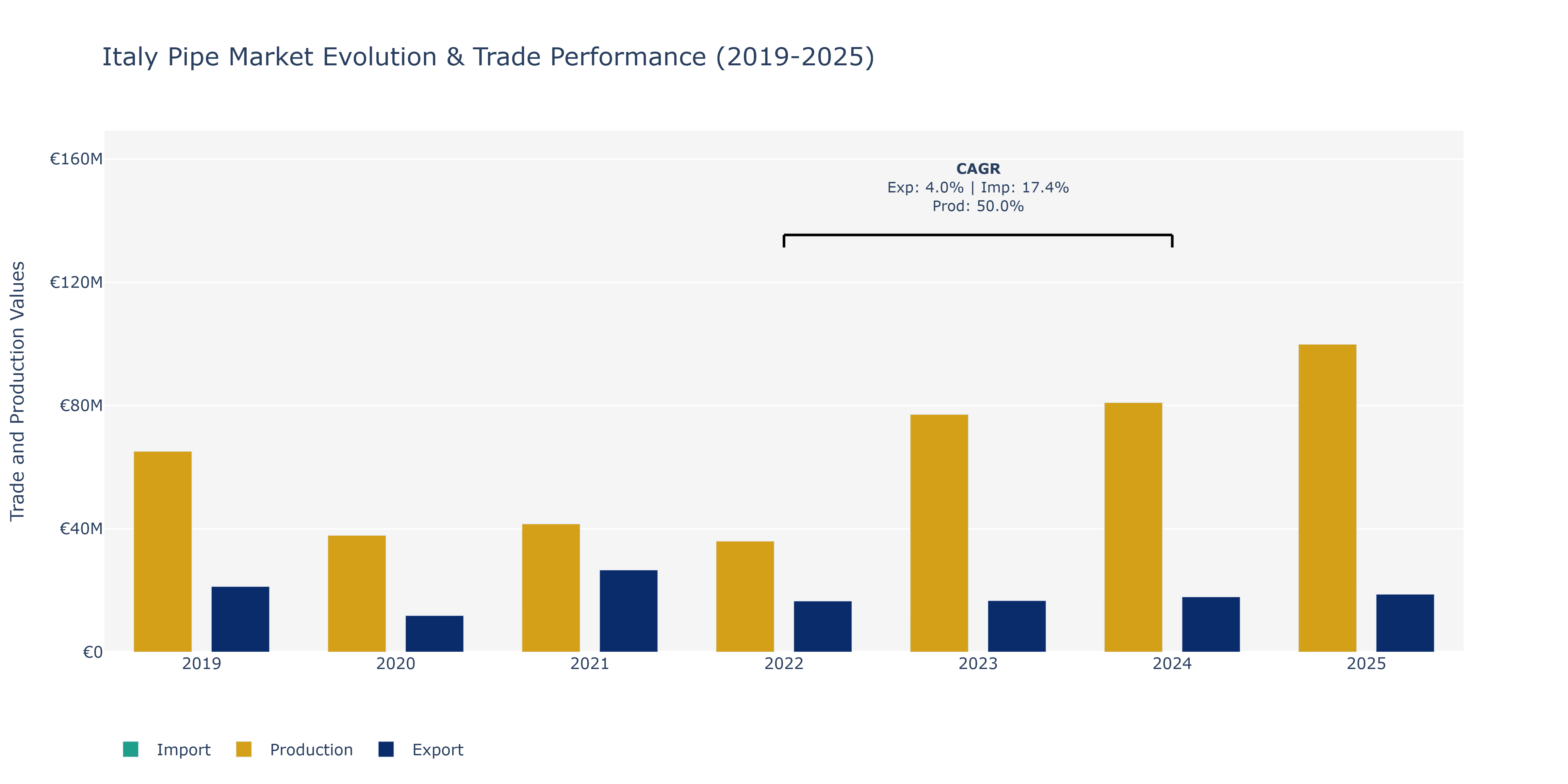
Between 2019 and 2025, the Italy Pipe Market witnessed notable shifts in Exports, Imports, and Production. Exports peaked in 2021 at approximately €26.64 million, demonstrating a substantial increase from the previous year. However, by 2025, exports had moderated to around €18.77 million. Imports, on the other hand, showed a consistent upward trajectory, reaching a peak of nearly €21.0 million in 2025, reflecting a growing reliance on foreign pipe products. Production displayed a remarkable surge, with a CAGR of 50.01% between 2022 and 2024, reaching close to €99.88 million in 2025. The surge in production can be attributed to increased demand for pipes in construction and infrastructure projects, aligning with Italy's focus on sustainable urban development and energy-efficient initiatives. The varying trends in exports and imports might be influenced by global economic conditions impacting trade dynamics and evolving consumer preferences towards domestically sourced materials, emphasizing the market's responsiveness to both domestic and international factors.
Key Highlights of the Report:
- Italy Pipe Market Outlook
- Market Size of Italy Pipe Market, 2025
- Forecast of Italy Pipe Market, 2032
- Historical Data and Forecast of Italy Pipe Revenues & Volume for the Period 2022-2032F
- Italy Pipe Market Trend Evolution
- Italy Pipe Market Drivers and Challenges
- Italy Pipe Price Trends
- Italy Pipe Porter's Five Forces
- Italy Pipe Industry Life Cycle
- Historical Data and Forecast of Italy Pipe Market Revenues & Volume By Material for the Period 2022-2032F
- Historical Data and Forecast of Italy Pipe Market Revenues & Volume By Concrete for the Period 2022-2032F
- Historical Data and Forecast of Italy Pipe Market Revenues & Volume By Thermoset and composite for the Period 2022-2032F
- Historical Data and Forecast of Italy Pipe Market Revenues & Volume By Metal for the Period 2022-2032F
- Historical Data and Forecast of Italy Pipe Market Revenues & Volume By Thermoplastic for the Period 2022-2032F
- Historical Data and Forecast of Italy Pipe Market Revenues & Volume By Diameter for the Period 2022-2032F
- Historical Data and Forecast of Italy Pipe Market Revenues & Volume By DN upto 50 mm for the Period 2022-2032F
- Historical Data and Forecast of Italy Pipe Market Revenues & Volume By DN 51 to 150 mm for the Period 2022-2032F
- Historical Data and Forecast of Italy Pipe Market Revenues & Volume By DN 151 to 300 mm for the Period 2022-2032F
- Historical Data and Forecast of Italy Pipe Market Revenues & Volume By DN 301 to 500 mm for the Period 2022-2032F
- Historical Data and Forecast of Italy Pipe Market Revenues & Volume By DN above 501 mm for the Period 2022-2032F
- Historical Data and Forecast of Italy Pipe Market Revenues & Volume By Application for the Period 2022-2032F
- Historical Data and Forecast of Italy Pipe Market Revenues & Volume By Water and wastewater for the Period 2022-2032F
- Historical Data and Forecast of Italy Pipe Market Revenues & Volume By Industrial for the Period 2022-2032F
- Historical Data and Forecast of Italy Pipe Market Revenues & Volume By Oil and gas for the Period 2022-2032F
- Historical Data and Forecast of Italy Pipe Market Revenues & Volume By Other for the Period 2022-2032F
- Italy Pipe Import Export Trade Statistics
- Market Opportunity Assessment By Material
- Market Opportunity Assessment By Diameter
- Market Opportunity Assessment By Application
- Italy Pipe Top Companies Market Share
- Italy Pipe Competitive Benchmarking By Technical and Operational Parameters
- Italy Pipe Company Profiles
- Italy Pipe Key Strategic Recommendations






































