Italy Potassium chlorate Market Size, Share & Growth Rate
The Italy Potassium chlorate Market was estimated at USD 189 Million in 2025 and is projected to reach USD 208 Million by 2032, growing at a CAGR of 1.4% from 2026 to 2032. This growth trajectory is driven by an increasing demand for potassium chlorate across diverse sectors, including agriculture for crop protection and in the pyrotechnics industry for fireworks production. Additionally, ongoing innovations in production processes and heightened regulatory compliance are likely to sustain this momentum.
Italy Potassium chlorate Market Year-wise Growth Rate and Key Drivers
This graph highlights how the Italy Potassium chlorate Market has steadily grown over the years, supported by major growth factors.
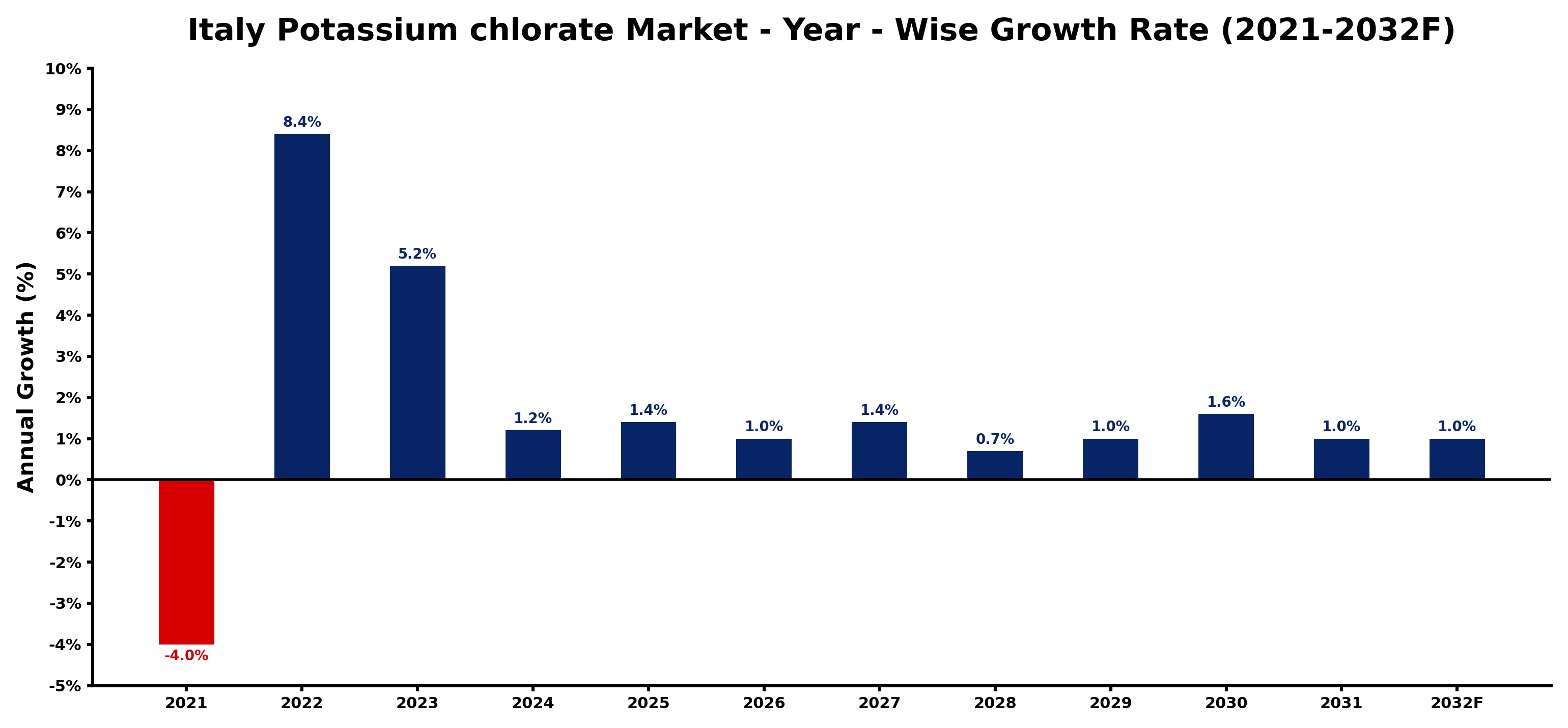
The table below presents the year‑wise growth rates along with the key drivers influencing the market
| Year | Growth Rate | Major Drivers |
| 2021 | -4.0% | Reduced demand from key sectors led to potassium chlorate production cuts |
| 2022 | 8.4% | Potassium chlorate manufacturing upgrades boost production efficiency and capacity |
| 2023 | 5.2% | Electrochemical production advancements drive potassium chlorate output efficiency |
| 2024 | 1.2% | Technological upgrades in production lines optimize potassium chlorate output |
| 2025 | 1.4% | Modernized chemical plants drive potassium chlorate production efficiency improvements |
| 2026 | 1.0% | Manufacturing investments in specialty chemicals drive potassium chlorate production |
| 2027 | 1.4% | Upgraded production lines boosted potassium chlorate manufacturing efficiency |
| 2028 | 0.7% | Manufacturing investments upgraded facilities boosting potassium chlorate output |
| 2029 | 1.0% | Strategic investment in advanced facilities boosts potassium chlorate production capacity |
| 2030 | 1.6% | Advanced manufacturing technologies boost potassium chlorate production efficiency |
| 2031 | 1.0% | Higher domestic demand prompts potassium chlorate production capacity investments |
| 2032 | 1.0% | Export driven chemical production expansion bolstered potassium chlorate manufacturing capacity |
Note - Market size estimations and growth projections presented in this report are based on 6Wresearch's advanced forecasting approach, validated with industry datasets as of June 2026.
Italy Potassium chlorate Market Synopsis
The Italy Potassium chlorate market is currently characterized by its dynamic interaction between supply and demand, fueled by diverse industrial applications. As businesses across agriculture, pharmaceuticals, and chemical manufacturing sectors continue to integrate potassium chlorate into their operations, the market remains on a growth trajectory.
In recent years, there has been a notable shift towards using potassium chlorate in advanced agricultural practices and effective weed control solutions. This trend underscores the chemical's vital role as a herbicide, helping enhance agricultural yields while also catering to safety and regulatory standards within the sector.
Italy Potassium chlorate Market Key Takeaways
- The market is driven by the increasing demand from the agricultural and pyrotechnics sectors.
- Research and development efforts are focused on improving product efficiency and safety.
- Regulatory compliance remains a critical factor influencing market dynamics.
- Investment in sustainable production methods is becoming increasingly relevant.
- The future of the market looks optimistic, with steady growth expected in various applications.
Evaluation of Restraints in Italy Potassium chlorate Market
Despite the optimistic growth outlook, the Italy Potassium chlorate market faces significant constraints, particularly in the realm of regulatory hurdles. The stringent regulations surrounding the handling, storage, and transportation of potassium chlorate due to its hazardous nature complicate the operational landscape for manufacturers. Companies must not only adhere to the European Union's REACH regulation but also navigate Italy's own legislation on chemical substances. This regulatory framework adds layers of complexity and cost, which can inhibit market participants from optimizing their supply chains effectively.
Italy Potassium chlorate Market Trends
Emerging trends in the Italy Potassium chlorate market indicate a growing focus on sustainability and eco-friendly practices. The industry's shift towards developing alternative production methods and eco-friendly applications aligns with global environmental standards. Additionally, increased awareness of potassium chlorate's benefits in agricultural efficiency is prompting greater adoption across farms, leading to a more sustainable approach to crop protection.
Italy Potassium chlorate Market Opportunities
The Italy Potassium chlorate market offers numerous investment opportunities as demand continues to rise across various sectors. Companies engaged in producing potassium chlorate stand to benefit significantly from the uptick in agricultural applications and the burgeoning pyrotechnics sector. Furthermore, there is ample potential for investment in research and development aimed at creating innovative and sustainable production methods, as well as exploring new applications such as in energy storage and water treatment technologies. This proactive approach can enhance profitability and market presence.
Government Initiatives in the Italy Potassium chlorate Market
The regulatory landscape for the Italy Potassium chlorate market is predominantly shaped by the European Union's REACH regulation, which emphasizes the registration, evaluation, and authorization of chemicals. Alongside this, Italian policies governing chemical safety underscore the importance of adhering to strict handling and storage protocols. These frameworks not only enforce safety standards but also push for innovation in production practices, potentially benefiting companies willing to invest in compliance and sustainability.
Future Insights of the Italy Potassium chlorate Market
Looking ahead to 2026-2032, the Italy Potassium chlorate market is anticipated to continue its steady growth trajectory. As various industries increasingly adopt potassium chlorate for applications like herbicides and disinfectants, the market will likely witness an uptick in demand. However, the commitment to environmental sustainability and adherence to stringent regulations will remain pivotal. The balancing act between innovation and compliance will define the market dynamics, presenting both challenges and opportunities for stakeholders.
Italy Potassium chlorate Market Latest Developments (May 2025 - June 2026)
Recent developments in the Italy Potassium chlorate market have shown a clear shift towards incorporating sustainable practices in production. Companies are increasingly investing in eco-friendly technologies and exploring alternative methods of production that minimize environmental impact. Furthermore, there has been heightened activity in regulatory compliance efforts, ensuring that manufacturers align with both national and EU guidelines while enhancing their operational efficiency.
Italy Potassium chlorate Market - Key Attractiveness of the Report
- 10 Years of Market Numbers
- Historical Data Starting from 2022 to 2025
- Base Year: 2025
- Forecast Data until 2032
- Key Performance Indicators Impacting the Market
- Major Upcoming Developments and Projects
Key Highlights of the Report:
- Italy Potassium chlorate Market Outlook
- Market Size of Italy Potassium chlorate Market, 2025
- Forecast of Italy Potassium chlorate Market, 2032
- Historical Data and Forecast of Italy Potassium chlorate Revenues & Volume for the Period 2022-2032F
- Italy Potassium chlorate Market Trend Evolution
- Italy Potassium chlorate Market Drivers and Challenges
- Italy Potassium chlorate Price Trends
- Italy Potassium chlorate Porter's Five Forces
- Italy Potassium chlorate Industry Life Cycle
- Historical Data and Forecast of Italy Potassium chlorate Market Revenues & Volume By Product type for the Period 2022-2032F
- Historical Data and Forecast of Italy Potassium chlorate Market Revenues & Volume By Pharmaceutical Grade for the Period 2022-2032F
- Historical Data and Forecast of Italy Potassium chlorate Market Revenues & Volume By Chemical Grade for the Period 2022-2032F
- Historical Data and Forecast of Italy Potassium chlorate Market Revenues & Volume By End-use for the Period 2022-2032F
- Historical Data and Forecast of Italy Potassium chlorate Market Revenues & Volume By Explosives for the Period 2022-2032F
- Historical Data and Forecast of Italy Potassium chlorate Market Revenues & Volume By Matches for the Period 2022-2032F
- Historical Data and Forecast of Italy Potassium chlorate Market Revenues & Volume By Disinfectants for the Period 2022-2032F
- Historical Data and Forecast of Italy Potassium chlorate Market Revenues & Volume By Bleaches for the Period 2022-2032F
- Historical Data and Forecast of Italy Potassium chlorate Market Revenues & Volume By Medical for the Period 2022-2032F
- Italy Potassium chlorate Import Export Trade Statistics
- Market Opportunity Assessment By Product type
- Market Opportunity Assessment By End-use
- Italy Potassium chlorate Top Companies Market Share
- Italy Potassium chlorate Competitive Benchmarking By Technical and Operational Parameters
- Italy Potassium chlorate Company Profiles
- Italy Potassium chlorate Key Strategic Recommendations






































